
Books

A Tyee Series

Naomi Klein's Global Coup

Her zooming book is reframing the debate.

By Crawford Kilian, 11 Sep 2007, TheTyee.ca

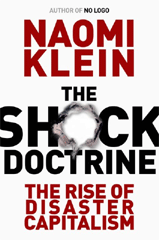
Shock Doctrine book cover (smaller)

  • The Shock Doctrine: The Rise of Disaster Capitalism
  • Naomi Klein
  • Knopf Canada (2007)

Aristotle called it anagnorisis -- the moment near the end of a drama when the characters, and the audience, suddenly understand the true nature of their situation. Usually defined as "recognition," the word literally means "high knowledge," an insight above that of ordinary life. Anagnorisis often involves a setback, the peripeteia, which throws one or more characters back on their own resources in a suddenly changed world. When Oedipus realizes he's killed his father and married his mother, it's a horrible recognition; only abdication and self-blinding can atone for his crimes.

A similar kind of anagnorisis must affect many readers of Naomi Klein's The Shock Doctrine: The Rise of Disaster Capitalism.

But we don't feel like Oedipus; we feel like characters in an Agatha Christie novel, gathering around Hercule Poirot to learn the murderer's identity. As Detective Klein calmly and logically marshals her evidence, we look at one another with a kind of nausea: Yes, we saw that, and that, but we didn't understand what we were looking at. Oh God, are we ourselves the murderer's accomplices?

Like a latter-day Poirot, Klein reviews the last 35 years and connects dots that always seemed unrelated: the overthrow of Allende, Argentina's dirty war, Reagan's firing of the air traffic controllers, the Falklands, the rise of Solidarity in Poland, the fall of the U.S.S.R., even the deaths of hundreds of security "contractors" in Iraq.

The birth of the Chicago Boys

In effect, Klein argues, we are living with the results of a decision of the U.S. government in the 1950s. Its original intent was to import Chilean students to the University of Chicago, pay their way through studies with the "Chicago School" of economics led by Milton Friedman, and then send them home to change Chile's mixed economy with its high tariffs and expensive social programs.

Scores if not hundreds of "Chicago Boys" went home to Chile but had zero impact on their country's politics and economy. Then Salvador Allende was democratically elected, and the U.S-funded the coup that killed him and put Augusto Pinochet in power. On the day he took over, the Chicago Boys gave Pinochet a 500-page "brick" of plans to establish a free-market utopia in Chile.

By now, Milton Friedman had been a voice in the wilderness for a generation, evangelizing against the mixed economy that Keynes had promoted in the 1920s and '30s. Friedman's ideas were politically impossible to establish in democratic countries, but a great many conservatives loved him. Even Richard Nixon, while he publicly endorsed Keynes in the U.S., authorized the coup that put Pinochet and the Chicago Boys in power.

Killing chickens to scare monkeys

Klein makes her narrative a kind of Bildungsroman, the story of the education of the Chicago School and its political allies. Chile (and then Argentina, Uruguay, Brazil, and Bolivia) taught Friedman and his students that nothing changes until a crisis -- an economic or political shock -- throws a society off balance. Disoriented, the society accepts whatever solution is presented to it -- or forced upon it.

They quickly learned that brutality was key to free-market success. The persons and groups benefiting from the old order had to be suppressed, suddenly and violently. When the Brazilian generals tried to run a "gentlemen's coup," they nearly lost power. Not until they began to imprison and "disappear" their opponents did they re-establish themselves. Conspicuous kidnappings and public murders added more shocks; as the old Chinese saying goes, "Kill the chicken to scare the monkeys."

Klein shows that it wasn't all thanks to the Chicago Boys. In 1965, a similar group of hot young economists from Berkeley helped General Suharto entrench himself in Indonesia, after a coup that led to the slaughter of over half a million Indonesian communists.

Thugs like Suharto, Pinochet and the Argentine generals knew nothing about economics except how to steal. But they were willing to impose Friedman's shock therapy as the price of American loans and military aid.

The contribution of Canada's mad scientist

The thugs also accepted advice in torture techniques that the CIA had learned from funding Canadian psychiatrist Ewen Cameron in the 1950s. With drugs, electroshock, and sensory deprivation, Cameron thought he could erase sick minds and grow healthy minds in their place.

He utterly failed, except to destroy his patients. But the CIA taught his methods to the juntas -- and they applied them to the union leaders, human-rights advocates, and academics who resisted the imposition of a free market.

The Chicago Boys' education continued. Margaret Thatcher, less popular in 1982 than George W. Bush is today, exploited the shock of the Falklands War to regain authority, break the British coal miners, and gravely weaken the British welfare state.

When Lech Walesa and Solidarity took power in Poland, Bush's father offered no support until the country was in disastrous economic shape. Then he sent in the Chicago Boys to impose shock therapy, ditching the worker-controlled companies that Solidarity had sought for over a decade.

And so it went, as free-marketers moved into one crisis-ridden country after another, stripping each of its publicly owned assets. That was always the price of "stability," of an end to the crisis.

From the Gang of Four to the Gang of Chicago

Milton Friedman went twice to China to tutor the Communists on privatization, and they followed his advice. Tiananmen Square was largely a protest against the resulting higher prices, lower wages, and unemployment. Workers, not students, were the majority of those executed and imprisoned by a government that was defending capitalism, not communism.

Klein repeatedly notes that Friedman was absolutely right: A crisis is essential because no democratic country freely chooses a free market. (They may elect a free-marketer like Reagan or Mulroney, but they support him only if he runs a huge deficit to keep people working.)

"Voodoo politics" also worked: Run on a popular platform, then junk it when you're elected. The Bolivians voted for a centre-left president who promptly imposed shock therapy on them. (Impoverished workers turned back to growing coca.)

Eventually, Klein suggests, the Chicago School and its government disciples realized that you don't have to wait for a crisis like Tiananmen Square or 9-11. A natural disaster like the Boxing Day tsunami, or Katrina, will do just as well. A war launched on lies will enable you to impose the free market on a whole country like Iraq.

So Sri Lankan fishers lost their villages, which were handed over to tourism developers. New Orleans lost its public schools because, just before he died, Friedman said this was a great opportunity to rebuild the system with charter schools. And hundreds of privatized soldiers, "contractors," die in Iraq without raising a political ripple. Their deaths don't count.

Did we let it happen?

In Murder on the Orient Express, Hercule Poirot gathers the passengers and proves that they all had to be in on the murder. That's the way many readers will respond to The Shock Doctrine: If we didn't actually put the knife into Chile and Argentina and Poland, we stupidly stood by and let it happen. We may not like the free market and free trade, but we stupidly accept them as givens. A session with Dr. Cameron's students would serve us right.

But Klein lets us off the hook. She reminds us, toward the end of this extraordinary book, that shock is a transient phenomenon. Even those who died resisting, like Argentina's Rodolfo Walsh, predicted that the impact would wear off eventually.

Klein offers evidence that Latin America, as the first torture chamber of the Chicago School, is also the first region to recover. Left-wing governments are flourishing, free of loans from the IMF and World Bank. Countries like Venezuela, Bolivia, and Ecuador are starting to stand on their own feet.

Equally importantly, the Chicago Boys and their supporters are turning into felons. The politicians and technocrats who handed their countries over to Milton Friedman's acolytes are now in jail or on the lam, charged with embezzlement or worse. Some of their cheerleaders, like Conrad Black, are convicted fraudsters.

I can take some personal consolation in this outcome. Almost 20 years ago, as the Berlin Wall came down, I wrote in a Vancouver Province column that "Communism is just the first to fail." Friedman's savage capitalism has failed everywhere it was imposed, just as communism did. Klein gives us some reason to look forward to a re-mixed economy where the government provides essential services again, and very few are very poor.

Future shocks?

Yes, we may still be shocked -- by another Al Qaeda attack, or an American attack on Iran, or the collapse of the U.S. stock market. But Klein reminds us that we can become shock-resistant, and sometimes shocks just make us grow up fast.

The publication of her book is itself a notable shock: on Amazon.ca, it has shot to #1 on the best-seller list in less than a week, and on Amazon.com, well before its American publication date, it's risen from almost #8,000 to #161. Alfonso Cuarón, director of Children of Men, has created an eight-minute "trailer" for the book that has spread across the web with a speed that viral marketers will study very seriously.

In other words, the free market has provoked an enormous demand for something better than itself. Lenin said, "The capitalists will sell us the rope we hang them with." Klein, no communist by any means, has tied the hangman's knot in that rope.

Those who have profited from political shock therapy will try hard to keep us off balance and scared; they're terrorists far more sophisticated than Osama Bin Laden. We can expect a ferocious counter-attack against Naomi Klein by the free-marketers.

But now that she has re-framed the debate, we have a fighting chance to shock the Chicago Boys right out of their half-century of misused power, giving them the anagnorisis, and the setback, they deserve. Like Oedipus, they must abdicate; they were self-blinded from the start.

[Naomi Klein will be speaking in Vancouver on October 4th.]

 [Tyee]

150  Comments:

  • sjd74

    10-09-2007

    Video of Naomi speaking about the book

    At www.youtube.com/policyalternatives
    (Speech she gave at a Canadian Centre for Policy Alternatives benefit earlier this year)

  • Skywalker

    10-09-2007

    Naomi rocks!

    Can't wait to get a copy of this book. If it is as researched and dead on an any of her other work it will be worth it. Naomi is superb.

  • nightbloom

    10-09-2007

    Is this a book review or an

    Is this a book review or an exhortation? Where's the critique? The author of the review writes like a Naomi Klein acolyte, without any pretense of neutrality or sober appraisal of her writing and argumentation. I don't disagree with the thrust of her argument, but Milton Friedman is just one aspect of that unfortunate equation. This review makes him sound like Sauron himself. And grand theories linking disparate events taking place over decades are never quite as black-and-white as their proponents would have it. Thatcher, Nott, Atkins, Carrington Leach and the rest could not be certain beforehand that Reagan would suspend the Monroe Doctrine...and even so, it was Argentina who invaded in the first place after 150 years of British sovereignty - hardly a Friedman and Hayek-inspired conspiracy. Britain simply couldn't not go to war at that point - they were backed into it.

    I'm sure Naomi Klein has written another fantastic book, but a little more critical thinking and a little less propaganda please, Crawford.

  • Crawford

    10-09-2007

    Review or Exhortation?

    Thanks for your comment, Nightbloom. Klein is going to get more than her quota of critiques, and I simply did not find much in her book that conflicted with my own (admittedly limited) experience over the last half-century.

    I can recall listening in Mexico in 1954 to radio reports of the overthrow of the Arbenz government in Guatemala, and fifty years of similar reports received in the US, Canada, and China...including the reports, on September 11, 1973, of the overthrow of Allende.

    I can also recall the mini-shocks of the Socreds' "restraint" budget in 1983, and the Liberals' assault on the unions in 2001-02, which left BC workers staggered.

    Doesn't mean it was a Grand Conspiracy of the CIA, Bill Bennett, and Gordon Campbell; but as T.S. Eliot observed, "Good poets imitate; great poets plagiarize."

    As for the Brits in the Falklands: The invasion by the junta was just another case of blowback—an embarrassing result of an American policy.

    Since US policy ensured and supported the military junta in Argentina only as long as it was convenient to do so, I don't think Reagan would have clung to the Monroe Doctrine if it meant hurting his ideological ally Margaret Thatcher.

    It should be clear by now that yesterday's American pal is tomorrow's American enemy—the mujahedeen in Afghanistan, Saddam in Iraq, etc.

    Much of the attack on Klein's book will be to call it "propaganda." Actually documenting her factual and interpretive errors would be a tedious and uncertain process, ignoring the truism that the most effective propaganda is the truth.

  • Truman Green

    10-09-2007

    On this we agree, nightbloom.

    This article seems to be more of a book promotion than a critique of Klein's ideas. I haven't read the book yet, but I'm absolutely sure it's much ado about absolutely nothing--just a new spin on something about which ANYTHING muttered or conceived would be at least partially true.

    And now for something totally different, folks. Capitalism works by the conspiracy of shocks.

    Any semi intelligent reader should immediately understand that a book entitled, 'The Shock Doctrine, The Rise of Disaster Capitalism' is really a pretense; a vehicle for Klein to make a few bucks.

    Capitalism has been at times a disaster and at other times a godsend.

    I believe I can watch the wheels in Klein's brain turning: how to do a book pretending that there's something we haven't yet noticed about capitalism. "Oh, yeah, that's the ticket...It works by shocks, yeah shocks. That'll sell this stupid concept."

    Now I gotta go read the damn thing to see if I'm right.

  • G West

    10-09-2007

    Connect the dots

    From Hayek to Friedman to Bush and the Heritage Foundation and then Katrina hitting New Orleans with stops in Chile, Grenada, Panama, Libya, Kuwait and Iraq. One failed mess after another. And now Petraeus says the best hope in Iraq today is an alliance with a few Sunni warlike cliques? Maybe they can resurrect Saddam.

    What the hell happened to democracy?

    Britain has a hard time accepting that it is now nothing more than second fiddle and Maggie wanted a chance to prove she was as tough as her friend 'Ronnie'.

    What's to prove - read the doctrines of the neocon think tanks and figure it out for yourselves.

    The only thing that surprises me is that anyone is surprised it has all turned out so badly!

  • IAMC

    10-09-2007

    Tell me what you really, really want.

    You are misleading the readers about the value of capitalism, writer.
    It's the system that keeps you viable.
    And keeps us all fed.
    I don't want to buy my food from a Government Food Outlet, sorry.
    You can dismiss Milton as an illogical outcast, who only has fringe group of socialist supporters, that don't deserve to be engaged in the present debate regarding our safe and happy future.
    Gloom and doom doesn't cut it anymore.
    We are all capable of seeing ourselves to a prosporous, happy, secure horizon, so don't worry, be happy.

  • skeptikool

    11-09-2007

    The Iron Lady and the Malvinas/Falklands

    As I recall, with a fast-approaching election, P.M. Thatcher was as much in favor as a boil on the arse.

    As an admitted Brit, I'm sorry, but it was that "war", plus a sad nation suckered by jingoism, that got Thatcher reelected. Nothing like a fight with neighbors for family togetherness.

    G.W. Bush, whose election was about to be seriously challenged as a result of questionable, electronic voting results, was similarly boosted tremendously by the downing of the Twin Towers.

    This is not to subscribe to the conspiracy theories regarding the buildings' destruction, though a laxness may well have been encouraged while knowledge of an imminent attack was available to some able to have done more to counter or prevent it.

  • Van Isle

    11-09-2007

    Back when the Soviet Empire

    Back when the Soviet Empire collapsed I predicted that the American Empire was next, it was just a matter of when. In the spring of 2001 Saddam came out of a cabinet meeting and made the comment that the future sale of Iragi oil was to be in Euros instead of US dollars; from that moment his fate was sealed. Last year both Russia and Iran have been calling for their oil to be traded in Euros also. Notice that they too have been demonized in the western press and it seems that some form of military action against Iran is being promoted. If the world decided to trade oil in Euros the American Dollar would drop 40% overnight and where it settles no one knows. Imagine now if gold was traded in Euros too. Imagine if Alberta told the Americans that all their gas and oil to be paid in Euros.

  • Birch

    11-09-2007

    Ah, but the review...

    Yes, we can scream at each other about the issues at stake, but what about Crawford's review?

    There seems to be some misapprehension out there that one can't simply approve of a book: buy into its thesis, appreciate the writing and the argument, and say so. Nope. Instead we have to come up with picayune criticisms to show that we truly are "objective" in our analysis--after all, everything must have SOMETHING wrong with it.

    True, the review comes from a fairly transparent political viewpoint (or bias, if you prefer), but that doesn't invalidate its utility or accuracy with respect to its judgments.

    Thanks, Crawford. I'm looking forward to the read. My only hope is that it includes some further hints as to how to counteract some of the blunders and outright felonies that have been perpetrated on victims around the world.

  • Truman Green

    11-09-2007

    And, of course, Friedman wasn't perfect,

    but I loved him when he talked about the "phony" market, referring to the market for so-called illegal drugs. He was one of the only well-known economists to admit that the exhoritant cost of a shot of heroin or cocaine is driven only by the fact that it is illegal. It was from Friedman that I learned that these drugs have almost no monetary value other than that created by their prohibition.

    Let the illicit drug market find its own center (freely, sans government prohibition) and the illegal drug industry will collapse, taking with it much of the crime in the developed nations. Said Friedman!

    Friedman was a greater thinker and wrong much of the time. So what? Is this news?

    This new big book of Klein's reminds me of 'Roots' for which many thousands of black people stood in line awaiting for the bookstores to open. I'll never forget an interview with a hopeful purchaser who claimed that she was so happy that someone had finally told black Americans where they had came from.

    Duh, eh!

    This is the kind of childish revelation that I'm sure Klein's big new book is full of.

    Is there really someone on this forum who doesn't know the history of capitalism and all its warts? Do we really need Klein's revelations?

  • James Burns

    11-09-2007

    Why Klein's work matters

    What is ideal about Klein's work is that it creates a trope, a metaphor that people unschooled in history and economics can relate to. She frames the debate, and the message is simple, clear and powerful. That is exactly the approach progressives need to take to bring the truth about the kinds of kleptocratic capitalism much of the world is infected with today.

    We have too many laughingly self-identified so-called progressives, who because they suck on the teat of corporate media, or corporate academe, lack the spine or the moral sense to articulate the truth, particularly the whole truth. They earn their living by downplaying or ignoring the facts, while pretending to affect concern for the downtrodden. But their real role is that of smoke screens, or obscurantists. Thus we have ethical eunuchs like Christopher Hitchens, who must castrate the course of historical events in order to justify current injustice, while keeping the corporate milk flowing.

    Klein's genius isn't in presenting anything new, it's in synthesizing all that disparate material into a message that resonates with people. Her explanation about the horrifying state of the world is not only true, it's spoken in words people can understand.

  • Fiat lux

    11-09-2007

    I was too busy in the past

    I was too busy in the past few days and just caught up with this story.

    What I find most welcome is that finally at least some people are beginning to wake up to the fact that the neoclassical market economic theory is a fraud and has now become the biggest crime wave in human history.

    As I've been writing for 20 years, don't blame the politicians, go after the universities where this crap is being taught as the "science
    of economics".

    IAMC the food market is now totally controlled by a few multinational mega corporations, very similar to the Soviet collectivization system, killing and putting the producers out of business, while raising prices in the stores.

    Hundreds of BC ranchers will go broke this year on account of the poor hay harvest and the prices they're receiving from the conspirators who own and control the feedlots.

    So much for the "competitive free markets".
    Meanwhile watch the prices going up in the supermarkets.

    Ed Deak.

  • Truman Green

    11-09-2007

    Just tell us one new, original thought

    in Klein's big new book--one that would warrant, for instance, the full page photo of her on the cover of The Georgia Straight?

    My thesis is that this is a phony book, fronted by Klein's friends in the publishing industry and not by the originality or brilliance of her ideas.

    Gimme one original idea from the book. Just one, eh.

    When a new book comes out with this much fanfare, it should be ONLY because the author has come up with some original, if not brilliant, ideas.

    Blaming free market capitalism for the problems in western civilization just don't cut it, eh.

    It's silly.

    We should be spending our time thinking and reading about challenging ideas. We already know that the free market works brilliantly to furnish a significant proportion of any population with goods and services, until it gets outta hand--until too many pigs with mega bucks show up to exploit their way into absurd profits.

    Is this news?

  • funniously

    11-09-2007

    Naomi is what she is.

    She's a great writer and a vigilant and energetic activist author. However, she isn't an economist, political scientist, philosopher or historian. So you have to keep in mind that stirring the pot is what she does best, and take it at face value. I like her books, but when I read The Rebel Sell (Potter and Heath), it laid bare for me some of her shortcomings as an analyst (although Potter and Heath went a little over the top, to the point of picking on her).

    For my own two bits, it's worth noting that greed, selfishness and violence pre-date capitalism by a longshot, and will likely still be here when and if we move on to some other system we regard as an improvement. I don't think it's wise to give capitalism and "free markets" too much credit for what are probably universal human failings.

  • James Burns

    11-09-2007

    It's the mixed economy

    Quote:
    We already know that the free market works brilliantly to furnish a significant proportion of any population with goods and services

    No Truman, it doesn't work brilliantly. Markets only start to work within a mixed economy where income is fairly redistributed in the form of public infrastructure and services that enable the majority of the public to engage their creativity, because they have the economic freedom to do so. That freedom is a direct result of that shared civic investment.

    Without it you have an economic jungle where those who can steal the most the fastest, can then leverage the power their wealth brings to steal even more, and to pay others to advocate their case for them, and to violently suppress those who resist. Those who benefit from that way of life adopt it as a true faith. And why not, it's been so good for them it must be right.

  • Truman Green

    11-09-2007

    Hi Ed. I guess you already know I'm going

    to celebrate any market system that would cause the closure of feedlots and the absurd and brutal animal killing business, eh. And I'd love to see ALL the BC ranchers go broke. Growing animals for food is the least efficient way to feed human beings and the most efficient method of environment degradation. The UN claims the meat industry is a bigger polluter than private automobiles.

    But thanks again, Ed, for showing up here under your real name, eh.

  • Fiat lux

    11-09-2007

    Truman, I never use any

    Truman,

    I never use any other than my own name and I'm always fully responsible for my actions.

    There are millions of acres in BC and all over Canada not suitable for ant other food production, but beef. So, what shall we do? take them out of production to please some hysteria?

    The environmental and health damage starts and ends in the disgusting, environmental disaster feedlots, where the animals are stuffed with medications, chemicals, hormones and steroids, while standing up to their bellies in manure, then sold in the supermarkets for the suckers to get fat and sick on.

    Our animals eat only grass and their meat tastes great. Anybody who eats some says they never tasted better.

    Ed Deak.

  • realisticman

    11-09-2007

    funniously

    Quote:
    For my own two bits, it's worth noting that greed, selfishness and violence pre-date capitalism by a longshot,

    Envy probably does too.

    Naomiphants love this stuff because it makes them think that a new apparition is imminent. Delivery to a fuzzy utopia is about to happen. They're lacing up their Birkenstocks ready to follow the pied piper as the towers of power are demolished. It's essentially a fairytale and has been around since some smart guy traded a chunk of flesh for a handful of berries and some others became envious.

    Socialists love to grab straws, it was going to be Ireland, but it didn't happen. Then it was going to be France but again, it didn't happen. Even Sweden, which is often heralded as an ideal is governed by a central-right coalition. Public-private partnerships, an anathema in to some in BC, is at the core of "the Swedish model", which was developed by the Social Democrats, who governed for most of the last 70 years until 2006.

    Naomi is sending out a straw to grab. She was born with a wooden spoon in her mouth and knows a good schtick when she sees one. This one's got legs and they're grabbing.

  • James Burns

    11-09-2007

    Two fundamentalists

    First the corporatist fundamentalist: IAMC the problem with your opinion is that it's based on a delusion. Mixed economies work far better than the Friedman modeled thievery we've been subject to for at least the last 27 years. It's getting harder and harder for your labels and propaganda to hide the truth: that your corporatist slash and burn model is destroying the foundations of civil society. Klein appears to have don a wonderful job turning over the rocks so we all can clearly see the glutenous greed of the criminals eating away at those foundations.

    As for you Truman, you sound like a PETA disciple with your spitting vitriol over the consumption of meat. An immense amount of land on this planet is suited only for grassland pasture. The imposition of grain cultivation on such lands requires an enormous amount of environmental degradation in the form of massive amounts of fertilizer and pesticide, all of which are derived from petroleum, and all of which pollute the environment. The problem humans face is over population. The consumption of meat is an entirely natural function of human beings eating a balanced healthy diet. And provided that meat isn't polluted by corporate thugs looking to squeeze every last ounce of profit from it, humans are in fact healthier with the consumption of it.

  • zalm

    12-09-2007

    Truman

    Quote:
    My thesis is that this is a phony book, fronted by Klein's friends in the publishing industry and not by the originality or brilliance of her ideas.

    Gimme one original idea from the book. Just one, eh.

    Seriously? The interviews here, in the Striaght, the Canwest rag, the Globe and everywhere else says her thesis is that disaster sites are immediately invaded by Friedmanites who immediately strip the country's resources instead of stewarding them wisely to rebuild the hard-hit region. These Friedmanites (her choice of words, not mine) are now so good at it that they look to create disasters when there aren't any handy.

    I've never seen that before. I guess I'll have to read the book to see how the proof works out.

    You on the other hand aren't worth reading. Your trade in blather and insults is a far cry from the wisdom you used to post. Get hit on the head lately?

  • nightbloom

    12-09-2007

    Klein's thesis makes more

    Klein's thesis makes more sense after I watched her speak (ref. the 6-part YouTube video of her talk at the CCPA, which sjd74 linked above). I can't speak for how she goes about supporting the thesis without reading the book, and I'm sure that qualified historians could take a crack at some of the more over-arching assumptions she makes. However:

    Her basic argument stems from Friedman's statement that in times of crises society gets by on the tools (ideas) which are close at hand and ready for implementation. Hence, neo-liberals (she barely used the word neo-conservative at all) have successfully laid the intellectual groundwork to implement their reforms (she used the word "counter-revolution" at one point) in times of crisis. So that when (for example) Katrina hit and the people were scattered, disoriented, disorganized, the think tanks were able to step in with a panoply of pre-prepared solutions (like charter schools). New Orleans became another laboratory. Thus, she draws a connection between New Orleans and other neo-liberal economic 'laboratories' like Chile, Russia, etc.

    What resonated with me is that this has been an aspect of my criticism of the liberal-left for some time. That they have been wasting their energy trying to create and consolidate constituencies in the classrooms and lecture halls, while conservatives have been steadily feeding governments hard thinking about how to get electricity, water, schools and other services running again while cutting the public sector infrastructure and public organizations off at the knees. This is a clarion call to the po-mo left to get back to reality, relearn the basics, relearn the history, recognize the patterns, and start worrying about the real problems of real people and the dangers of leaving the public sector so vulnerable. Stop mucking around in the Sociology and Womynz Studies departments, philosophizing over the exact nomenclature of the perfect Oppression Narrative, and start doing some real thinking for a change. The neo-liberal economists have done a complete end-run around you. They define, determine and finish the debate. Fait accompli. You're irrelevant.

    So I think Naomi Klein's book, as summarized in the CCPA talk, is a much-needed tonic for a liberal-left that risks missing its moment due to it's ingrained navel-gazing habits.

    Incidentally, more of the same from The Chronicle Review:
    The Liberal Moment
    http://chronicle.com/temp/reprint.php?id=39g20r5pgts19x36n4l86mkfwjw4c01h

  • G West

    12-09-2007

    Big problem with that nightbloom

    Is the essential lie at the bottom of the neo-liberal agenda - that it's for anyone's good but the top 1%.

    Let me quote for you, once again, from the first couple of paras in Jon Chait's article in the current NEW REPUBLIC:

    American politics has been hijacked by a tiny coterie of right-wing economic extremists, some of them ideological zealots, others merely greedy, a few of them possibly insane. The scope of their triumph is breathtaking. Over the course of the last three decades, they have moved from the right-wing fringe to the commanding heights of the national agenda. Notions that would have been laughed at a generation ago— that cutting taxes for the very rich is the best response to any and every economic circumstance or that it is perfectly appropriate to turn the most rapacious and self-interested elements of the business lobby into essentially an arm of the federal government—are now so pervasive,
    they barely attract any notice.

    The result has been a slowmotion disaster. Income inequality has approached levels normally associated with Third World oligarchies, not healthy Western democracies.

    [emphasis mine]

    The success of the deal notwithstanding - the essential point is that it is a DISASTER.

    I do agree that the left needs to coalesce around a more robust economic critique AND, more critically, begin to prepare for what will be a FIGHT and not a debate. The one percent have to be taken down - preferably through tax policy but, in necessary, by other means.

  • James Burns

    12-09-2007

    Money, money

    I disagree NB. The problem, as I've pointed out before, is money. There is an enormous amount of research out there that demonstrates what actually works when applied to the real world. That's true of the delivery of public services such as health care, education, and infrastructure. But the people who most often get the money to spread their message are corporatist fundamentalists and those who pretend to a smattering of progressive views, yet who's real focus is on their own career advancement. They are useful, because they provide a softer corporatism. They give the appearance of diversity of opinion where there really is none. They just dress differently. You can see numerous examples of the latter in pro-war so-called leftists.

    The trope of navel-gazing as being a particular attribute of the left is untrue. Navel-gazing occurs equally deeply across the political spectrum. The difference is that those with the money have been able to pay for a very loud voice to support their ideology, and they use that bought and paid for voice to spread lies about those they disagree with politically. They also use their money to ram through their policies by buying politicians.

    It really just the very simple trick of distraction. Magicians use it all the time to make it appear they are doing something paranormal. In the case of corporatists, instead of talking about the details of an issue, what actually does and doesn't work in application. They resort to ad hominem.

    Where progressives error is in focusing too much on what works, and not enough on an articulation of common values. Again, what makes Klein useful is that she creates a trope that, while it educates people historically, it appeals to their values. Using atrocity and disaster to enrich yourself off the misery of others is repugnant. Yet it is a tactic that has been used throughout history by the greedy. Klein gives it a name, a story and provides the current contextual details. And what makes it even more powerful is its truth.

  • nightbloom

    12-09-2007

    Gwest, I think you're

    Gwest, I think you're missing Naomi's point. She's making an argument about systemic change in multiple theatres, how that change has been promulgated through crisis through the arsenal of ready 'solutions' that Friedman's neo-liberals have carefully prepared and communicated. You're falling back on your oppositional binary mentality again (us versus the 1%, women versus men, etc.). I'm sure Naomi has no love for your proverbial "1%" but her critique is much more expansive than that, with an even bigger lesson for the intellectual left (in academia and public policy). I appreciate your tangent, but doesn't accurately reflect the nature or Naomi's argument here.

  • nightbloom

    12-09-2007

    James Burns - not sure where

    James Burns - not sure where we disagree. I was summarizing Naomi's argument (as articulated in the YouTube vid). You mean you disagree with her?

    Navel-gazing in the liberal-left isn't a trope - it's a fact. There was a deliberate shift to identity politics which necessitated all sorts of guided navel-gazing. Contrary to what you assert, that trend isn't generally reflected on the other side of the spectrum. What you have on the right (until very recently) is an absence of introspection, an absence of self-questioning, and absence of doubt, and an absence of navel-gazing. They've admitted NO doubt (esp. not its fundamentalist Christian wing). I shouldn't have to point this out to you, JB. There's a reason why there's a near-vaccuum in real-world public policy thinking on the left. The CCPA is a total anomaly in a sea of conservative (neo-liberal) think tanks. The discourse has been effectively colonized by the right. If the left spent a fraction of the energy developing strategies to safeguard public infrastructure as it has colonizing the social sciences and inventing useless doctrines and specious grievances for well-fed bourgeois kids, then there wouldn't be this vaccuum...the neo-liberals wouldn't wield this monopoly over public policy thought, and we'd have a genuine discourse (and a real social sciences curriculum).

  • G West

    12-09-2007

    Of course it doesn't

    But the point is that all such battles are, in the end, political and moral. Any philosophy based upon the aquisition and retention of more power and influence for a tiny minority at the expense of the all the rest (in greater or lesser terms depending upon where one lives) has to fall. Klein does her work at a necessary level - others work in other ways. The CCPA is an important component of this work in Canada - in other countries the lead will come from elsewhere.

    The point is that this can't be just an academic exercise - and on that point I'm in complete agreement with you. Progressives have to get their act together and they have to play hardball.

    In the end, knowing Naomi a bit myself, I'm comfortable with sayuing she's on the activist side of this business and her books and public appearances are just part of what she's doing.

  • Stump

    12-09-2007

    social infrastructure

    Nightbloom:

    Shouldn't preserving our social infrastructure be the purview of all politicians regardless of political stripe? The blame doesn't lie on the "left" or with those seeking to understand the inequities that underpin our beliefs, but with those that have abdicated their responsibilities in favour or greed and personal gain.

    It surprises me that someone of your intelligence would be so derisive towards those seeking to understand our world and cultures.

  • James Burns

    12-09-2007

    You're missing the point NB

    Of course I don't disagree with Klein, and that should be obvious from my comments.

    As for the navel-gazing on the right, I don't believed I characterized it as doubt. Introspection doesn't require doubt, it can simply be an unhealthy preoccupation with a personal set of beliefs. It can be faith. The master conspiracy theorists come from the right, undoubtedly because many of them hold so fast to superstitious beliefs. There is also deeply entrenched identity politics on the right. There are huge gulfs between social conservatives, and libertarians to name just two flavors (without going into all the various religious and ethnic derivations).

    Again, the primary difference is one of organization made possible through the expenditure of money. Wealthy corporatists have purchased politicians in order to have them reduce their tax burden, they then have used some of the money thus gained to fund political think tanks to propagandize their ideology, and to further organize ever more tax reduction and deregulation, coupled with the selling off of public assets.

    If you take the time to look you'll find a wealth of progressive policy based on what actually works in application. The problem is that it has been drowned out by the well funded efforts of the aforementioned corporatists, while they simultaneously encourage the media they control to focus on the extremists who identify themselves as being on the left (those extremists also tend to create more controversy and thus attract more of an audience which is more profitable). That said there has been a lot of positive change due to the efforts the social theorists you routinely deride in the areas of race, sex and sexual orientation.

    The problem among progressives is a lack of resources in comparison to corporatists. But that's beginning to change. More and more people are being forced into action by very real impoverishment due to the erosion of our civil foundation by corporatists busying themselves with plundering it.

  • nightbloom

    12-09-2007

    Stump - the point is that

    Stump - the point is that the left has been ineffective at protecting public infrastructure and ineffective at "seeking to understand our world and cultures." And I gave you my opinion why. Klein has given her own opinion why. The only question is why so many on the left still refuse to hear it.

    JB - I still don't see where we disagree, although I think you're reaching a bit with your definitions (i.e. of navel-gazing, of identity politics, etc.). Conspiracy theories are currently a left-wing fetish, as evidenced by some of Chomsky's more embarassing (to him) fans, or by the guy marching at the front of the SPP protests in Ottawa yelling "9/11 was an inside job" and other nonsense. Then there's my favourite sequel in the trilogy of left-wing paranoia, the Revenge of the Straussians.

    No, the left has been (comparatively) M.I.A. on public policy thinking because its intelligentsia has been busy doing other things, and its foot-soldiers don't even accept or understand the basic premises of responsible public policy (and who can blame them - there leaders & thinkers have let them down).

    I think it's a critique the left needs to hear, needs to listen to, and needs to internalize & act upon.

  • Truman Green

    12-09-2007

    Trying to funny James Burns? Meat-eaters

    are much more likely to get all the big diseases than vegetarians. Cut it out. Oops, a pun. On average it takes eight pounds of vegetation to grow one pound of meat. How come you don't know this?

    And I'm still waiting for one original thought from the Klein book.

    I repeat, it's a carnival trick of regurgitating the obvious history of free market capitalism's failures and excesses about which any half-educated lefty around here already knows.

    Spinning an often-told story in supposedly new packaging. Get it?

  • nightbloom

    12-09-2007

    Don't shoot the messenger if

    Don't shoot the messenger if you don't like the message. For a number of reasons, the left has failed to get its message across, and has failed to deploy and apply its intellectual capital in ways that are effective in halting the erosion of the public sphere. This is fact, not a figment of nightbloom’s putative contrarianism. Fact. You’re in denial, and have to either play the blame-game or invent a conspiracy theory. The fact is the left has been wasting its time institution-busting, idol-smashing and conducting thought experiments in the Ivory Tower which no high-voltage brain would ever willingly choose to invest themselves in.

    Yes, there is some progressive public policy thinking going on (like at the CCPA). But it’s a drop in the ocean. The right has exerted effective hegemony over the debate. It wasn’t always so - a sea-change occurred which coincides roughly with the oil crisis of the early seventies. Keynesianism used to be the hegemonic mode of thought, and Friedman and co. were the outsiders (a point which Naomi makes in her talk….even Nixon was a Keynesian). You need to ask yourselves where you went wrong, what friends it has alienated along the way (there have been many), and how it needs to change itself in order to effect change on society.

  • clubofrome

    12-09-2007

    So What?

    This book echo's everything Ed Deak has said for as long as I've been reading the Tyee. Should Naomi not be credited or paid for writing a book that repeats what others have been saying for decades? Has she done nothing other than collect facts and data that already existed and put it into a format that tries to make a valid point? Is there a worthwhile message in this book? Compared to volumes of trash marketed everyday teaching how to pick pocket the money from all the suckers born in every minute, I'd say we need more books like this one and Collapse by Jared Diamond. Some of us are reading these idea's for the first time. I don't know where you crashed TG but any way I slice it your point is infinately less important than even the most repeated thought in this book.

  • Stump

    12-09-2007

    what went wrong

    Quote:
    You need to ask yourselves where you went wrong

    More misinformation. Viewed through the long lens of history, the 'left' and its philosophy is slowly winning the battle of hearts and minds.

    While the monied and powerful win some battles, every time their depradations become too much to stomach by the average citizen, society takes another leap towards equality and democracy in all things.

    It's unfortunate that we should have to fight so hard for those things, but humans are slow to evolve, especially those with a vested interest in greed.

    Let's face it, the actions of the 'right' aren't those of the victors, it's the behaviour of a class on the run, desperately trying to shore up the structures that gave them their power, all the while slowly sliding 'left' in response to public pressure.

    But, when the sh*t really hits the fan, all they will have to protect them are gated communities guarded by rent-a-cops making not much more than minimum wage. Whose side do you think they'll come down on?

  • snert

    12-09-2007

    Don't smirk.

    Quote:
    But, when the sh*t really hits the fan, all they will have to protect them are gated communities guarded by rent-a-cops making not much more than minimum wage. Whose side do you think they'll come down on?

    If it really does hit the fan you and yours could go down just as fast as those you despise.

    Shit and fans should not be allowed to mix.

  • Stump

    12-09-2007

    I ain't smirking

    Believe me snert, no glee on my part if things fall apart. I'm happy to die in my sleep at a ripe old age. But, it seems history has a tendency to repeat itself.

    Despise... not so much. Pity maybe. I'm happy with enough. Too much is too much hassle for me.

  • asher

    12-09-2007

    review and China

    I know what people above are refering to when they ask where is the reiview. It definately is not a prototypcial book review. More and more Tyee articles are just resembling blog entries.

    In any case, I enjoyed this entry by Killian.

    I'd like to highlight the point made that the Tiananmen Square massacre was more about workers protesting against the high cost of living under Deng's capitalist reforms than anything.

    And now, if only the US can initiate another disaster in China and replace Chairman Hu with a more pro-American leader, then Blue Cross can come in and privatize socialized health care and put a billion customers to its name.

    I say we all support a truckers strike a la 1970s Chile, so that China can finally get the government it deserves. If anything, the old feudal lords need to return to power and regain the upper hand they had over damn peasants and slaves. What is this crap about people getting health care and pensions nowadays? I head some even want t be paid overtime! Poppycock!

    In my China we had international zones within the same city. If a lord or mafia boss had to flee he could always count on the French or the Yanks to escape the law and hide in their section of the city.

    We need disaster capitalism to ensure that I can continue to buy tube socks for $4/dozen for the rest of my life.

  • asher

    12-09-2007

    Zhongshan City, China

    And it is in Zhongshan City, China where these tube socks are made. Please, I appeal to all Zhongshan factory owners and managers in BC, I demand to have the right that my RBC investment manager be able to exploit teenage children from Hunan Province to work in Zhongshan's factories! I desperately need cheap socks!!!!!

    Heroes from Zhongshan of the Chinese Revolution of 1911 like Sun Yat Sen would be proud to see that the future generations of Zhongshan families such as Mayor Alan Lowe of Victoria are engaged in promoting that workers receive no overtime, that injured workers are left to rot, and that silly uneducated peasants receive no pension.

  • Frank

    12-09-2007

    nightbloom

    Quote:
    I think it's a critique the left needs to hear, needs to listen to, and needs to internalize & act upon.

    I think I have that t-shirt. Did you know you and Working Man say the exact same things?

    Anyhoo, your point is that the Left has allowed the Right to run the world because we've been too busy with Women's Studies?

    I have a counter-theory, the Right was running the world since before there was a Women's Studies and therefore is solely to blame for the state of it. If you disagree show me a time when the Right didn't run the world so I can study when the Left fell from power and get back to you on my reasons why it (never) happened.

    Basically since the Napoleonic Wars most of us in the West have lived under various forms of capitalism. Yes Virginia, even Keynes was a capitalist. In fact, he was trying to save capitalism from the Left using the Depression the way Friedman would use an in debt South American country.

    Strangely, the Left's path to power also lies in using disasters to push their agenda. Not exactly new if you're up on the history of how Germany and Italy became fascist and Russia dumped the Tsar. World war? Depression? Rampant poverty? Gee, when society is in turmoil sounds like a good time to put forward one's platform as there's a good chance people are more receptive to new ideas when the old ones don't seem to be cranking out the results.

    So if both Left and Right want to take advantage of problems to push their programs why does the Right always win? Simple really, the same reason why Nike always wins when it comes to footwear, money. He who has the gold can build a limitless supply of think-tanks, buy all the media except university radio stations and push the message 24/7 year after year.

    Your argument that the Left could do the same assumes that we have the same billions of dollars the Right does but choose to spend ours on Women's Studies courses just doesn't stand up well to scrutiny.

  • nightbloom

    13-09-2007

    Frank & Stump, you both seem

    Frank & Stump, you both seem to be in denial.

    Yes, the people are being robbed blind by their elites. No argument there. There's a lot of bad men in power, and a lot of them are aligned with conservative and neo-liberal forces and philosophies. Bad on them. Repeat: bad on them.

    But you're missing point.

    The left has failed to communicate its message to generate the coalitions and constituencies necessaary to win electoral victories. Fact. Fact. Fact.

    Why is that? I've been explaining why in my 2-years-plus contributions here at the Tyee. You react with denial and blame, but the left has made a huge number of strategic and doctrinal errors which have cut across massive swathes of potential constituencies. Why has it been so easy to paint the left as anti-family, anti-life, anti-faith, anti-male, anti-western, anti-free speech, anti-progress, anti-culture, anti-decisive, anti-achievement, anti-freedom? This list goes on. The left wears every feather any schlock tries to pin on it. Why? You can invent a right-wing conspiracy to explain it, and you might be partially correct, but the feathers stick because they each contain a grain of disgruntled truth. The left has presented its case poorly for decades, has pursued a bad strategy to consolidate and re-forge its constituencies, has communicated a divisive - nay, corrosive - social meta-narrative, has waged an unproductive and alienating war on institutions, culture, and language....and when words fail all they have left is sarcasm and whithering cynicism which people instinctively turn away from. The left is defined by what it is against, not what it has for, because it has failed to adequately articulate (in a manner electorates can understand) what its program is.

    Part big part of this is that is doesn't know what it's program is - its been so busy complaining that it hasn't done the brain-work necessary to develop the realistic public policy solutions to the problem it sees. That's the message here. The left has invested its intellectual capital in all the wrong things.

  • Stump

    13-09-2007

    Denial? Not me

    Well Nightbloom I guess if you can explain to me how our world isn't more 'left' now than any other time in history, you'll have made your point. Until then, I'll go with what's clear to me, civilization is inexorably moving towards equality and democracy for all, despite the occasional setbacks, misinformation, and red herring arguments which make up the stock in trade of the 'right'.

    Point out where in my posts I'm denying anything. I'm affirming what's obvious... we're in the final throes of a malignant system, but the trend over the long haul is a move away from oligarchy.

    BTW, you won't hear me making accusations of right-wing conspiracies. You're tarring the wrong man with that brush. And, out in the real world, the people I speak with understand what the fight is about and understand what is at stake.

  • nightbloom

    13-09-2007

    Then you're an optimist.

    Then you're an optimist. Klein is arguing the opposite...that inequalities are becoming more entrenched and its mechanisms are being replicated globally.

    I don't think we're seeing increased equality in relative terms, even if poor people are getting gradually improved access to medicines and technology (for example, cell phones & wireless services are fantastically cheaper in the the developing world). They're still missing basic protections, have no say in government, are at the mercy of local militias or mobsters, and have little hope of improving their lot. What we're seeing globally is increased disparity between rich and poor, balanced off by the emergence of somnolent and apathetic middle classes in the emerging economies (China, India). But the inequalities are growing and the legal protections, civil society bulwarks, and electoral participation mechanisms aren't anywhere close to where they need to be.

  • Stump

    13-09-2007

    Quote:Then you're an

    Quote:
    Then you're an optimist.

    I sure am. I have confidence in the people.

  • RickW

    13-09-2007

    Ever since the days when George Washington...

    ...was "persuaded" to lead the American army aginst the British, with the promise of ownership of large tracts of the Ohio Valley, the stage was set for Klein's 'disaster capitalism' today......

  • ov

    13-09-2007

    It's not a left right thing

    It is a class issue where the main stream media is controlled by the ruling class. When the public establishes a reputable alternative media then they will stand half a chance against being duped. Until then the majority will vote in favor of the elites.

  • Frank

    13-09-2007

    nightbloom

    The Left has its own list. For example the Left says the Right hates the poor and disabled, the sick, the weak, etc. Yet somehow they continue to vote Right. Rather than saying the Left doesn't get elected because they don't have a good message (and have never thought of one you claim) its probably necessary to look just a little deeper than that.

    Quote:
    The left has presented its case poorly for decades, has pursued a bad strategy to consolidate and re-forge its constituencies, has communicated a divisive - nay, corrosive - social meta-narrative, has waged an unproductive and alienating war on institutions, culture, and language...

    You're ignoring every other factor in order to blame the Left for its lack of success in taking over the world.

    For one thing, I know you rarely step off campus but the fact is most people don't sit around discussing their disagreement with left-wing social narratives. It just doesn't happen. And although it doesn't happen you think its the key reason people don't vote for left-wing candidates? An argument that says people vote Right because they don't like a certain left-wing message that they have neither heard nor ever discussed isn't going to take us very far.

    For one thing it certainly doesn't address people generally voting the same as their parents. A point which continues to be the primary factor in determining one's voting preferences.

    After that, you ignore advertising. Every other group trying to get their message across uses advertising. Yet you don't think a media that generally puts out a "hurrah for our side" message has any effect on people's political attitudes? In other words you actually believe that either all money spent on advertising is a waste of money or that advertising works except when it comes to politics. Now that truly is a conspiracy theory.

    You can't ignore the real world nightbloom and the evidence as to how people's opinions are formed on everything from what kind of car they drive to their world view. And certainly you can't just wave your hand and say anybody who doesn't agree that the Left loses elections because of issues like Women's Studies is in denial.

    I think its more a case that you're the one in denial, you just don't want to accept the fact that people believe what they're told to believe by those they like and respect.

    Being as the Left lacks the resources to generate the same level of noise as the Right the same results will occur over and over until there is a disaster that shakes people's confidence in the message they've been raised on. Because in the end, Friedman is right, that's when people are receptive to changing their mind.

  • nightbloom

    13-09-2007

    That's one big sop, Frank.

    That's one big sop, Frank. It boils down to a media conspiracy to keep the left down & out. We're living in the digital age...even the Okrana couldn't keep the underground press down, and that was when they were using old broken presses in factory basements. The message itself was on fire. You're telling me the only reason the left has fumbled every easy-pass tossed its way is because no one can get the word out--? Nope. You can't mobilize people anymore - even the students just lie down and play dead and call it "protest". No one is investing themselves in it any more than is fashionable. Ideology-as-fashion-statment. It's because there's something wrong with the message(s) and there's something wrong with the people being set up to tell it. People don't want union bosses, they don't want social engineers, and they don't want doctrinaire ideologues.

    What's been interesting about Hillary Clinton's reinvention is the amount of energy she's had to expend to transcend the labels that hang like millstones around the neck of anyone carrying the progressive banner. That should tell you something. Everyone knows she's still a radical liberal, but for the last several years she's had to walk, talk and squawk like a conservative just to be able to transcend all that baggage and get her essential message and program across. That should tell you something about the self-sabotage and misspent capital going on for the past few decades on the political left.

  • Frank

    13-09-2007

    nightbloom

    Quote:
    That's one big sop, Frank. It boils down to a media conspiracy to keep the left down & out.

    As opposed to everyone in Canada discussing left-wing social narrative over lunch? I'm pretty sure what you call a "conspiracy" and what I call reality is closer to the truth.

    Quote:
    We're living in the digital age

    Yes, for about 10 years. And not everyone was on the internet in 1997. Give it a generation or two and let's see what happens.

    Quote:
    You're telling me the only reason the left has fumbled every easy-pass tossed its way is because no one can get the word out--?

    Sarcasm?

    Look, you don't believe the stats showing that your parents determine how you will vote most of the time. And you don't believe advertising affects political opinions.

    You want to believe everyone off campus is discussing politics and new ideas and so on and so forth. And that we all live in a big digital world where great ideas rise to the top via a process of natural selection.

    All well and good but sadly that just isn't the world most of us live in. No wonder you believe the Left is cynical. But hey, I like reading views from wide-eyed idealists, especially in the morning.

  • James Burns

    13-09-2007

    "Baaaaa...."

    NB, sometimes your naivety astounds me. We live in a society where the greediest and most acquisitive are the most powerful and the most lauded. We live in a society where branding, marketing and advertising promoting acquisition through money are as ubiquitous as the air we breathe. Those messages literally drown out everything else. In fact, I challenge you to look around your immediate surroundings and not see an example. We live in a society that requires people to do whatever they have to, to earn money, or they will not survive. There is no form of motivation more powerful. You ignore all that in favor of simply regurgitating anti-progressive propaganda endlessly bought and broadcast by corporatist media and academe. Stop being such a sheep.

    That said, alternative forms of media are having a very gradual and increasing impact in spreading progressive values. Of course one of the reasons many progressive values have been adopted is that many of them are profitable. But until most people's immediate survival depends substantially on something other than making money we will see only slow change at best. However, with overpopulation, environmental degradation, and serious economic failures due to greed and corruption of the monied elites, what behaviors we need to engage in to survive will very likely change. When that happens, the power of money could easily evaporate.

  • kootcoot

    13-09-2007

    Hillary Clinton - Radical Chic

    Surely you jest, or are drinking or something. I mean:

    Quote:
    Everyone knows she's still a radical liberal,

    That's Hillary Rodham Clinton you are talkin' about, the one that was first lady, the lawyer, HoJo LIEberman's good buddy....

    HaH,HaH,HaH,HaH,HaH,HaH,HaH,I could go on...

    these days anyone to the left of the John Birch Society is a Commie.......................

    Yeah I guess old Hill is a radical liberal, BTW, Barry Goldwater was the founder of the Black Panthers and Harriet Miers is smart, and Justice Scalia derives his legal reasoning from watching Jack Bauer torture people on 24 (oops, the last one is true).

    I hope you are donating your brain to science, it really works in wondrous ways...

  • nightbloom

    13-09-2007

    You boys are funny. I'm

    You boys are funny.

    I'm hardly "railing" here. I've presented one fact (that the left can't galvanize a critical mass of the support to win elections) and one opinion to explain why (that the left has squandered its intellectual resources developing faulty critiques that people don't buy) and I get a parade of mealy-mouthed denials.

    I think I've helped you guys all I can. My opinion's out there. So is Naomi's. Watch her YouTube talk - she made absolutely perfect sense to me.

  • Frank

    14-09-2007

    nightbloom

    Quote:
    And you've avoided my critique of what the left has been doing there and its general failure to delve into hard policy (notwithstanding a few exceptions).

    Not at all, Working Man has said exactly the same thing every month for the last 3 years.

    But the point is, there is nothing to actually discuss in your argument. It can be summed up by saying the Left doesn't win because the Left is wrong. Or that the Left doesn't win because they believe in things the rest of the population doesn't.

    So, in your and Working Man's view, the Left doesn't win because they're not on the Right which is where most of society is.

    Going deeper into the subject and looking at the inertia built into the political system (parental influence and people raised within a capitalist culture) doesn't interest you. You think all that is for conspiracy theorists.

    So to me it looks like you're looking for the simplest solution to explain a complex subject. To me its the equivalent of my daughter telling me planes crash because they fly too high but if that's as deep as you wanna go, sure.

  • clubofrome

    14-09-2007

    Hard message, mistakes repeated.

    The lesson will be repeated until learned. The lesson has been repeated since we moved from trees to caves to communities. Is it a defective gene that mutates into insatiable human power that corrupts indviuals, communities and societies? Or is it a learned behaviour? Passed down from generation to generation like racism. Along with explosions in population growth we're looking directly into the eyes of a monster psychopath built with the human mind. The military, industrial and marketing complex madness that exploits at every opportunity for profit. How sick did it make you to see the studies undertaken by companies like McDonalds to target children as consummer units? Exponential growth of profit taking and wealth creation, leading the way to the destruction of the life sustaining systems needed to support us here on Earth. NB tries to argue that we've had a choice between left and right, but there has never been a choice to make. It's a matter of survival. A blacksmith can trade his wares for food grown by the farmer, it's not left or right. Eventually that community out grows it's local resources and may collapse. Sometimes entire society's collapse. As we grew up we thought there was a clear choice to vote left or right, but I think you make a case for them having more in common than any real difference. Now as parts of our society begin to collapse we still see the main focus on wealth creation. The more taken now the more the pain will be felt in the future. An equal and opposite reaction in the form of a brutal reconcilliation of our accounting to mother Earth. So, perhaps the real issue is not left and right, but right and wrong. The lesson will be repeated until learned. Obviously humans are not that evolved as to understand what we're doing. I've got twenty bucks that says Dolphins have it figured out better than we do...

  • Frank

    14-09-2007

    Stump's post

    Stump, you seem to be saying that society has been becoming more left-wing over the decades even though very few left-wing governments have been formed?

    Even Working Man admitted this a long time ago in response to the suggestion that the Left wins be merely existing, putting out its ideas (regardless of how over the top they may seem to some at first) and gradually shifting people's opinions on subjects. We may not win many elections but by making people think about what they believe in society has become much more left-wing than it was even 60 years ago.

    Unfortunately, I don't think we're winning economically. Lots of gains elsewhere but economically we seem to be shifting back towards the 19th century. If Otto von Bismarck showed up in Vancouver today I think he'd be appalled at how society has changed but feel right at home in the corridors of power.

  • Frank

    14-09-2007

    My apology

    Quote:
    So to me it looks like you're looking for the simplest solution to explain a complex subject. To me its the equivalent of my daughter telling me planes crash because they fly too high but if that's as deep as you wanna go, sure.

    Just to be clear, I'm not trying to say you're childish nightbloom. Perhaps I hit send too fast sometimes when I should re-read them.

    Just to be clear, I'm attacking your argument, not you.

  • James Burns

    14-09-2007

    Socially progressive

    We've become more socially progressive, but more economically corporatist. The expansion of many, if not most, aspects of social progress is perfectly acceptable to corporatist economic policy, because social acceptance of diversity creates more opportunities for profit. How? The increased diversity provides more market niches.

    Corporations can then create and market products for the new niches, and they can more easily rotate fads by hyping different niches at different times. So, in the case of male related products, you'll get the hyping of metrosexual products and entertainment (Queer Eye for the Straight Guy), then once that fad begins to subside and sales drop, you'll perhaps see a shift to fascist hyper-male products and entertainment (300, et al.).

    The problems occur when economically progressive policies are promoted, because the most effective and efficient way to deliver services and infrastructure with real social benefits (such as education, health, sanitation, public transportation, etc.) are through locally managed, public, not-for-profit institutions (particularly when their revenue is tied directly to a particular form of taxation rather than derived from general government controlled revenue). Yet those kinds of institutions are not created for profit, and greedy bastards see the opportunity for profit, and want a piece.

    The biggest problem with all institutions, corporate or government, is a lack mandated local public participation.

  • nightbloom

    14-09-2007

    No worries, Frank. I

    No worries, Frank.

    I think I'm attempting a fairly complex argument given the limitations of this medium. It’s not that the left is fundamentally wrong in its objective to off-set the inherent inequalities of our system, or to pursue a new conception of the public sphere and the citizen’s relationship to it. That hasn’t been my argument here, if you’ve read me closely.

    But I think the left doesn’t articulate its goals effectively, and is often divided on those goals – or perhaps is pulled in too many directions at once. It's an uneasy patchwork of interests that don't really see eye-to-eye. As for developing concrete policy options, my sense is that the left has been caught largely off-guard by the sudden policy shifts and other surprises over the past few decades, and that it’s only starting to assert a new and self-confident ownership over rational policy discourse. I’m paying close attention to how Hillary is going to spin the second incarnation of her universal healthcare proposal. I’m not a fan, but don’t underestimate the significance of the moment. Change is in the air. The left has wasted a lot of energy trying to cobble together new constituencies to replace those it has lost as a result of major internal policy shifts (for example, the loss of social democratic religious constituencies like the Catholic Left as a result of pro-abortion policies). A lot of that effort has been very counter-productive, and hasn’t reaped dividends at the polls. The left made the mistake of internalizing a lot of nonsense that trickled out of the Ivory Tower in the '70s and '80s, which has become lost in translation. Leaders on the left have been obliged to devote more of their energies counter-messaging a lot of the perceptions that have resulted from past folly. About two years ago on these threads, I explained how I felt Hillary Clinton was pioneering a new paradigm for liberal-left candidates to consolidate constituencies behind them - a lateral repossession of issues right across the political spectrum while preserving a core program. We’ll see if it’s enough to overcome her baggage. Against all odds, I think the long pass is gonna make it through, and a Clinton/Obama ticket will be a juggernaut that will leave a lot of dropped jaws on the morning of November 5th 2008. But I digress...

  • Stump

    14-09-2007

    What's Left

    Quote:
    But I think the left doesn’t articulate its goals effectively, and is often divided on those goals – or perhaps is pulled in too many directions at once.

    I would suggest that there's room for everyone's way of life, be it left or right, but no room for those who would try to eradicate the other. And, for good or ill, that the left is not a monolithic entity with a common goal. I would suggest it IS a little less enamoured of group-think than the supposedly ruggedly individualistic 'right' but maybe that's just my exposure to my milieu.

    What is lacking, on the extremes of both sides, is some variant of a categorical imperative that allows one to permit differing viewpoints and goals, in the same way we wish our own aspirations to be respected.

    We need all the viewpoints and all the approaches. The community-minded and the entrepeneur driven by self-interest are both vital to our success as a species. The navel-gazers and the get 'er done types complement each other.

    Frank, there's no doubt in my mind we're slowly moving towards a more egalitarian world. Too slowly for my tastes. Certainly in terms of sharing the wealth we have so far to go that I am derisive of those who rationalize their own greed, or worse, are co-opted by the baubles of consumerism. So yeah, we're in a trough, but it will level out eventually. Easy to be so dispassionate in my comfy home, with a comfy job, loved, and well fed.

    My fear is that if we take the path of the right, eventually we'll all have nothing. I think the left has a better handle on the realization that the right's mono-maniacal obesiance to capitalism's built-in leniency in terms of freedom to exploit your fellow man could use some strictures. I think the right's mistaken belief that compassion and aid somehow equals weakness is due to a moralistic streak that's equally evident from the left, but less damaging to the planet and its people.

    I'm rambling. Most of all, I believe the needs of the many outweigh the needs of the few, to quote a green-blooded, pointy-eared fictional character, but the rights of the individual are the keystone to a better world. I see the right failing on both accounts more so than the left.

  • The discussion for this story is closed. No more comments can be added.