
Books

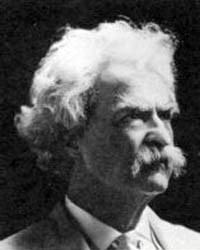
Mark Twain, Father of the Internet

He saw it all clearly through his 'telelectroscope.'

By Crawford Kilian, 8 Jan 2007, TheTyee.ca

Mark Twain

Twain: 'marvelous instrument'

Mark Twain died in 1910, a lifetime before the founding of ARPANET, the precursor of the Internet and the web. So that you could read this on The Tyee, hundreds of brilliant scientists and engineers worked for years to get the clanking, room-sized computers of the 1960s to communicate with one another. You've probably never heard of them: Vinton Cerf, J.C.R. Licklider, Robert Taylor, and Paul Baran, to name just a few. Tim Berners-Lee, the creator of the web, was a latecomer.

Yet I contend that Mark Twain (one of the great science-fiction writers of all time) first conceived the Internet. Like the wizards of the 1960s and '70s, his contribution has been forgotten. But like Arthur C. Clarke, who conceived the earth satellite and could have patented it, Twain understood the idea of the Internet before the scientists did. If anything, he leaped beyond the text-based Internet to the just-dawning world of video chat and vlogging (video blogging).

Surfing the telelectroscope

Even Twain scholars seem to have missed his foresight on this subject. I discovered it by accident, in browsing through the 24 volumes of his collected works in the "Author's National Edition." In an 1898 short story called "From the 'London Times' of 1904," he describes an invention called the "telelectroscope," a gadget hooked up to the phone system: "The improved 'limitless-distance' telephone was presently introduced, and the daily doings of the globe made visible to everybody, and audibly discussable too, by witnesses separated by any number of leagues."

The story itself revolves around the unjust conviction of an American army officer for the murder of Szczepanik, the inventor of the telelectroscope. On death row, the officer is allowed to use the invention. That narrator, who appears to be Mark Twain himself, is a friend who spends time with the doomed officer as he surfs around the world:

"...day by day, and night by night, he called up one corner of the globe after another, and looked upon its life, and studied its strange sights, and spoke with its people, and realized that by grace of this marvellous instrument he was almost as free as the birds of the air, although a prisoner under locks and bars.

"He seldom spoke, and I never interrupted him when he was absorbed in this amusement. I sat in his parlour and read and smoked, and the nights were very quiet and reposefully sociable, and I found them pleasant. Now and then I would hear him say, 'Give me Yedo[Tokyo]'; next, 'Give me Hong-Kong'; next, 'Give me Melbourne.' And I smoked on, and read in comfort, while he wandered about the remote under-world, where the sun was shining in the sky, and the people were at their daily work. Sometimes the talk that came from those far regions through the microphone attachment interested me, and I listened."

Story too forgettable

The actual story, alas, is pretty bad. Clayton, the condemned officer, is about to be executed, and Twain, remaining in his friend's cell, looks through the telectroscope at an event in Beijing (the coronation of the Czar as emperor of China). In the crowd he sees the inventor of the device, who hasn't been murdered at all. The narrator manages to stop the execution, and within minutes Szczepanik is conversing with his supposed murderer:

"A messenger carried word to Szczepanik in the pavilion, and one could see the distressed amazement dawn in his face as he listened to the tale. Then he came on to his end of the line, and talked with Clayton and the governor and the others; and the wife poured out her gratitude upon him for saving her husband's life, and in her deep thankfulness she kissed him at twelve thousand miles' range."

Twain then describes how "for many hours the kings and queens of many realms (with here and there a reporter) talked with Szczepanik, and praised him; and the few scientific societies which had not already made him an honorary member conferred that grace upon him."

The story then degenerates into a second part about whether Clayton can be pardoned for a crime he didn't commit. (You can read it here.) It is all very melodramatic, but Twain clearly understood the basic concept of the Internet: effortless world travel through an electronic medium. Just past the centenary of his imagined "telelectroscope," we who surf the web should pause to thank America's greatest author -- a man ahead of his time in more ways than one.

 [Tyee]

6  Comments:

  • doggone

    08-01-2007

    A.C. Clark also predicts a future " entertainment centred

    A.C. Clark also predicts a future " entertainment centred appartment city where residents play interactive fantasy games perpetually in "the City and the Stars"

    One science fiction author (Sturgeon?) actually details some of his own and other writers' correct predictions including the crucial image of DNA in "The Golden Helix" This story concerns itself with genetic manipulation and was published long before Watson and Crick made their breakthough.

    A short story from the '50s called something like:"Grasp tufts and Gulp Air" depicts the few survivors of a world gone over the Run away Greenhouse" boundary.

    I hope that not all of the science fiction futures will be played out - some of them are grim

  • dolphin

    08-01-2007

    One of my favourite examples of prescience in sci-fi is

    One of my favourite examples of prescience in sci-fi is Robert Heinlein's The Moon is a Harsh Mistress, where freed prisoners from the Moon's penal colony wage a war of independentce against the earth by catapulting grain containers full of moon rocks onto Earth. Last week's news talked about Canada having people on the moon within the next few decades. Heinlein's vision may well come to fruition. In addition, check out Jack London's Star Rover, for a very good novelistic treatment of astral travelling.

  • Gerhardius

    08-01-2007

    Science fiction can open doors to ideas and concepts for

    Science fiction can open doors to ideas and concepts for the general public, and may inspire future scientists, but actual developments in technological fields are built upon the inventions and academic works of others and often these people inspire science fiction authors. Twain did write about a global transmission system, but did where did he get the idea from? During the same period that Twain wrote "From the 'London Times' of 1904," Tesla was working on ideas that he believed would make it

    Quote:
    possible for a business man in New York to dictate instructions, and have them instantly appear in type at his office in London or elsewhere. He will be able to call up, from his desk, and talk to any telephone subscriber on the globe, without any change whatever in the existing equipment... In the same manner any picture, character, drawing, or print can be transferred from one to another place

    Not only did Tesla have similar conceptions to Twain, but he had the knowledge to move the concept forward and he was also a friend of Mark Twain. The two met in the mid-1880's when Tesla was living in New York and Twain was known to have visited Tesla's lab. In addition, Tesla was known for his predictions regarding the possible future uses of his inventions and regaling guests with tales of future science. The story itself does feature Szczepanik, a figure in the evolution of imaging, and uses the term "telectroscope" which had reached semi-popular usage in some circles, indicating further that Twain was "up to date" in popular science.

    Quote:
    But like Arthur C. Clarke, who conceived the earth satellite and could have patented it, Twain understood the idea of the Internet before the scientists did.

    Clarke did not "conceive" the satellite, but he did conceptualise the use of satellites in geostationary orbits as telecommunications relays and it was not done as science fiction. Clarke served in the RAF during WW2, his work involved Radar but he did not yet have his degree in Math & Physics so I imagine he had a relatively non-technical position. His paper regarding the technical benefits of geostationary satellites was written in 1945, before his body of science fiction while he was with the British Interplanetary Society. In the early 20th century, Russian rocket scientist Tsiolkovsky calculated the rocket power necessary to lift an object into a geostationary orbit, and an Austro-Hungarian (can't think of his name at the moment) scientist thought of a space station in geostationary orbit for scientific and military uses.

    I just read the story online found nothing particularly prescient in it, although I might if I was reading it in the isolation of the era or if I had no idea of the people that met and inspired Twain. Good science fiction is derived from science fact at least to some degree, and Twain had many scientist friends whose ideas a fertile mind like Twain' s could churn out in his stories.

  • Alcibiades

    08-01-2007

    Valid points Gerhardius. I think there are some interesting

    Valid points Gerhardius. I think there are some interesting connections between Tesla and H G Wells as well. (War of the Worlds and "death rays"). The fiction almost always follows the science.

    One other tiny point: I love Twain's writing - but America's greatest fiction writer? I can think of at least 2 or 3 pretenders to that throne...
    Writers like Poe, Melville and Hawthorne.

    Have you seen this little video?
    http://video.google.com/videoplay?docid=-5834867580747017149&q=tesla

  • doggone

    11-01-2007

    not quite finished

    James Blish's "Cities in Flight" shows the way out of our energy dilema and the last frame is existential to say the least.

    Visionaries have always been with us,T'anks God!
    "That's How The Light Gets In"

  • The discussion for this story is closed. No more comments can be added.