


 SHARE:
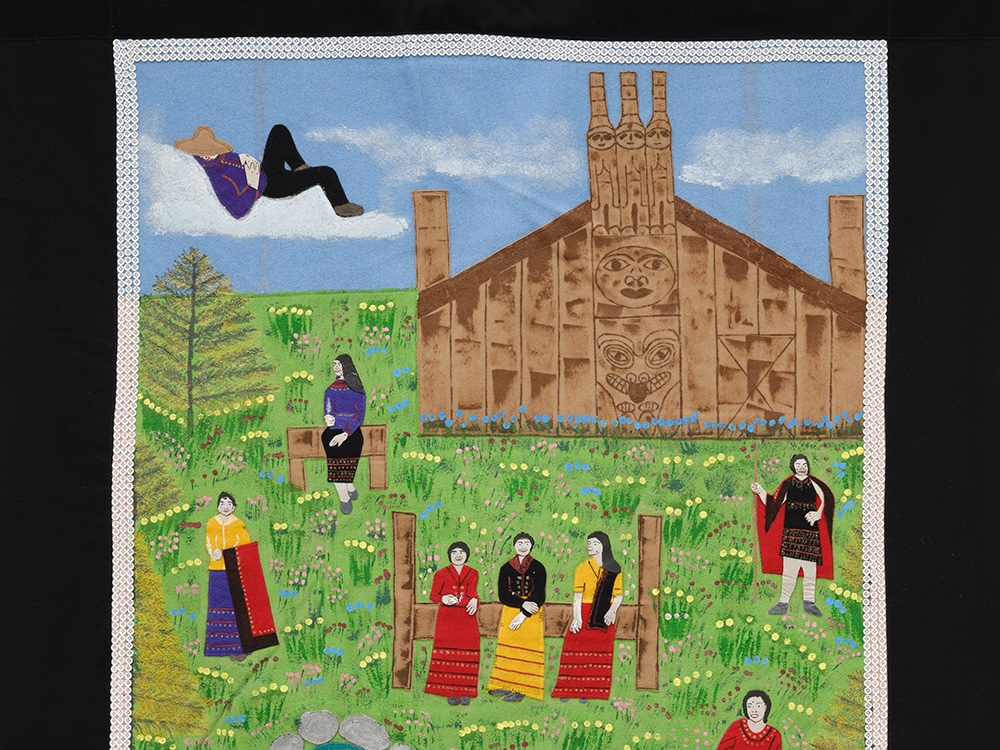
I Use My Haida Eyes: The History Robes of Jut-ke-Nay Hazel Wilson — which runs from May 14 to Oct. 12 at the Museum of Anthropology at UBC — showcases a genre-defying body of work by the late Haida artist Jut-ke-Nay Hazel Wilson.
Over a brief period from 2005 to 2006, Wilson created an untitled series of 51 “history robes,” brought together in this exhibition for the first time, some 20 years after their creation. The richly painted and appliquéd robes document specific episodes of Haida history from a Haida perspective, including narratives of Wilson’s Haida ancestors, settler colonial acts of oppression, and Wilson’s memories of her childhood, gathering and harvesting on the Haida Gwaii landscape. Each is a record of her lived experiences and the historical episodes passed down to her.
Drawing on the distinctive form and techniques of traditional “button blankets” of the northwest coast — robes typically adorned with an individual’s family or clan crests — Wilson’s works are a radical departure in terms of their representational quality, bringing her practice into the realm of history painting and folk art. Wilson intentionally departed from conventions, both in material and imagery. She used acrylic paint alongside appliqué, and took a highly figurative approach to depict her narratives. Her history robes index the innovative ways in which Haida and other Indigenous artists continuously expand on traditional forms to speak to a changing world.
Wilson also wrote out the stories she depicts in each robe. These handwritten texts, many of which impart lessons, were intended primarily to pass along knowledge to her immediate family: her children, grandchildren and future descendants. The narratives, left unsequenced by Wilson, are a combination of recollections of her own life and historical episodes shared with her by her Elders.
The written texts are complex in their challenge of conventional conceptions of time and perspective. Sometimes Wilson wrote more than one version of a robe’s story; these alternative tellings reveal the layers of knowledge stitched into each robe. Some stories collapse time, beginning in a distant past but ending with Wilson’s first-person perspective in the present. Others seem to be set in a pre-European contact period, but bear evidence of colonial history — such as figures wearing button blankets. Throughout all is Wilson’s strong and distinct voice, engaging directly with the reader.
Born in 1941, in G̲aw Tlagée, or Old Massett, Haida Gwaii, Wilson belonged to the Duugwaa St’Langng 7laanaas Raven clan. Her Haida name, Jut-ke-Nay, “The One They Speak Of,” was given to her by her maternal grandmother.
At a young age, Wilson was tasked by her family’s matriarchs with the responsibility of making button blankets for her extended family. She was also a warrior of Canada’s residential school system: as a child she attended Alberni Indian Residential School on Vancouver Island, hundreds of kilometres from her home.
Wilson was supported in her artistic practice by her family, including two of her daughters, Dana Simeon, a button blanket maker, and Avis Simeon, a prolific beadworker. They helped their mother source materials, scouring thrift stores for the right beads and fabrics. Dana and Avis, who were both advisers on this exhibition, describe their late mother as an “easy, complicated” woman. This description also applies to this series of robes, which do not fit neatly into a single category. Are they history paintings, genre painting, folk art or ceremonial regalia?
Regardless of category, the artist imagined each robe as taking her place as storyteller, directly addressing the viewer. In I Use My Haida Eyes: The History Robes of Jut-ke-Nay Hazel Wilson, the viewer is invited to see the world through Wilson’s eyes: to learn about her life, her Haida histories and lessons meant for all who listen.
‘I Use My Haida Eyes: The History Robes of Jut-ke-Nay Hazel Wilson’ runs May 12 to Oct. 12 at the Museum of Anthropology’s Audain Gallery, on the Vancouver campus of the University of British Columbia. For more information, visit MOA’s website. ![[Tyee]](/design-article.thetyee.ca/ui/img/yellowblob.png)
Read more: Indigenous, Art
This article is part of a Tyee Presents initiative. Tyee Presents is the special sponsored content section within The Tyee where we highlight contests, events and other initiatives that are put on either by us or by our select partners. The Tyee does not and cannot vouch for or endorse products advertised on The Tyee. We choose our partners carefully and consciously, to fit with The Tyee’s reputation as B.C.’s Home for News, Culture and Solutions. Learn more about Tyee Presents.






Tyee Commenting Guidelines
Please note that email notifications for replies are not currently working due to a software issue which may be resolved in a future update.
Comments that violate guidelines risk being deleted, and violations may result in a temporary or permanent user ban. Maintain the spirit of good conversation to stay in the discussion and be patient with moderators. Comments are reviewed regularly but not in real time.
Do:
Do not: