


 SHARE:
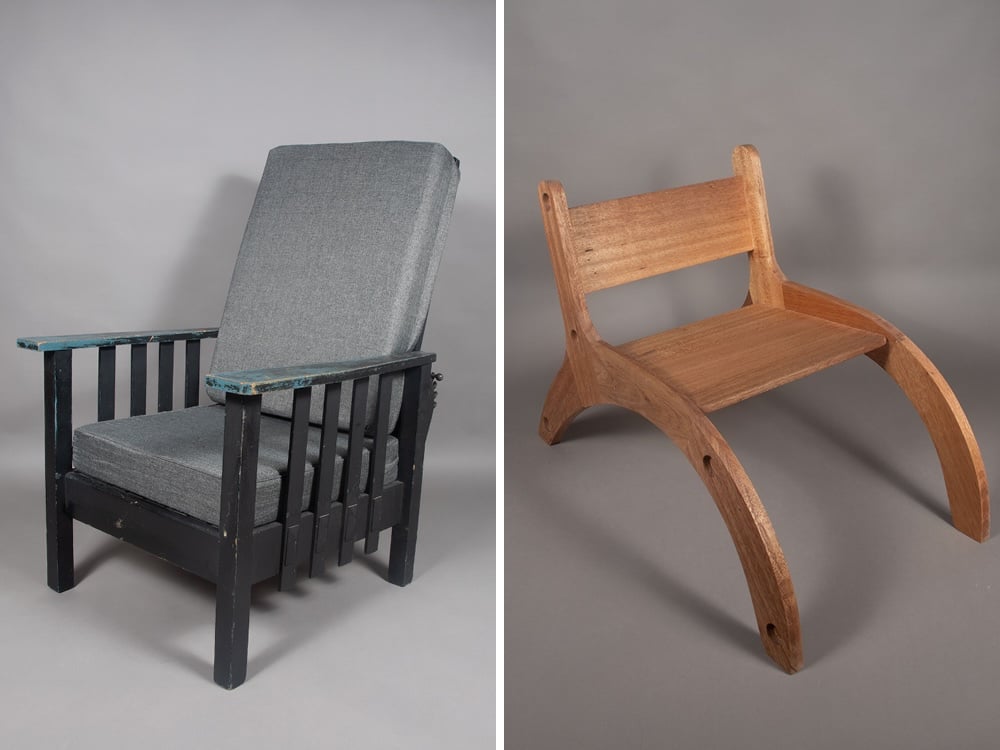
Although Canadian adults spend five to 10 hours a day sitting, most don’t spend a lot of time thinking about chairs. But over the past year, Museum of Vancouver staff have thought a lot about what a chair can say. Two exhibitions recently opened at the MOV, Deep-Seated Histories: Chairs from the Collection and Future Makers: Chairs by New Designers — each has a different focus, but both put chairs on a pedestal.
Denise Fong, curator of urban cultures and lead curator of Deep-Seated Histories, and Viviane Gosselin, director of collections and exhibitions, curator of contemporary culture and lead curator of Future Makers, sat down to answer a few questions about their chairs.
Museum of Vancouver: Was it really a coincidence that there were two chair-related exhibitions at the MOV at the same time?
Viviane Gosselin: It’s kind of a coincidence, but a good one! We’d been wanting to showcase our permanent collection of chairs for over a decade. Then, when working with the design students at Kwantlen Polytechnic University (KPU), we couldn’t resist giving them a chair prompt — the curatorial team always had a soft spot for chairs. As luck would have it, the exhibition calendar aligned. So yes, this summer MOV is fully in chair mode. It’s been fun (and surprisingly moving) to explore them side by side.
What can visitors expect to see as part of Deep-Seated Histories and Future Makers?
Denise Fong: Deep-Seated Histories showcases 150 chairs, seating, doll chairs and miniatures covering more than 200 years of Vancouver’s history. You’ll see everything from Victorian parlour chairs to practical pieces like an antique Koken’s barber chair — each one connected to a story, whether it’s personal, political or cultural. The show explores big themes like migration, labour, identity and settler colonialism, all through the simple but powerful lens of where — and how — we sit. There’s also film and art inspired by chairs.
Gosselin: Visitors to Future Makers will discover 15 original chairs designed by KPU students using reclaimed mahogany. Each one reflects creativity, material stewardship and thoughtful design. There’s also a Maker Zone where you can sketch and build your own chair using cardboard — just like the students did in the early design process. It’s a playful, hands-on space that invites reflection on how we consume — and how, with care and creativity, we can make beauty from what already exists.
@museumofvan This video was filmed in the 1900s - 1920s section of the Vancouver History Galleries at the Museum of Vancouver with a focus on the telephone operator’s chair—a chair designed to keep the operator alert while at work. This chair has been temporarily moved from the History Galleries so it can be part of Deep-Seated Histories: Chairs from the Collection, a feature exhibition that opens on June 20, 2025 and will remain on display through the end of the year. The exhibition uses the chair as a medium to tell stories about notable Vancouverites and the City’s shifting thoughts on work, leisure, design, and neighbourhoods over time. The “I am your new telephone” booklet, switchboard, phone and more are on view in the History Galleries. Come visit to see it all in person. MOV Catalogue # : H2002.57.13: Telephone Operator's chair, c. 1920-50 H2002.57.1: Booklet, "I am Your New Telephone," c. 1910-30 H973.829.4: Telephone Switchboard, c. 1900 H992.76.2: Rogers' Gabriola telephone, 1905 H2002.57.19: Wall Telephone, 1908 Archival Footage: Library and Archives Canada, accession 1973-0127, item ISN 18447. Thanks to @Christian Zane Clado for the video. Voiceover by @Debby 🇨🇦 (Debby Reis). #Telephone #Phone #VintageTelephone #AntiquePhone #TelephoneOperator #womenatwork #telephoneoperatorschair #Chair #ChairDesign #AntiqueFurniture #museum #FYP ♬ original sound - Museum of Vancouver
Turning first to the historical chairs, what are some themes that emerged once you started researching the chairs in the MOV collection?
Fong: There are nearly 250 chairs in our collection, but a central criterion for selecting chairs was their historical tie to Vancouver and uncovering the human connections behind the objects. Key themes are in the stories tied to the chairs; everyday life, family and social activism; chairs from beloved heritage sites, theatres and small businesses across the city; the development of chair design — from the iconic ribbon back chair by a descendant of English cabinetmaker Thomas Chippendale to locally produced mid-century modern steel chairs. Visitors may even recognize a chair that once sat in a family living room. There’s something for everyone.
Do you have a favourite story you found as part of your research?
Fong: Over the years, we’ve had researchers and descendants of Capt. Charles William Barkley and his wife Frances come to the museum specifically to see their chair. Dated to the 1700s, it is one of the oldest in the MOV collection. It’s fascinating to witness the enduring interest in this family heirloom, which has been the subject of numerous articles and books. It has remained in excellent condition thanks to the care and restoration efforts of our conservators. It truly stands as a witness to history.
Another fun series is a set of tiny wooden armchairs made by Sonia Messer, who was known for crafting high-end dollhouse furniture. Each chair was originally sold for $40, which was a lot of money back in the 1960s! Dollhouses go back to the late 1500s and weren’t originally made for kids — they were luxury items, often made with fancy materials like exotic woods. Miniatures have definitely made a comeback in recent years. They blend nostalgia, a love of design and the calming joy of working with tiny, intricate details.
Speaking of exotic woods, tell us about the mahogany used in the Future Makers chairs.
Gosselin: In 2021, the MOV was gifted reclaimed mahogany once destined for Vancouver’s marine industry. This set two stories in motion. Reclaim + Repair came first. On view from July 2023 to September 2024, that exhibition showcased seasoned makers steeped in regenerative design who were handed the wood and essentially told to “go wild.”
We flipped the script with Future Makers. This time the spotlight is on emerging talent: industrial-design students at KPU. Their brief was tighter — build a chair — but the challenge was the same: how do we promote reuse without reinforcing the very cycles of consumption we’re trying to disrupt?
Fifteen prototypes later and the gallery is filled with seats that fold, bloom, reminisce and critique. Together, the two shows demonstrate how both experienced and rookie designers can transform leftovers into possibility.
We wanted emerging designers to grapple with real-world questions about sustainability, colonial legacies and material ethics. It was about more than building chairs — it was about shaping thoughtful makers who see design as both creative practice and cultural responsibility.
Tell us about how the exhibition will be giving back to where the wood came from.
Gosselin: The exhibition includes a built-in repair element. Recognizing that the reclaimed mahogany originated from Central America — where deforestation has had lasting impacts — MOV, KPU and the students agreed to auction off the chairs, and the proceeds will be donated to Indigenous-led reforestation efforts in Guatemala. It’s a small but meaningful way to give back to the regions impacted by extractive logging, and to show that circular design isn’t just about reuse — it’s also about repair, reciprocity and care for the communities and ecosystems connected to the materials we work with.
@museumofvan Welcome to Deep-Seated Histories and Future Makers, two chair-related exhibitions on view now at the Museum of Vancouver! We wanted to take this opportunity to remind you which chairs you can and cannot sit on in our galleries… especially after what happened to Nicola Bolla’s “Van Gogh” chair at the Palazzo Maffei (@palazzomaffeiverona). Special thanks to Minneapolis Institute of Art (@Minneapolis Institute of Art) for letting us copy their idea! #DoNotTouch #Chairs #MuseumRules ♬ Jazz masterpiece "As time goes by" covered by a Jazz violinist by profession(962408) - ricca
‘Deep-Seated Histories: Chairs from the Collection’ and ‘Future Makers: Chairs by New Designers’ are on display now at the MOV through January 2026. For more information on these and other exhibitions at the MOV, visit the museum’s website. ![[Tyee]](/design-article.thetyee.ca/ui/img/yellowblob.png)
This article is part of a Tyee Presents initiative. Tyee Presents is the special sponsored content section within The Tyee where we highlight contests, events and other initiatives that are put on either by us or by our select partners. The Tyee does not and cannot vouch for or endorse products advertised on The Tyee. We choose our partners carefully and consciously, to fit with The Tyee’s reputation as B.C.’s Home for News, Culture and Solutions. Learn more about Tyee Presents.







Tyee Commenting Guidelines
Please note that email notifications for replies are not currently working due to a software issue which may be resolved in a future update.
Comments that violate guidelines risk being deleted, and violations may result in a temporary or permanent user ban. Maintain the spirit of good conversation to stay in the discussion and be patient with moderators. Comments are reviewed regularly but not in real time.
Do:
Do not: