

 SHARE:
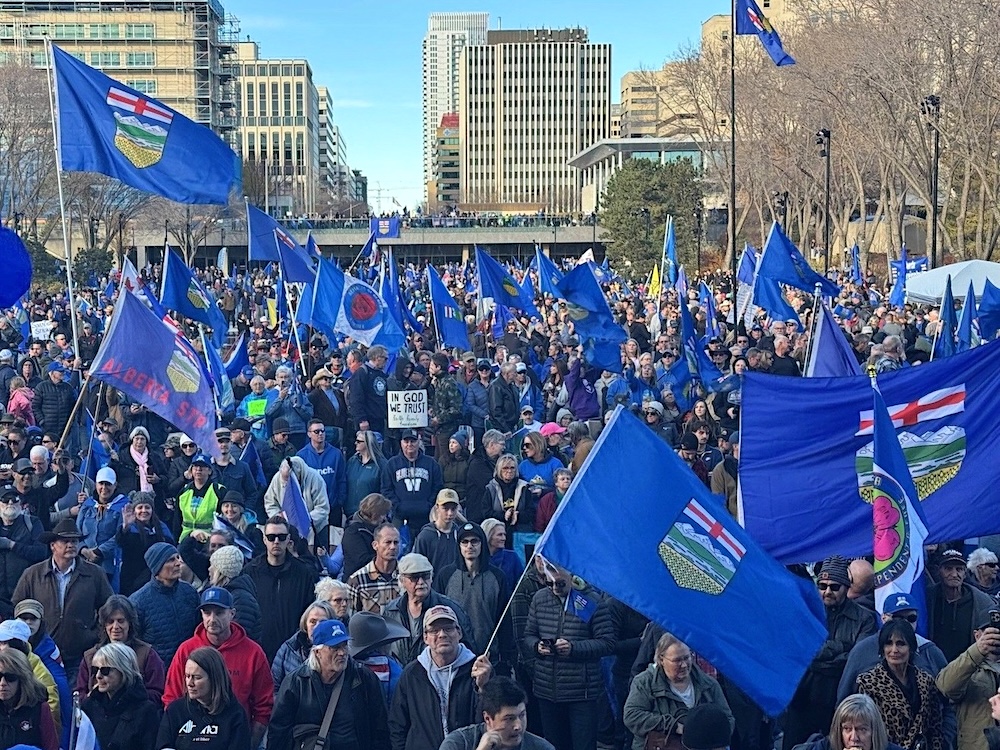
Early last May, news media reported that Alberta Premier Danielle Smith had been granted “top secret” security clearance. Really?
A report in the Globe and Mail Saturday with new details about what a group of self-appointed separatist leaders got up to in Washington, D.C., in 2025 raises intriguing questions about Smith’s security clearance.
According to the detailed weekend Globe report, when leaders of the so-called Alberta Prosperity Project met with as-yet-unnamed U.S. State Department officials on three occasions in 2025, they offered “access to fresh water and royalties on crude oil, in exchange for help transitioning to independence.” Or to put that another equally accurate way, for help breaking up Canada.
With her top-secret security rating, one would think Smith would have been told about this at her first briefing. Or did Canada’s security agencies have no idea what happened at those meetings in April, September and December last year?
Back on May 7, Smith’s press secretary, Sam Blackett, told reporters for various news organizations that the premier had been granted what the federal government says publicly is its highest level of security clearance so that she could “receive briefings on issues related to national security.”
This followed news stories in March that quoted Premier Smith complaining that the RCMP wasn’t telling her what she needed to know about foreign interference on security issues related to the Oct. 19 separation referendum, which is now only two weeks away.
“The RCMP does not brief our government, I made that clear, and no, I’m not happy with that fact, which is why we have to go to alternative sources to be able to get intelligence,” Smith said on March 18. She indicated that she wanted to be briefed by the Canadian Security Intelligence Service, or CSIS.
It was obvious at the time that Smith was peeved when she learned that B.C. Premier David Eby already had top-secret security clearance. Perhaps she was also irked because Eby had sharply attacked the very same Alberta separatists named in Saturday’s Globe story, who seemed to be political allies of Smith at the time. “To go to a foreign country and to ask for assistance in breaking up Canada, there’s an old-fashioned word for that, and that word is treason,” the B.C. premier said in February.
In a followup story yesterday to the Globe’s Saturday scoop, Blackett was quoted as saying that his boss “has no knowledge of these alleged meetings.”
This is difficult to believe, since the occurrence of the meetings has been widely reported and confirmed by participants, although some of the details offered up by the Globe this weekend were new. Presumably, though, what Blackett meant was that Smith has no knowledge of what happened during the meetings.
But does that mean that Canada’s security agencies didn’t know either? Or just that they didn’t tell Smith? Or what?
Certainly Blackett’s assertion raises interesting questions about the true nature of Smith’s security clearance.
Even without her pro-American ideological history, I wrote back on May 10, “Smith is temperamentally a bad risk for a security clearance. She is a political opportunist and a blabbermouth. Conservative commentator Andrew Coyne recently compared her to a magpie. There is no way, given secret information she could use to her political advantage, that she will be able to resist the temptation. This, we can be confident, Canadian security agencies understand.”
It is not entirely clear who is responsible for giving security clearances to politicians. For government employees, CSIS is said to do the investigation. According to news reports at the time, the Privy Council Office, or PCO — that is, the cabinet’s secretariat — is responsible for issuing security clearances to provincial officials.
I wondered at the time if we could take it on trust that the security clearance given Smith was really top secret, as Blackett believed. “Most likely the PCO decision was purely a political one, and the secrets to which Smith will have access — in the form of oral reports only — will definitely not be off the ‘top’ shelf, let alone unspecified levels above top secret,” I wrote then.
And now Smith’s office says she knew nothing about the information uncovered by the Globe. This suggests several possibilities, none of which can be proven, and none of which are particularly reassuring. These include:
- that the premier just made it up about having top-secret clearance and no one contradicted her;
- that she wasn’t really issued top-secret clearance but was told that she had been;
- that she was issued top-secret clearance but never went back and asked for a briefing about the 2025 meetings in Washington;
- that she’s been briefed about the Alberta Prosperity Project “negotiators’” antics and is not being truthful when she says she knows nothing; and
- that Canada’s security services had no clue about what happened at the meetings.
Perhaps someone could ask Alberta Public Safety Minister and Deputy Premier Mike Ellis. Last spring the former Calgary police officer was said to be seeking top-secret clearance too. There seem to be no reports on whether or not he succeeded.
Canada requires a legal prohibition of freelance diplomacy
Yesterday’s Globe follow story focused on a call by Calgary Confederation Liberal MP Corey Hogan to consider a law that would ban such freelance negotiations with foreign governments.
Ironically, if the shoe had been on the other foot and, say, Minnesota separatists had been seeking Ottawa’s help to separate from the United States, their activities would have been clearly illegal.
Since 1799, the Logan Act has made it a crime for an American citizen to carry on unauthorized negotiations with foreign governments. That includes well-intentioned negotiations, as well as outright efforts to betray the country to foreign powers.
The Logan Act has remained on the U.S. law books ever since — for the obvious reason that there is a real need to prevent such interventions, all the more so in the globalized and corporatized world of the 21st century. Its mere presence is a useful reminder of the necessity of a nation’s government holding a monopoly on diplomacy.
The need for a similar prohibition in Canadian law on freelance diplomacy remains a matter of urgency in defence of the realm. Perhaps this would be a good project for Hogan. ![[Tyee]](/design-article.thetyee.ca/ui/img/yellowblob.png)
Read more: Alberta









Tyee Commenting Guidelines
Please note that email notifications for replies are not currently working due to a software issue which may be resolved in a future update.
Comments that violate guidelines risk being deleted, and violations may result in a temporary or permanent user ban. Maintain the spirit of good conversation to stay in the discussion and be patient with moderators. Comments are reviewed regularly but not in real time.
Do:
Do not: