

 SHARE:
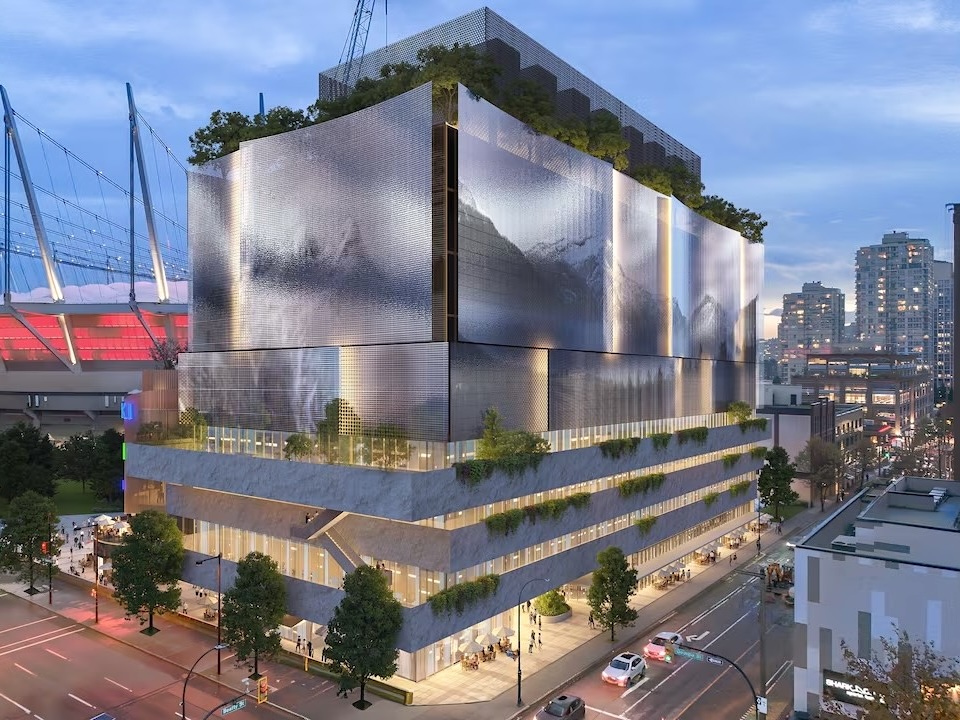
The federal government and Telus have announced plans to advance three “AI factory projects” in British Columbia, including two in Vancouver and one in Kamloops.
These projects are the first to be developed under the federal government’s “Enabling Large-Scale Sovereign AI Data Centres” program, which invests in “promising AI infrastructure projects.”
The use of the term “AI factory” rather than “data centre” is telling. For all intents and purposes, the proposed facilities are hyperscale data centres that will perform both the training of AI models and their operation.
But if the federal government and Telus had hoped to avoid public opposition simply by renaming data centres as something else, they will, no doubt, be disappointed. Indeed, the announced project raises more questions than answers — particularly for the residents of Vancouver.
As Jesse Cole reports, the proposed Vancouver facilities include a 100,000-square-foot repurposed facility in the Mount Pleasant neighbourhood, as well as a 400,000-square-foot development at 150 W. Georgia St., adjacent to BC Place stadium.
Both locations are densely populated and the proposed facilities would have to be sited close to residential neighbourhoods.
Why are three levels of government encouraging energy-intensive server racks to be located in the middle of prime inner-city locations? Are there not better social uses, like housing and businesses?
As we know from the U.S. experience, the closer these facilities are to residential neighbourhoods, the more public opposition they often generate.
Data centres require large and extensive cooling systems, meaning they emit constant and repetitive noise from industrial fans and other mechanisms. Residents living in close proximity to data centres report difficulties sleeping and other health problems brought on by the incessant low-frequency drone of these buildings.
Yet conventional noise bylaws are often insufficient to regulate the constant, 24-7 noise of these buildings. Attempts at installing suppression devices or sound baffling to reduce noise have had mixed results in other communities.
As a result, more local governments are looking to increase the setback limit for these facilities to ensure they are a safe distance from housing, schools and hospitals so they do not reduce quality of life. Dropping one of these facilities in an already densely populated neighbourhood will make proper setbacks all the more difficult to achieve.
In order for data centres to deliver on their promise to provide virtually continuous service, they must be able to operate under any circumstances. This means ensuring they have redundant backup power requirements to weather blackouts or any other power interruption.
Backup power for these facilities almost always means diesel generators — sometimes hundreds of them. For a 100-megawatt facility like the one proposed in downtown Vancouver, this could mean anywhere between 25 and 50 diesel generators on site, depending on their size. Diesel generators are notoriously dirty, emitting fine particulate matter associated with a host of health and breathing problems. It’s why diesel generation is often strictly regulated.
However, as electricity grids strain under demands, the pressure to switch to diesel generation at the slightest hint of a potential energy disruption has been growing. Placing that many generators directly in the middle of the urban core could be a major public health issue. Due to these challenges, the state of Virginia — home to the largest concentration of data centres in the world — concluded that the “industrial scale of data centres makes them largely incompatible with residential uses.”
That leads to the next question. Who asked for this? One would hope that extensive consultations of affected communities would be done before moving forward with a project that has the potential to be profoundly disruptive — both in the construction phase and the operational phase.
And as it turns out, there was a consultation, just not one that captured what is actually being built.
When the City of Vancouver rezoned 150 W. Georgia in 2023, the applicant at the time — Creative Energy Vancouver Platforms Inc., which owns the site and operates the downtown steam heating network — sought to add “bulk data storage” as a permitted use to an already approved commercial building. Six people submitted comments during the online engagement period. By the day of the Sept. 28, 2023, public hearing, a single written submission was received (in support), and the rezoning passed.
The only legally binding public benefit secured through that process was a community amenity contribution of $295,425 (found on page 6 of the referral report), which is less than the cost of a single affordable housing unit in Vancouver. The $9 billion in projected economic activity, the 525 permanent jobs and the renewable energy commitments announced were not secured in the application with the city.
This is precisely the problem that community benefit agreements, or CBAs, are designed to solve. A CBA is a legally binding contract negotiated between a developer and the affected community before a project proceeds.
Unlike a standard rezoning process, which captures only a narrow set of contributions calculated against a floor area, a CBA can require developers to commit to local hiring targets, living wages, noise mitigation measures, environmental monitoring and ongoing community oversight.
Critically, these commitments are enforceable, not aspirational talking points delivered at a press conference.
For large-scale infrastructure projects with significant community impacts like data centres, CBAs are one of the few tools that shift bargaining power toward residents rather than investors. Voluntary commitments are only as strong as the incentive to keep them.
The absence of these binding commitments is not incidental. BC Green Party Leader Emily Lowan has accused lawmakers of using a “build-first, regulate-later model” and called for a moratorium on new data centres in the province until stronger regulation and environmental policies are in place.
Promising to be the “world’s most sustainable sovereign data centres,” Telus announced these facilities will run almost exclusively on renewable power and will use state-of-the-art cooling technology to minimize water consumption, as well as recaptured heat. In his remarks, Minister of Artificial Intelligence and Digital Innovation Evan Solomon stated that “this is how you build right.”
While it is important that these facilities be built to the highest environmental standards, it does raise the question of why we do not regulate to ensure that all future builds meet such standards. Instead, we seem to be relying on boosterism and wishful thinking that private corporations will prioritize the environment in their mad rush to cash in on AI infrastructure without asking the right questions about impact. ![[Tyee]](/design-article.thetyee.ca/ui/img/yellowblob.png)
Read more: Health, Politics, Science + Tech








Tyee Commenting Guidelines
Please note that email notifications for replies are not currently working due to a software issue which may be resolved in a future update.
Comments that violate guidelines risk being deleted, and violations may result in a temporary or permanent user ban. Maintain the spirit of good conversation to stay in the discussion and be patient with moderators. Comments are reviewed regularly but not in real time.
Do:
Do not: