

 SHARE:
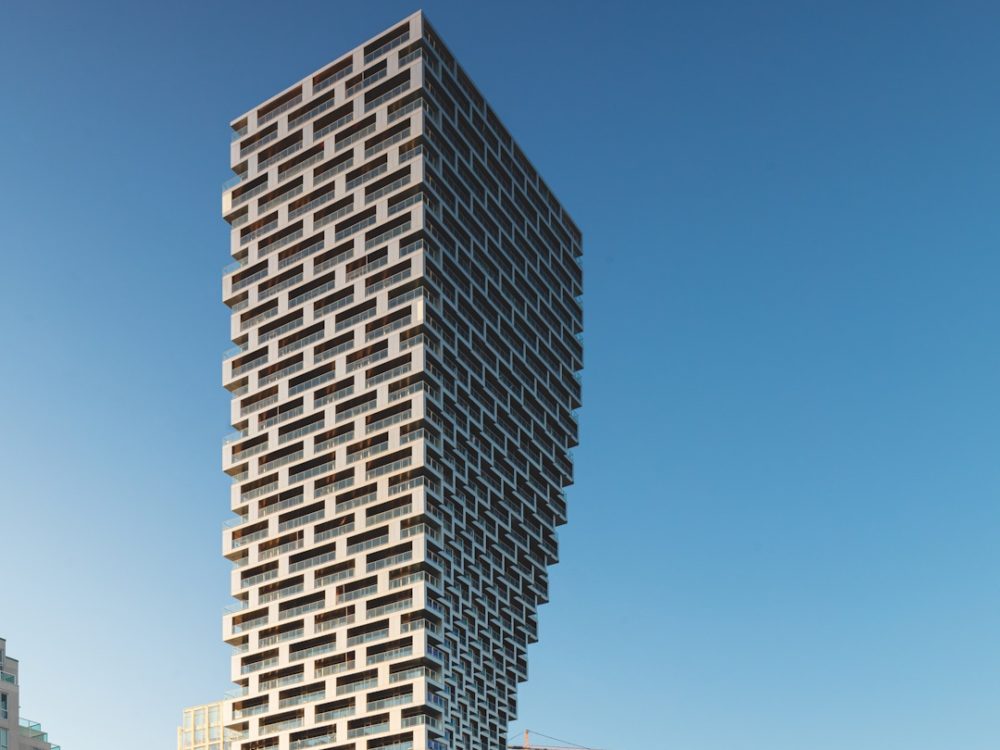
The Vancouver House luxury condominium highrise makes a bold visual statement by creating the illusion that it miraculously balances on a base that is partly carved away.
When Vancouver’s auditor general took a look at the building through the lens of fiscal accountability, he found quite a bit that truly was missing — key amenities the developer, Westbank, had promised to provide the city as part of the project.
The details are found in the 2025 Whistleblower Report issued by the Office of the Auditor General, or OAG, on February 5, 2026.
The whistleblower complaint that initiated the investigation by the auditor general was made by me. I’d also published an article about the issue in The Tyee about a year and a half ago.
And now, the OAG report finds “waste” by the city detailed in Section 5.1 “Delivery of Community Amenity Contributions (CACs)” as well as Appendix C.
In short, the city blew opportunities to either put millions more dollars in its coffers or to add significant improvements to its streetscape. Here is how.
Understanding community amenity contributions
Rezoning to a higher density typically increases land value. This increase for a particular development site is called its “land lift” and the city’s policy is to negotiate for community amenity contributions, or CACs, worth at least 75 per cent of that land lift.
A CAC might come in the form of cash, or sometimes social housing, or a childcare centre or other public amenity.
The auditor general looked into the amount of CACs the city agreed upon with developer Westbank for the Vancouver House rezoning and found that it was substantially less than the city’s policy target of 75 per cent of the anticipated land value increase or “land lift”.
The OAG’s report says that city staff “originally calculated the anticipated increase in land value for the proposed Vancouver House development as $34,976,972,” which should have required the developer to deliver $26,232,729 worth of public amenities.
Instead, the Property Development team of the city’s real estate and facilities management department negotiated with the developer and agreed on $10 million — $4 million in cash and $6 million in in-kind CACs which would be spent on “public realm improvements” in the area.
A particularly damning section of the OAG report goes on to say:
The in-kind contributions were never properly defined and documented. In some cases, the City excused the developer from delivering items that had been publicized as part of public consultation, because of concerns about future maintenance obligations the City would inherit. No action was taken to quantify and replace the value of the eliminated amenities. Delivery of the in-kind contributions does not appear to have been monitored or enforced.
The auditor general’s report notes risks in negotiating CACs and that Vancouver’s city council relies on staff to seek to maximize the public benefit. The OAG reviewed the record of negotiations and reports it showed complexity and pushback from the developer.
There was no evidence of mismanagement of public funds or assets, or of bribery or fraud.
The negotiated amount was approved by council, and although it was significantly below the city’s policy target, the auditor general concludes “this does not equate to the high threshold required for serious wrongdoing, given the multiple variables at play.”
Management of the in-kind community amenity contributions
As noted above, the CACs for Westbank’s Vancouver House rezoning were $4 million cash and $6 million in-kind for public realm improvements in the area surrounding the development. The OAG quotes the following details about those improvements from council’s approval:
- A more direct and enhanced pedestrian connection (vertical elevators/stairs and horizontal bridge) between the upper Granville Bridge deck sidewalks and Granville Street below
- Public realm features, such as landscaping, seating opportunities, patio spaces and kiosks, need to be considered.*
- Pedestrian access through the terraced semi-public courtyards to Pacific Street should also be maintained
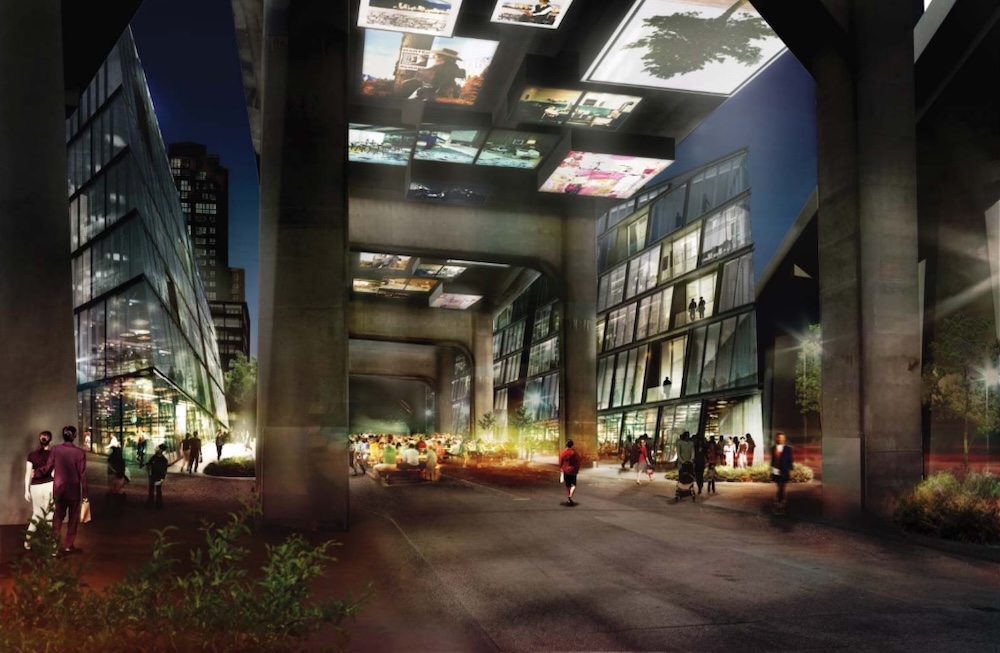
- Enhanced public realm treatment that contributes to the unique environment under the Granville Bridge and ramps.
- Design development and provision of a conceptual lighting strategy and implementation plan for pedestrian scale lighting and feature lighting to enhance the unique under the bridge/ramp environment.
- Provision of an animation strategy and implementation plan demonstrating the proposed use of City streets and structures, and provision of basic infrastructure, to support public realm programming. Basic infrastructure should be provided to facilitate event programming, including electricity, water, storage, and accessibility to public washrooms, including arrangements to secure public access.”
The document notes that some bureaucratic hurdles remained to allow some of these features, such as outdoor furnishing and lighting, to be installed. But if the proposed features had been implemented, Vancouver would have transformed a rather empty-feeling corner of the city into an area enlivened by light projections and performances.
What was missing became glaring when the auditor general paid a site visit to Vancouver House in October to view what improvements had been provided. Here are some observations in the OAG’s report:
- The elevator from the development's ground floor to the deck of the Granville Street Bridge was closed to the public. We were told by a security guard from one of the private commercial tenants in the building that this had been the case for several months.
- The same security guard told us that there was no public washroom at the development, only one inside a nearby grocery store.
- There was minimal landscaping between and around the Vancouver House development, except for a narrow strip of small plants near the entrance to the residential portion of the building on Howe Street, and street trees on Pacific Boulevard. Noticeably absent was any trees or other green spaces in the area around and under the Granville Street bridge.
- There was limited seating, and no public patio spaces nor kiosks.
The auditor general sums up by describing how the promise of a lively new public space turned into a mirage:
The intention of the in-kind CACs and the activation plan completed as part of the Development Permit Application was to create a space capable of hosting public events. However, the infrastructure to support event hosting did not appear present.There also did not appear to be any information that indicated that the area was available for public events or any amenities that would support public events. The space is not listed on the City’s Plazas and Public Space page, which lists options for organizing special events across the City.
A preliminary web search by the OAG could not find any evidence that any public events had ever taken place in the public realm which was created as part of the in-kind CACs related to Vancouver House.
In my view, this is a devastating documentation of staff’s failure to have the developer provide the amenities promised to the public and council.
This failure seems to partially stem from a lack of co-ordination between the real estate and facilities management department, planning, engineering, legal, and development buildings and licensing departments. For example, engineering department concerns over long-term maintenance resulted in some items being simply scrapped, instead of being provided “under maintenance agreement with the owner” as engineering suggested.
Nor did the city request alternative deliverables or benefits from the developer in lieu of the cancelled amenities. The OAG also reports that the 2014 Development Permit Board application “does not reference the $6 million value of the in-kind CACs” although the rezoning report said that further details of the in-kind CACs were to be specified in it.
The most important cause was the incomprehensible fact that “no enforceable, specific and itemized list of what was to be delivered, broken down by the value of each component, was produced.” This is an almost unbelievable failure by staff to look after the public interest.
Beyond the OAG report
Neither in this report nor its land sales report did the OAG look into the city’s sale in 2014 of 87 per cent of the Vancouver House site to developer Westbank after it had been rezoned. That sale was for $32 million as recommended by real estate and facilities management department and approved by council. Real estate and facilities management department calculation of an anticipated land lift of $35 million from the rezoning (cited by the OAG) means that staff expected the market value of that land to be over $60 million when it was sold.
That turned out to be a severe underestimate. The actual land lift achieved by the developer was almost $100 million. The land the city sold for $32 million actually had a market value of $128 million on the day of the sale, as attested to by BC Assessment’s valuation, an independent appraisal and the $100-million mortgages Westbank immediately obtained.
My analysis finds the real estate and facilities management department staff achieved a low valuation for sale of the site by instructing the appraiser to value the land on the basis of a fictional rezoning at low density instead of on the high density rezoning which was actually in progress as a condition of the sale.
This means that real estate and facilities management department negotiations with the developer, which resulted in $10 million in CACs, yielded the public only 10 per cent of the actual land lift that developer Westbank was granted, as opposed to the city’s 75 per cent policy goal.
What the OAG recommends
The OAG concluded that the city’s actions fell below a reasonable standard and met the definition of “waste” i.e. mismanagement of city resources or assets in a willful, intentional or negligent manner.
The OAG also stated that the CAC process “needs to be more transparent to support ongoing public trust and to allow residents to verify that the City has obtained the benefits developers undertook to provide.”
To ensure satisfactory outcomes when in-kind CACs are accepted in future, the auditor general made eight useful recommendations, the first of which seems almost embarrassingly obvious, though important and clearly needed.
When the City and a developer agree upon in-kind CACs, a clearly defined, itemized, and costed list of deliverables should be created. This list should be reviewed and agreed to by the developer and the City departments with relevant subject matter expertise to provide the necessary certainty for an enforceable agreement, ideally prior to it being submitted to Council for approval.
City management have accepted the auditor general’s recommendations and have advised “that greater robustness has been incorporated into the process for managing in-kind CACs since the Vancouver House approval process.” ![[Tyee]](/design-article.thetyee.ca/ui/img/yellowblob.png)
Read more: Municipal Politics, Urban Planning





Tyee Commenting Guidelines
Please note that email notifications for replies are not currently working due to a software issue which may be resolved in a future update.
Comments that violate guidelines risk being deleted, and violations may result in a temporary or permanent user ban. Maintain the spirit of good conversation to stay in the discussion and be patient with moderators. Comments are reviewed regularly but not in real time.
Do:
Do not: