


 SHARE:
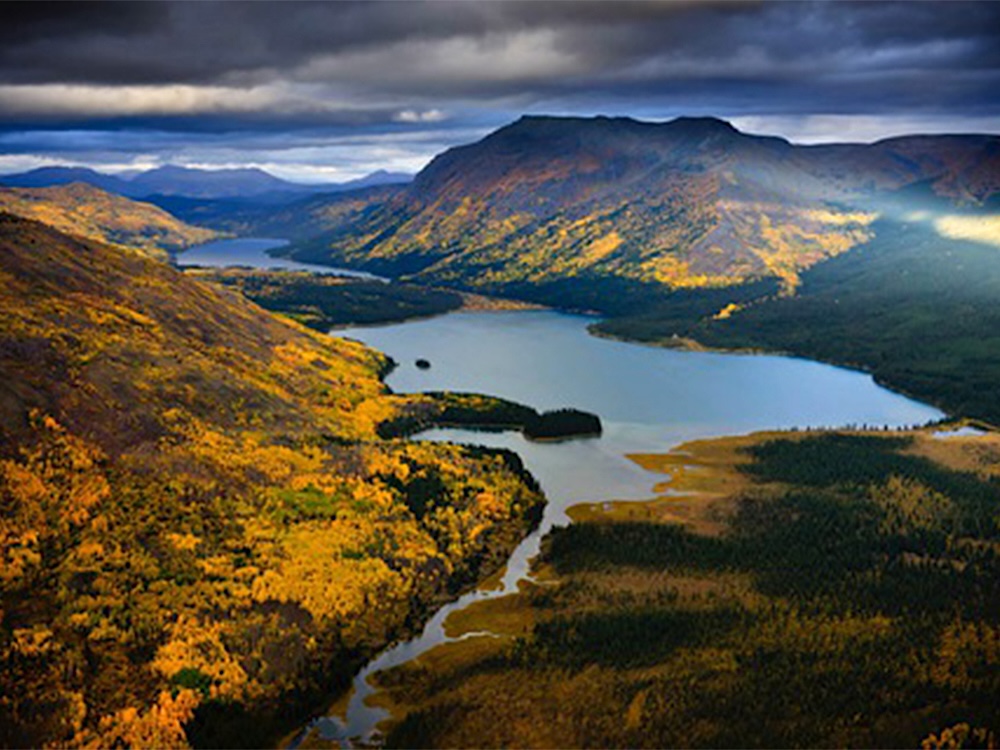
With curious timing, the B.C. government announced yesterday that major progress has been made in creating two new Indigenous-led protected areas in the province’s north and expanding a third.
The projects include advancing permanent protection for the Klappan Sacred Headwaters as a 300,000-hectare conservancy to safeguard the headwaters of the Skeena, Nass and Stikine rivers, critical salmon watersheds in Tahltan territory.
A draft plan to protect the ancestral territory of Kaska First Nations in a proposed three-million-hectare conservancy was also unveiled, as was the proposed expansion of a conservancy in the Meziadin River watershed, northwest of Prince Rupert, to protect salmon spawning habitat.
The Meziadin watershed is the largest sockeye salmon nursery in the Nass River system and accounts for about 75 per cent of the total Nass sockeye run.
“Safeguarding these wild salmon populations is essential not only for the ecology of the region, but for the cultural and food security of future generations,” Gitanyow Hereditary Chiefs said in a statement.
The proposed protected areas are part of land-use planning initiatives that aim to balance conservation with resource extraction.
News about progress on the initiatives and proposed protected areas followed Prime Minister Mark Carney’s much-anticipated announcement that his government will uphold a tanker ban off B.C.’s North Coast.
Ottawa’s renewed commitment to the tanker ban is part of a new multibillion-dollar agreement between B.C. and the federal government, also announced yesterday, that includes up to $3 billion for upgrading the George Massey Tunnel under the Fraser River and up to $10 billion to upgrade the Roberts Bank port and container terminal.
The agreement also provides $3.9 billion for the North Coast Transmission Line, which will channel electricity from the publicly funded John Horgan Dam (formerly known as the Site C dam) and other projects to new and expanded mines, and liquefied natural gas projects, such as LNG Canada and Cedar LNG.
Later in the day, at a press conference, Carney and Alberta Premier Danielle Smith announced that the preferred route for a new oil pipeline from Alberta will parallel the Trans Mountain pipeline to the southern B.C. coast, signalling that the new pipeline will likely terminate near Vancouver.
Carney signed a memorandum of understanding with Smith last fall on the development of a bitumen pipeline, with the goal of exporting to Asian markets.
Carney’s deal with BC
As recently as May, B.C. Premier David Eby criticized the federal government’s negotiations with Alberta, saying Canada shouldn’t reward Alberta’s “bad behaviour” around separation threats with a pipeline.
“It cannot be the case that the projects that get prioritized in Canada are those where a premier threatens to leave the country,” he said.
Eby continued that the federal government needed to work “as closely” with B.C. on its critical minerals, natural resources and port access projects “as they work with the Government of Alberta on Premier Danielle Smith's proposed pipeline.”
Eby referred to the pipeline as “a project that has yet to identify a proponent or a route.”
Eby said B.C. also had no intentions of changing its mind on the North Coast tanker ban.
The deal announced yesterday appears to satisfy several of the issues raised by Eby.
“We will support the development of the power, the mining and the trade infrastructure to unlock northern B.C.’s full potential in an environmentally sustainable way,” Carney told reporters Thursday.
The prime minister also announced the creation of a new B.C. conservation area “the size of Greece, consistent with Canada’s commitment to preserve 30 per cent of our lands by 2030.” He did not elaborate on where that conservation area would be located.
Erin Burchett, press secretary for Premier Eby, told The Tyee that it appears Carney was describing the previously announced Northwest Critical Conservation Corridor, an area of northwest B.C. that includes the Red Chris mine and other proposed industrial development.
While details are scant, the corridor — which is being considered by Canada’s Major Projects Office — was previously described by Carney’s office as presenting “opportunities for critical minerals development, clean power transmission, Indigenous project leadership and a potential new conservation area the size of Greece.”
The new agreement between B.C. and Ottawa includes a $500-million federal investment in the Red Chris mine expansion in Tahltan territory, which Carney said is expected to increase Canada’s annual copper production by more than 15 per cent.
Newmont Corp., headquartered in the United States, owns 70 per cent of the Red Chris mine, while Vancouver-based Imperial Metals owns 30 per cent of the venture, which is supported by the Tahltan.
In a statement, Kerry Carlick, president of the Tahltan Central Government, said advancing permanent protection for the Klappan Sacred Headwaters is a major step forward for the nation “and for our shared work with British Columbia to recognize Tahltan title and rights, and decision-making.”
The recommendation to protect the headwaters as a conservancy under the Park Act is part of the Klappan Plan, a joint land-use plan developed by the nation and the B.C. government.
The land-use plan and proposed Sacred Headwaters conservancy area, which is central to the identity of the Tahltan people and supports wildlife and ecosystems, are open for public feedback until Aug. 4.
Nikki Skuce, director of the Northern Confluence initiative, called protection for the Sacred Headwaters “long overdue” and lauded the leadership role the Gitanyow have taken to protect the Meziadin. She said the proposed Kaska protected area, Dene Kʼéh Kusān (meaning “Always Will Be There” in the Kaska language), is the largest wild area in B.C. that “few British Columbians have heard of.”
“With mining pressures increasing, it’s important to ensure large areas are restricted from industrial development and wild salmon rivers are protected,” Skuce said.
The proposed Dene Kʼéh Kusān protected area would protect Kaska cultural sites, intact watershed and critical wildlife habitat for a multitude of species that include seven herds of woodland caribou, genetically distinct Stone’s sheep and tens of thousands of songbirds.
The area is one of North America’s last intact major landscapes, stitching together snow-crested mountains, boreal forest, lakes and rivers in an area that has sustained the Kaska Dena continuously for at least 4,500 years.
The Kaska Dena say the protected area is necessary to protect nature and safeguard their way of life at a time when Indigenous cultures around the world are threatened with extinction.
“The Kaska Elders have long held a vision for safeguarding the heart of our ancestral territory,” Chief-elect Harlan Schilling of the Liard First Nation said in a statement. “It is rooted in the knowledge that healthy lands support healthy people and communities.”
Skuce said the B.C. government’s announcement is “another important step for conservation” and commitments to protect 30 per cent of the province’s land and waters by 2030, despite increasing pressures to deregulate and fast-track major projects. ![[Tyee]](/design-article.thetyee.ca/ui/img/yellowblob.png)
Read more: Energy, Alberta, Environment










Tyee Commenting Guidelines
Please note that email notifications for replies are not currently working due to a software issue which may be resolved in a future update.
Comments that violate guidelines risk being deleted, and violations may result in a temporary or permanent user ban. Maintain the spirit of good conversation to stay in the discussion and be patient with moderators. Comments are reviewed regularly but not in real time.
Do:
Do not: