


 SHARE:
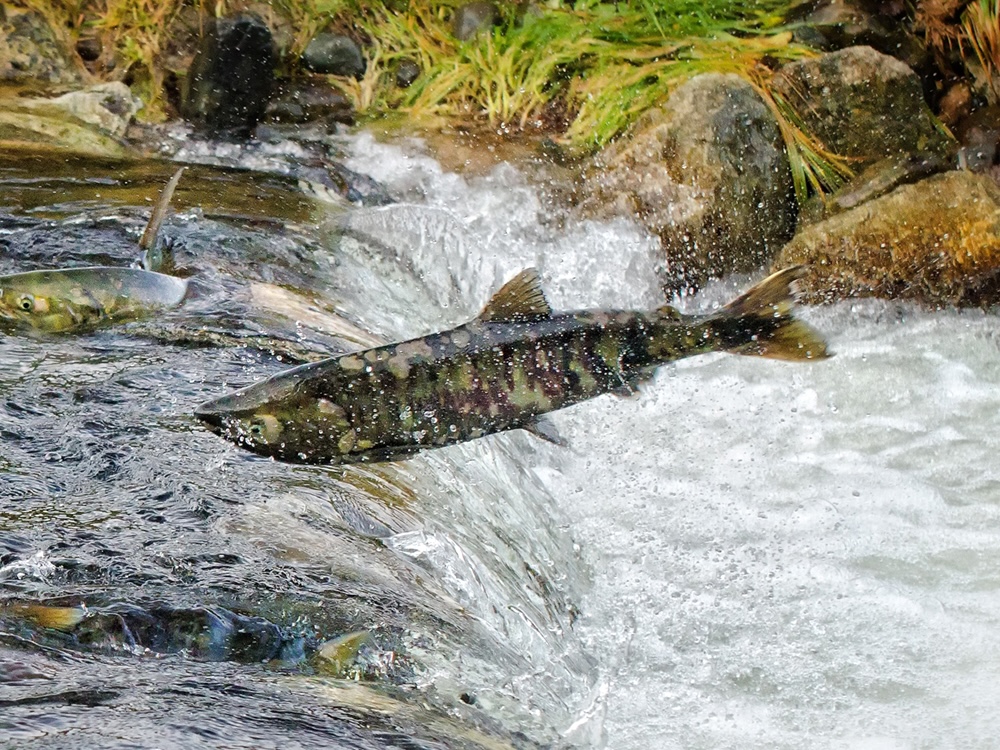
Prime Minister Mark Carney appears to be backing away from Ottawa’s commitment to ban open-net salmon farming in coastal B.C. in 2029.
Bob (Galagame’) Chamberlin, chair of the First Nation Wild Salmon Alliance, told The Tyee that the federal government won’t recommit to the ban and he’s very worried it will be dropped or altered.
“I'm not sure if they're intimately aware of the pushback that’s going to erupt should the ban be tinkered with,” Chamberlin said, pointing out the ban is supported by 130 First Nations in B.C.
The decision to end open-net pen salmon aquaculture in coastal B.C. was made by Justin Trudeau’s Liberal government in 2024, following mounting evidence that parasitic sea lice and diseases from farmed fish were being transferred to wild juvenile salmon along migration routes.
For a story published earlier this week, The Tyee asked Fisheries and Oceans Canada, commonly referred to as DFO, if the government is still committed to the ban or planning to modify it.
DFO referred questions to Innovation, Science and Economic Development Canada, which didn’t answer the questions directly.
After the publication of The Tyee’s initial story, media relations spokesperson Alison Reilander sent an emailed statement saying the federal government is “considering how it can best move sustainable aquaculture forward in British Columbia.”
The government’s unwillingness to recommit to the ban follows lobbying by seven international salmon aquaculture industry groups and individual salmon farming companies that say Atlantic salmon can be farmed sustainably in open-net pens along B.C.’s coast. Atlantic salmon are not native to the west coast.
The three biggest salmon farming companies operating in B.C. — Norway-headquartered Grieg Seafood BC, Mowi Canada West and Cermaq Canada — have reported lobbying the federal government a total of 42 times since Carney took office in March 2025, according to the federal lobbyist registry.
Grieg and Cermaq lobbied to promote the benefits of their salmon farming investments in Canada, while Mowi lobbied about regulatory decisions for B.C.’s salmon farming sector and the transition plan for salmon farming.
Mowi, the world’s largest salmon farming company, has reported lobbying Fisheries Minister Joanne Thompson three times and the Prime Minister’s Office four times since Carney took office, according to the registry.
‘A deeper understanding of the industry and regional economy’
Reilander said the federal government “recognizes the importance of salmon aquaculture for the B.C. economy.”
She pointed to a draft salmon aquaculture transition plan released in September 2024, before Carney was elected. Since then, an interdepartmental task force has conducted more than 120 engagements with First Nations and stakeholders, Reilander said.
“This work has provided a deeper understanding of the industry and regional economy, as well as the diverse views on the transition,” she said, adding the government is reviewing “all of the different perspectives.”
At a press conference last week in Ottawa, Chamberlin and other members of the First Nation Wild Salmon Alliance called on the Carney government to honour its commitment to the ban, warning that continued hesitancy to reaffirm support for the removal of open-net pen farms will undermine reconciliation with Indigenous Peoples.
Chamberlin said the alliance’s repeated requests for a meeting with Carney have been rebuffed. He said he met last fall with Thompson but has been unable to obtain a meeting with Thompson or any other federal minister since then.
At a meeting in Ottawa last week with Sony Perron, a deputy minister with Innovation, Science and Economic Development Canada, Chamberlin asked about a timeline for the publication of a promised report related to the salmon farming transition but didn’t get a direct answer, he said.
“When I read those tea leaves, it tells me that they are not in a position to make the call, and they're the ones that were supposed to be in the lead,” said Chamberlin, who led negotiations to remove most salmon farms from the Broughton Archipelago by 2023.
“It signifies to me that the government’s perspective on this comes and goes with the ebb and flow of tide, and it’s really troubling.”
Disease a risk to wild salmon
The ban means salmon farming companies are expected to transition to closed containment systems or land-based salmon farms, instead of raising fish in open-net pens in sheltered bays in the ocean, where the tide flushes away waste.
But in a letter to Carney, recently released through B.C. freedom of information legislation, international salmon aquaculture industry group executives said that a transition to closed containment salmon farming by 2029 is “simply not feasible” and will result in the collapse of the B.C. salmon farming sector. This claim has been echoed by the BC Salmon Farmers Association.
Will Bugg, an independent post-doctoral researcher who is studying conservation and environmental impacts on wild salmon, told The Tyee he’s concerned Ottawa might allow salmon farming containment systems that are not truly “closed.”
“The whole point or emphasis of banning open culture and moving to a transition to something else was to move the risk associated with this type of farming,” he said.
“It seems that there may be an emphasis to move to types of farming that still allow the transfer of pathogens to wild fish,” he added.
DFO’s definitions of closed containment allow for wiggle room, Bugg pointed out.
For example, while effluent from closed containment salmon farms is expected to be treated, DFO doesn’t provide enough specifics about how that treatment should occur. Bugg said that means effluent “could still have pathogens in it and that still exposes wild fish to risk.”
When farmed fish are kept in high densities in pens it can decrease their immune competency, allowing them to be more easily infected with pathogens that are present in the environment or passed on from other sources, Bugg said.
“Those pathogens can then spill over to populations of wild fish, spill back to domestic or cultured populations, and spread as these fish make their outward marine migration.”
Bugg pointed to multiple studies outlining the risk of a variety of pathogens, including sea lice and Piscine orthoreovirus, which is linked to a host of fish health problems, including hemorrhages in internal organs.
The federal government’s potential retreat from the open-net salmon farming ban comes as Carney focuses on “nation-building” projects — including new mines, pipelines and liquefied natural gas exports — during an ongoing trade war with the United States, as the once amiable relationship between the two countries remains fraught.
Chamberlin said he’d like to see Carney designate wild salmon recovery as a “nation-building” project, a proposal he said is backed by the First Nations Leadership Council in B.C.
Focusing on wild salmon — including fulsome protections and habitat rehabilitation — would reap multiple benefits, including for Aboriginal rights and culture, sports and commercial fishing, and food security, he said.
“Let’s not forget the environment and all the animals that depend on wild salmon as well, who don’t have a voice in this, and the southern resident killer whales,” Chamberlin added.
He said restoration efforts could focus on areas where the ban creates job loss, “and then we could start to begin the long road of recovery for salmon.” ![[Tyee]](/design-article.thetyee.ca/ui/img/yellowblob.png)
Read more: Politics, Environment






Tyee Commenting Guidelines
Please note that email notifications for replies are not currently working due to a software issue which may be resolved in a future update.
Comments that violate guidelines risk being deleted, and violations may result in a temporary or permanent user ban. Maintain the spirit of good conversation to stay in the discussion and be patient with moderators. Comments are reviewed regularly but not in real time.
Do:
Do not: