

 SHARE:
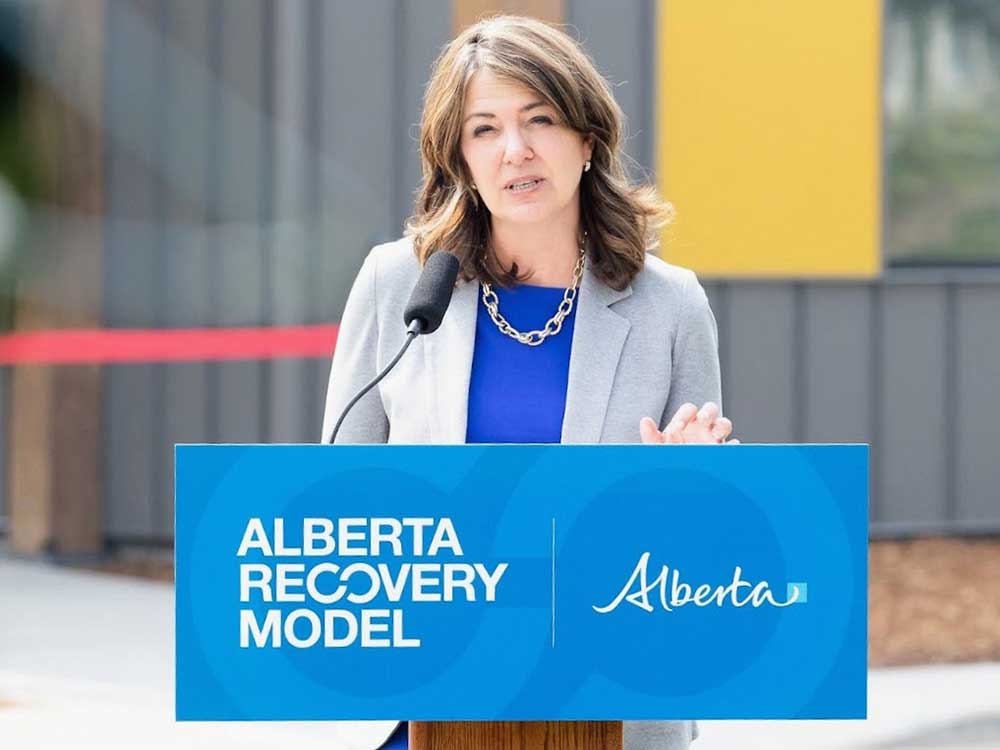
The rollout of recovery centres vital to the Alberta government’s controversial approach to lessening drug addiction and overdoses has hit a roadblock.
A legal dispute between a contractor and Sam Mraiche, the Edmonton multimillionaire at the centre of an ongoing scandal involving Alberta’s ruling United Conservative Party, has stopped work on one of three provincially funded addiction recovery centres and is threatening a work stoppage at a second.
Subcontractors, who have not been paid for months, are blaming the government of Premier Danielle Smith for first failing to provide oversight on more than $100 million of taxpayers’ money and then failing to help resolve the impasse as they struggle to survive.
“This will probably bankrupt us if I don't get paid,” said one Edmonton subcontractor who hasn’t been paid in more than two months. “I'm about a million dollars out so that is a pretty heavy hit.”
Another Edmonton subcontractor told The Tyee she has been owed more than $500,000 since July 2025.
“This shows to me that the government doesn't have our back, that we can’t trust the government.
“We can't trust them with our taxpayers’ money. We can't trust them on a government-funded project.”
Last week, The Tyee published a story, based on voluminous civil court records, that detailed an alleged conspiracy with Mraiche as the supposed “controlling mind.”
It is alleged that more than $11 million was funnelled to Mraiche and his associates from several construction projects, including three recovery centres funded with about $104 million from the UCP government of Premier Smith.
The contractor, Lewis Semashkewich of Melewka Homes, claims he was forced to make payments to Mraiche and others in order to gain the release of funding to pay subcontractors and continue construction on several projects, including addiction recovery centres for the Métis Nation of Alberta and the Enoch Cree and Tsuut’ina First Nations.
Mraiche, his brother-in-law Mike Eldassouki, his accountant Sam Jaber and others named in the court documents have strongly denied all the allegations. They in turn have accused Semashkewich of knowingly making false allegations in order to evade paying his construction debts.
They also alleged that Semashkewich used a forged document to take over Eldassouki’s company and to transfer more than $8 million from his bank account.
None of the many contradictory allegations have been tested in court.
As first reported by the Globe and Mail, the RCMP executed search warrants on business offices belonging to Mraiche, Jaber and former Alberta Health Services procurement chief Jitendra Prasad last week.
The subcontractors learned about the legal dispute only when they read The Tyee story, which was independently sent by their lawyers to each of them. They spoke on condition of anonymity because they fear speaking publicly could jeopardize their chances of being paid what they allege Semashkewich owes them.
Neither Semashkewich nor his lawyer responded to several emails and calls over the past week.
A setback for the ‘Alberta model’
The delayed opening of one recovery centre and possibly two others could mean 225 treatment beds will be unavailable just as the UCP government finishes closing most of the province’s safe consumption sites.
The closures are a main pillar of a major policy initiative by the UCP that shifts the focus from short-term harm reduction aimed at keeping people from overdosing to long-term abstinence-based recovery, including forced treatment in some cases. Critics have assailed the policy shift as overdoses and deaths spiked.
Premier Smith’s former chief of staff, Marshall Smith (no relation), a former addict, has been hailed as the chief architect of what has become known as the “Alberta model.”
He resigned in October 2024 but has maintained a high profile in the ongoing procurement scandal involving Mraiche, in part due to a lawsuit he filed against former Alberta Health Services CEO Athana Mentzelopoulos and the Globe and Mail.
Questions about the three recovery centres were first raised in the legislature by the Alberta NDP in November 2025. In response to those questions, Mental Health and Addiction Minister Rick Wilson said he had tabled documents that he said showed the Métis Nation and First Nations were wholly responsible for the contracting and construction of the recovery centres.
‘You have the responsibility as a government’
On Monday, Progressive Tory Party of Alberta MLA Peter Guthrie again raised the issue in the legislature.
“This government claims once grant funding is issued, procurement decisions are no longer their responsibility, and they wipe their hands clean,” said Guthrie, who defected from the UCP to form his own party.
Seniors and Social Services Minister Jason Nixon fielded Guthrie’s question. He said: “It was up to [First] Nations to determine the location and to determine their construction provider. We are happy to provide that to First Nations and unlike the NDP, we trust our First Nation partners to make the best decisions they can for their people.”
One of the subcontractors, who is owed more than $500,000 on the Métis Nation project, found that response from Nixon to be incredible.
“Do you think a bank would lend millions of dollars to an owner who is building a project and then just say, ‘We're just going to walk away. It's up to you guys now to pay for everything.’
“Of course not. It’s your tax money, it’s my tax money. You can't just say, ‘Oh, we trusted them to do their job, and they didn't.’ It's millions of dollars of our money.
“You have the responsibility as a government to be prudent with our money, and you weren't, and it’s not an excuse to say, ‘Oh, we don't want to disrespect them.’”
Payments said to be six months overdue
The Métis Nation subcontractor said her company and others have not been paid by Semashkewich for invoices issued since July on the Healing Waters Recovery Community project at Métis Crossing, north of Edmonton. Those invoices should have been paid in September. They weren’t, and neither was the next invoice.
She pulled her employees and equipment from the site on Oct. 23, but she said Semashkewich told her that other subcontractors quit the site in early September. As far as she knows, no work has been done on the site since then.
She emailed Wilson, the mental health and addiction minister, but instead received an email from Yvonne Carignan, a senior official within the ministry.
In the email, Carignan tells the subcontractor that “grant payments are subject to the terms of conditions set out in the grant agreement.”
“[Mental Health Alberta] has taken all measures available under the grant agreement with Métis Nation of Alberta regarding the non-payment concerns you have raised and in addition, have requested confirmation of all subcontractor payments from the Métis Nation of Alberta.”
Wilson did not respond to an interview request.
The other subcontractor said he and others on the Tsuut’ina recovery centre project have not been paid for more than two months and have discussed walking off the site if payment isn’t forthcoming.
In an emailed statement, Tsuut’ina Nation Xàkíjí-tii (Chief) Ellery Starlight said: “The recovery centre is a priority for our Nation, and we have paid the contractor, Melewka, substantial funds under the contract.
“Melewka is responsible for paying its own subcontractors from those funds. If subcontractors have not been paid, that is a matter between them and Melewka. We are actively monitoring the situation.”
In a statement provided after publication, a spokesperson for the Enoch Cree said their contractors are being paid, the project is on schedule and is expected to open in June.
The Métis Nation were first contacted for comment on Monday. In an emailed statement late Tuesday, a spokesperson said only that they have paid Semashkewich.
“As I’m sure you can appreciate, these are sensitive matters that are before the courts and which are continuously evolving,” the spokesperson said. He promised to provide more information on Wednesday.
The Métis Nation has not been sued by Semashkewich, but he did sue its senior executive officer, Aaron Barner.
Barner was a director along with Sam Mraiche in Métis Strategic Services Corp., which is named in the court documents.
Both subcontractors told The Tyee that Semashkewich kept promising for months that they would be paid, but he eventually cut off communications and didn’t respond to their emails or calls.
Both found it troubling that they kept working, in good faith, on the projects and were not told of the major dispute playing out in the courts.
“Nobody told us anything, and we were just told, ‘Don't worry, you will get paid,’” said the Métis Nation subcontractor.
“So we kept working. The only reason we finally went off site is because we weren't believing the bullshit anymore.”
She said it wasn’t until she read The Tyee story that she understood what was going on.
“When I read it, then it became crystal clear to me what the problems were. I was like, ‘OK that is why we haven't been paid.’ And I was thinking, ‘That is why everyone has been stonewalling me and not telling the truth.’
“None of us subtrades would have known any of this unless we had read your article.”
A search conducted by The Tyee revealed that her company, and another contractor to which she subcontracts, have filed separate liens totalling more than $1.9 million.
The Tsuut’ina subcontractor doesn’t know what to do because that project is on reserve land, and it’s impossible to file a lien for a project on Indigenous land.
Both subcontractors are angry that they are being made to carry all the cost of their work for months. Like all the trades, they had to order and pay for supplies in advance and pay their employees with no cash flow for months to offset these costs.
The Métis Nation contractor said that even if the impasse over funding is resolved, her company will not go back to work on that project unless they are paid in full.
“The trust is completely destroyed,” she said, adding that she also no longer trusts the UCP government and its leader, Danielle Smith.
“If you're in construction like we are, it is a huge disappointment to know that our leadership would just give away our money for what were worthy projects, and then wash their hands of it when they're not completed and when hard-working Albertans are not paid.
“It is egregious and we just can’t trust leadership that doesn't have the gumption to enforce accountability and to enforce the monitoring of taxpayers’ money to ensure that it is being used in the manner that was intended.
“That shows you have no backbone, and I can't trust you, and you're not a leader, you're a follower.”
If you have any information for this story, or information for another story, please contact Charles Rusnell in confidence via email. ![[Tyee]](/design-article.thetyee.ca/ui/img/yellowblob.png)










Tyee Commenting Guidelines
Please note that email notifications for replies are not currently working due to a software issue which may be resolved in a future update.
Comments that violate guidelines risk being deleted, and violations may result in a temporary or permanent user ban. Maintain the spirit of good conversation to stay in the discussion and be patient with moderators. Comments are reviewed regularly but not in real time.
Do:
Do not: