

 SHARE:
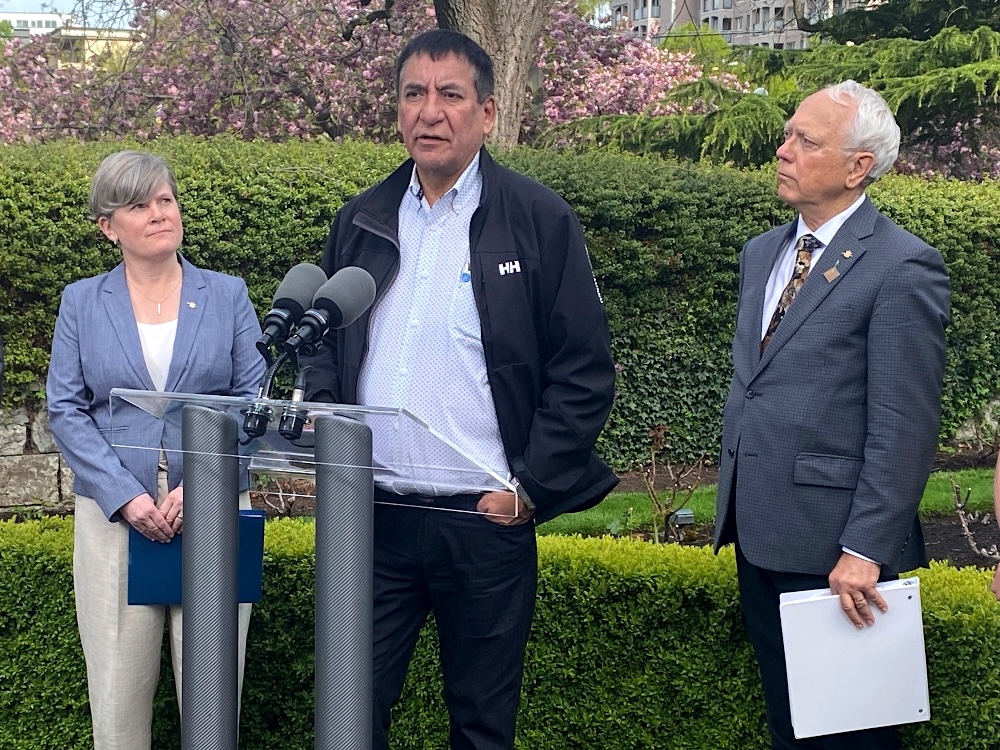
Press conferences held in the Premier’s Rose Garden don’t just happen, especially when more than one provincial cabinet member and a special guest are involved.
Ministers receive press release drafts and background materials and are carefully briefed by staff on who they will share the stage with. So plenty of planning preceded May 3, 2023, the day three ministers joined McLeod Lake Indian Band Chief Harley Chingee to announce a new revenue-sharing and land management agreement between the province and the northern B.C. band.
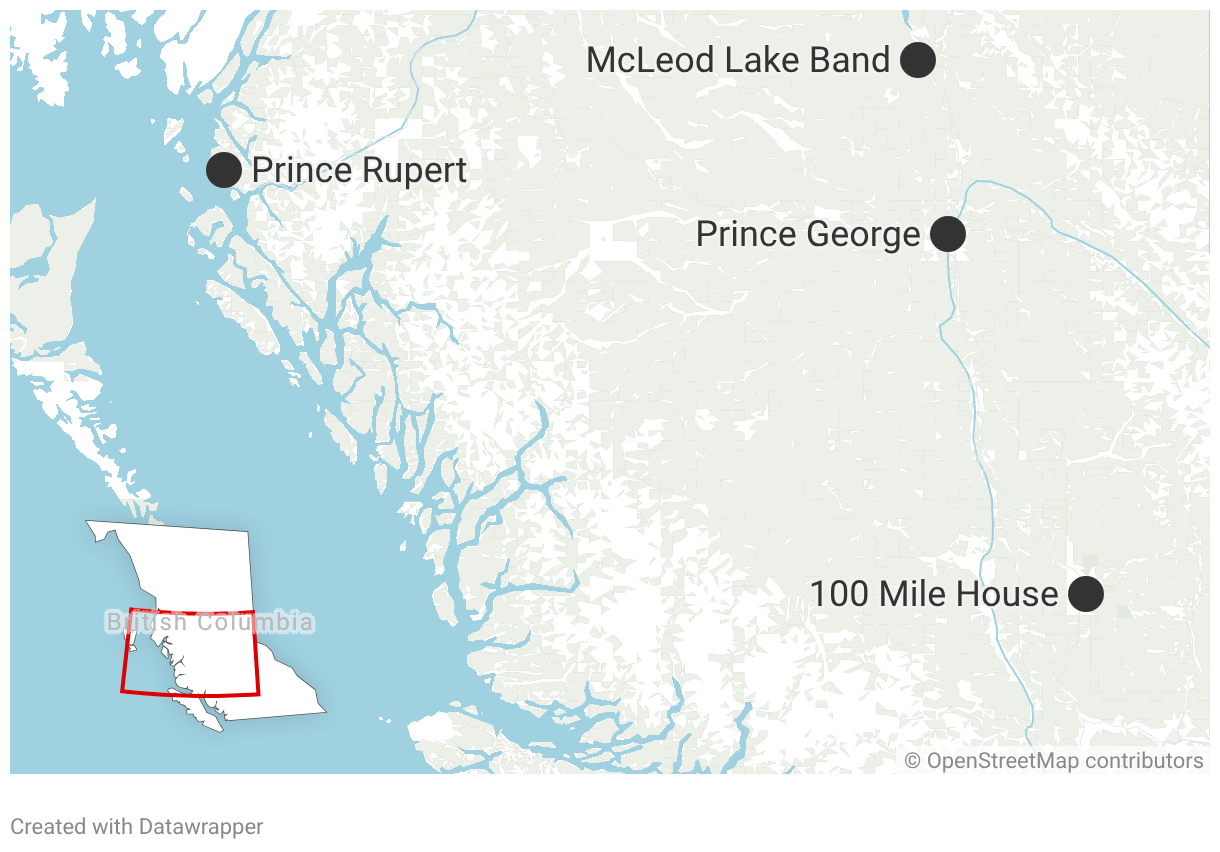
Even more cabinet ministers — five — were quoted in an accompanying press release that spoke of a new “multi-year shared restoration fund to help heal the land,” with spending decisions to be made by the elected leaders of the 590-member band, whose main reserve and treaty lands are located a 90-minute drive north of Prince George.
Not disclosed during the joint announcement was a fast-approaching and consequential day for McLeod Lake Indian Band members. One month later, they would vote for a new Chief and council, and Chingee was once again running for the top job.
With the Chief now embroiled in a dispute with the band’s elected councillors and racking up six-figure annual expense totals, critics say the proximity of the press conference to the election amounted to an endorsement of Chingee at the expense of other candidates seeking the band’s top job.
In an email, a provincial spokesperson said the timing of such conferences is determined by “a range of factors” and considered on a “case-by-case basis.”
A fast-approaching election
Chingee hailed the signing of the 2023 agreement, saying that it would “benefit our present members” and “ensure that future generations will inherit more prosperous and healthy land.”
His enthusiasm was echoed by government ministers.
“Together with Chief Chingee and McLeod Lake Indian Band, we will make shared decisions on the land that ensure all Nation members can meaningfully exercise their Treaty Rights, while building a healthy and prosperous future for everyone,” said Nathan Cullen, then-minister of water, land and resource stewardship. Soon after, Cullen posted a photo of the event on his Instagram account.
Days later, photos of Chingee at the press conference with the cabinet members appeared in the Chief’s new campaign brochure, a document that included other photos of him posing with Premier David Eby, former Alberta premier Jason Kenney and then-prime minister Justin Trudeau.
Accompanying the photos was a list of Chingee’s campaign promises, the first of which was to give each eligible McLeod Lake Indian Band member a cheque for $15,000 within 45 days of his re-election. Chingee promised a further $10,000 would be paid to all band members in December.
As detailed previously by The Tyee, Chingee’s promises fit a pattern. After his predecessor, Frank Orr, was re-elected in 2014, more than $11 million was distributed to band members. In 2017, when Chingee was elected to succeed Orr, $12 million in cash was disbursed.
The Premier’s Rose Garden press conference received a smattering of coverage from non-Indigenous media and was soon forgotten. But it was another matter in the tiny community of McLeod Lake, where Chingee’s campaign materials circulated, and on the internet among the diaspora of off-reserve McLeod Lake members.
After the window for casting ballots closed on June 2 that year, Harley Chingee received 110 of the 275 votes cast, winning re-election. Between them, his two closest rivals, Eureka Carty and Tania Solonas, received 142 votes.
A subtle or not-so-subtle endorsement
The Tyee spoke to multiple people who said the press conference gave Chingee a leg up on his campaign rivals.
“That’s very unfair,” band member Kandy Stout told The Tyee when she learned of a press conference being held so close to the band’s election date. “There’s going to be people that are going to be swayed in how they vote by that alone. That takes away from our right to vote without outside interference.”
The Tyee received no response to repeated questions sent to Chingee and the McLeod Lake Indian Band.
Mike Morris, the region’s former MLA, said he was disturbed by the event’s timing. Morris, a former cabinet minister who represented the sprawling Prince George-Mackenzie riding as a BC Liberal from 2013 to 2024, told The Tyee that the timing of the announcement and the attendance by three ministers can be read as the provincial government endorsing Chingee for re-election.
Morris said it was not plausible that the ministers and their advisers didn’t know that Chingee was standing for election and that the election was so close at hand.
“Ministry communications staff would have been aware of that,” Morris told The Tyee. “I would find it shocking that they didn’t appraise the ministers involved, particularly with that government’s propensity for liaising closely with First Nations.”
Putting so much provincial government horsepower into a press conference a month before the band election date sent a signal, Morris said.
“Subtle or not, it was an endorsement of the Chief at the expense of the other candidates,” he said.
Morris and others say provincial governments should refrain from making any announcements in the lead-up to or during band elections.
Robert Dudoward, who was an elected member of the Skidegate Band Council on Haida Gwaii and also served a four-year term on the Council of the Haida Nation, said he favours a blackout period of at least three months, during which provincial and federal governments would refrain from announcements that could be seen to favour one candidate over another.
Dudoward did not want to comment on specifics of the last McLeod Lake band election but said that when provincial or federal politicians make joint announcements with First Nations leaders in the lead-up to a band election, they create “a very unfair playing field for anyone challenging the incumbent.”
Dudoward said it doesn’t take much to tilt outcomes in band elections involving small numbers of voters where the margins between elected and defeated candidates can often be very close.
“There should be no interference federally and absolutely no interference provincially in the lead-up, because that will influence the outcomes in our minuscule tribes,” Dudoward told The Tyee.
One recent example occurred in Fort Nelson First Nation’s 2022 election, in which just five votes separated the three candidates who received the fifth-, sixth- and seventh-most votes from the candidate who finished eighth and fell just short of winning a seat.
‘It’s their MO’
First Nations elections rarely receive press coverage. But Pehcheh, a Dene Elder and Fort Nelson First Nation band member, says provincial and federal governments know that much may be at stake in such elections — particularly in regions where pending energy, mining, logging and hydro developments may be delayed or expedited depending on which candidates are elected.
In such an environment, Pehcheh said, provincial and federal governments see it to their advantage to subtly or not so subtly show their support for particular candidates who are deemed friendly to provincial government and industrial resource development agendas.
“It’s their MO [modus operandi] through and through — both the feds and the province,” Pehcheh said.
The McLeod Lake Indian Band has long-established resource sector businesses focused on logging, road building, pipelines and other projects like mining wastewater reclamation in the province. The projects have resulted in large contracts being awarded to band-owned businesses while also helping move related and sometimes controversial projects to completion.
The band was among the earliest beneficiaries of direct-award contracts — contracts where no bids are made and no competing bids assessed — at the Site C dam construction project. That project was the subject of legal opposition by the West Moberly First Nations throughout almost the entirety of its nine-year construction.
McLeod Lake Indian Band-owned businesses also worked on the Coastal GasLink pipeline, a project that was also fought by Wet’suwet’en hereditary leaders but actively promoted by the provincial NDP and BC Liberal governments.
This allowed the B.C. government to claim that First Nations supported projects even while some First Nations leaders were adamantly opposed to them.
Silence from government
The Tyee emailed questions to all three ministries involved in the 2023 press conference, asking whether they had guidelines for ministers participating in events during or immediately before First Nations elections, whether communications staff briefed the ministers on the upcoming election and whether the ministers felt it appropriate to hold the press conference when they did.
An emailed response from the Ministry of Indigenous Relations and Reconciliation did not directly address many of the questions but said that the B.C. government had “worked with McLeod Lake for several months” prior to holding the press conference.
“The timing of these announcements is determined by a range of factors, including relevance to the community, contractual obligations, and co-ordination with third-party partners,” the response continued. “Each announcement is considered individually to support effective communication and public awareness.”
In a separate email on behalf of all three ministries, a provincial government official wrote that “decisions about interactions with other governments — whether First Nations or municipal — in the lead-up to their election periods are made on a case-by-case basis.”
The Tyee contacted a number of First Nations leaders, including university law and political science professors, a Chief with a leading First Nations umbrella organization, one former and one current First Nations Chief, and a former MLA and First Nations member. All declined to comment on the record.
The Tyee received no response to repeated questions sent to Chingee and the McLeod Lake Indian Band. ![[Tyee]](/design-article.thetyee.ca/ui/img/yellowblob.png)
Read more: Indigenous, BC Politics






Tyee Commenting Guidelines
Please note that email notifications for replies are not currently working due to a software issue which may be resolved in a future update.
Comments that violate guidelines risk being deleted, and violations may result in a temporary or permanent user ban. Maintain the spirit of good conversation to stay in the discussion and be patient with moderators. Comments are reviewed regularly but not in real time.
Do:
Do not: