


 SHARE:
[Editor’s note: The writer of this article was present as a reporter during the April 5, 2023, decampment on Hastings Street and testified to BC’s Office of the Human Rights Commissioner during its inquiry.]
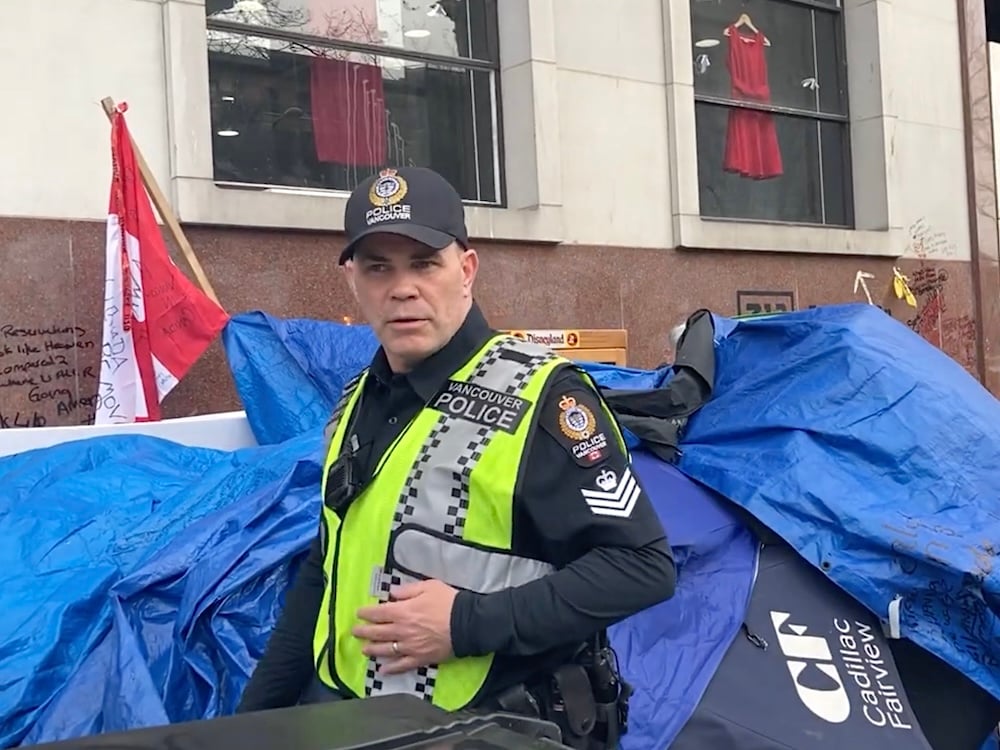
An inquiry by B.C.’s Office of the Human Rights Commissioner has found that news media faced numerous problems accessing the scene of a decampment operation on April 5 and 6 in 2023, despite the Vancouver Police Department’s continued claim that there were no restrictions.
The actions police took to bar media from entering a two-block stretch of East Hastings Street during the forced removal of numerous tents set up by homeless people was “not in accordance with human rights standards,” the inquiry’s final report found. That in turn affected the rights of the vulnerable unhoused people living in the encampment, the report found.
“Human rights advocates and the press must be permitted to work without unreasonable interference, to gather and distribute information about incidents of forced eviction in order to protect the rights of unhoused people,” Kasari Govender, B.C.’s current human rights commissioner, said during a Wednesday press conference.
“As noted by one resident after his belongings were destroyed during an encampment eviction in Prince George, he said: ‘I want the court in this city to know we are people and we exist. We just want to survive and be treated like human beings.’”
In response to a request for comment from The Tyee, Vancouver Police Department spokesperson Steve Addison said the department disputes the conclusions of the human rights commissioner’s report.
“We disagree with the suggestion that media was banned or excluded from the Hastings Street decampment. We have concerns with how the human rights commissioner has characterized our actions,” said Addison, who handled media relations for the VPD during the 2023 decampment operation.
“Truth is, we wanted media present during the decampment. We went to significant lengths to ensure media could observe the process taking place so they could report on it accurately,” he told The Tyee in an email.
In a joint statement, the City of Vancouver and the VPD repeated the assertion that they disagreed with the human rights commissioner’s conclusion that a media exclusion zone was in place.
“The City proceeded with bringing the encampment to a close due to significant and intensifying worker and public safety concerns,” the statement says. “To ensure worker and public safety, the City requested VPD support to manage access to the active work area.”
“Media were invited and permitted inside, with a dedicated VPD liaison on site at the safe work zone perimeter to facilitate media entry and respond to questions. While a managed perimeter was in place for safety, equating managed access with exclusion remains inaccurate.”
However, after interviewing police representatives, city staff and 10 journalists who reported or attempted to report on the operation, Office of the Human Rights Commissioner staff concluded that at least eight journalists had experienced some sort of problem or delay getting access to the decampment work zone on April 5, and two journalists were turned away by police on April 6, when decampment work continued.
The report said Office of the Human Rights Commissioner staff also reviewed video, social media posts and the journalists’ published news reporting to make this conclusion.
The city and the VPD also said media were restricted to maintain the privacy of the homeless residents who were being evicted.
The human rights commissioner’s report described that explanation as “ironic,” given that city staff and police were engaged in dismantling unhoused people’s tents.
“The City and VPD had themselves chosen to engage in high-profile interference with the privacy of encampment residents by implementing the decampment, which forcibly removed people from their homes,” according to the report.
A senior Vancouver Police Department officer told the inquiry that “reputational risk” to the city, police department and provincial government was also a factor in decisions about restricting media access.
The report found that the Vancouver Police Board erred when it swiftly dismissed a complaint about the media exclusion zone in place on the day the operation started.
Although the Office of the Police Complaint Commissioner had recommended that the police board “obtain independent advice in addressing this complaint distinct from the VPD,” the board opted to dismiss the complaint after hearing an explanation from VPD Supt. Don Chapman that no media exclusion zone had been in place.
“I found that the investigator assigned to investigate the complaint was not sufficiently independent, because that investigator was also the Gold Commander with overall operational responsibility for the decampment,” Govender said.
“The complaint was not adequately investigated and considered by the VPD and the Vancouver Police Board due to insufficiencies in this investigative process. The board is required to follow fair administrative processes, which it did not do in the investigation of this complaint and some of the process for ensuring oversight was significantly compromised.”
The Tyee has reached out to the police board for comment. You can read more details of what The Tyee experienced when trying to report on the decampment in this Nov. 27, 2023, report.
The human rights commissioner report says the provincial government should rewrite its laws and regulations to clearly protect the right of journalists to report on police enforcement activities.
The commissioner wants police to stop using “exclusion zones” to bar the media from areas where officers are undertaking enforcement activities, unless they have judicial permission or are facing an immediate public safety threat.
And with police forces continuing to restrict media access despite legal rulings calling the practice unconstitutional, the commissioner is asking the province to restrict the practice, while also asking for more education for frontline officers.
After presenting her recommendations to the provincial government, B.C. municipalities, the VPD and the City of Vancouver, Govender said numerous municipalities have indicated they intend to follow her recommendation to “immediately cease excluding or restricting media access around police action” without an order from a judge or a “credible and substantial” threat to public safety.
However, the VPD and City of Vancouver have indicated they will not follow the recommendation, Govender said.
The Tyee has reached out to the Ministry of Public Safety and will update this story when we receive their response.
With files from Tyler Olsen. ![[Tyee]](/design-article.thetyee.ca/ui/img/yellowblob.png)
Read more: Rights + Justice, Media









Notice about commenting changes
The Tyee’s commenting system will be moving to a new platform on Nov. 12. If you’re already a Tyee commenter you must register with the new system on or after Nov. 12 with your preferred username.More information can be found here.