


 SHARE:
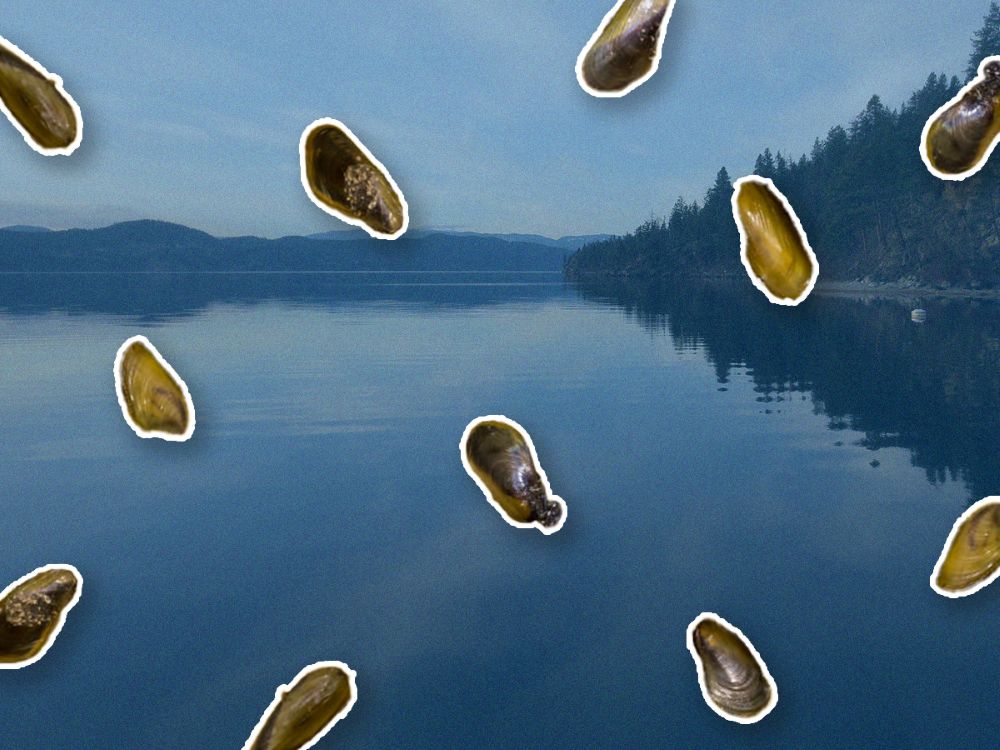
While Canada’s military has been planning for the threat of an American incursion, officials in the Okanagan are warning about the possibility of another invasion — one involving a particularly ravenous type of shellfish.
Invasive mussels are “like the pine beetle of the water” and pose a billion-dollar threat to British Columbia, according to Okanagan Basin Water Board chief operating officer James Littley. And now B.C. is grappling with a new threat — the golden mussel — that could put even more lakes at risk.
The mussels ravage ecosystems, clog pipes, concentrate toxins, corrode man-made surfaces and leave razor sharp shells on beloved beaches. And once they get into a lake, they are almost impossible to extinguish.
“These mussels are forever,” Littley told The Tyee.
Lake Country Mayor Blair Ireland, who chairs the Okanagan Basin Water Board, has recently dispatched letters to the provincial and federal governments warning that time is running out to prevent rampaging mussels from reaching British Columbia’s lakes.
Ireland is suggesting increased enforcement activity this coming summer.
The province told The Tyee it recognizes the mussel threat and will continue to fund watercraft inspection sites. But it says there’s a need to manage a budget in a “fiscally conservative” manner — meaning it doesn’t have the resources to implement further steps, such as barring recreational boats from high-risk regions.
Meanwhile, the Okanagan Basin Water Board’s letter says the federal government’s participation has been “negligible,” and the province told The Tyee it wants Ottawa to resume paying for mussel enforcement at the border.
The federal government has responded by citing its funding for aquatic invasive species defence and research.
Mussel threat
Western North America is fighting a two-front mussel battle against three different species of shellfish.
Officials, inspectors, and conservationists have been on the lookout for zebra and quagga mussels for years, but the recent detection of golden mussels in California has intensified the risks.
All three types of mussels pose a threat to native plants and animals, and to the critical human infrastructure that communities depend upon.
While native mussel species can be critical for the health of a waterbody, removing toxins and improving water quality, invasive species often do more harm than good. They accumulate in such great numbers as to strip a lake of the food that native aquatic species depend on. And clearer water, taken to the extreme, can cause aquatic vegetation to blossom, which in turn can lead toxic algae blooms. Those blooms bring a range of consequences, including the spread of avian botulism that can kill migrating birds.
Unlike B.C.’s home-grown mussels, which are relatively large and can’t cling to hard surfaces, the invasive species can also latch on to docks, bridges, boats, water pumps and other man-made objects and surfaces. They clog billion-dollar pipes and water systems, corrode surfaces, gunk up boat motors and bog down marine vessels.
All three invasive mussels typically spread from lake to lake by hitching rides on boats or other human vehicles. They can then colonize lakes at an astonishing speed, with a single mussel laying up to a million eggs. If mussels were to make it to British Columbia’s beloved lakes, the B.C. government has warned the costs would be enormous, potentially exceeding $100 million annually.
Having gained an eastern foothold in the Great Lakes nearly 40 years ago, zebra mussels have slowly spread through lakes and water systems, consuming food that would otherwise support native lake species and damaging human infrastructure.
The major Canadian front in the zebra mussel battle has been in Manitoba, where — as The Tyee reported in 2024 — the mussels have spread to some of the province’s most beloved lakes.
Golden mussels could be even worse because they can live in a wider range of lakes, Littley told The Tyee.
He and other officials have been closely watching B.C.’s southern border since the mussels were detected in California in 2024. They have since been found across a wide area between Los Angeles and San Francisco. In June, a golden mussel was detected on a boat that was trying to enter Lake Tahoe in Nevada, raising concerns that the legendary American lake could be vulnerable to the invasive shellfish.
The mussels are native to Asia and can easily acclimatize to new environments. After being introduced in Argentina in 1991, they “moved upstream at a rate of 250 kilometres per year,” according to a B.C. government fact sheet.
The province has estimated that a full-blown zebra and quagga mussel invasion could cost the province between $64 and $129 million every year. The majority of the costs would come from mitigating the impact of mussels on hydro, water supply and irrigation infrastructure. A decade ago, officials in Ontario estimated they were spending up to $91 million each year on zebra mussel impacts.
“They’re kind of the ultimate invasive species,” Littley said. “Once it’s here, there’s no way to get rid of it. It’s an economic, ecological and social disaster.”
To reduce the spread of mussels and other invasive species, British Columbia and other jurisdictions operate checkpoints to inspect boats being transported.
Over the last decade, inspectors with B.C.’s Invasive Mussel Defense Program have inspected more than 300,000 watercraft and found 176 “mussel-fouled” boats, according to an email from the Ministry of Water, Land and Resource Stewardship.
Last year, inspectors found mussels on five watercraft from Ontario and another boat from North Dakota. The Invasive Mussel Defense Program spent $3.6 million last year. The province provided a little more than half the money, with conservation groups, BC Hydro and the federal government also providing funding.
Call to ramp up efforts in the Okanagan
In the Okanagan, where thousands of boats come and go each year, officials say more needs to be done.
In November, the Okanagan Basin Water Board dispatched letters to federal Fisheries Minister Joanne Thompson and provincial Water, Land and Resource Stewardship Minister Randene Neill, asking both to scale up their respective efforts.
The letter to Neill was mostly appreciative of the province’s recent moves, which include amendments to the Wildlife Act to provide new prevention tools. But it also called on the province to “move swiftly” to increase enforcement, make inspections mandatory, and provide staffing and money to allow for enforcement. The Okanagan Basin Water Board said the province should institute a “pilot region” this summer where ramped-up enforcement could be trialed.
But all that would cost more money, and in a statement to The Tyee, the Ministry of Water, Land and Resource Stewardship said budget constraints limit its ability to implement a pilot program.
In a statement to The Tyee, a ministry spokesperson noted that the Wildlife Act enabled the mandatory inspections, but that “further analysis and consultation is required to identify potential options for future implementation.”
“A regional pilot may be considered but timelines for implementation would need to be balanced against the continued delivery of [Invasive Mussel Defense Program] operations in a fiscally conservative context.”
Similarly, the province also suggested it won’t be able to meet the Okanagan Basin Water Board’s call to adopt interim safeguards that could prevent boats from importing mussels to British Columbia. Other jurisdictions have banned watercraft from high-risk locations, but the province says doing so in B.C. would both require co-operation across jurisdictional lines and, again, be too expensive.
“Significant investments would need to be made to increase outreach to educate boaters on the new requirements,” the ministry’s statement said. “For this coming year, with its projected fiscal constraints, it will be important to keep resources focused on [Invasive Mussel Defense Program] operations and assessing options for mandatory inspection prior to launch.”
As for the federal government, Okanagan Basin Water Board Chair Blair Ireland wrote that while the province has been helpful, “federal participation has been negligible — despite the clear national implications of a mussel invasion.”
Ireland wrote in his letter to the federal government that invasive mussel prevention is a national, not a provincial, issue, because it relates directly to watercraft crossing international borders.
Ireland asked the federal government to match provincial spending on mussel defence, update its risk mapping to include golden mussels, and provide annual progress reports on its work and enforcement issues. He also asked the federal government to pay $200,000 toward a new mussel detection tool proposed by Okanagan researchers.
The Okanagan Basin Water Board has committed to giving $200,000 to researchers at UBC Okanagan to develop a tool that scientists say would allow inspectors to quickly detect mussel DNA on boats. But the project needs another $200,000 from another level of government, and Ireland would like Ottawa to ante up.
“This work represents the kind of innovation that federal science agencies should be championing and scaling nationally,” he wrote.
In an email to The Tyee, a spokesperson from Fisheries and Oceans Canada didn’t directly address the Okanagan Basin Water Board’s calls to action, but pointed to a variety of ways the federal government provides funding for invasive species issues. That included the “more than $475,000” it provided to the Invasive Mussel Defense Program between 2023 and 2025.
Asked about the province’s call for Ottawa to recommit to mussel defence work at the U.S. border, a federal government spokesperson wrote that DFO officers had “conducted border-adjacent roadside watercraft inspections” over the last two summers and will do so again next year.
For officials in the Okanagan, any money spent on prevention is worth the expense.
This summer, watercraft inspection stations will again pop up on B.C.’s highways to monitor potential boats that could be inadvertently smuggling the mussels into the province’s lakes. It’s unglamorous and costly work, but Littley and his colleagues say more is needed
“Anything we spend on them is a drop in the bucket compared to what it’s going to cost us if the mussels get in.”
If you have a story tip, contact reporter Tyler Olsen in confidence via email. ![[Tyee]](/design-article.thetyee.ca/ui/img/yellowblob.png)
Read more: Environment












Notice about commenting changes
The Tyee’s commenting system will be moving to a new platform on Nov. 12. If you’re already a Tyee commenter you must register with the new system on or after Nov. 12 with your preferred username.More information can be found here.