


 SHARE:
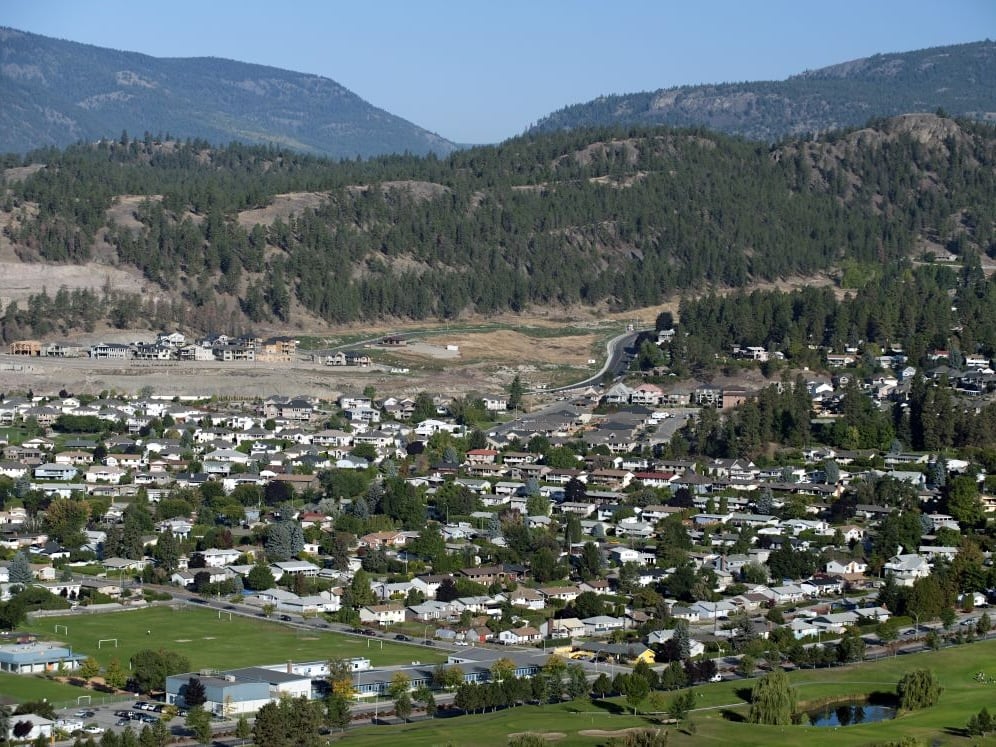
When the city of Oliver tested 83 homes for radon exposure last October, 57 per cent of the houses exceeded Health Canada’s safety guidelines. That’s seven times the provincial average.
B.C.’s Interior has Canada’s highest levels of radon, a naturally occurring radioactive gas that kills an estimated 3,200 Canadians annually.
But unlike homeowners in Saskatchewan or Manitoba, where provincially funded relief exists, Interior residents must pay out of pocket.
What is radon?
Radon is a colourless and odourless gas that is released as naturally occurring uranium in soil and rock breaks down. Outdoors, it dissipates harmlessly. In an enclosed space like a home, radon can accumulate to dangerous levels. Lifetime cancer risk from long-term high radon exposure is one in 20 for non-smokers, according to Health Canada. That rate jumps to one in three for lifelong smokers. And because it can be neither seen nor smelled, the only way for homeowners to know if they are at risk is by testing.
Several provinces offer tax credits or financing programs to assist homeowners with radon testing and mitigation. Homeowners in Saskatchewan can claim a provincial tax credit. In Manitoba, interest-free loans are available to spread the cost. Several Quebec municipalities fund subsidies for radon-related renovations.
B.C. offers none of the above, even though one-third of homes across the Interior test above the threshold at which mitigation actions are recommended. Why is a known cause for lung cancer not backed by stronger government support?
The answer, experts say, comes down to geography, politics and priorities.

In search of a champion
Unlike in other provinces with more uniformly elevated radon levels, B.C.’s exposure is uneven.
This could weaken efforts to build provincewide political momentum for residential testing and mitigation, says Aaron Goodarzi, a University of Calgary scientist who led a massive countrywide study on radon.
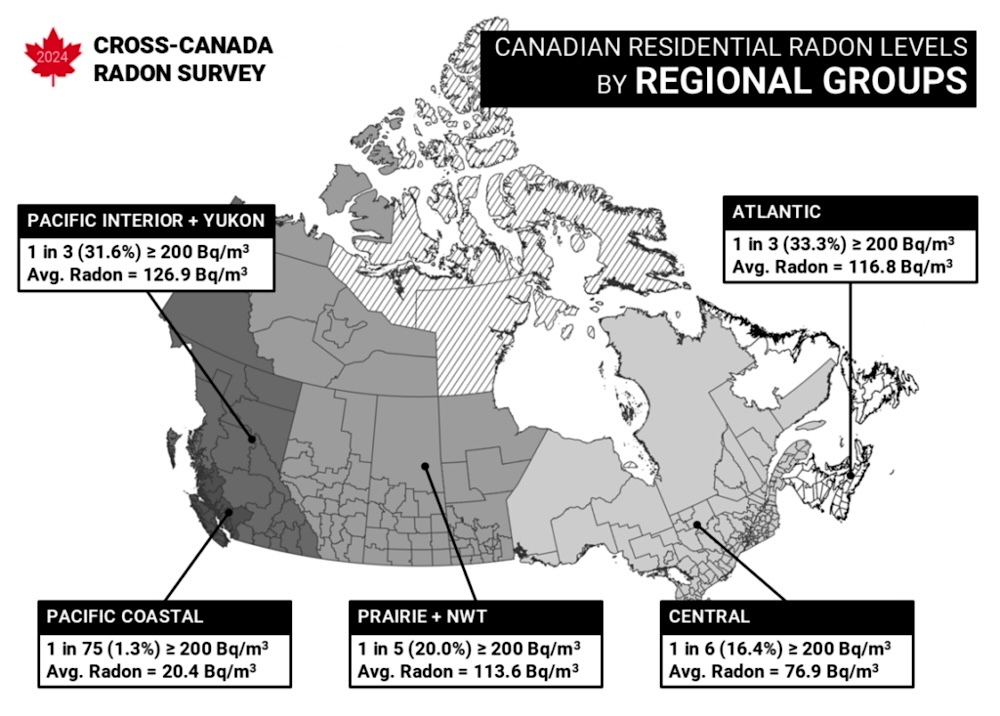
The Evict Radon National Study analyzed nearly 70,000 radon test results for its 2024 report. According to the study, radon concentrations in B.C. are significantly lower in coastal regions compared with the interior and north of the province.
The project involves university researchers across the country and is funded by organizations including Health Canada and the Canadian Cancer Society.
When it comes to funding, Goodarzi said, “it takes a champion.” He pointed to New Brunswick, where legislators this year funded radon tests for every household after years of advocating from the non-profit NB Lung.
In B.C., Interior Health air quality specialist Greg Baytalan secured funding in 2017 to require radon testing for child-care facilities in the province. Anne-Marie Nicol of the BC Centre for Disease Control pioneered her own initiative, giving out radon test kits to residents in Vancouver’s North Shore and Sea-to-Sky regions.
However, the B.C. Ministry of Health offers no financial aid for homeowners — neither for testing nor for mitigation. The ministry says it previously provided funding to the BC Lung Foundation’s RadonAware initiative, to raise awareness of risks and improve testing and mitigation efforts, but that support ended in 2017.
When asked why it does not offer direct funding for mitigation, the ministry said it is “responsible for ensuring that public dollars are spent where they will have the most value for the health-care system.” It added that this includes working closely with other government agencies and community partners to leverage existing services and minimize duplication.
When asked about the potential for future funding, the ministry replied that it is unable to forecast funding plans beyond the 2025 fiscal year at this time.
Radon test kit loans don’t last long enough
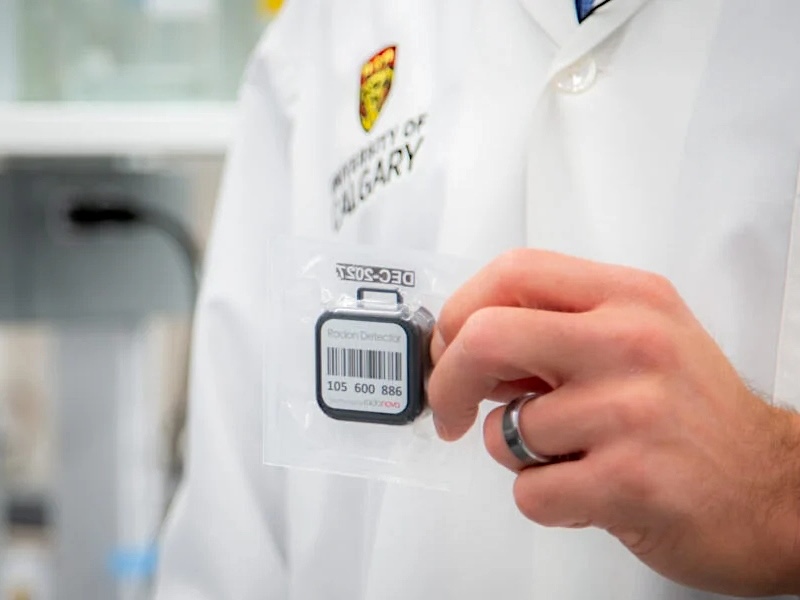
Test kits can cost between $50 and $200. With no provincial government funding for testing, non-profits like the BC Lung Foundation have stepped in to provide support. BC Lung offers free radon test kits at dozens of public libraries provincewide. But loans last just four weeks, and Health Canada recommends at least three months of testing to ensure reliable results.
Take Action on Radon, a Health Canada-funded campaign, runs an annual “100 Radon Test Kit Challenge” that allows some communities to register for free test kits.
According to the program’s website, test kits are still available in several B.C. communities, including in the Regional District of Okanagan-Similkameen, the Regional District of Central Okanagan, Penticton, Osoyoos and Creston. Supplies in each location are limited and offered on a first-come, first-served basis.
Identifying a radon problem is only the beginning. For households with elevated exposure levels, mitigation can cost thousands.
British Columbians with household incomes below $102,500 can apply for a Canadian Lung Association grant of up to $1,500 towards radon mitigation renovations. To qualify, applicants need long-term test results from at least 90 days showing radon levels above 200 becquerels per cubic metre. (A becquerel is a unit used to count the quantities of radioactive substances.)
The Evict Radon National Study found that of thousands of Canadians who had run radon tests, one-third of respondents had elevated levels but didn't take further action because they couldn't afford to.
Who’s most at risk?
The Interior’s elevated radon levels are largely due to its geology. B.C. has five tectonic belts — long, narrow zones where tectonic plates have previously collided with one another to form the province’s array of mountain ranges. The easternmost belts contain more uranium deposits, and therefore more radon.
Nelson, Kelowna, Prince George, Vernon, Penticton and Trail are among the B.C. towns and cities where at least one-quarter of residents have radon at or above Health Canada’s action threshold, Goodarzi’s research suggests.
Goodarzi and his team found rural communities face higher exposure than urban areas, but not just because of the soil. He attributes higher levels to rural communities’ reliance on groundwater wells, enabling radon to reach the surface faster.
New homes also have the highest occurring radon levels, according to Goodarzi.
Newer energy-efficient homes are built with tight seals that keep heat in but inadvertently also trap radon. Older, draftier homes can have better natural ventilation, allowing the gas to escape. But Goodarzi says renovations of older houses sometimes increased their radon hazards.
Detecting the risk
The only way for a person to know if they have a radon problem is to test. Andrew Arshinoff, who owns a Calgary-based radon testing and mitigation company and frequently works with B.C. homeowners, says alpha track detectors are the best option. He suggests homeowners buy tests through Goodarzi’s study so their results can help improve Canadian data sets. They cost about $50 and include a return shipping envelope for laboratory analysis.
The device, which sometimes resembles a hockey puck, should sit in the basement or at the home’s lowest level for at least 90 days. Long-term testing is key as radon levels fluctuate, rising in winter when windows stay closed and falling in summer when homes are better ventilated.
Digital radon meters that don’t require lab analysis are an option too, but Goodarzi cautions that buyers should first check the Canadian National Radon Proficiency Program's approved list.
Arshinoff warned that many radon detection kits sold through Amazon have been recalled by Health Canada.
Health Canada recommends taking mitigation action within one year if testing shows average radon levels above the threshold of 200 becquerels per cubic metre. Theoretically, that process should be less expensive for newer homes — though Arshinoff says that’s no guarantee.
Not up to code
Since 2012, the BC Building Code has required that new homes in certain regions be built with radon “rough-ins.” A rough-in is essentially a vent pipe built from the floor that makes it easier to add a full radon mitigation system later down the line, if needed.
Hundreds of cities and towns were included in that initial code, including Abbotsford, Castlegar, Cranbrook, Kelowna, Penticton and Smithers.
In March 2024, the code was adapted to require rough-ins across the province. But a building code won’t guarantee change by itself. Training contractors, disseminating updates and auditing compliance all present challenges, particularly in smaller municipalities.
Arshinoff says he often sees homes that should have rough-ins, but don’t. Even when they are built, Arshinoff says, they’re usually built wrong.
The systems don’t do much on their own anyway.
“It is the same as if somebody pre-wires your house for an alarm system,” Arshinoff said. “In itself, it's not doing anything unless you activate it.”
Reducing radon risk
There’s no one-size-fits-all solution for those who discover radon at home. But Arshinoff says that “every home or building can be fixed.”
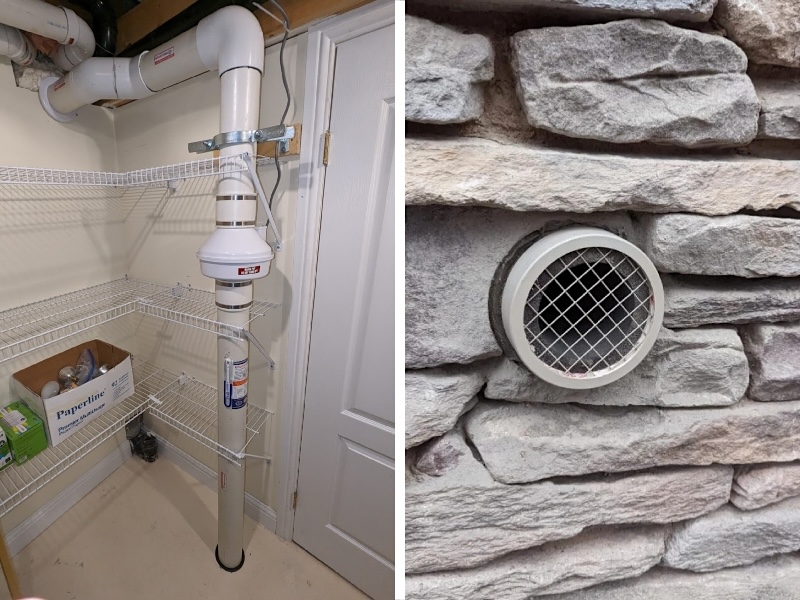
The most common mitigation system begins with a radon expert drilling small test holes at strategic points in the basement floor, then using pressure gauges to determine how air moves beneath the home. The process identifies the best spots to intercept radon before it seeps inside.
Next comes the actual installation — drilling a larger hole, installing a pipe and mounting a fan that creates gentle suction below the foundation. The pipe vents radon outside, typically through the roof.
But systems vary depending on the house and the composition of the ground below.
“We have to design the system as we go,” Arshinoff said.
In a newer home with gravel beneath the foundation and a rough-in pipe already installed, the job can take just one day and cost about $1,500.
For those eligible, the Canadian Lung Association grant could cover those costs.
In older, complex or non-compliant homes, mitigation efforts can cost several thousand dollars.
Mike’s story
Mike Lowther, a retired pilot, bought his Vernon home with his wife in 2020. Their home, which was built in 2008 prior to any rough-in requirements, fell on the complex end of the spectrum for radon jobs.
Lowther had good reason to be concerned about his radon exposure.
“I spent my career flying airplanes at 40,000 feet, and radiation doubles every 6,000 feet,” he explained. “Every time I went to work, I was getting a chest X-ray on average.”
Radon gas is the largest source of natural radiation for most people, because radon itself is a radioactive gas from uranium decay.
After testing with an alpha track detector, Lowther discovered his radon levels peaked at 300 becquerels per cubic metre — 50 per cent above Health Canada's guidelines. His annual average was below Health Canada's action threshold, but he wanted to reduce that number as close to zero as possible.
Lowther called in Arshinoff, who assessed the complexity of the job. Some parts of the home had crawl spaces, while others could be accessed only after getting through six inches of reinforced concrete.
Arshinoff spent four days drilling foundation walls and sealing cracks. At one point, Arshinoff removed glass from a display cabinet so he could squeeze into a space barely two feet wide.
The final bill was about $7,000. That’s an exceptionally high price tag, according to Arshinoff, who said 90 per cent of jobs cost less to complete.
But Lowther said the project, which lowered the radon levels in the house to less than 100 becquerels per cubic metre, brought peace of mind. Another unexpected benefit for Lowther and his wife was that they noticed the house feeling, and smelling, fresher.
Arshinoff explained that in addition to pulling in radon, Lowther’s older HVAC system was also pulling in fibreglass insulation. This was fixed with the mitigation, which also helped even out heating across the house.
Lowther’s advice to other homeowners? “The mitigation might save your life.”
For the DIYers
Some homeowners attempt to do the mitigation work themselves.
Baytalan, Interior Health's air quality champion for daycares, installed his own system — a fan and perforated pipe to dispel the radon beneath his Glenmore-area home.
Renovations can be done by homeowners, though Health Canada recommends hiring a professional certified under the Canadian National Radon Proficiency Program.
Arshinoff says that one risk of doing it yourself is using too big of a fan. In doing so, you can cause backdrafting: where carbon monoxide is pulled from water heaters or fireplaces into living spaces, rather than venting it outside. Arshinoff says DIYers should use the smallest fan possible to help avoid it.
The economic argument
Goodarzi argues that government investments in radon testing and mitigation save money in the long run — especially as cancer treatment costs climb.
“Lung cancer care 10 years ago [cost about] $55,000 per case,” he said. “Today, you have to add a zero to many of those numbers, because we're better at treating people. That's good. But it's much more costly.”
His research suggests radon-related health-care costs could reach $750 million annually, if rates from Atlantic provinces and Alberta hold true countrywide. B.C.'s share of the burden remains uncalculated.
Testing and mitigation costs are a known barrier to decreasing radon-related lung cancer. Goodarzi’s 2021 study found that many Canadians who couldn’t afford mitigation costs were younger homeowners, often with young children: the demographic with the most years of radon exposure ahead of them.
Even a little financial assistance could go a long way, Goodarzi says.
“Given a bit of help, not necessarily the government paying for the whole thing, they could have [afforded it].”
According to a 2018 Environics Research survey of 1,600 Canadians, the most effective way to get them to take action on radon would be to require testing when buying or selling a home.
B.C. real estate agents already have professional duties to advise clients about radon risks and ask them for known radon levels. But there is no requirement to test or share findings from completed tests. In some U.S. states, sellers have a legal duty to disclose any known radon test levels.
But information remains scarce in B.C. A 2018 BC Lung Association survey of B.C. real estate agents found 94 per cent weren’t even aware of the guidelines and standards that apply to them.
That number may have improved. Interior Health’s Baytalan says radon risk awareness is generally increasing across the province but that there is still “a long way to go.”
Without provincial support, most homeowners face the costs alone — and many may simply end up living with the risk. ![[Tyee]](/design-article.thetyee.ca/ui/img/yellowblob.png)
Read more: Health










Notice about commenting changes
The Tyee’s commenting system will be moving to a new platform on Nov. 12. If you’re already a Tyee commenter you must register with the new system on or after Nov. 12 with your preferred username.More information can be found here.