 SHARE:
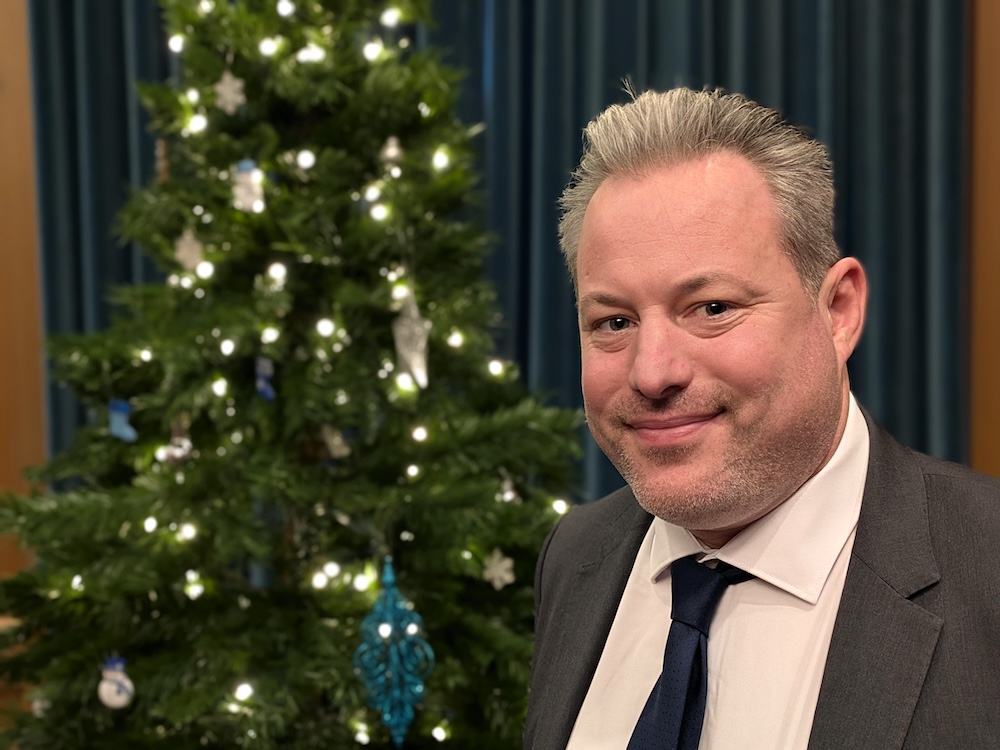
In his first week as interim leader of the Conservative Party of BC, Trevor Halford travelled to Ottawa to meet with federal Conservative Leader Pierre Poilievre.
When asked why he didn’t also meet with Liberal leader and Prime Minister Mark Carney, Halford responded, “Yeah, good question.”
“Pierre reached out, he reached out pretty much immediately after I took the position of interim leader,” he said. “We had a really good phone call. He invited me to Ottawa and I took him up on that, and we had a very good, productive meeting, which I was grateful for.”
The provincial and federal Conservative parties have no official link, but Halford sees much in common between them. “There's a lot of things that he's been talking about... that we are quite aligned on, that our caucus is quite aligned on, so it was important to me to have that conversation directly and make sure we establish that relationship.”
Cosying up to Poilievre is an interesting choice for Halford to make. First elected in Surrey-White Rock as a BC Liberal in 2020, he came to provincial politics as part of a movement that won elections by uniting federal Liberals and Conservatives against the NDP.
Starting in 2001 the BC Liberals won four elections in a row using that formula, or five if you include 2017, when the party won the most seats but fell short of a majority. A similar strategy kept the Social Credit party in power for all but three years from 1952 to 1991.
And while that pattern might seem a relic of the past, federally the Liberals hold 20 of B.C.’s 43 seats and the Conservatives have 19.
So what would Halford say to people who voted Liberal in the last federal election who might balk at voting for a provincial party aligned with Poilievre’s Conservatives?
“I really don't prescribe to this version of identity politics,” Halford said. “Ninety-nine per cent of British Columbians do not have a party membership card in their wallet. They don't. They don't identify as a Conservative, a Liberal, an NDPer.”
It’s not about left or right, he said, but about what’s right and wrong.
“I can tell you the majority of British Columbians right now are struggling and they're fed up, and in some cases they're very angry with what they're seeing from this government,” he said.
Halford became interim leader in early December as the party forced out John Rustad, the leader who in less than two years had taken the Conservatives from having no seats in the legislature to falling just short of forming the government after the 2024 election.
The party is organizing a leadership contest, and there’s a long list of potential candidates.
“I think that if you put forward a vision, which I think we're going to see in this leadership race, for a better British Columbia, one that gives them hope and promise and a path forward, I think people are going to be very, very receptive to that,” Halford said. “I don't think they're going to think about party ideologies at that point.”
Chosen by the Conservative caucus and endorsed by the party’s executive, he sees the interim leader position as a caretaker role, but also one where there’s an opportunity to do some rebuilding.
“Really it's going to come down to stability and making sure there's stability within the caucus, there’s stability within the party,” said Halford. “When the next leader comes in, whenever that may be, I want to hand this office off better than when I found it.... I believe that whoever wins this leadership race will be the next premier of this province, and I want to make sure that I'm putting them in the best position possible to succeed.”
There will be changes to staff for his office and the caucus, but not immediately. “Those changes will be coming,” he said. “It's Christmastime... and I was staff here, so I know the work that they put in day in and day out, and we have tremendous staff... but, yeah, there'll be some people coming in.”
Making those changes is part of rebuilding the office and making the opposition more effective, he said. “We have a very crucial legislative session coming up, and we are going to be holding this government to account in a way they haven't seen before.”
As he sees it, there is plenty in the government’s performance to oppose.
He acknowledged that U.S. tariffs are a serious threat to B.C.’s economy, but he said the province has been slow in its response and has made poor financial decisions.
“I don't think this government has any concept of reality when it comes to managing our economy or the budget itself,” said Halford. “British Columbians have to make tough decisions in their lives every day under enormous strain right now to balance their own household budgets. The government doesn’t adhere to that.”
The government is running the largest deficit in the province’s history, he added, but has little to show for it.
“Has health care gotten better? No. Has education gotten better? No. Has transportation? No. I can go down the list, and the fact is, is that this is the government that spends more on growing government than they do on providing services for British Columbians.”
When David Eby became NDP leader and premier he made a list of the big issues that would be his priorities: affordability; health care and strong public services; strong and safe communities; and the environment, a category he later repackaged as “strong and clean economy.”
For each, The Tyee asked Halford how the government is doing and what is one thing a Conservative government would do differently.
“If they want to measure themselves on affordability, they should measure the fact that we have the longest lines at the food bank than we've ever had in the history of this province right now,” Halford said.
“I think for us, the best way to deal with affordability is by job growth, and not through government job growth but by private sector job growth, and I think when you do that, everybody prospers. Growing government does not grow affordability.”
How about on health care?
“People do not have access to adequate health care in this province,” said Halford. “That is not through the lack of the work of the frontline workers who are working day in and day out to provide adequate health care, but they are burned out.”
People’s struggles to find a family doctor, emergency room closures and the government sending patients to Bellingham for cancer treatment are all signs of failure, he said.
“I would invest in our doctors and our nurses, not in bureaucracy,” he said. “The amount of redundancy we have in the health authorities is startling. We have more people in communications positions in health authorities than we've ever had before. That money needs to be invested in our frontline workers, not building bureaucracies at health authorities with massive payouts.”
The government is also failing on making communities stronger and safer, by Halford’s account.
“You look at right now we have an extortion crisis that's in Surrey, but it's growing to other communities,” he said. “We see crime on the rise if you look at even going into my local grocery store, they have to invest thousands of thousands of dollars every day on their own security. People don't even put insurance claims in anymore because it's just repeat repeat offenders.”
Fixing it requires targeting repeat offenders, he continued. “That's the biggest thing is that you know when somebody goes in and they do something, there is a very strong likelihood that they've done it multiple times, in some cases over 100, and we have to realize that the best place for them to be is not on our streets.”
As for the environment, Halford said, some of the government’s initiatives to reduce carbon emissions are making people’s lives more expensive and not delivering any positive environmental gain.
“This government as of Jan. 1 is going to increase airfare in British Columbia,” he said. “Not only that, there's airlines... where they're saying, We are now going to start avoiding British Columbia with some routes and using Bellingham, Seattle and Calgary to avoid this surcharge.”
It’s presented as being for environmental sustainability but it adds costs for travellers, and a Conservative government would reverse it, he said. “It's not going to have any environmental positive effects whatsoever. It's just a tax. You can't tax your way out of these situations.”
Sure, it’s easy to criticize, but is there anything the government has gotten right?
“Man, that's a good question,” said Halford. “I wish I could give you a clear answer. It's in the best interest of British Columbians that they do get some stuff right, and they haven't done that.”
But ultimately, no, there was nothing he could come up with. “I think British Columbians are going to measure them on results, and I can tell you they're failing on every step of the way.”
When the next election comes, many people will be looking for a change, Halford said.
“I think that this province is looking for a government that doesn't continue to overpromise and underdeliver in the most critical areas,” he said. “And I think that the Conservative Party of BC is going to show British Columbia in 2026 that we are government in waiting and that we're ready to step up and actually put British Columbians as the priority, not the premier's friends and insiders.”
Happy holidays, readers. Our comment threads will be closed until Jan. 5 to give our moderators a much-deserved break. See you in 2026! ![[Tyee]](/design-article.thetyee.ca/ui/img/yellowblob.png)
Read more: BC Politics