 SHARE:
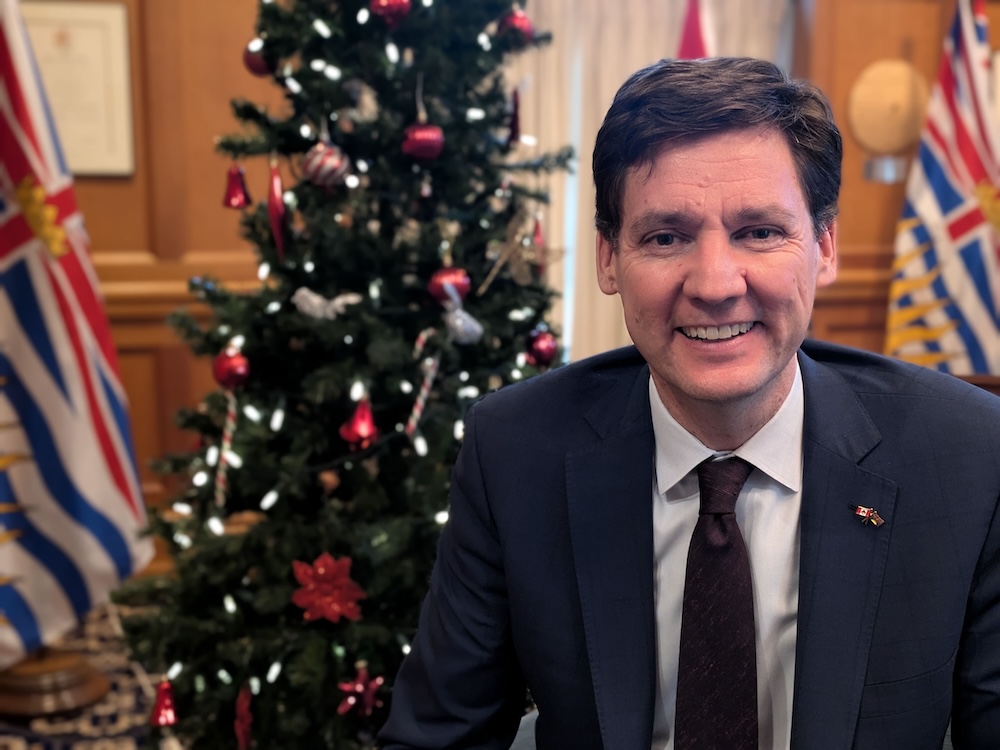
It was not the 2025 that B.C. Premier David Eby expected.
“I guess one of the big takeaways from this year is that things aren't going to settle down,” Eby told The Tyee during an interview in his wood-panelled legislature office.
“I kept saying to our team here, you know, eventually things will settle down and we'll all be able to catch our breath, but it has just been one significant international event after another hitting British Columbia.”
He listed U.S. tariffs on softwood lumber and flooding in the Fraser Valley as examples. “You name it, it has been a very eventful 12 months.”
Eby became premier in 2022 promising progress on the province’s most intractable problems, then won re-election a little more than a year ago with the slimmest possible majority. On his watch the government has run record deficits and added large amounts of debt, financial difficulties he says have made it challenging to deliver on promises and keep the government united.
Low prices for timber and natural gas, along with a weak real estate market and a decline in property tax revenue, have had a bigger impact on B.C.’s budget compared with other provinces, Eby said.
“How our finances are structured as a province puts us in the position of having to be tightening our belt as a government,” he said. That’s meant cutting back on some of what the government wants to do and instead “really being focused on economic growth and jobs for British Columbians, training opportunities for British Columbians in a time of great global uncertainty, and that was not what a lot of the people who ran for us signed up for.”
New MLAs in particular decided to run for election just a few months before Donald Trump was elected U.S. president and began an international trade war and musing about Canada becoming the 51st state, said Eby. “It has been a shift for a lot of us in terms of what we're working on and what we have to respond to.”
Two months ago, Eby stressed his willingness to go to an election if the government couldn’t pass the legislation needed to accelerate the construction of the North Coast Transmission Line.
At the time, observers understood it as a warning to the Greens, who have an agreement to support the government on confidence motions, and other opposition parties.
But the warning was also to his own caucus and cabinet, some of whom were dismayed that liquefied natural gas and other resource projects, at the expense of climate action, were presented as the answer to the province’s problems. With a single-seat majority, any one MLA could hamper the government’s plans.
“Oh, absolutely,” responded Eby when asked about the dynamic. “I mean, there are always those discussions internal, both to our team but also to our party.... The balance between environmental protection and economic growth has always been a source of tension for the NDP.”
He was, however, proud of how the caucus came together, Eby said, particularly as he watched the official Opposition Conservative Party of BC struggle to get along, then eventually fire their leader, John Rustad.
“Coming out of convention with the level of support that I saw from our party, I'm very grateful for it, and appreciative of the trust that our party members are placing in me,” said Eby. “I know that not all the positions our government has taken are 100 per cent in sync with the positions of a number of NDP activists, and still they voted to support me and our government carrying forward knowing the challenges and the complexity of the moment that we're in, and I'm really grateful for that.”
When Eby first became premier, acclaimed as NDP leader after late former premier John Horgan’s resignation, he promised action on four priorities: affordability; health care and strong public services; strong and safe communities; and the environment, a category he later repackaged as “strong and clean economy.”
On each, The Tyee asked Eby for what he would point to as one success and one priority remaining to be done.
“You know, we've been able to deliver consistently low car insurance and hydro rates for people,” he said about affordability. “We also cancelled the carbon tax without increasing corresponding taxes for British Columbians, and we increased the number of seniors able to access the SAFER [Shelter Aid for Elderly Renters] rent allowance and for people who are struggling with rents.”
He did not mention the $1,000 per family “grocery rebate” promised during the last election campaign, then abandoned afterwards as unaffordable.
“It is a challenging time for us to be able to deliver all of the affordability initiatives that we want to be able to deliver, given the state of the income streams for government being under huge strain and the resulting deficit from that, as well as the demands of our health-care system,” he said.
“So that's led to a real focus on using growth, economic growth in the province, to drive opportunities for British Columbians to move to better paying jobs, but also to create streams of revenue for government that will help pay for public services, other than taxation, and allow us to drive more affordability.”
On health care, Eby said, there’s been progress on recruiting doctors and nurses, as well as connecting people to them. “Still more to do,” he said. “There's lots of people without family doctors, but we've added about a thousand doctors to the province. We've recruited more than 170 American doctors and nurses specifically.”
At the same time, the province faces challenges with emergency room closures in rural areas and an aging and increasingly ill population that puts unsustainable pressure on the system, Eby continued.
“We need to be in a position to do two pieces of work. One is to address the triage issues of continuing to drive down wait-lists, connect people to family doctors and address emergency room closures,” he said.
“Simultaneously, we have to move upstream, opening more long-term care beds for people, so they get care outside hospital. Preventing people from attending at the emergency room in the first place through management of chronic illnesses like diabetes and people struggling with mental health and addiction who use a disproportionate amount of emergency room and emergency response services.”
There needs to be a focus on the acute issues, but also on the longer term pieces that will take pressure off the system, he said.
And on making communities safer?
“I'm pleased that we've driven down the headline crime numbers, that crime’s down seven per cent in the province, that we've seen a 24 per cent reduction in homicides,” Eby said. “We've seen a significant reduction in random stranger attacks that were causing a lot of anxiety for people.”
But there’s more to do on the street disorder that makes many people feel unsafe in the downtown cores of the province’s cities, he added. “When you see somebody screaming or pounding on a wall or something, you don't feel safe.”
That means continuing to open and expand involuntary care beds in the province. “We've got sites in Surrey and in Prince George that we hope to be able to formally announce soon.... We'll have a site on the Island and in the Interior as well.”
It’s an effort to reverse “the catastrophic decision” to close the Riverview psychiatric hospital in Coquitlam, which transferred out its last patients in 2012, and fill the gap with “modern and regional beds that are compassionate and ideally stabilize and get people to a point where they're able to live in community.”
On the fourth priority, the environment and a cleaner economy, Eby offered: “A dark horse candidate for environmental story of the year, one that has been completely unfortunately missed, is our ability to reduce methane emissions associated with natural gas production.”
The province has some of the highest standards in the world, he said. “Together with industry we have dramatically reduced methane emission associated with natural gas production, which is a huge concern, and rightly so, of people concerned about climate as part of the natural gas production process.”
According to the BC Energy Regulator, by 2023 (the most recent year for which figures are available) the province had reduced methane emissions from the oil and gas sector by 51 per cent from 2014 levels.
At the same time, Eby said, there’s a “wildly frustrating” risk of the progress getting undermined by the recent agreement the federal government made with Alberta that included a weaker methane emission standard for that province.
The lower standard would give industry an incentive to invest in Alberta instead of B.C., he added. “We compete with Alberta for this,” he said, so the decision “is deeply disappointing and something we hope to ultimately reverse in partnership with Alberta and the federal government.”
Looking ahead to 2026, one thing the government won’t be doing is appointing a citizens’ assembly to consider changing the voting system to one that’s more proportional. It was a recommendation made in late November by the Special Committee on Democratic and Electoral Reform.
“We had a commitment with the Green Party to establish a parliamentary committee on democracy,” Eby said. “I think there's lots of issues for us to talk about about how to strengthen our democracy in the province, and the committee certainly did that.”
The Green Party is particularly interested in having another referendum on proportional representation, he said. If one were held, it would be the fourth in 20 years.
“I personally bear the scars of the last round and have absolutely no appetite to go back to voters one more time,” said Eby, adding he told the Green Party they can use the results from the committee to campaign in the next election and win enough support to move it forward. “I understand that that's what they're going to try to do.”
The next election is scheduled for 2028.
Happy holidays, readers. Our comment threads will be closed until Jan. 5 to give our moderators a much-deserved break. See you in 2026! ![[Tyee]](/design-article.thetyee.ca/ui/img/yellowblob.png)
Read more: BC Politics