

 SHARE:
For the second time in less than a month, a barge operated by the same Seattle-based shipping company encountered serious trouble on B.C.’s north coast.
On Dec. 14, a barge called Arctic Provider ran aground near the abandoned cannery town of Butedale, about 165 kilometres southeast of Prince Rupert. It has since been towed out of Canadian waters, according to its owner, Alaska Marine Lines.
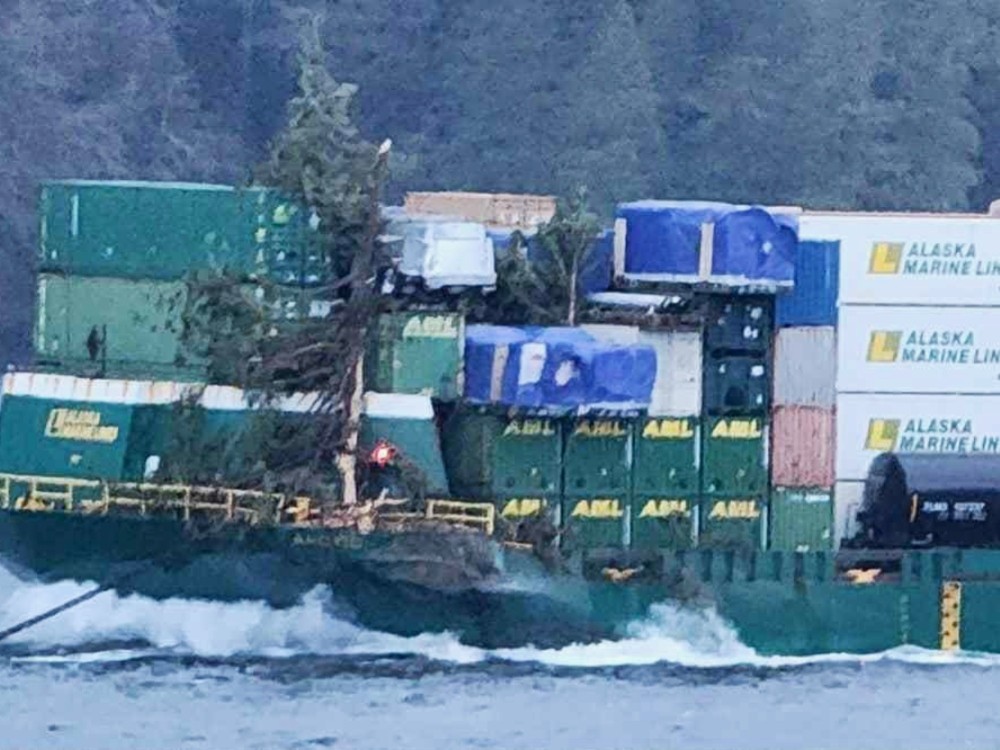
A photo circulating online shows the barge carrying numerous containers and at least two railcars, one a black tanker car. The photo showed remnants of a large coniferous tree implanted in the front left portion of the barge. Although some suggested the image was created by artificial intelligence, The Tyee confirmed its veracity.
The Tyee learned of the collision Friday, five days after it occurred. Roger Sterritt, manager of the Gitga’at First Nation’s Emergency Response Team, confirmed in an email to The Tyee that a U.S. tugboat ran its barge aground just north of Butedale in the early morning hours of Dec. 14.
“The barge stayed afloat and did not release any contaminants into the environment,” Sterritt wrote. The vessel moved to nearby Whale Channel and was inspected by Transport Canada before it was approved to continue to its destination in Alaska. The nation plans to release a statement once more is known about the incident, Sterritt added.
Alaska Marine Lines said the barge was towed from the area on Dec. 18. The matter has been referred to Transport Canada for an investigation. Transport Canada said it would issue a statement on Monday, Dec. 22.

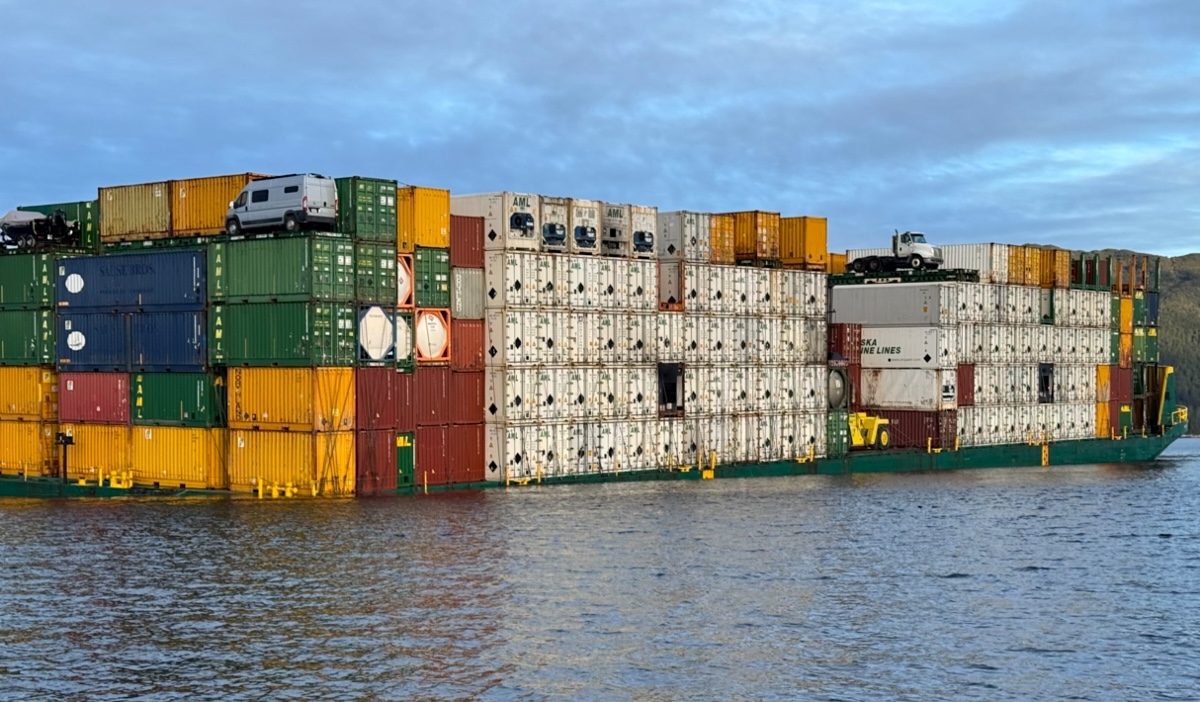
The incident followed a similar event weeks earlier, when a second Alaska Marine Lines barge, the Bering Trader, began taking on water near Bella Bella on Nov. 17. In that case, the loaded freight barge, which was being towed by the tugboat Malolo, began taking on water in Fisher Channel, near Bella Bella, as it was travelling from Alaska to Seattle.
The vessel was initially moved to safe harbour, and 25 containers were removed to increase its buoyancy. The vessel continued its journey to Seattle on Nov. 25, with an escort from Canadian emergency towing vessel Atlantic Eagle.
The incidents, which occurred roughly 100 kilometres apart, were both resolved by Thursday, according to Alaska Marine Lines. A spokesperson said the company makes “hundreds” of barge voyages every year and “has a very strong safety record.”
“It is unfortunate that two unusual incidents happened within a short period of time, but in both cases all proper procedures were followed with Canadian authorities, there was no pollution or substances spilled, and no cleanup was needed,” the company said.
In both cases, the Canadian Coast Guard confirmed that there were no reports of pollution from the vessels.
The shipping incidents come as the Canadian government floats plans for opening the region to oil tanker traffic.
On Nov. 27, Prime Minister Mark Carney signed a memorandum of understanding with Alberta Premier Danielle Smith that includes plans for a bitumen pipeline to B.C.’s north coast. The deal, which is opposed by the B.C. government and Coastal First Nations, includes “adjustments” to federal legislation banning oil tankers from accessing B.C. ports north of Vancouver Island.
U.S. oil tankers are prevented from coming within 70 nautical miles of the B.C. coast through a voluntary agreement signed with the Canadian government 40 years ago.
In a statement that followed the first barge incident last month near Bella Bella, in Heiltsuk territory, the nation said its crews were monitoring the barge “around the clock” and that booms were in place to protect the environment.
“This ongoing marine emergency shows once again that coastal First Nations are ground zero for the dangers of marine accidents, including oil spills, and we shoulder the burden of risk of expanded marine traffic,” the Heiltsuk wrote, adding that the agreement with Alberta and plans to make exceptions to the oil tanker ban “could not come at a worse time.”
“This adds insult to injury. A tanker ban is not a ban if it includes exceptions,” it said.
Both the Heiltsuk and Gitga’at nations have previously been affected by shipping incidents in their territorial waters.
In March 2006, a BC Ferries passenger vessel, the Queen of the North, sank off Gil Island, south of the Gitga’at community of Hartley Bay, after it failed to make a turn and ran aground. Two passengers drowned, and the ship’s navigating officer, Karl Lilgert, was later convicted of two counts of criminal negligence. The sunken wreck continued to leak fuel for at least a decade, according to Coastal First Nations.
In October 2016, the tugboat Nathan E. Stewart was towing barge DBL 55 south from Alaska when it missed a turn north of Bella Bella. The tug ran aground, spilling nearly 110,000 litres (about 690 barrels) of diesel and heavy oils into the Heiltsuk Nation’s fishing territory. In that case, the Transportation Safety Board of Canada determined that a crew member had fallen asleep while on watch.
The federal government later fined the tug’s owner, Texas-based Kirby Offshore Marine Corp., nearly $3 million for violations of the Fisheries Act.
In its recent statement, the Heiltsuk said that cultural and harvesting areas have remained closed since the Nathan E. Stewart incident nine years ago. The Heiltsuk noted that the spill of about 700 barrels of fuel polluted more than 1,500 acres of the nation’s territory, and that supertankers can carry two million barrels of oil.
“All it would take is one oil spill to destroy our way of life,” it said.
Sections of B.C.’s north coast are known for having some of the most dangerous waters in the world. On Dec. 14, the day of the most recent incident, the B.C. government issued a warning about the potential for heavy precipitation for the B.C. coast, including the north. ![[Tyee]](/design-article.thetyee.ca/ui/img/yellowblob.png)
Read more: Transportation, Environment





Notice about commenting changes
The Tyee’s commenting system will be moving to a new platform on Nov. 12. If you’re already a Tyee commenter you must register with the new system on or after Nov. 12 with your preferred username.More information can be found here.