


 SHARE:
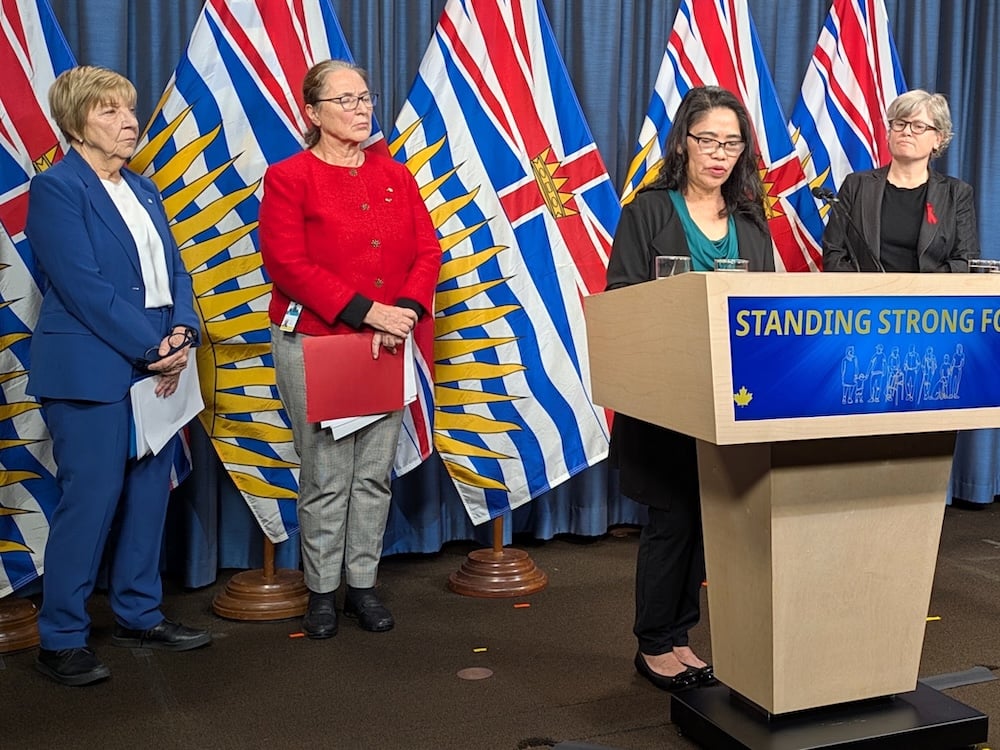
A Hospital Employees’ Union official said Monday that an agreement with the British Columbia government to bring some 5,000 workers at 100 care homes back into the sector’s main bargaining unit is a win for the union and seniors.
“Today's announcement marks a major step forward in repairing and rebuilding a seniors' care system that has been deeply fractured by two decades of privatization,” said Lynn Bueckert, secretary-business manager of the Hospital Employees’ Union, or HEU. “It's a step forward for fairness, for workers’ stability, for seniors and a more accountable public system for all British Columbians.”
Bueckert was at the legislature Monday with Health Minister Josie Osborne to announce that the Health Ministry, the Health Employers Association of BC, or HEABC, and the Facilities Bargaining Association have signed an agreement to bring care homes where at least half of the beds are publicly funded into the HEABC.
The change will mean that workers at those facilities will be included in the collective agreement negotiated with the HEABC, which is the employer bargaining agent for most publicly funded health employees in the province.
The agreement needs to be ratified by members of the HEABC and the Facilities Bargaining Association, which represents nine unions including some 67,500 workers in the sector, almost all in the Hospital Employees’ Union.
The voting is expected to be completed by Dec. 20.
“This is a big win,” said Bueckert, who traced the fragmentation of the system to decisions by the BC Liberal government after 2001 that allowed employers to contract out work and opt out of the standard labour agreements. “[It’s] a win for workers who've held the system together, a win for seniors who deserve continuity and quality in their care, and a win for public health care in B.C.”
Osborne said the agreement will strengthen labour standards across the long-term care and assisted-living sectors and make a big difference for people receiving care.
“Every senior in British Columbia deserves dependable, compassionate care,” she said. “Care that's delivered by workers who are respected, supported and provided fair wages, strong benefits and meaningful protections.”
The transition will be made in two phases, said Osborne, with half of the homes returning to HEABC by Sept. 30, 2027, and the rest coming in a year later.
In the meantime, until at least March 31, 2027, the government will continue the wage-levelling payments that started during the COVID-19 pandemic so that workers at those homes are paid the same as workers at homes that are already part of HEABC.
At facilities that receive some public funding but don’t meet the criteria to join HEABC, wage-levelling payments will continue for now but can be terminated with 90 days’ notice.
“We know that the best care for seniors comes from workers who feel respected, supported and treated fairly, no matter where they work, or who employs them,” said Osborne.
“Right now, more than 5,000 long-term care and assisted-living workers, many of whom are women and racialized workers, still don't have access to pensions and benefits comparable to those who are doing the same essential work in our hospitals, even though they perform the same demanding and often emotional and challenging work.”
The agreement will make labour standards more consistent in the sector and be more equitable for the workers in it, she said.
Osborne said implementing the agreement will cost about $85 million.
In a later email Monday, ministry staff said Osborne misspoke and the cost would be $72 million over two years.
But on Tuesday, the ministry said the cost of raising pensions and benefits for the 5,000 workers would be $72 million a year. Wage increases would be an additional cost, the ministry said in a statement.*
Edil Bukid, a care aide working in Vancouver, said that in 2004 she had to reapply for her job after the facility where she worked brought in a private contractor to provide care. She kept her job, but her pay dropped from $23 an hour to $15 an hour.
“That was a big drop, especially with my young family,” she said.
There was another wage and benefit rollback in 2007 when the care home flipped the contract to another provider.
By the time the home where she works came back into the HEABC after a 2023 sale, Bukid said, she had missed 20 years of being part of a pension plan.
The agreement announced Monday will provide workers much more stability, she said. “It means my co-workers will have a chance to retire,” she said. “It isn't just about the pay. It's about dignity for workers, for seniors and for their families who trust us.”
There are around 30,000 long-term care beds in B.C. and the system has long been mixed, with about two out of three beds contracted out to either for-profit or not-for-profit providers. The remainder are owned and run by the province’s health authorities.
* Story updated on Dec. 2 at 4:30 p.m. to include statements from the ministry correcting its initial information. ![[Tyee]](/design-article.thetyee.ca/ui/img/yellowblob.png)
Read more: Health, Labour + Industry











Notice about commenting changes
The Tyee’s commenting system will be moving to a new platform on Nov. 12. If you’re already a Tyee commenter you must register with the new system on or after Nov. 12 with your preferred username.More information can be found here.