


 SHARE:
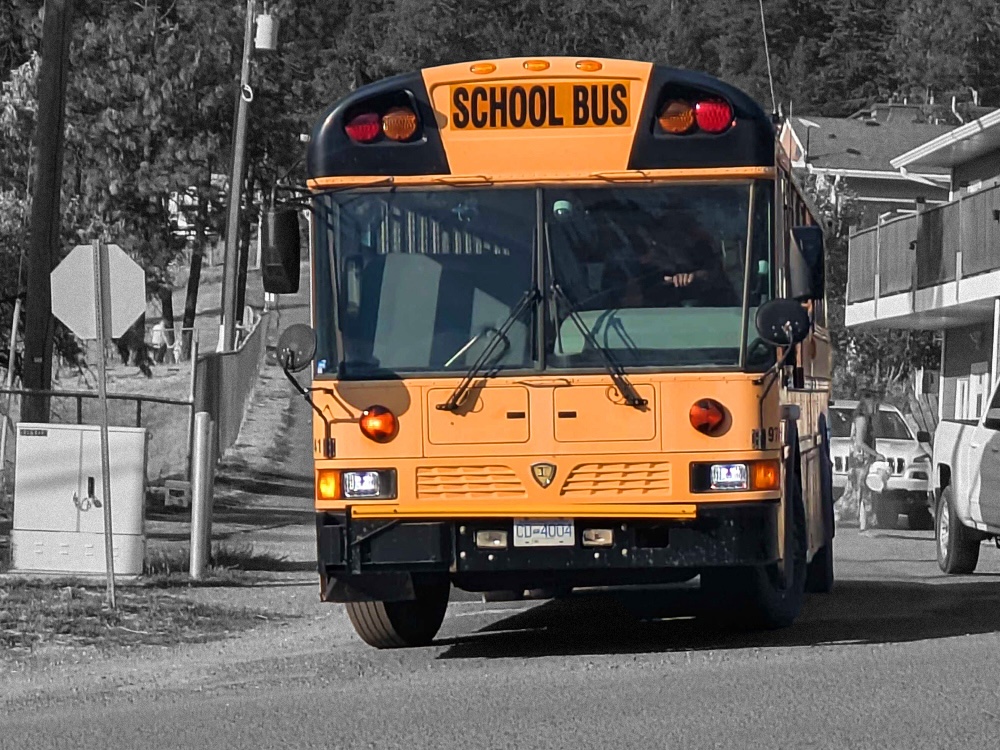
Pity the commuters who didn’t realize school is back in session.
One week, you’re cruising towards work with time to spare. The next, you’re stuck behind a line of minivans, pounding the dashboard and slowly realizing that September has arrived and so have legions of school-bound kids.
The traffic can be nightmarish close to schools — at one North Vancouver school, a vice-principal trying to slow traffic was cursed at and threatened by impatient parents earlier this year — but the car crunch manifests itself in cities across B.C.
Studies of communities across the world have found school trips account for a significant share of traffic before and after school. During peak drop-off and pickup hours, anywhere between 10 per cent and 45 per cent of all traffic can be attributed to school trips.
But even as many B.C. communities try to reduce car dependency, cost concerns have led many school districts to discourage the use of a key alternative to driving: the good old yellow school bus.
Wheels on the bus
As a kid, Norah Bowman walked to school. But when she became a parent and it came time for her eight-year-old to make his own two-kilometre journey to school, the pair hopped in a vehicle and joined the school traffic chaos.
For Bowman, a single mother, there wasn’t much of a choice. She didn’t have the time to escort her kid to school and get to her job on time, and her kid wasn’t yet ready to cross busy intersections on his own. But she also lived too close to her school for her kid to be eligible to take the bus. So Bowman, an environmentally conscious transit advocate, became one of the many parents driving a looping route through Kelowna streets congested by vehicles and drivers just like her.
“I was one of those people contributing to air pollution and dropping my kid off at a school two kilometres from my house, but I had to get to work,” she said.
For B.C.’s car-dependent mid-size cities, full city buses are a sign of success: an indication that locals are turning to transit and leaving their vehicles at home. Cities like Abbotsford, Kelowna and Vernon have created strategies aimed at encouraging more residents to use alternative forms of transportation.
Fewer drivers mean less pollution, reduced infrastructure costs and milder traffic for those who remain behind the wheel.
“The more people get on the bus, the less cars are in front of you,” said Gord Lovegrove, an engineering professor at the University of British Columbia Okanagan campus in Kelowna, where he also serves as a city councillor.
That’s the case no matter the colour of the bus. But while municipalities try to get drivers into buses, B.C. school officials often now speak of busing as a burden for their education-focused organizations.
School bus fee policies discourage ridership
This year, the Surrey school district slashed its busing budget. Other Lower Mainland districts such as Maple Ridge have phased out buses in recent years.
And many of B.C.’s largest school districts outside of Metro Vancouver (where few school buses exist because of the density of schools and robustness of the public TransLink system) now charge substantial fees for students to ride the bus.
That’s particularly the case across the Fraser Valley and the Okanagan. On southern Vancouver Island, the Sooke School District reintroduced fees last year, after having cut them in 2016. While some of those fees apply only to students who live within walk limits — set distances within which students aren’t eligible for automatic busing — other school districts, such as Kelowna’s, charge students no matter how far they live from school.
The idea is that the fees can help districts recoup transportation-related costs that could otherwise be spent on teachers and education assistants. But Lovegrove notes that increasing transit costs also tends to deter riders. In standard transit systems, a 10 per cent increase in price can be expected to be accompanied by a three per cent decline in ridership, he said.
The Tyee examined the bus fee policies of B.C.’s two dozen largest districts.
Central Okanagan Public Schools, which serves Kelowna and the surrounding area, had the highest fees by far. It charged families $575 for each of their first two bus-riding students, and $262.50 for a third and fourth student, up to a maximum of $1,575. Other districts that charged fees included Surrey Schools, the Sooke School District and those serving Langley, Mission, Abbotsford, Vernon and Penticton. Most fees cost parents between $300 and $400 per student, up to a maximum of around $700. Some districts charged only for students who lived outside of walk limits. Others, like Vernon and Penticton, gave students within the walk limits a heavy discount.
School board trustees and administrators in the districts have spoken of the fees with regret — but say they face a no-win situation. Districts, especially urban ones, get only a tiny amount of transportation-specific funding from the province. Most of the money needed to operate a school bus system comes out of the same pot of cash that is used to pay teachers, education assistants and other school staff. And school districts are legally required to balance their operating budgets.
“The educational landscape is evolving rapidly, marked by increasingly complex classrooms and a rising demand for support services among students,” Sooke School District chair Amanda Dowhy told CHEK News last year when asked to explain why her district would be charging for buses.
“The reality is that inflation has gone up so much that we are continuing to take additional funds out of our operating budget to subsidize the school bus system,” Central Okanagan trustee Chantelle Desrosiers told the Langara Voice this year when that district increased fees yet again.
B.C.’s school districts expect to spend a combined $143 million on transportation and housing this year, according to provincial figures. (Housing is lumped in with the data but accounts for a tiny slice of that sum.)
That amounts to 1.8 per cent of all education spending, down from two per cent in 2022-23.
Even districts that charge hefty fees aren’t immune to the overall budget crunch, with money from riders covering less than half the cost to run their transportation systems. The Central Okanagan school bus system, for example, will bring in $2 million in fees this year but spend more than $6.4 million on operating costs. Central Okanagan is also, notably, one of the only school districts that will increase its bus services this year, adding five new routes.
Societal factors
B.C.’s yellow bus challenges have put the priorities of municipalities and school districts at crossroads. But it’s not the first time policies by one jurisdiction have created challenges for another.
Some of today’s school transportation hurdles, for example, are the result of decisions made at city halls decades ago.
Lovegrove and others in Kelowna have noted that the city’s sprawling, low-density nature means students live relatively far from schools and one another. That means many students are less able to walk or bike to school and are more reliant on a bus or a parent’s vehicle.
“As the city has developed, we’re going up the mountains into more remote areas,” Central Okanagan Parent Advisory Council president Nicola Baker told the Langara Voice. “So you tend to then be bringing students to the school, instead of bringing the school to the students.”
Similar circumstances exist elsewhere in the Okanagan and Fraser Valley.
Parents across North America have also become less willing over time to allow their children to walk and bike to school.
Safety concerns related to traffic are often blamed. A survey of parents in St. Albert, Alberta, found one-fifth of all parents chose transportation based on the perceived level of safety. But that has created a vicious cycle, with safety concerns about traffic leading to more traffic, which in turn brings greater safety risks for pedestrians and cyclists.
This dynamic has produced real costs for school districts and the provincial government, which funds the construction of new schools. Shirley Wilson, the chair of the Abbotsford School District, noted that the increase in students being driven to school has forced officials to allocate more space to parking lots and driving lanes in new facilities.
“You’ll notice that newer schools have more parking spots — not just for staff but also visitors — and also bigger loops as part of the design element,” she said. “In those areas, it gets congested, then people have a hard time getting to work.”
Solutions
To reduce some of the traffic chaos, schools and municipalities have tried to create safer routes and experimented with new methods for kids to get to school on foot or by bike. One idea is the walking school bus, which attempts to mimic a yellow bus's hop-on, hop-off benefits on foot.
Busing, though, remains a challenge. In recent years, a lack of school bus drivers has posed a new problem for those hoping to take the bus. Wilson noted that even when a district wants to add a bus route, hiring drivers can make that difficult.
For Lovegrove, in Kelowna, one of the solutions is better integrating student transportation with existing transit systems. Combined busing can increase efficiency and reduce challenges related to obtaining vehicles and bus drivers, both of which have been in high demand and short supply in recent years. It can also facilitate the creation of routes that enable more students within walk limits to catch the bus.
Many communities, including Kelowna, already do that, to varying extents, with students able to ride city buses in some parts of town.
But combined systems come with obvious challenges. When Maple Ridge cancelled a bus route to a high school in 2022, the district suggested students could instead take public transit. But one parent noted that the local system’s route wasn’t optimized for students and a trip that once took 15 minutes would take 50 minutes on public transit. Another parent suggested they might quit their job to drive their kid to school, rather than letting them walk 40 minutes.
Issues can also arise when youth and teenagers share a transit system with adults. In Kamloops, where students use public transit in some areas, parents and children have raised concerns about the safety of vehicles and behaviour of other riders.
Students have also noted capacity challenges — such as full buses bypassing waiting riders.
Additionally, though moving school transportation from the Education Ministry to B.C.’s Ministry of Transportation and Transit could help remove the education-or-buses choice facing administrators, it wouldn’t totally remove the funding challenge. As The Tyee recently reported, municipalities have sought to improve their local bus systems only to be told by the province that required matching funds are not available.
“Our problem with public transit when school hits is that we need more buses,” Lovegrove said.
School buses remain the gold standard
For many parents and school administrators, school buses remain the gold standard to ensure kids can get to school safely without relying on their parents to drive them. It just costs so much money.
In 2018, years after she found herself with no good option other than to drive her son to school, Bowman was elected to Kelowna’s school board. Over the following years, she and her colleagues voted to increase bus fees.
“I do respect people’s frustration and I feel like maybe that political frustration needs to build to a point that there’s upward pressure somewhere,” said Bowman, who left the board in 2022.
“School boards can’t relieve that pressure, but some part of our social system’s got to,” Bowman added. “Maybe it’s public transit, maybe it’s another branch of government.”
Cities love transit. People and parents love school buses. But right now, pro-bus school boards find themselves having to choose between wheels on a bus and teachers in the classroom.
“The yellow school bus is the best and safest way to get kids to and from school,” Bowman’s colleague, Central Okanagan Public Schools chair Moyra Baxter, said in 2022.
Then she and her colleagues voted to increase fees. ![[Tyee]](/design-article.thetyee.ca/ui/img/yellowblob.png)
Read more: Education, Transportation





Tyee Commenting Guidelines
Please note that email notifications for replies are not currently working due to a software issue which may be resolved in a future update.
Comments that violate guidelines risk being deleted, and violations may result in a temporary or permanent user ban. Maintain the spirit of good conversation to stay in the discussion and be patient with moderators. Comments are reviewed regularly but not in real time.
Do:
Do not: