


 SHARE:

Dr. Victoria Lee, Fraser Health’s recently fired former chief executive officer, will receive about $600,000 in severance pay after leaving the health authority earlier this year.
The payout amounts to 18 months’ salary for Lee, who had served for seven years as CEO after first joining Fraser Health in 2010. An employment lawyer told The Tyee that 18 months’ salary is in line with severances for executives in other fields, but far above what an average worker might be able to expect after being fired without notice.
Lee left Fraser Health, the largest of B.C.’s five regional health authorities, in February. An initial press release declared she and Fraser Health had “mutually agreed” she would leave, and the existence of severance negotiations triggered questions in the B.C. legislature about her departure.
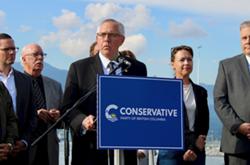
In April, B.C. Conservative MLA Trevor Halford asked in the legislature if Lee’s severance exceeded $1 million. Health Minister Josie Osborne refused to reveal the scale of the payout, saying only that it would be released through normal disclosure processes.
Now, documents quietly released online show that Lee did receive a large severance payout — though not as large as Halford had floated as a possibility. Lee will be paid a total of $609,335 of “salary continuance” over an 18-month period. Continuance is a form of severance in which a person is paid their normal salary for a set period of time after their departure. Lee’s last day of work was Feb. 18, 2025.
Lee was promoted to lead Fraser Health in 2018, after having previously served as the health authority’s chief medical officer.
The long end of the stick
Employment lawyer Aleks Kukolj told The Tyee that 18 months of salary for a CEO at a public organization is in line with typical severance deals for high-level executives in both the public and private sector.
“In the case of a CEO, that is nothing out of the ordinary,” Kukolj said.
Kukolj said British Columbia’s public sector organizations are often particularly generous with severance provisions in contracts for non-unionized executives. Whereas most organizations have contracts that attempt to limit severance to the minimum required by law, Kukolj said public sector executives often have contracts that stipulate severance will be paid out based on common law — meaning any severance must roughly match payouts deemed appropriate in previous court rulings.
The situation is much different for lower-level employees — especially those in the private sector, Kukolj said. B.C. legislation entitles workers who are fired or laid off without notice to severance. The amount of severance usually depends on the length of employment, but it generally caps out at just eight weeks of pay, he said.
For private employers, “the only way they are paying months and months of severance is if they haven’t done their homework,” Kukolj said.
“The trend in B.C. is for private sector employees to receive only the absolute minimum,” he continued. “They are getting the short end of the stick.”
Unionized public service workers, like those who work for Fraser Health, have contracts that generally provide more severance. But even their severance is only a fraction of that of non-unionized bosses.
The most recent contract between the health authorities and the unions representing their health services and support community workers stipulates that laid-off workers will receive one week of severance for every year of service, to a maximum of 20 weeks’ pay. The contract for B.C.’s nurses also caps severance at 20 weeks’ pay. Under such contracts, Lee would have received 15, rather than 78, weeks of pay.
Although an executive’s weekly salary may be four or five times that of an average worker, they can expect 10 or even 20 times more severance if they are ever fired. That’s because total severance pay is calculated by multiplying a worker’s base pay with a certain number of weeks determined by a contract, law or judge. When executives receive several times more weeks of severance than their employees, that magnifies pre-existing pay differentials between workers and bosses.
So although Lee’s salary may have been about three times more than that of an experienced nurse, the former CEO’s severance will be 15 times more than what the worker would be entitled to.
New leaders, old problems
Fraser Health’s hospitals have been plagued by overcrowding and bad press. But when Lee took over as CEO in 2017, Fraser Health had already been struggling for years. Problems with high patient loads and hallway medicine date back to the BC Liberals, but Lee, Fraser Health and British Columbia’s NDP government have been unable to reverse the trajectory of health care in the province’s fastest-growing region.
The challenges are not unique to Fraser Health, but the region consistently has had the most overcrowded hospitals in the province, with Abbotsford Regional Hospital operating at 128 per cent capacity in recent years. Fraser Health’s own report cards reveal that less than 20 per cent of incoming patients are assigned a bed within 10 hours. The target is 65 per cent.
The struggles have come despite massive increases in spending at Fraser Health. In the 2023-24 fiscal year, the last full year before Lee’s departure, Fraser Health spent $1 billion more than it had forecast, blowing its budget by more than 20 per cent. (B.C.’s other health authorities also missed their budgets, though none to the same extent as Fraser Health.)
The B.C. Conservatives made the lack of progress an election issue last fall, suggesting that health authorities were spending too much on executives and middle managers. In June, the party called for the CEO of Interior Health to resign amid a shortage of doctors in the region.
Corporate spending at Fraser Health has increased significantly and outpaced expenses across the massive organization, but it remains a relatively small portion of the health authority’s overall $6.8-billion budget.
Following the NDP’s narrow election win, Josie Osborne was appointed health minister and has initiated a wide-ranging review of the province’s health authorities. That included a review of the Provincial Health Services Authority and the removal of its CEO, David Byres.
Lee’s departure was also followed by the departure of Jim Sinclair, a longtime NDP ally and former president of the BC Federation of Labour who had chaired Fraser Health since 2017.
In June, Osborne announced the province was reviewing all of B.C.’s regional health authorities to attempt to reduce “unnecessary administrative spending.”
Lee’s departure came just as Fraser Health was completing its first on-budget year in more than five years. According to financial statements released alongside those detailing Lee’s severance, the health authority actually spent slightly less in the 2024-25 fiscal year than it had budgeted.
Although total expenses at the health authority still increased by nearly seven per cent, that money mostly went to hospitals and community care programs and facilities. Meanwhile, corporate spending was actually level after steadily consuming an ever-greater share of resources in recent years.
Fraser Health, meanwhile, has not yet appointed a CEO to replace Lee. Lynn Stevenson, a registered nurse, former provincial associate deputy minister of health, and health administrator and executive, was appointed interim CEO when Lee was fired. At the time, Sinclair said in a press release that “the Board will be working quickly to recruit a new permanent president and CEO as quickly as possible.” ![[Tyee]](/design-article.thetyee.ca/ui/img/yellowblob.png)
Read more: Health, Labour + Industry, BC Politics











Tyee Commenting Guidelines
Please note that email notifications for replies are not currently working due to a software issue which may be resolved in a future update.
Comments that violate guidelines risk being deleted, and violations may result in a temporary or permanent user ban. Maintain the spirit of good conversation to stay in the discussion and be patient with moderators. Comments are reviewed regularly but not in real time.
Do:
Do not: