

 SHARE:
What do a B.C. Supreme Court petition against the University of British Columbia, the arrest of journalists covering Indigenous land defenders and the punishment of students who speak out against potential genocide in Palestine all have in common?
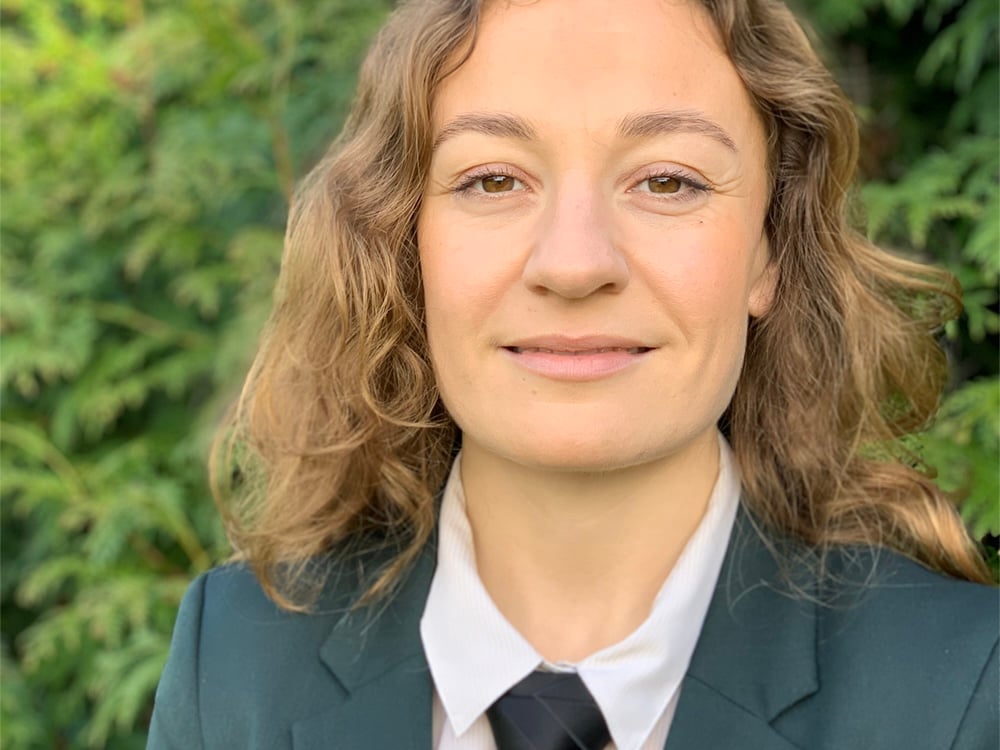
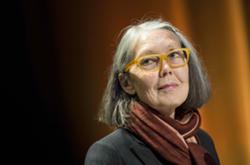
If you ask Liza Hughes, executive director of the BC Civil Liberties Association, the petition, arrests and punishments are all aimed at limiting free speech, which can lead us down the path to fascism.
“You can't have free expression and fascism,” Hughes told The Tyee in an interview. “In some ways, robust political critique and protest is the antidote to fascism.”
Earlier this spring, four University of British Columbia professors and one PhD graduate student filed a petition against the university in B.C. Supreme Court.
They were seeking prohibitions on the university acknowledging it operates on unceded Indigenous lands and requiring or encouraging others to do so; making any statements supporting or opposing Israel or Palestine or the violence in either country; and requiring potential employees to express support of or commitment to the university’s diversity, equity and inclusion initiatives or “any other political beliefs.”
The petitioners argue these actions contravene the University Act’s requirement that a university be “non-sectarian and non-political in principle.”
For the petition’s purposes, the university is defined as including all senior administrators, boards of governors at both the Okanagan and Vancouver campuses, the senate and all administrative and academic units including faculties, schools, offices and other bodies.
It does not include educators, students or UBC employees outside of governance and administration roles.
Hughes wrote a blog post on the BC Civil Liberties Association’s website criticizing the petition a week after it was filed on April 7.
“BCCLA fully supports the need to keep universities free from state interference, which is why we condemn this case,” Hughes wrote.
“We disagree with the interpretation of the University Act advanced by the petitioners and raise alarm at a lawsuit that considers diversity, equity and inclusion values, land acknowledgments, and faculty statements of solidarity to be inconsistent with civil liberties.”
There have been no updates on the case since the petition was filed. A UBC spokesperson declined to comment as the petition is before the courts.
The Tyee also reached out to the petitioners, UBC Okanagan professor Andrew Irvine and associate professors Brad Epperly and Michael Treschow, UBC Vancouver professor Christopher Kam and recent PhD graduate Nathan Cockram, for a response to Hughes’ interview.
They responded via email through Josh Dehaas, counsel at the Canadian Constitution Foundation, or CCF, a national non-partisan charity providing support for what they define as rights and freedoms cases. That includes Cambie Surgeries Corp. et al. v. Medical Services Commission et al., a failed bid to allow doctors to charge patients fees for care that is covered by public health care — broadly seen as a step towards health-care privatization.
The CCF’s litigation director was a public policy advocate with the Canadian Taxpayers Federation and several current and previous board members have ties to the conservative think tank the Fraser Institute.
In his statement to The Tyee, Dehaas said Hughes had made “false assumptions” about the “political leanings or motivations of the petitioners” and failed to focus on the issues at hand. “It’s widely recognized that institutional neutrality is a necessary precondition for academic freedom,” Dehaas wrote.
Dehaas referred to the University of Waterloo’s policy on institutional restraint as an example of what the petitioners would like to see UBC adopt as a policy.
The following interview has been edited for length and clarity.
The Tyee: Why did you decide to weigh in on this particular case?
Liza Hughes: The BC Civil Liberties Association has a long-standing commitment to protect free expression on university campuses, and a track record of engaging with issues like this, where there's an attempt to muzzle or silence certain kinds of expression in a university setting.
We think that it's important for us to weigh in with a civil liberties perspective because of the way academic freedom and concepts of free expression are being weaponized in this case, in a manner that actually undermines free expression and thriving discourse.
This is not a case where the petitioners are concerned with making sure the university remains non-partisan or free from party politics influence, which would be one thing. They're really grasping at straws to find an angle through which they can silence a certain kind of political expression that they disagree with, which, of course, is an affront to free expression.
Why should people outside of the University of British Columbia care about the case?
First, there are the substantive legal issues and the way this particular interpretation of the University Act would impact other universities, or potentially be applied to other settings.
Second, it's part of a broader trend. This is replicating what we're seeing out of the United States, outside of Canada, where attacks on any kind of progressive or inclusive initiatives are really wreaking havoc and creating an incredibly dangerous situation. It is definitely a slippery slope, and it's one that's rooted in attempts to preserve a certain norm or colonial supremacy — white supremacy, interlocking systems of oppression that uphold colonialism.
Universities are learning institutions. They're incredibly important social spaces for thought and dialogue. So they play a really important role in our society and in our culture. They're meant to be spaces for the exploration of ideas and for free exchange of ideas.
And throughout history, we've seen really progressive movements like anti-war movements, the civil rights movement, queer or feminist movements, take hold or gain momentum in educational settings like universities.
So it's not a coincidence that on the one hand, there's this wonderful opportunity, wonderful social organizing space. On the other hand, it's the first place that an authoritarian government, for example, would really crack down to try and limit expression or radical or independent thought.
We’ve seen an uptick in right-wing and alt-right folks citing “free speech” to attempt to widen the Overton window about what can generally be discussed in public, and to make space for bigoted views in the public sphere. We now see creeping fascism in the U.S. What do you make of that?
Speaking more broadly than just the UBC case, I don't think fascism comes from free expression or even from reprehensible speech. Fascism is really repression, and let's be honest, that's what we're seeing in the States: we're seeing the rise of fascism, and this is about crushing opposition.
So thinking about this in terms of this reliance on free speech to really force through or perhaps create more space for these bigoted views, I think it's important to recognize that these bigoted views are what this country is built on. The quote that comes to mind is “fascism is colonialism turned inward.”
Aimé Césaire, who wrote an essay in the 1950s about fascism in Europe, explained this as the “imperial boomerang,” or the process where colonizer nations — nations that had long been committing atrocities abroad — turned on their own citizens and applied those tactics domestically. The systems of oppression are connected, just as our liberation is connected.
As long as there's been Canada, there have been bigoted views in the public sphere. From a civil liberties perspective, it’s not so much free expression that gives rise to the widening of the Overton window. If people can share their oppressive ideology and they're swiftly shut down by a plurality of voices that disagree and that chime in with counter-arguments and with truth, then those oppressive views don't necessarily become mainstream or acceptable.
But when the media, our social institutions, our social media platforms, even non-profits and arts institutions, park boards, when everything is under the thumb of an oppressive government, it's really the quelling of the progressive voices that is shifting that window.
Do you think this UBC case is an attempt to widen the Overton window?
I would suggest that the UBC case is about narrowing this window by preventing diverse voices from being included and being given equal opportunity in the classroom, and by preventing the basic acknowledgment of Indigenous lands, and by preventing university faculty from taking political positions, specifically as it relates to Palestine. There is a common denominator here: these are all attempts to challenge dominant systems.
The petitioners are not challenging three statements made by faculty or three different hiring policies. They're taking these three things together, which are actually legally, conceptually quite distinct.
But the common thread is they're trying to strike down three things that, taken together, really do have potential to move the dial.
The petition also supposes that being on unceded xʷməθkʷəy̓əm (Musqueam) territory and not saying anything about it is not political, and that acknowledging it is political, which, of course, it's no more political to acknowledge it than to be there without acknowledging it.
One of the petitioners’ points is that they feel like they don't have the freedom to express that they don't want to make land acknowledgments. How do you weigh that point against the free expression argument that you're making?
In claiming that conservative voices are being silenced by the university's decision to seek DEI competent faculty or to make a land acknowledgment or to issue statements that support Palestine, they conveniently leave out that the neutrality that they're claiming to protect here is a system that privileges the status quo.
Their analysis is failing to consider the context, the structural power systems. And I don't think this is an accident. Again, returning to what I've been saying about how we should be cautious when there's a dominant voice or institution claiming that they need special protection: is being silent in the face of genocide neutral? Is that the kind of neutrality that the university environment or academic freedom demands?
They're taking for granted the idea of neutrality, and saying, “This is impeding neutrality and we need neutrality to say what we want to say.” And in fact, there is no neutrality. There has never been neutrality.
How do we identify bad-faith actors using “free speech” as a cover for a particular social agenda?
In this case, again, free speech is a bit of a red herring, because when I look at this case, what I'm seeing is the attempt to quell certain expression. At least expression that challenges colonial dominance, by deeming it unacceptably political or asserting that policy of neutrality.
What I see as dangerous here is the concept of accepting existing systems of dominance as neutral and positioning resistance to those systems as unacceptably political. And that's something that we see happen in a lot of different ways, not just in this lawsuit.
We’ve been seeing a lot of shocking infringement on free expression: crackdowns on student protests; criminalization or attempts to criminalize political speech; surveillance and increased sharing of information between government bodies; journalists arrested for attending and reporting on pro-Palestinian protests and Indigenous land defence; people fired, penalized or expelled from school if they promote Palestinian human rights; land defenders arrested if they assert Indigenous laws and governance.
This is the context in which the lawsuit arises. And if these people cared at all about free expression, they'd be outraged by all of this. Yet paradoxically, these folks, they're really contributing to this silencing.
In terms of tips, one thing I think we should be wary of is hypothetical arguments that are not really grounded in reality or in an analysis of power. We need to be critical of efforts that promote free speech with no analysis of power.
There's generally not a material threat to dominant normative speech. Often those claims about protecting dominant normative speech are actually an attempt to silence dissenting expressions. I think when you talk about bad-faith actors, you're talking about, as we referenced earlier, that path to fascism, and fascism, by nature, is silencing all dissent.
So what we need to look out for is the silencing of dissent in the name of free expression. We need to think critically. We need to follow those arguments to their logical conclusion and then decide for yourself: does this make sense? Does it make sense that I'm being told I can't make a land acknowledgment, and that that's in the name of free expression?
It's important that we don't fall for the guise of neutrality, or the idea that occupying xʷməθkʷəy̓əm land without acknowledging it is not political, but acknowledging it is.
Or the idea that teachers being unable or unwilling to facilitate an inclusive space is not political, but requiring them to have that as a hiring competency is. And then the idea that silence on genocide is neutral and speaking out against it is not.
We really need to think critically whenever neutrality is held as a standard. And we should certainly be wary of those who claim that neutrality, in a civil liberties context.
Because we’re living in a time of incredible repression, and we do need to actively resist limits on expression, and limits on political expression, in particular, limits on defence, on Indigenous rights, on the rights to defend land and water, which are all things that are actually under threat.
Is the BCCLA considering applying to intervene in this case?
We're exploring that possibility. We're definitely watching this case very closely. ![[Tyee]](/design-article.thetyee.ca/ui/img/yellowblob.png)
Read more: Rights + Justice, Politics, Education


Tyee Commenting Guidelines
Please note that email notifications for replies are not currently working due to a software issue which may be resolved in a future update.
Comments that violate guidelines risk being deleted, and violations may result in a temporary or permanent user ban. Maintain the spirit of good conversation to stay in the discussion and be patient with moderators. Comments are reviewed regularly but not in real time.
Do:
Do not: