


 SHARE:
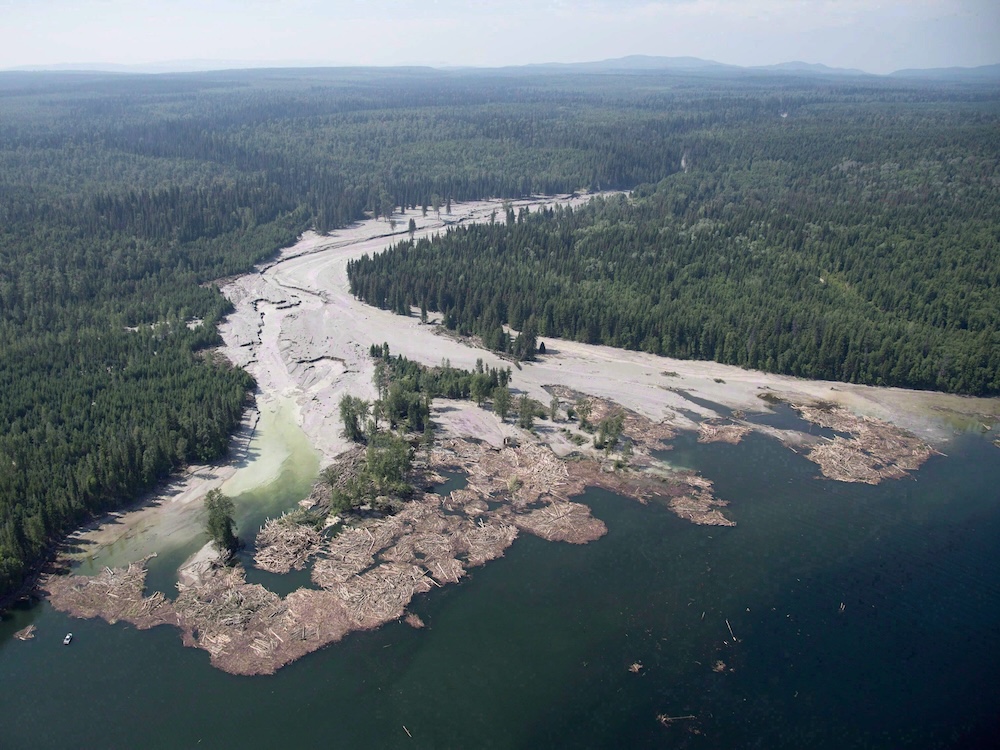
The Xatśūll First Nation is back in court this week renewing its pitch for an injunction to stop the Mount Polley mine from expanding the use of its tailings storage facility, a 60-metre-high dam that collapsed in 2014 and spilled 25 million cubic metres of waste into the Fraser watershed.
But experts told The Tyee that success might prove difficult, as the courts have a history of siding with industry on issues related to resource extraction and land use in the province.
The First Nation’s 5.6 million hectares of traditional territory includes the mine site, where the tailings dam collapsed on Aug. 4, 2014. It is considered one of Canada’s worst mining disasters.
This week’s B.C. Supreme Court hearing, scheduled to end Friday, is part of the First Nation’s broader legal bid to reverse B.C. government approvals for the tailings facility expansion. It comes more than a month after the court delayed a decision on granting an injunction until the case was heard.
Instead, the parties agreed May 8 that the open-pit copper and gold mine could continue construction to raise the dam by four metres as long as it didn’t use the additional capacity until the case is settled. The company agreed to hold off until July 1.
That undertaking expires Tuesday, Xatśūll’s lawyer Keith Brown noted in court on Wednesday, adding “some urgency” to the court’s decision on an injunction, he added.
“Deposition of tailings into a tailing storage facility is an irreversible process,” Brown said. That could mean irreparable harm for the nation, he said, given the potential for another tailings dam breach and significant environmental damage.
The mine returned to full operations two years after the 2014 dam breach when the B.C. government issued a temporary discharge permit that allowed it to continue discharging wastewater into Hazeltine Creek.
Last year, Mount Polley said it planned to expand its operations and extend the mine life by eight years to 2031. Raising the tailings facility will allow it to contain more mining waste, it said.
In December, more than a decade after the breach, Vancouver-based mining company Imperial Metals, which operates Mount Polley, was finally charged with 15 offences under the federal Fisheries Act relating to the 2014 breach. Those charges remain before the court.
The Xatśūll First Nation requested a judicial review of the province’s approval of the mine’s expansion on April 15, nearly a month after the province agreed, on March 27, to Mount Polley Mining Corp.’s request to raise its tailings dam.
The injunction would stop work while the judicial review is before the court.
While Mount Polley has told the court that it won’t need the additional capacity prior to July 1, it has also said it can’t know for sure when it might be needed. Factors could include precipitation, air temperature and extreme weather events.
Injunctions against industry are rarely granted
The nation might have an uphill battle winning an injunction that would stop work on the tailings dam, according to experts interviewed by The Tyee.
Irina Cerić, an assistant law professor at the University of Windsor, said Canadian law is tied into the nation’s resource extraction economy, which is based on colonialism.
In 2019, the Yellowhead Institute released a study looking at more than 100 injunction cases involving First Nations going back to the 1950s. It found that injunction applications filed by industry and government against First Nations had a 76 per cent success rate, while injunction applications by Indigenous groups had an 18.5 per cent success rate.
Cerić updated the statistics in 2021 and found injunctions sought by corporations against First Nations jumped to an 81 per cent success rate that year, following the Wet’suwet’en solidarity protests that swept across the country in 2020.
The updated report, called “‘The Legal Billy Club’: First Nations, Injunctions, and the Public Interest,” published in 2023, described a “profound discrepancy” between First Nations obtaining injunctions against industry and government versus those obtained by corporations and government against First Nations.
“The legal question that’s underlying so many of these conflicts is: Why was this pipeline approved? Why was this mine approved? Why was this logging permit issued, when there’s other interests at stake?” Cerić said.
“An injunction process doesn't care about that underlying question,” Cerić said.
“If there’s a permit, if there's a licence, that can't be questioned, that can't be challenged, and so that's why corporations are really able to weaponize this idea that the status quo on the ground is meant to be protected, and that status quo is the approved project, not territory that didn't have a pipeline crossing it.”
While the purpose of injunctions was originally to maintain the status quo as a dispute made its way through the courts, they’ve become a tool to address “major issues of public policy” such as Indigenous land claims and opposition to resource extraction, she said.
In the past, First Nations were able to successfully use injunctions to prevent unwanted activities, such as logging, on their territories by arguing the work would do greater damage to their interests, while companies could cope with delay.
But Cerić said that changed in the early 1990s, around the time of the B.C. Supreme Court’s 1991 Delgamuukw decision, which found that most Indigenous title in B.C. had been extinguished when the former colony joined Confederation in 1871.
The decision was overturned in the groundbreaking 1997 Supreme Court of Canada Delgamuukw-Gisday’wa decision. It found that the Wet’suwet’en and Gitxsan nations had never ceded rights to their traditional territories, but left the nations to work with governments to form land-use agreements. That never happened, leading to disputes — and court-issued injunctions — in recent years over pipeline construction through the nations’ territories.
The courts shifted to favouring industry in their injunction decisions around the same time, Cerić said.
“There was this very ironic and kind of unexpected shift after the introduction of Section 35 of the Constitution in 1982. Suddenly the courts realized, ‘Oh my God, all of these claims... take so long,’” she said. The issue of timeliness began preventing First Nations from using injunctions to challenge things like mining, logging or pipeline permits, she said.
Section 35 affirms but does not define existing Aboriginal rights.
“You saw a real dip in both the number of injunctions filed by First Nations and the success rate of those injunctions,” Cerić added.
The pattern of courts favouring industry injunctions and not those filed by First Nations has continued in recent years, said Deborah Curran, a law professor and executive director at the University of Victoria’s Environmental Law Centre.
Curran’s students recently did a research project called the Power of Restraint: Exploring Provincial Injunctions as Legal Responses to Environmental Challenges, in which they researched provincial injunction cases involving natural resource extraction projects.
Curran said the definition of property becomes unclear when it comes to unceded First Nations territories.
“There’s often going to be an inherent conflict between Indigenous legal orders and the issuance and implementation or enforcement of injunctions when it comes to activities that the province or feds have permitted but that Indigenous communities have not permitted,” she said.
Curran said that over the past five years the B.C. government has taken “additional extraordinary action” to support the enforcement of injunctions, such as creating a Civil Disobedience Work Plan and supporting a dedicated RCMP protest unit, known as the Critical Response Unit — British Columbia.
What’s next for the Xatśūll First Nation’s request
Xatśūll is asking the court to confirm that the company will not be permitted to deposit additional tailings into the storage facility until its petition to quash B.C.’s decision to issue permits to expand mine tailings has been considered.
“If Xatśūll is successful on the judicial review, but an injunction is not granted, Xatśūll may be left with... a somewhat hollow remedy,” Brown said, depending on how much of the additional storage volume is used prior to the court’s decision.
“The egg cannot be unscrambled. There’s no way for civil engineering equipment to simply suck back out the tailings if the authorizations are quashed. That is the key aspect of irreparable harm that we're advancing on this issue.”
This week’s hearing began Tuesday and is scheduled to wrap up on Friday. A date has not been set for decision and it’s unclear when Xatśūll might learn about the fate of its injunction application. ![[Tyee]](/design-article.thetyee.ca/ui/img/yellowblob.png)
Read more: Indigenous, Rights + Justice, Environment










Tyee Commenting Guidelines
Please note that email notifications for replies are not currently working due to a software issue which may be resolved in a future update.
Comments that violate guidelines risk being deleted, and violations may result in a temporary or permanent user ban. Maintain the spirit of good conversation to stay in the discussion and be patient with moderators. Comments are reviewed regularly but not in real time.
Do:
Do not: