


 SHARE:
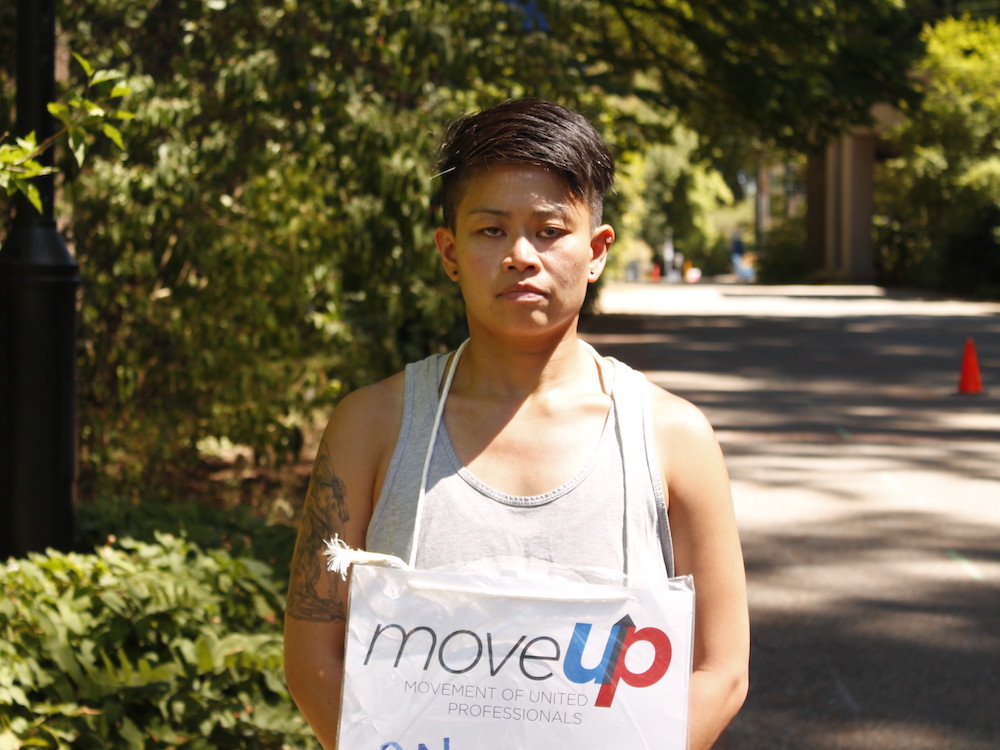
Rose Anza-Burgess became a parent on the picket line.
Anza-Burgess’s spouse gave birth during the fifth week of an administrative worker strike at Capilano University in North Vancouver, where about 350 MoveUP members had been off the job since the start of June.
Anza-Burgess, an academic advisor, had scheduled paid vacation for when her child was born. But because of the strike, she couldn’t take it. She took five unpaid days of leave from the picket line instead. “It was really sad, heartbreaking to leave them all alone at home,” Anza-Burgess said last week, during the strike’s sixth week.
On Friday, the university and MoveUP finally reached a tentative agreement after nearly seven weeks of a full strike.
Members are set to vote on the agreement this week. Terms were not immediately released, and neither the union nor the university was available to comment.
But some members fear the settlement won’t heal rifts born from the bitter labour dispute, which dragged on even after core issues were resolved because union members feared reprisal from administrators for actions during the strike.
It has left some students without grades, workers without pay and deep divides between the university and its workers.
“I’m incredibly concerned about the damage this is doing,” said Chris Shier, a MoveUP member who works in information technology at the school. Shier and other MoveUP members quoted in this article spoke to The Tyee the day before the strike ended.
“I hate to think that this is going to create a division between us.”
The strike originally hinged on remote work. The union wanted the right to work from home in the contract and the ability to grieve a manager’s decision if that was denied.
Christy Slusarenko, MoveUP’s vice-president, says her members had proven during the early years of the COVID-19 pandemic that they could work effectively from home. Many, she said, had moved away from Capilano’s campus in North Vancouver in search of affordable housing.
“Throughout the pandemic they’ve had to move out of the North Shore and move into places like Langley, largely to find a place where they can rent,” Slusarenko said last week before the tentative deal with the school was reached.
Shier said the option to work remotely had allowed his family to spend more time with their newborn daughter and save on commuting. Anza-Burgess said it was useful for her family, too, and said workers wanted a guarantee they could grieve a decision to make them work from the office.
MoveUP began targeted picketing in May, which escalated into a full general strike on June 6.
“I didn’t expect it to be more than a couple days of job action at most,” Shier said.
Instead, the strike continued for weeks. Professors represented by the university’s faculty association initially refused to cross the picket line. Some classes were cancelled. Some students taking summer classes were faced with a difficult choice between a refund or accepting academic credits without an attached letter grade.
“It was causing chaos. Students didn’t know what to do,” said Karandeep Sanghera, the president of the Capilano Students’ Union.
Sanghera said some international students needed to be in classes as a condition of their visas and thus could not withdraw. Other students couldn’t get basic information about courses, Sanghera said, because MoveUP members who usually updated websites and other databases were off the job.
Brian Ganter, a steward with the Capilano Faculty Association, said it got to a point where administrators were going to mark students’ assignments.
“They don’t have biologists. They don’t have English teachers. They don’t have women’s studies or art history professors doing the work. It’s just someone up the chain,” said Ganter.
Typically, unions don’t cross other unions’ picket lines. But in late June, faculty members began crossing the line with MoveUP’s blessing.
Eduardo Azmitia, the faculty association’s president, says his union still unequivocally supported MoveUP, but wanted to minimize the pain felt by the rest of the university community.
“If we were not going to be able to return to the classes, there would have been significant consequences for the university community and for students in the future,” Azmitia said. He and Ganter said faculty association members were sometimes asked to do jobs usually done by MoveUP, which they refused.
Meanwhile, the strike dragged on. Slusarenko said some of her members began looking for other jobs, though she did not know how many did so.
Slusarenko said the proposed settlement does not include the right to work remotely. Instead, the parties negotiated a separate letter outside the agreement to allow remote work, something also done by the federal government and public servants earlier this year.
But even after reaching that deal in early July, the strike didn’t immediately end, largely because of the mistrust that had grown on both sides of the picket line.
MoveUP wanted a return-to-work agreement that included a guarantee that no members would be disciplined for actions they had taken during the strike. The union also originally asked the school for back pay for the entire time when members had not been working and to destroy any records related to the strike, including video footage of striking workers.
In a public statement, Capilano noted those requests were highly unusual, and that the latter might be illegal under its obligation to keep public records.
MoveUP backed off on its requests to destroy records and back pay.
But it maintained it wanted a guarantee no member would be disciplined for anything they did during the strike.
Capilano University, meanwhile, wanted the caveat it could discipline members if they had done something illegal.
Slusarenko said she had no indication any of her members had broken the law during the strike. But she said the university’s insistence on keeping that clause felt like a threat, even though the school said it was a standard provision in such labour disputes.
The two parties eventually went to mediation on July 19. The appointed mediator recommended the university accept the union’s terms on the outstanding issues.
Workers are now expected to be back on the job this week for the first time in nearly two months.
Many workers, though, have been personally and profoundly affected by the strike.
Carrie Jung, an executive with the faculty association, said many on the picket line worried about reprisal for their role in the strike.
“They worry that by observing the picket line as they have been that they will be denied promotions… that they will not be able to move forward,” Jung said. Many others had lost a great deal of pay because of the strike’s duration and had to miss on important life events because of the time spent on the picket line.
“My colleagues have lost family members within the strike and have not been able to properly grieve or celebrate life events. They haven’t been able to live like as they do normally,” Anza-Burgess said.
Anza-Burgess will now be able to take time to spend with her spouse and their newborn son. But on Wednesday, she said she would never be able to get back the time she has already lost.
“Even if they say we can use those benefits in the future, that time is gone,” Anza-Burgess said. “I needed to use that time.” ![[Tyee]](/design-article.thetyee.ca/ui/img/yellowblob.png)
Read more: Labour + Industry











Tyee Commenting Guidelines
Comments that violate guidelines risk being deleted, and violations may result in a temporary or permanent user ban. Maintain the spirit of good conversation to stay in the discussion and be patient with moderators. Comments are reviewed regularly but not in real time.
Do:
Do not: