


 SHARE:
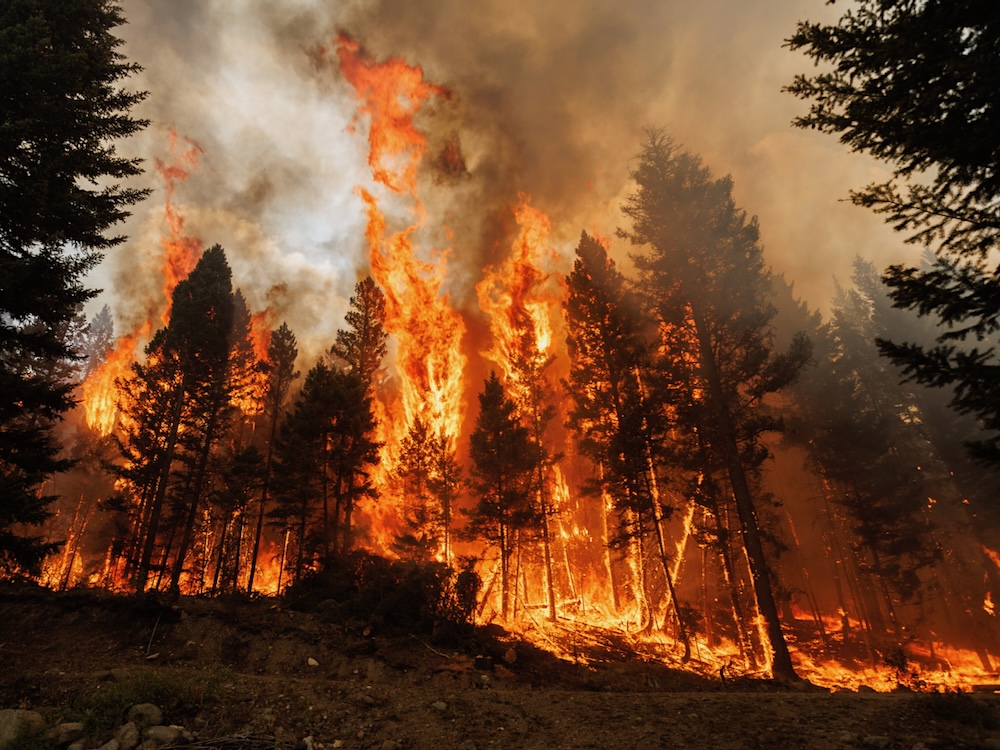
[Editor’s note: On Thursday, The Tyee published an interview with photojournalist Jesse Winter about his new book ‘Wild Fire: Dispatches from a Country Ablaze.’ In this excerpt, Winter describes how one crew became trapped inside a raging wildfire while fighting the Adams Lake fire in B.C.’s Shuswap region in 2023.]
By 8:25 p.m., the fire was burning freely in the Scotch Creek valley. Two minutes later, it consumed a wide section of the power line corridor and began spreading vigorously. With the situation deteriorating rapidly, command ordered everyone off the line. But as the crews prepared to evacuate, the fire cut across their only known route to safety.
Frantically, helicopter co-ordinator Ingham scanned her maps again. The ground crews desperately needed a new way out. Luckily, Ingham spotted one. A spur road cut across the mountainside south of the firefighters and eventually joined with the Lee Creek forest service road. But to reach it, they would have to drive off-road, navigating around spreading spot fires and over ditches. It would be a pell-mell race to reach safety before the fire caught up to them.
In the chaos, Coast Zulu’s crew leader realized that some of the Brazilian firefighters were not receiving the message to evacuate. Rather than head for the newly identified escape route, the Brazilians were driving the wrong way back towards the now-escaping fire itself. One Coast Zulu crew member jumped out of their IA truck and sprinted ahead, down the rough road, through swirling smoke and embers. They knew that, at this point, they could run faster than their trucks could drive. They flagged down the Brazilian crews and passed the message to evacuate. Then they sprinted back to their truck.
Finally, with a convoy of trucks organized, firefighters began making their way back towards their evacuation point, only to find it cut off by flames. To reach the secondary evacuation route, they were forced to drive off-road through bushes and trees. As they drove over a steep embankment, one truck kicked up onto two wheels, nearly rolling over. The convoy passed so close to burning slash piles and spot fires that some of the trucks’ plastic components started to melt. Eventually the ground crews emerged from the smoke, and reached the safety of the Lee Creek logging road, to everyone’s immense relief.
But there was a problem: not everyone had made it out. From high above, Ingham could see what those on the ground couldn’t: that in the chaos of the retreat, a truck full of Brazilian firefighters had been left behind. Now the fire had trapped them.
At 8:27 p.m, a voice came over the radio into Ingham’s ears. It was Shane Derhousoff, the heavy equipment branch director, planning to drive into the fire and attempt to rescue the trapped Brazilians. Unable to raise him on the radio directly, Ingham texted him frantically. “Shane, do not go in there,” she wrote.*
She saw what he could not: the fire had crossed in multiple places between Derhousoff and the crew. The forest service road was impassable.
Ingham urged the trapped Brazilians to abandon their truck and attempt to hike out between the spreading spot fires. But she got no response on the radio. Hovering above, she watched as the flames and smoke bore down on them — their truck now only a barely visible speck of white amid a spreading curtain of smoke, ash and flames.
At 8:30 p.m., as Ingham watched the situation on the mountainside worsen, a public update went out to area residents describing the back-burn as a success, unaware of the frantic retreat taking place on the ground. “Fire in the ignition area will now burn towards guards,” the statement said, “while being monitored by crews patrolling along the power lines” — the same ground crews that were, at that very moment, racing to escape the flames.
Some residents, who watched the ignition unfold from their properties across the valley, received this update as they were watching the fire escape. It appeared to them that the district, in collaboration with the BC Wildfire Service, was asking them to disbelieve what they were seeing with their own eyes.
Meanwhile, Ingham could see from her helicopter that fire was continuing to spread towards the southeast where 23 homes and other structures were spread out along Meadow Creek Road. As Ingham fired off messages to command about the Brazilians’ entrapment and the now-escaping ignition, homeowners in Meadow Creek watched the fire grow rapidly towards them. Everywhere Ingham looked, the situation seemed to be growing increasingly dire.
At 8:44 p.m. Ingham sent a series of text messages and photos to operations chief Scott Reynolds, showing the entrapment and the fire burning across the power line.
“It’s blown over the power lines and moving downslope,”** Ingham wrote, referencing map co-ordinates southeast of the power line. “If they aren’t already, those homes in Meadow Creek need to be evacuated. Blowing hard out of the west and pushing downslope in that direction, slightly south across the line.”
“Roger, will talk to Mark right now,” Reynolds replied, referring to incident commander Mark Healey.
Her text exchanges with Reynolds were the last Ingham made about the fire that night. With darkness spreading and already an hour beyond her required skids-down landing time, she was forced to fly back to base, leaving the Brazilians to an unknown fate. The drive back to their hotel rooms in Kamloops that night was tense. Ingham and everyone else who witnessed the entrapment were certain they’d just watched the trapped Brazilians die.***
*“Shane, do not go in there.” Text messages from Leanne Ingham to Shane Derhousoff, obtained under B.C.’s Freedom of Information Act.
**“It’s blown over the power lines and moving downslope.” Text messages from Leanne Ingham to operations chief Scott Reynolds, obtained under B.C.’s Freedom of Information Act.
***Certain they’d just watched the trapped Brazilians die. BC Wildfire Service, Fire K21620 Fire Crew Entrapment Investigation — Full Report, pg. 6.
Excerpted from Wild Fire: Dispatches from a Country Ablaze by Jesse Winter. Copyright © 2026 Jesse Winter. Published by HarperCollins. Reproduced by arrangement with the Publisher. All rights reserved. ![[Tyee]](/design-article.thetyee.ca/ui/img/yellowblob.png)
Read more: Books, Labour + Industry, Environment










Tyee Commenting Guidelines
Please note that email notifications for replies are not currently working due to a software issue which may be resolved in a future update.
Comments that violate guidelines risk being deleted, and violations may result in a temporary or permanent user ban. Maintain the spirit of good conversation to stay in the discussion and be patient with moderators. Comments are reviewed regularly but not in real time.
Do:
Do not: