

 SHARE:
“The word is fragile and uncertain, but extremely precious. We are left with only the word. It is our last resort, but is irreplaceable for establishing communion between us, and also between us and something as indispensable to us as our daily bread.” — French sociologist and theologian Jacques Ellul
Sometimes a story crosses my desk that weaves together the themes of my critical reporting on technology, and often in unexpected ways.
For decades now I have argued that technological devices and systems, all designed to further the efficiency of machines, have become a dominant colonial force that has eroded our humanity.
Yet, we swerve around the growing evidence of loss and conquest like frenzied commuters avoiding potholes on a one-way road called progress.
The American social psychologist Jonathan Haidt, for example, has shown how technological devices have ruined our attention spans and filled the lives of children with anxiety, depression and dread.
Meanwhile the American journalist Nicholas Carr has documented how increasing the speed and flow of information on the internet undermines the art of talking and plunges users into “a very, very busy void.”
As Carr eloquently writes in an April 2026 essay on World Wide Web founder Tim Berners-Lee’s new memoir: “The internet operates at a scale and speed that conflict with the brain’s deliberate pace of thought, the intellect’s slow accumulation of knowledge and the psyche’s limited capacity for stimulation and social exchange.”
Iain McGilchrist, the brilliant Scottish psychiatrist and neuroscience researcher, has documented how engineered environments or historical traumas can rewire brains balanced by two hemispheres for left hemisphere dominance.
The left hemisphere is reductionist, brash, opinionated and manipulative. It treats the world as an object and operates with the subtlety of autocorrect. And when it no longer serves the right brain, the side that prizes real things and intuition, things go astray. You end up with a Silicon Valley brain.
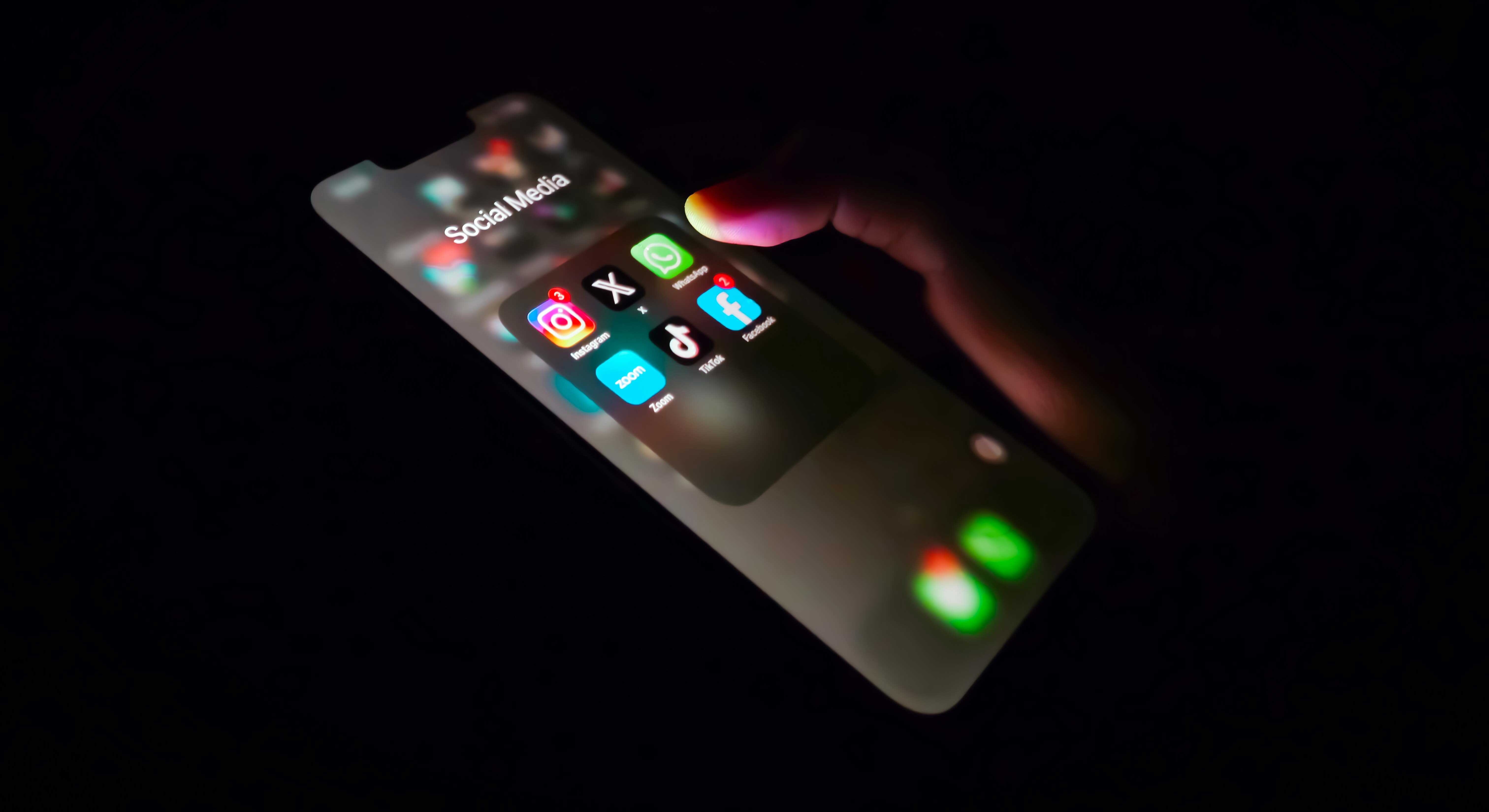
Now these same insidious technological forces rewiring human thought appear to be silencing another human behaviour: the spoken word.
We’re speaking 338 fewer words a day
A startling March 2026 study, called Sliding into Silence? We Are Speaking 300 Daily Words Fewer Every Year, from researchers at the University of Missouri and University of Arizona reports that for each year between 2005 and 2019, people spoke an average of 338 fewer words a day.
That translates into a loss of some 120,000 every year.
In July 2007, Matthias Mehl, a psychology professor at the University of Arizona, reported in Science on talkativeness among the genders.
In that study, he noted that the average person spoke about 16,000 words a day. That was 2007, before the launch of the iPhone, Facebook, Instagram and TikTok, and the mania known as AI.
Mehl’s estimate on the volume of human chatter was based on a technological intrusion. Participants in the study wore a device called EAR, or electronically activated recorder. It fit into a pocket like a glass case. Every 12 minutes or so, the device sampled 30 seconds of conversation. From recordings collected by the device, researchers were able to estimate the number of words spoken daily.
Let’s fast forward to 2026. Mehl and his colleague Valeria Pfeifer, a psychologist at the University of Missouri, sought to replicate the study. They captured chatter data from more than 2,000 participants, all wearing EARS in 22 different studies over a 14-year period, from 2005 to 2019, and all for different study purposes.
They accidentally found that a profound change had taken place.
Compared to subjects first reported on in 2005, the average volume of spoken words had dramatically eroded by nearly 3,000 words.
Instead of expressing 16,000 words a day, people from the age of 10 to 90 are now averaging around 12,700 words a day.
The reduction from 2005 to 2019 in the estimated number of words spoken per day represents a 28 per cent decline.
Where did the words go?
The researchers don’t know where the words went. Were they lost with friends, family or strangers? “Were they lost equally for everyone, or just for a select few?” they asked.
What stories, songs and jokes disappeared?
What were the social costs of speaking less with people?
As expected, the decline was even more dramatic among young people. In an email to The Tyee (and note the absence of conversation here), Pfeifer found that the loss of spoken words seems to be more accelerated in younger people — about 451 daily words per year.
In comparison, adults older than 25 years surrendered 301 daily words per year.
I again asked Pfeifer — by email, due to time constraints or perhaps the sheer efficiency of the machine — about the role of technology.
“We think that at least some of this loss of spoken words is attributable to shifting towards digital forms of conversation, such as texting, email, social media and others,” she replied.
Human contact erodes
At an automated grocery store, there are no clerks to chat with. When an office worker orders coffee by an app for efficiency’s sake, they avoid humans and interact only with machines. The banking machine tells no stories and offers no jokes. And so, the erosion of human contact.
I then asked Pfeifer about the quality of the words being used. Three decades ago the German linguist Uwe Poersken urgently warned about the proliferation of meaningless plastic words in human speech and political discourse.
These plastic words such as “progress,” “growth,” “energy,” “development” and “communication” could be fit together like Lego bricks and act as “the everyday prison of perception.” Poersken thought they debased meaning.
Pfeifer replied that she and her colleagues did not analyze the quality of words used. “Our dataset does not currently contain data at the content level, only at the level of estimated number of words spoken in a day,” she said.
“Thus, we cannot say how language itself has changed, only how our behaviour (that of speaking) has changed.”
In her study and interviews, Pfeifer noted that humans have been speaking for 200,000 years. She also noted that real, live conversations “involve different social and cognitive processes than typed conversations and that such live conversations can elicit benefits in well-being that apps and social media cannot readily replace.”
And yes, she is clearly concerned. “Constant dripping wears away a stone. But in this case it is not a stone we are wearing away.” The erosion of this precious stone called the word began long before the advent of the iPhone and AI.
In 1934, as the radio invaded homes with propaganda, the poet T.S. Eliot asked, “Where is the knowledge that we have lost in information?”
In 1985 the radical social critic Jacques Ellul answered that question in his prophetic and haunting book The Humiliation of the Word.
Ellul argued that technology preferred images over words because it needed visually orientated people to evolve and triumph. Ellul argued that the intrusion of one gadget after another — from the telegraph to the television, from film to computers — had punished and marginalized the word.
In this world of proliferating images, we no longer rely on the sight of birds, trees and mountains, noted Ellul, “but rather on the multiplication of artificial visual images that constantly attract our attention.”
‘Without the word, human life is hell’
In The Humiliation of the Word, Ellul warned that “No gadget, however ingenious, will enable humanity to discover the meaning of life (and notwithstanding certain brilliant philosophers, we cannot live if our life has no meaning).”
“Without the word,” Ellul wrote, “human life is hell.”
Ellul elaborated on the depth of the humiliation: “The word discourse itself contains part of the explanation of this tendency. Discourse implies a long process: an indirect approach and a kind of winding movement involving successive approximations that irritate lazy modern people. Visual representation is the easy, efficient, quick path.”
In a technological society, images do the talking and ordering.
In recent years, social media has assaulted language with more violence than even Ellul anticipated. It has accelerated the adoption of abbreviations, acronyms and a host of Disney-like emojis.
The evolutionary new tech speak, of course, prizes brevity and speed over depth or traditional grammatical forms. It is the language of efficiency shaped by algorithms. It serves one master: the machine.
Ultimately, the Sliding into Silence study is another reminder that technological world is re-engineering our brains, our thoughts and our spoken behaviours with a totality most of us cannot imagine.
As a consequence, speaking to another human being with warmth and conviviality has now become a revolutionary act.
In his latest book, Against the Machine: On the Unmaking of Humanity, the British journalist Paul Kingsnorth reminds us there is an alternative to blindly conforming to the constant subtraction of the human experience. Poets, believers and radicals have championed these alternatives for millennia all over the world.
It is not a formula but a position, writes Kingsnorth. “It is living within limits, refusing to consume for the Machine, refusing to give the Total System what it wants. It is planting our feet on the ground, living modestly, refusing technology that will enslave you in the name of freedom.
“It is building a life which you can see the stars and taste the air. It is to live on the margins, in our home or in your heart: to scatter the pattern. It is to speak truth and try to live it, to set your boundaries and refuse to step over them. It is to be a conscientious objector to the Machine.”
And that objection now begins with the courage to speak the word to another person. ![[Tyee]](/design-article.thetyee.ca/ui/img/yellowblob.png)











Tyee Commenting Guidelines
Please note that email notifications for replies are not currently working due to a software issue which may be resolved in a future update.
Comments that violate guidelines risk being deleted, and violations may result in a temporary or permanent user ban. Maintain the spirit of good conversation to stay in the discussion and be patient with moderators. Comments are reviewed regularly but not in real time.
Do:
Do not: