



 SHARE:
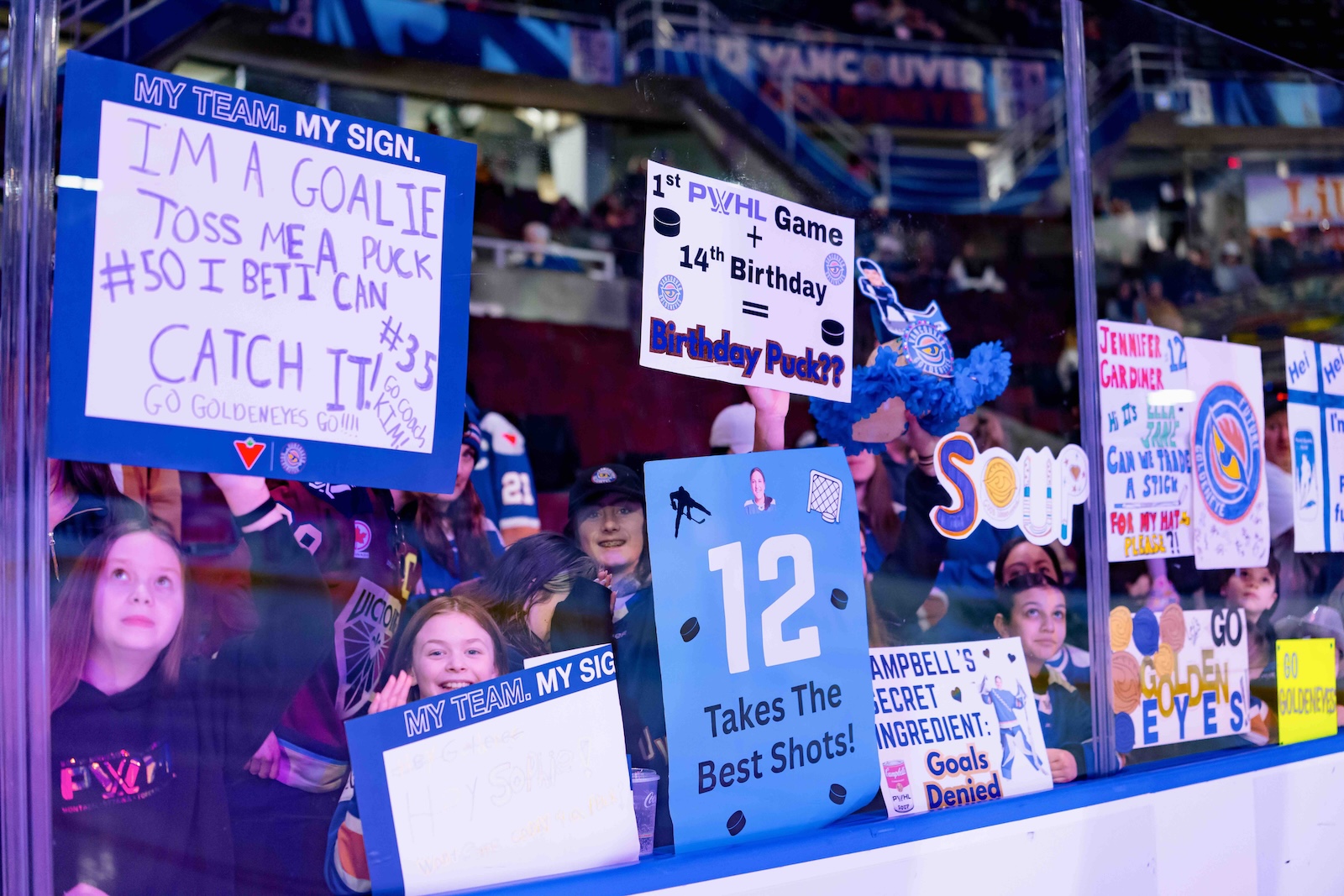
The smell of buttered popcorn wafts through the air at Pacific Coliseum on a Saturday afternoon. Outside the stadium, fans dressed in blue and gold buzz with excitement from the game, snapping photos with their friends, families and dates. Younger fans carry homemade signs with their favourite player’s names or messages like, “’Cuz girls are players too,” as they line up for a snack at food trucks.
It’s been a close game throughout the three periods, and while there’s clear tension on the ice, Chappell Roan’s “Pink Pony Club” choruses through the venue, with the crowd singing along joyously. The Vancouver Goldeneyes eventually lose 3-2 to the Ottawa Charge in overtime.
One year ago, there was no Professional Women’s Hockey League, or PWHL, team in Vancouver. Now, as the first season comes to a close, fans of the Vancouver Goldeneyes are filling the Pacific Coliseum for every home game, often decked out in Goldeneyes toques and sweatshirts and toting small plastic ducks in honour of the team’s name.
“They’ve been showing up for every game — no matter what the score is on the scoreboard, they’re there,” said Goldeneyes captain Ashton Bell. “They’re giving us more energy — they’re having a great time.”
Record-setting attendance
At the close of their first-ever season, the Vancouver Goldeneyes have made a lasting impression on the city, bringing in 9,000 to 14,000 fans every home game. That compares with the average of 8,500 fans that the Montreal Victoire had at their home games during their first season in 2024, and the league average of 8,795 fans per game this season.
In the home opener, Vancouver even set an attendance record at the time for largest crowd at a home venue, bringing in 14,958 spectators, according to the PWHL.
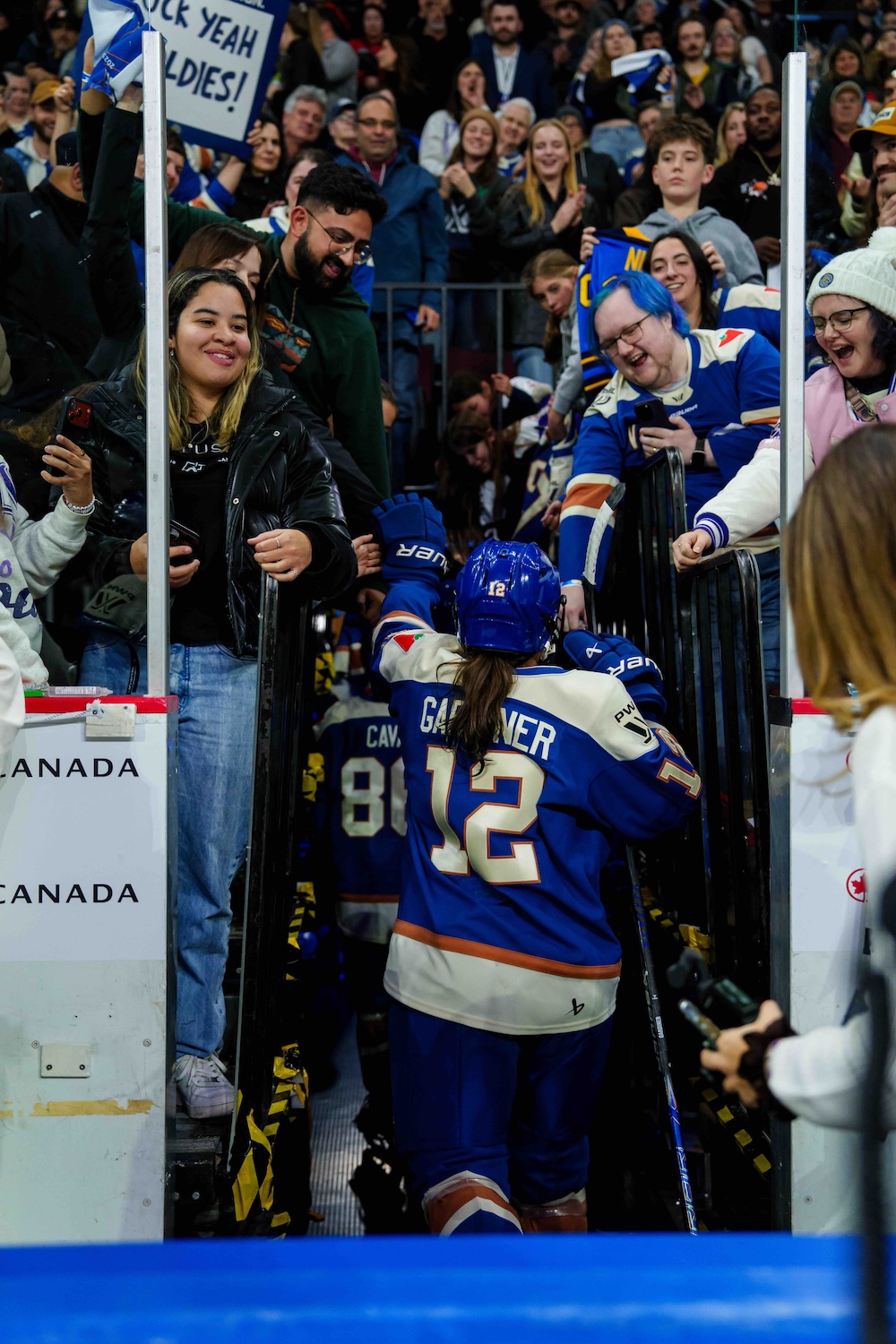
Some of the fans, like season-ticket holders Alex Welsh-Piedraita and his wife Kyla Schenk, have been fans of Vancouver hockey before, but hadn’t ever been able to become season-ticket holders. The Goldeneyes’ first season, they say, provided them with an opportunity to see what it was like.
“I grew up with a single mom, so having a strong female presence in a professional setting was really personally powerful,” explained Welsh-Piedraita. “So, we bought the tickets, and honestly, it was one of the best decisions we’ve made. It has been so fun every single game, and my wife has latched onto it.”
Now, the husband-and-wife duo trek down from Squamish to Vancouver to make every home game.
Schenk said she previously watched hockey passively. But the Goldeneyes have changed her connection to the game: she finds herself looking up fun facts and sharing side stories about each of the players.
“It's really cool getting to see women holding their own space and really shining at these games,” said Schenk.

Beyond the excitement for the team and what they stand for, the energy of the people in the stands has also made this experience easy to fall into. Welsh-Piedraita said he loves the positivity of the games, a feeling that persists even when the team is on the back foot.
“If we’re losing, you get that negative feeling in other spaces. Here, there’s not ever really a negative feeling,” said Welsh-Piedraita. “People are still happy, they’re doing the wave… I don’t think I’ve had any negative experience within the Coliseum once.”
Thirteen-year-old Sandra Chisholm and her mom, Tracey Moss, were attending a Goldeneyes game for the first time. To them, the Goldeneyes represent a brighter future for young women who love hockey and want to go pro.
“It’s so amazing to know that they have avenues for progressing and to have such great role models,” said Moss. “And a lot of them really give back to the hockey community by coaching and mentoring, which is so amazing.”
Even though it was her first game, it wasn’t Chisholm’s first time seeing some of the players on the team. She had met both defender Sophie Jaques and forward Jennifer Gardiner at a youth hockey camp, and was excited to see them in full action for the first time.
Building this type of atmosphere at the games is extra special for Gardiner, who grew up in White Rock, B.C. For her and the other local B.C. players like Nina Jobst-Smith, Katie Chan, Kimberly Newell and Hannah Miller, it was incredibly important to be accessible to the community. They make time to meet young girls, sign autographs and answer any questions that they might have, she told The Tyee at a press availability after a Goldeneyes practice.
Now, there’s never a home game where Gardiner doesn’t recognize a face in the stands.
“It means a lot to me to get to share my dream with everybody,” said Gardiner. “Along the glass during warm-ups there will be so many girls that I’ve coached, that have come to my camps, or camps that I’ve been at — and they’re all smiling.”

The long struggle for professional women’s hockey
While the PWHL is relatively new, women’s professional hockey is not.
The PWHL has numerous predecessors. There was the first National Women’s Hockey League (1999 to 2007). Then there was the Western Women’s Hockey League (2004 to 2011). There was the Canadian Women’s Hockey League (2007 to 2019). And there was the National Women’s Hockey League again, later renamed the Premier Hockey Federation (2015 to 2023).
While the Canadian Women’s Hockey League was considered the first centralized elite women’s hockey league, because the players weren’t paid, it was not considered professional, according to the Colgate Maroon-News. It also wasn’t sustainable as its funding came from donations and small sponsorship deals.
The National Women’s Hockey League, which came along in 2015, was founded by former ice hockey player Dani Rylan Kearney, and was primarily based in the United States and China. The league became the first women’s hockey league to offer salaries, although the pay was very low, ranging from $10,000 to $26,000. However, in the second season of the National Women’s Hockey League, the players’ salaries had to be cut due to budget constraints, according to the New York Times. The event caused some players to retire from ice hockey completely, or rejoin the Canadian Women’s Hockey League.
Then in 2019, the Canadian Women’s Hockey League officially announced the league would close because of financial instability. Despite the National Women’s Hockey League’s attempts to expand into Canada, the previous frustration over extremely low salaries in the past led to distrust and more than 200 players announced via social media that they would no longer be playing in North America until there was a single and economically stable league.
The National Women’s Hockey League, which rebranded as the Premier Hockey Federation in 2021, continued to boost salary caps up to $300,000 per team for the 2021-22 season, but the league was still facing boycotts from key players.
Then, in June 2023, just six months after the Premier Hockey Federation announced that they would be providing teams a $1.5 million salary cap, Mark Walter, the owner and chairman of the LA Dodgers, acquired the Premier Hockey Federation, and joined it with the Professional Women’s Hockey Players Association, Forbes reported.
In September 2023, the Professional Women’s Hockey League, or PWHL, announced its inaugural six teams (with the names coming later in 2024): the Montréal Victoire, Ottawa Charge, Toronto Sceptres, Boston Fleet, Minnesota Frost and New York Sirens. The teams started their first official season in January 2024.
It was clear that fans were eager for the league to expand west. During the PWHL takeover tour, where regular games were held in cities that didn’t have a team, the game in Vancouver’s Rogers Arena had the largest attendance out of all the tour stops, with 19,038 fans attending the game.
Hockey returns to Vancouver’s Pacific Coliseum
The energy from the fans at that time was what made the Pacific National Exhibition, or PNE, realize that the league expansion for the PWHL was the right move for the Pacific Coliseum, said Karen Massicotte, the PNE's vice-president for sales, marketing and business development. The PNE runs the Coliseum along with other venues at Hastings Park.
“We knew that this was the right group of people, from the league and the leadership of the league, straight down to the local community,” said Massicotte. “And that this was what was needed in the City of Vancouver.”
In April 2025, the PWHL announced that Vancouver would be one of two new teams added to the league, along with Seattle. The team was later named the Vancouver Goldeneyes and started its first season in the fall of 2025.
Now, Gardiner says that she and the team play for not only the young girls in the stands, but the women who love hockey but didn’t get to play at a professional level.

“We’re getting to live a dream that they never had an opportunity to have, but they now get to live it through us,” said Gardiner. “It makes us feel that much extra gratitude [for] big moments to actually get to play on the stage and live this out because they couldn’t.”
Goldeneyes season-ticket holder Meghan McConnell is one of those fans. She grew up playing hockey and ringette, and never dreamed that there would be a women’s team in Vancouver she might be able to play for, let alone cheer for.
“We were just Canucks fans,” says McConnell. “That’s all there was.”
The Pacific Coliseum has had a long history of being Vancouver hockey’s first home, long before it was made into the Goldeneyes’ new nest.
It was the site of the Vancouver Canucks’ first NHL game back in October 1970. The arena was the team’s home, and hosted the games of two Stanley Cup finals with the Canucks in 1982 and 1994. The team officially relocated to Rogers Arena in 1995.
After the Vancouver Canucks, the WHL team the Vancouver Giants were the primary tenant of Pacific Coliseum from 2001 until their move to the Langley Events Centre in 2016.
The venue has hosted arts, culture and sporting events, but hasn’t been a full-time home to hockey since the Giants left.
Nine years after the PNE said goodbye to the Vancouver Giants, they got ready to welcome a new hockey franchise into Vancouver: the PWHL Goldeneyes.
Before the venue was able to welcome the team, the Coliseum was upgraded to make the arena PWHL-ready. This included adding a new score clock, broadcast lines, fibre lines, a new production studio and media spaces, along with general updates to the facility, Massicotte explained.
Pacific Coliseum also decided to update the food options for the fans, adding a variety of food trucks in addition to traditional Vancouver hockey game snacks like Triple O’s, pizza and wings. The PNE also added a new chef offering carved roast beef, chicken pot pies and salads, “really tailoring it to the audience,” said Massicotte.
All these alterations, Massicotte explained, were to ensure that the Goldeneyes and their fans had a great first season in Vancouver.
“We’re in a place of giving an amazing organization like the PWHL an opportunity to be the first in Vancouver to launch a successful female hockey team, said Massicotte. “And let their legacy begin here in the town, give them a platform to start their legacy.”
The Goldeneyes take flight
At almost one full season into their legacy, everyone has high expectations for the future of the Goldeneyes and the PWHL in Vancouver.
Currently, the Goldeneyes stand as seventh in the league, with only one of the four playoff spots available. This year, it’s unlikely they’ll make it to the playoffs.
But as the captain of the team, Bell still hopes that the Goldeneyes can be a winning team that the city can stay behind in the future. It is, after all, only year one for the Goldeneyes.
“We want to continue to put a good product on the ice for them and to be a winning team, a championship team,” said Bell.
Beyond Vancouver, fans hope that the success of the latest expansion will lead to new teams in other cities, especially in the west where just two teams — the Vancouver Goldeneyes and the Seattle Torrent — are currently playing.
“The success of the Goldeneyes and Torrent has made us even more excited for the second round of PWHL expansion, which will bring the league from eight to 10 or 12 teams in the league’s fourth season,” said the PHWL in an email. “We look forward to sharing more in the coming months.”
For Gardiner, her goal is to ensure that the Goldeneyes and the PWHL remain an opportunity for the next generation of women in sport.
“Let’s keep the torch lit. There have been a lot of trailblazers who have led the way for us to be able to walk out of college and have this league,” said Gardiner.
“I think now our job is to give back to the community and do everything that we can to ensure that the PWHL is continually supported with fans and finances.”
As it stands, for the financial stability of the PWHL’s players, the PWHL’s eight-year collective bargaining agreement states that the salary range for players will be between $35,000 to $55,000 — a far cry from the giant salaries professional male athletes receive.
As for the league’s own finances, they continue to expand their partnership portfolio. Forbes reported that the league’s portfolio had grown by 50 per cent in 2025. These partnerships include Intact Financial Corporation, Canadian Tire, Royale, Scotiabank and EA Sports.
Beyond being able to watch the Goldeneyes for years to come, young fans at the games, like 13-year-old Chisholm, hope the league will continue so they might have a chance to play one day themselves.
“I hope that someday I can play on the Goldeneyes and [my parents] can watch me,” said Chisholm. ![[Tyee]](/design-article.thetyee.ca/ui/img/yellowblob.png)
Read more: Gender + Sexuality, Sports












Tyee Commenting Guidelines
Please note that email notifications for replies are not currently working due to a software issue which may be resolved in a future update.
Comments that violate guidelines risk being deleted, and violations may result in a temporary or permanent user ban. Maintain the spirit of good conversation to stay in the discussion and be patient with moderators. Comments are reviewed regularly but not in real time.
Do:
Do not: