

 SHARE:
In a busy coffee shop in downtown Smithers, Christine Añonuevo fans several issues of Northword Magazine across the table. Just then, a woman leans in and introduces herself.
“Are you Christine?” she asks, explaining that she’s an advertiser with the magazine. While the pair have emailed, they’ve never actually met. The moment feels like a reflection of the power of regional culture magazines; they bring people together.
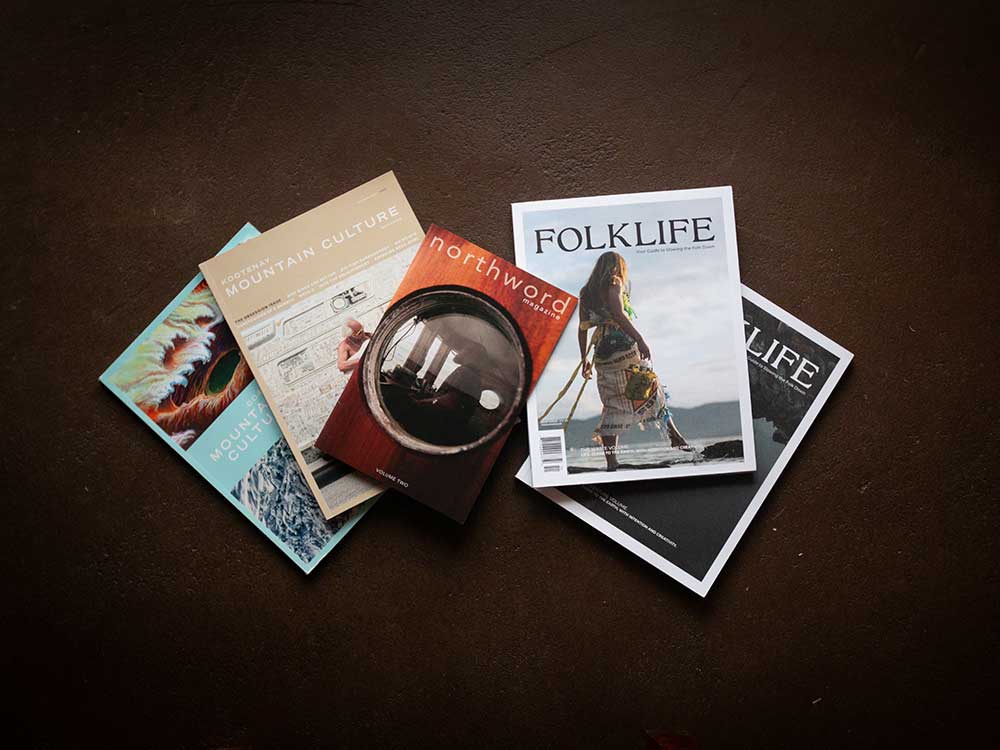
In an age of online news and chronic doom-scrolling, print magazines invite you — to borrow the tagline from one B.C.-based publication — to slow the folk down. They provide an excuse to take a moment, put your feet up and enjoy your coffee as you flip through the pages of stunning photos and place-based stories.
These magazines reflect and connect our communities, while also explaining them to the rest of the world. They have a physical presence — the weight of the magazine in your hands, the texture of the printed page under your fingertips.
More than one person The Tyee spoke with described their smell.
“I don’t know many venues where people from across the north can come together to tell their story,” Añonuevo says. “Northword provides that forum, that place for dialogue, that place for discovery, connection and the start of relationship building.”
The way we access information is rapidly evolving and the news media is changing along with it. With most of us chronically online, advertisers have turned to virtual platforms. Printing costs are rising. Grocery stores and pharmacies are gradually decreasing or removing their magazine racks. It’s getting harder and harder to make the publications sustainable.
In an increasingly globalized world, what is the role of regional culture mags?
The Tyee spoke with two magazine publishers and one former publisher in three corners of the province. They used phrases like “passion project” and “labour of love” to describe the energy they’ve poured into their publications. In many ways, they are not so much media owners as they are community organizers.
For northern BC, Northword Magazine
Añonuevo is the newest owner of northern B.C.’s long-standing lifestyle magazine.
Northword began in the late 1990s under a different name before it was bought and re-branded about 20 years ago. It continued under a series of owners until the pandemic hit. As local businesses shuttered and its advertising base dried up, Northword was mothballed in 2020.
“It was unprecedented. A lot of businesses had to shut down,” Añonuevo says about the period that marked a significant blow to publications that were already struggling with the shifts in news media.
Although she’d never had a formal role in Northword, Añonuevo found herself missing it. She recalls reading it as a newcomer to northern B.C. and learning about her adopted home.
“It has this — I don’t want to say magic, because that sounds kind of cheesy — but it has this drawing power for people that read it,” she says. “I always wanted to write for it. I think the magazine really inspires people and people see themselves reflected.”
When the previous owner posted on social media that he was considering selling, Añonuevo was intrigued. “On a whim, I sent him a message,” she says.
It sparked a conversation that led to her buying the magazine in 2024. What happened from there was a “huge learning curve,” she says. Añonuevo has a degree in English literature and enjoys creative writing. But while she’d read many magazines, she never imagined she’d ever be running one.
“It was a lot,” she says, four issues later. But when the magazine re-launched last spring, readers were excited.
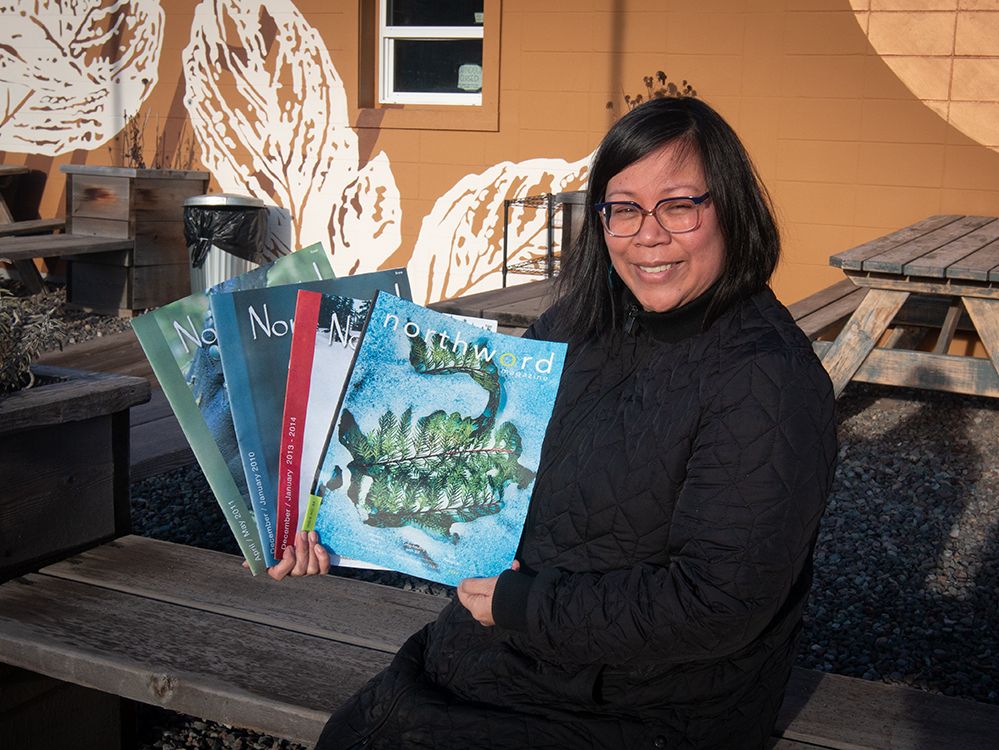
Today, Northword is back to distributing quarterly to dozens of communities between Prince George and Haida Gwaii. It is shipped to Jasper and Banff in Alberta and is quickly gaining new subscribers across B.C. and beyond. It has a new website and Añonuevo is working with the local museum to digitize the magazine’s back issues.
But its online presence is secondary to the print magazine, she says. Because printing constitutes a substantial portion of production costs, she’s looking at ways to diversify the revenue stream and make it more sustainable.
As Northword re-emerges into a very different media and political landscape, she hopes it offers readers stories that are uplifting, community-oriented and focused on solutions.
“But having said that, we’re not going to shy away from challenging subjects,” she adds. “If we’re not talking to one another and communicating about the things we care about, that makes being neighbours and being in community a lot more difficult.”
For the Gulf Islands, Folklife
As Alina Cerminara prepares to distribute each new issue of Folklife, there is one final ritual she undertakes. She writes a short message of appreciation to every subscriber — there are, literally, hundreds of them.
“It’s not easy,” laughs Cerminara, who admits that subscription sales may soon outpace her capacity to continue the tradition. “But it’s worth it for how it makes people feel.”

The Gulf Islands-focused lifestyle magazine was inspired by the power of connection. When Cerminara began planning the publication in 2019, it was a response to the slow and intentional lifestyle she observed in places like Salt Spring Island and Gabriola Island.
“That community vibe is just so amazing,” she says. “Everybody can take the time to talk and connect with you.”
But Cerminara also recognized the isolation of living on an island, in a rural area, particularly during long, dark winters. At times, she saw the region as disconnected and lonely. She wanted to connect people.
As she sent the first issue to press on March 13, 2020, Cerminara could never have imagined the isolation that was about to envelop the world. But when she hand-delivered those first copies a month later, the magazine gave residents a connection not just to one another but, soon, to the rest of the world.
While Folklife features primarily Gulf Island writers, Cerminara quickly realized that the “slow-living lifestyle” it portrays is universal. The magazine soon attracted a distributor, putting it on racks across Canada and around the world.
“For people to see their community members highlighted in such a beautiful way and then, soon after, in shelves internationally, everybody was super stoked,” she says.
While a crowdfunding campaign helped cover initial publication costs, “the rest I just bootstrapped,” Cerminara says. A simple lifestyle and working other jobs allowed her to subsidize costs. It’s only recently that she’s begun consistently paying herself.
The bi-annual publication schedule allows her to live the slower-paced lifestyle she espouses in the magazine, with long lead times and the ability to approach the magazine with intention.
But there was never any question about whether Folklife would continue as a print publication.
“That’s just who it is,” Cerminara says. “We’re about being close to the Earth with intention and creativity. For it to just be a digital magazine wouldn’t fit.”
Folklife’s revenue stream combines newsstand sales, ads and grants. But subscriptions offer the most promise, she says.
She says she’ll continue writing those subscriber notes for now.
“It goes back to that loneliness thing,” she says. “For a lot of people, that note is as important as the magazine. It makes people feel special.”
For the Kootenays, Kootenay Mountain Culture
Kootenay Mountain Culture began as an outdoor adventure magazine meant to showcase the region’s mountain lifestyle. But it never fed the tropes associated with gearheads and ski bums.
Instead, it offered something more. It delved into the region’s unique culture, profiling its characters, examining its history and taking a lens to communities transitioning from a resource-based economy to one focused on tourism.
“We really wanted to represent this region as authentically as we possibly could,” says Mitchell Scott, editor-in-chief and co-publisher at Mountain Culture Group. “We were clear with our advertisers. We did not do a single gear review in our magazine, ever. We did not do a single ‘top 20 places to go in the Kootenays.’
“Maybe that was not a smart business decision in the end. But I think we realized that this was not a get-rich-quick scheme. We wanted to exercise our creative freedom.”
When he joined publisher Peter Moynes at the fledgling Kootenay Mountain Culture magazine in 2001, Scott, who had previously freelanced for prominent outdoor magazines like Powder and Bike, was focused on compelling storytelling.
Paired with stunning photography and layout, the glossy mag, which was distributed free throughout the region, attracted big advertising accounts like Arc’teryx, North Face and Toyota.
Its success led Mountain Culture Group to launch Coast Mountain Culture a decade later. In 2013, the magazines were honoured with Magazine of the Year and Best New Magazine at the Western Magazine Awards.
They were in the midst of expanding when the pandemic hit.
Advertisers scattered, taking with them $300,000 in revenue over a matter of weeks. The magazines quickly retooled to produce one consolidated issue in summer 2020. But it proved to be the last for Coast Mountain Culture.
Mountain Culture Group never really recovered, Scott says.
“We looked at each other and said, ‘Do we really have the energy to do this?’” he says. “We were like, ‘Hey, this has been a real blast. We’ve contributed greatly to our community and the mountain culture publishing world in general. We could drag this along or we could just close it up and call it good.’”
In 2024, Kootenay Mountain Culture suspended publication. Moynes took the helm at Nelson Kootenay Lake Tourism Association. Scott has pivoted to housing development — another job that keeps him immersed in community.
Asked whether the magazine could, like Northword, experience a resurrection, “It’s doubtful,” Scott says. He fears a new owner with a different vision could change the legacy left by the local mags.
“I’ve run into people who moved to the Kootenays because they found our magazines. I’ve also run into many people who have moved here who can’t really explain it and send Kootenay Mountain culture back to their family,” he says.
“We’re very proud of what we did.” ![[Tyee]](/design-article.thetyee.ca/ui/img/yellowblob.png)
Read more: Media










Tyee Commenting Guidelines
Please note that email notifications for replies are not currently working due to a software issue which may be resolved in a future update.
Comments that violate guidelines risk being deleted, and violations may result in a temporary or permanent user ban. Maintain the spirit of good conversation to stay in the discussion and be patient with moderators. Comments are reviewed regularly but not in real time.
Do:
Do not: