
 SHARE:
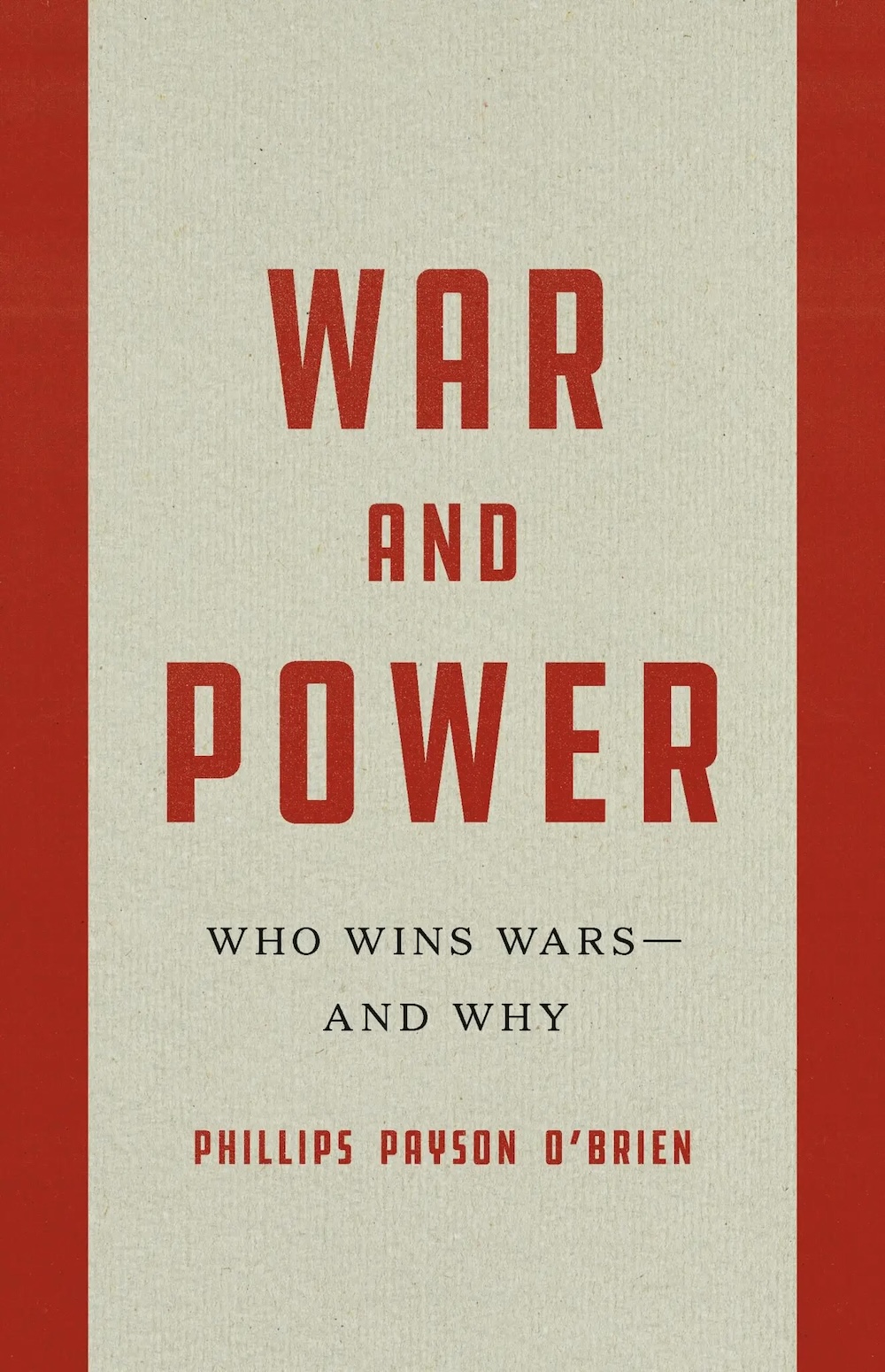
War and Power: Who Wins Wars — and Why
Phillips Payson O’Brien
PublicAffairs (2025)
Phillips Payson O’Brien is a “revisionist” military historian. Rather than examine the conventional wisdom about modern warfare, he junks it and proposes a very different analysis of war itself.
While O’Brien deals with war since Napoleon and especially since the First World War, his ideas in his latest book, War and Power: Who Wins Wars — and Why, throw light on very recent conflicts like those in Ukraine and Gaza, and even Donald Trump’s threatened military actions against countries like Venezuela and Nigeria.
Rather than an epic clash of great powers winning or losing on the battlefield through sheer guts and firepower, war to O’Brien is a struggle of economies and societies, technologies and political systems. There are no “great powers,” he argues. But a “full-spectrum” power with a strong economy, a united society, advanced technology and a functional political system — plus good allies — has at least the potential to win a war.
The first element is an advanced economy capable of building advanced technology.
O’Brien writes:
Power in both times of peace and times of war depends on the ability to design, build and manipulate “stuff.” The stuff in question has to be the most technologically advanced for its time, well made, produced in substantial quantities (especially during wars), and at a cost that is sustainable and competitive. This matters more than geographical size or population numbers when it comes to national power. Indeed, looking at which states have been the most powerful over the last two centuries, it has been the economically largest and technologically most advanced that have dominated.
So Britain’s economy, O’Brien says, enabled it to build a powerful navy, up to and including the absurdly expensive “dreadnought” battleships that triggered an arms race with Germany in the early 1900s.
The U.S. economy in the Second World War was able to build an even more complex and expensive weapon, the B-29 bomber, while the Germans tried and failed to build a comparable bomber. The B-29 cost more than the Manhattan Project that built the first atomic bombs, but it did irreparable damage to German industry.
Leadership is O’Brien’s second element of success: to succeed in war, a country must have a leader who understands war and can take the steps to win it.
Here, Adolf Hitler comes off badly. An infantryman in the First World War, he thought in terms of massive attacks, both on land and in the air. He also thought wars could be won by striking first, fast and hardest — what came to be known as blitzkrieg or lightning war. And he wasted resources by building the V-2 rocket and insisting that Germany’s first jet plane be a dive bomber, not a fighter.
By contrast, Franklin Delano Roosevelt had been secretary of the U.S. navy during the First World War, and he understood the next war would be won at sea and in the air. He was determined to get into the war but had to wait until Japan bombed Pearl Harbor and Hitler declared war on the United States. Once that happened, an all-out war effort was politically possible.
The third element is the society at war. Hitler distrusted Germans’ support for the war, so he kept up consumer goods production. Roosevelt knew Americans who had been reluctant to fight were now eager to do so, enabling him to convert the U.S. economy entirely to the war effort.
In the military, size doesn’t always matter
A country’s military, O’Brien argues, can’t be judged by numbers and hardware alone. Roosevelt, against the advice of his generals, developed a relatively small army while building an enormous navy and air force.
The Japanese military dominated the civilian government — but Japan’s army and navy each fought the war it wanted to fight, with little co-ordination and very little civilian influence.
Japanese military doctrine was focused on decisive battles won by firepower. They built enormous garrisons on the Pacific islands they had conquered, and simply ignored the American ships that crossed the ocean laden with war supplies. Meanwhile U.S. submarines hunted Japanese shipping, depriving the island garrisons of their own supplies.
Allies, O’Brien says, are the fifth component of modern warfare. In the First World War Germany was burdened with Austria-Hungary, whose military was sadly inadequate; in the Second World War Hitler had to rescue Mussolini from his military misadventures, and Japan was too far away to offer Germany any help. In both wars, O’Brien says, the winners were able to lend support to one another, and all relied on the U.S. economy for weapons and other supplies.
O’Brien makes a good case for his version of victorious warfare, when all the elements are working properly. But even the victors can forget, and fall back into the delusion of bigger armies and superweapons.
Twenty years after Hiroshima, the United States found itself fighting in Vietnam against a far weaker enemy, the North Vietnamese under Ho Chi Minh.
Winning every battle but losing the war
For all their technological might, the Americans couldn’t get the support of their own people, while Ho’s supporters in both North and South Vietnam were dedicated to throwing foreigners out of their country. As O’Brien notes, the Americans won every battle but still lost the war.
Similarly, the United States and Europe assumed Russia would roll into Kyiv in a matter of days because the Russian army was far larger than the Ukrainian army. Yet as we all know, Volodymyr Zelenskyy and his government mobilized Ukrainian society and developed extraordinary weapons technology that stopped the Russians on land and kept their navy in its Black Sea ports — rather like the German battleships in both world wars that went to sea rarely and were sunk when they did.
Ukraine is also fortunate in having powerful allies, both in Europe and North America. Russia’s Vladimir Putin has few allies except the North Koreans (and the Chinese, at a discreet distance).
O’Brien, though, is contemptuous of the United States’ feeble support for Ukraine. Deceived by the numbers of the Russian army, both Trump and Joe Biden rationed the weapons they would provide to Ukraine, and they put limits on their use. Supposedly this was to avoid provoking Russia into using nuclear weapons, but O’Brien thinks a better-armed Ukraine would have defeated Russia after a much shorter war.
As O’Brien scathingly puts it:
“The army of Vladimir Putin was arguably the most overrated military force of the modern world, even more so than the military of Benito Mussolini.”
Now, of course, Trump has ceased all direct aid to Ukraine; he sells weapons to NATO countries that they send on to Ukraine, and Trump continues to pretend that Zelenskyy “doesn’t have the cards” to win.
With friends like the US, who needs enemies?
Worse yet, the Americans and Russians recently cooked up a 28-point “peace” proposal that met with polite throat-clearing from western governments that didn’t want Trump to have a tantrum over the flat rejection the proposal deserves.
The United States has decisively lost its reputation as a reliable ally.
O’Brien examines the potential for war between the United States and China, by far the two biggest military powers in the world. He sees the U.S. military as experienced by its 85 years of warfare since Pearl Harbor, but with a string of defeats including Vietnam, Iraq and Afghanistan.
O’Brien also worries that the U.S. military now comprises mostly personnel from Republican states, so it’s not really representative of the whole country.
On top of that, the U.S. economy is now based on services, not manufacturing, so sustaining war production could be difficult in a war with China.
That’s in part because China is, as O’Brien puts it, a “manufacturing powerhouse.” But China hasn’t fought a war since a 1979 quarrel with Vietnam, which the Vietnamese won easily. The People’s Liberation Army has gone through many upheavals since then, but it’s uncertain whether Chinese society would back Xi Jinping in an all-out war with the United States. Ideally, both sides would find a way to stay out of war with each other.
Meanwhile, several other conflicts loom for the Americans. They’ve proven to be an unreliable ally for Ukraine and therefore for Europe and Canada.
Yet Trump talks about attacking Venezuela to remove the Nicolás Maduro regime, and to launch attacks on the drug cartels in Mexico. He even threatens to go into Nigeria, “guns a-blazing,” to rescue Christian Nigerians from imagined oppression.
Bound to lose every war
By O’Brien’s metrics, Trump would be bound to lose every such war, if only on poor leadership. As well, both the U.S. military and civilian populations would be deeply reluctant to support such adventures.
A recent CBS poll showed 70 per cent of Americans would oppose military action against Venezuela, while 30 per cent would support it. Seventy-six per cent say Trump hasn’t clearly explained the reasons for action against Venezuela.
The numbers would be even more negative for an attack on Nigeria or Mexico. Trump would find himself alone and friendless (except for Saudi Arabia, El Salvador and Hungary, perhaps).
Boycotts of U.S. trade would grow exponentially, and even Canadian elbows would go up and stay up. Protests in the United States would dwarf those against Vietnam.
We might even see massive resignations among senior military officers, and at least one U.S. senator thinks an attack on Venezuela would “fracture” the Republican party.
So the United States might be a full-spectrum power, but almost any all-out war it gets into would be its undoing.
Reading O’Brien’s book is oddly cheering. The two biggest threats to global peace, Putin and Trump, are by O’Brien’s standards incompetent leaders of societies in disarray, without the political, technological or allied resources for an extended war.
They may start wars, but they will lose them — and likely lose power altogether.
If the democratic nations can apply O’Brien’s ideas to other wars, like those in Sudan and the Democratic Republic of Congo, they can punish the external funders of those conflicts and make them an example for any other countries thinking of making themselves great again.
Happy holidays, readers. Our comment threads will be closed until Jan. 5 to give our moderators a much-deserved break. See you in 2026! ![[Tyee]](/design-article.thetyee.ca/ui/img/yellowblob.png)