 SHARE:
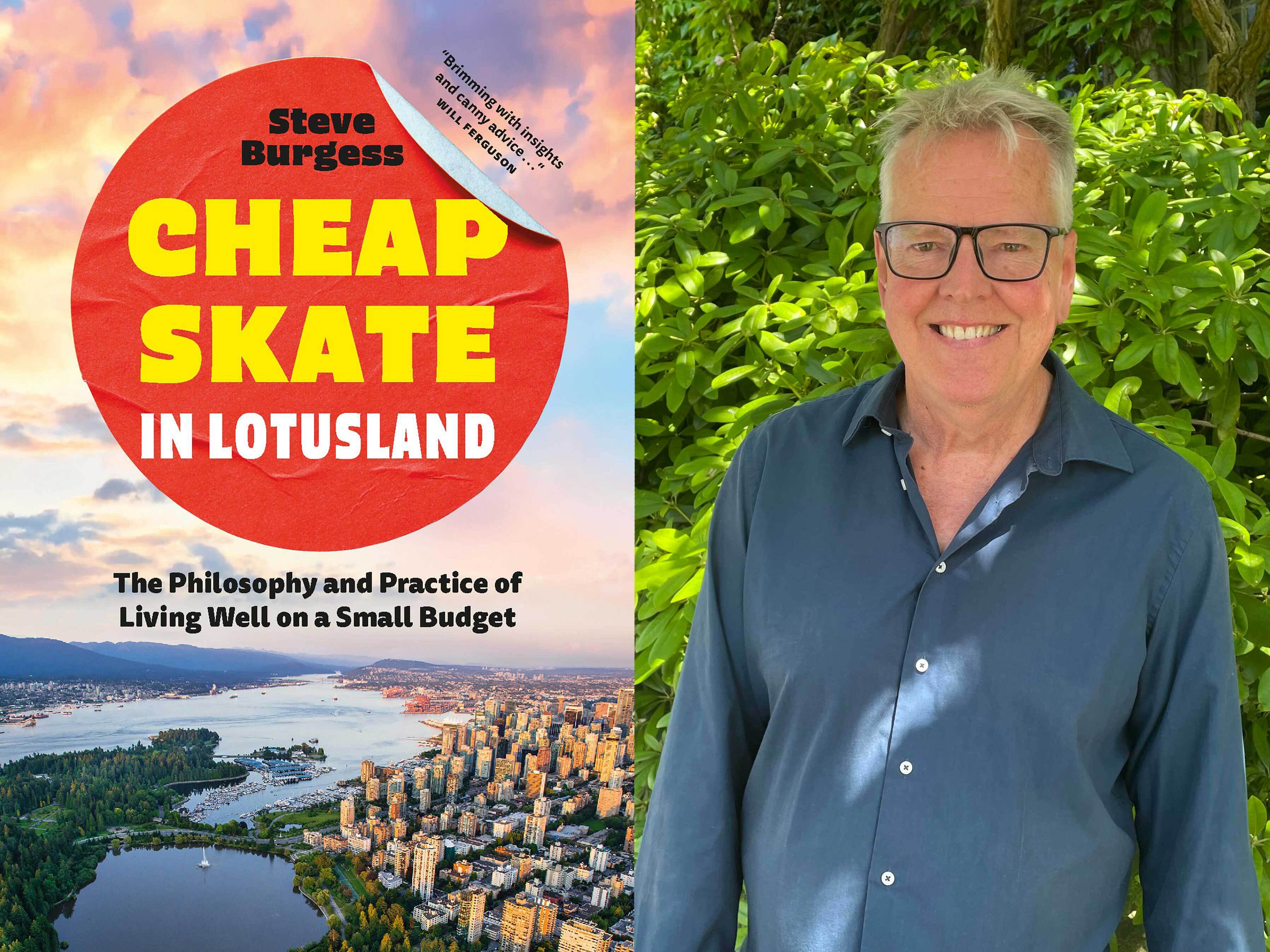
[Editor’s note: Tyee contributing editor Steve Burgess’s latest book dives into the philosophy and practice of frugality. A blend of memoir and reportage, ‘Cheapskate in Lotusland: The Philosophy and Practice of Living Well on a Small Budget’ is out through Douglas & McIntyre in the new year and considers what it means to live modestly but happily in Vancouver, an expensive city. In this excerpt from ‘Chapter 20: The Virtuous Cycle,’ Burgess traverses the city on his trusty bicycle, a fun and frugal form of transportation.]
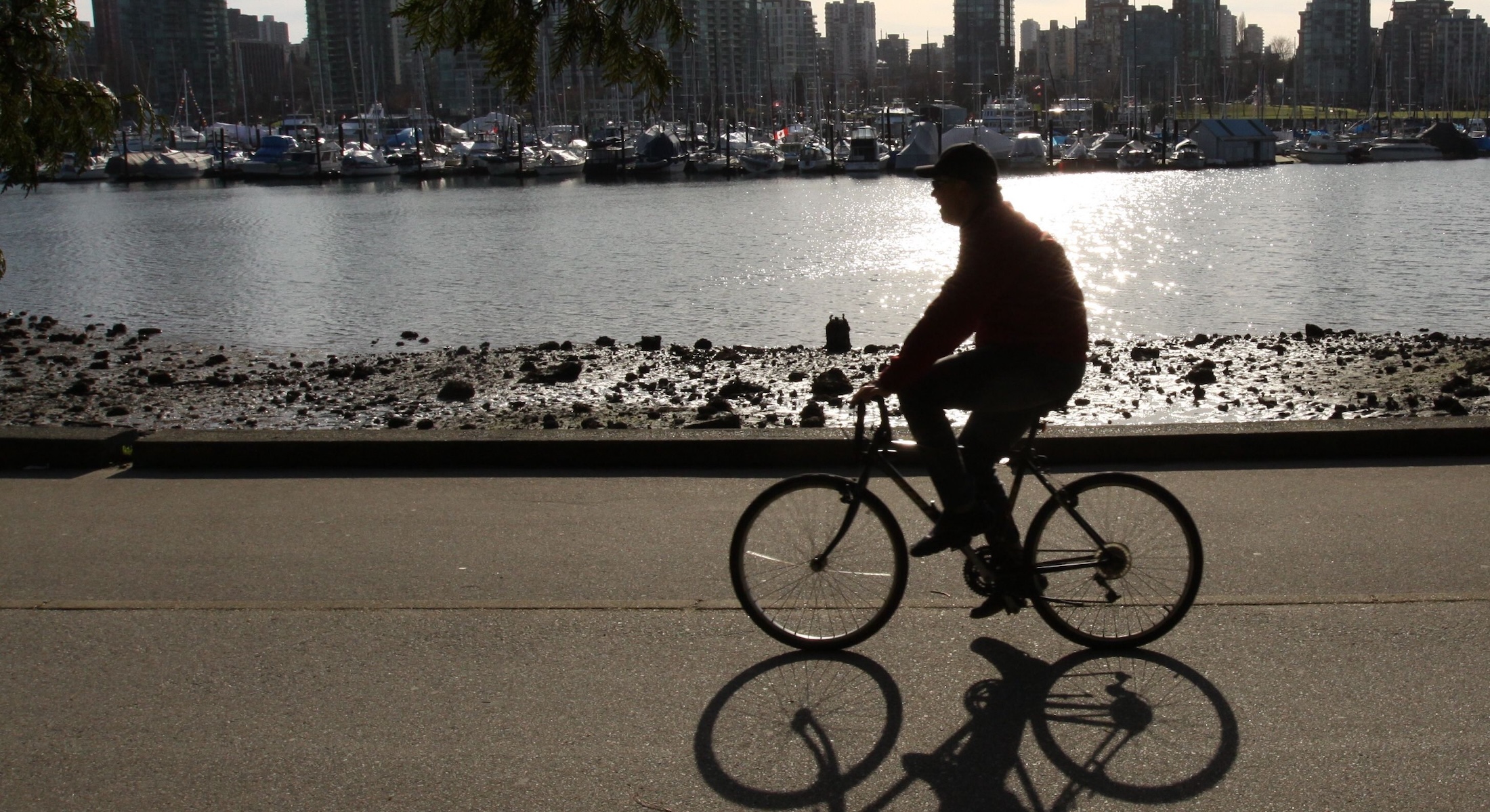
I get around by bicycle. I used to drive. But my car use just fell away — living in Vancouver’s West End and working at home, the car was a burden, an inconvenience, an expense. Was it frugality that kept me on two wheels? Probably. But as has been the case in other aspects of my life, frugality has been a path to unintended benefits.
Good health is, in some respects, a lottery. A person can do everything right and still be hit with a debilitating or deadly disease. Those of us who have not suffered such a malady must bow our heads in gratitude every day.
I have indeed been lucky. But there are aspects of personal health that are under one’s control. I do not drink or smoke, and although officially classified as a senior citizen I take no drugs — prescription, over the counter or otherwise. I have not even had a family doctor for over 30 years. (That’s not a good thing, and it opens up an entirely different discussion about the state of health-care services in this country. I have been trying to find a doctor. But the point is that until now I have been fortunate enough not to need one.) I believe that the key to my personal health is my bicycle.
I salute those who faithfully keep to their gym routine. But a bicycle needs no schedule, nor any great act of willpower. It’s an integral part of your day. You are on your way to buy groceries, go to work or visit friends. The exercise is simply a byproduct of living. A bicycle wheel is a virtuous circle.
I was always the type of guy who’d be picked last for schoolyard soccer. (I once made the junior high basketball team because of my height, and in one game launched a shot that went so badly wrong the entire gymnasium erupted in howls of hilarity.) So it’s beneficial to have a form of exercise that does not feel like yet another depressing demonstration of my athletic inability.
I’m not a goalie letting his team down yet again, a yoga class novice making the instructor question her life choices, or a weak pickleball player being schooled by octogenarian hustlers.
I’m just an old dude pedalling off to Save-On-Foods to grab a bargain on chicken thighs. And, incidentally, not paying for parking.
‘In terms of frugality, bicycles rule’
“Life happens on foot,” writes Danish urbanist Jan Gehl. “Man was created to walk, and all of life’s events large and small develop when we walk among other people.
“By being sweet to the pedestrian and the cyclist you hit five birds with one stone — you get a lively city, you get an attractive city, you get a safe city, you get a sustainable city, and you get a city that’s good for your health,” Gehl contends. “These are all things we are very concerned about at this time in history.”
You also save money. In terms of frugality, bicycles rule. Taras Grescoe, author of books like Straphanger and The End of Elsewhere, has four different bikes in his Montreal basement, each suitable for a different situation.
“They say the cost of car ownership in Canada and the United States is $12,000 a year if you live in a city,” Grescoe says. “Your mileage will vary according to where you live. But for most people, when you factor in depreciation, tickets, gas, insurance, it’s about 12 grand a year. You add that up over a lifetime. That’s really significant. North Americans pay more for transportation than almost anybody else in the world.”
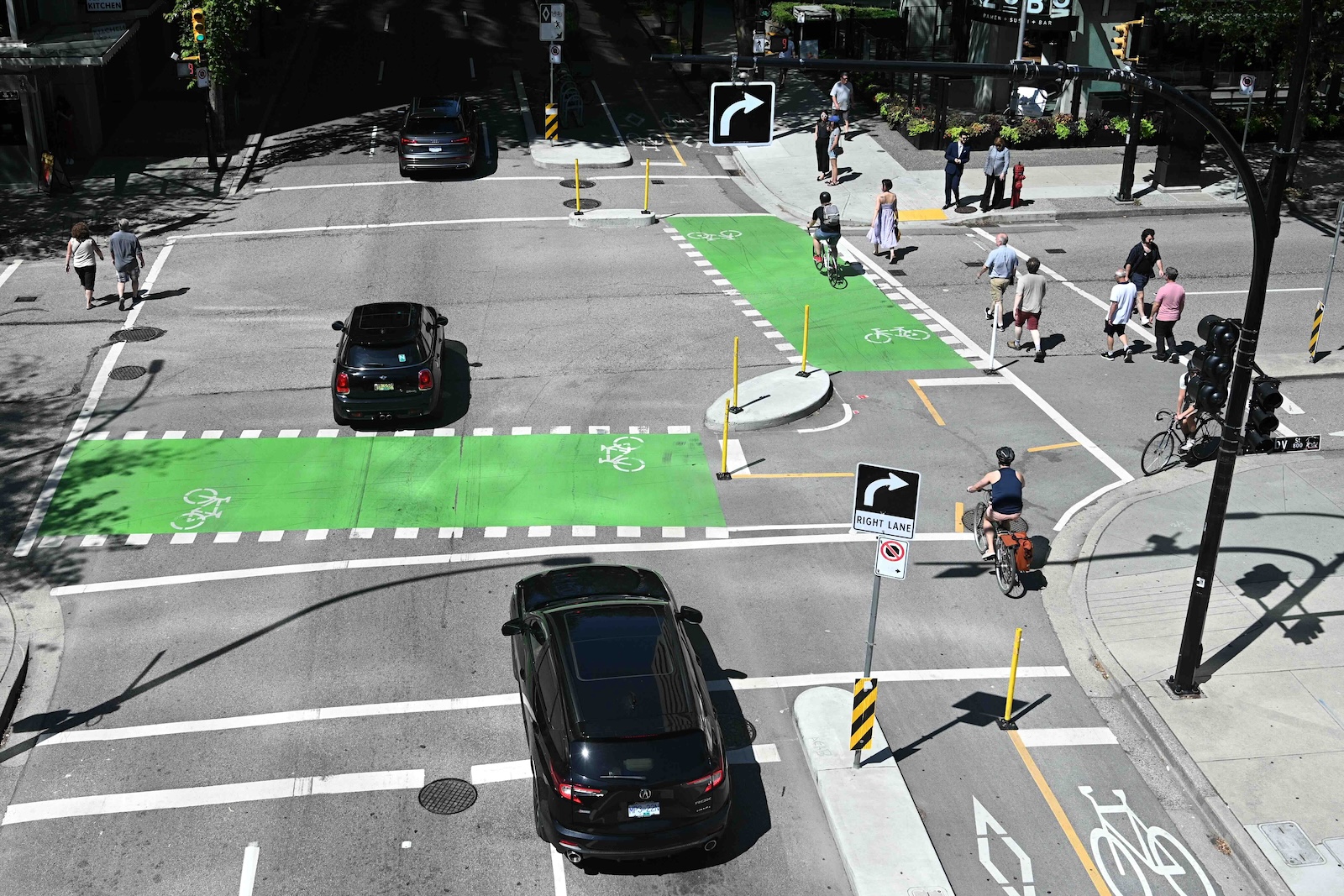
It’s expensive for cities as well. “Building bicycle infrastructure in a city, protected bike lanes, is a matter of a few million dollars,” Grescoe says. “In larger cities, it might go up to hundreds of millions. But the infrastructure to support cars costs billions. It’s a drag on the economy of cities, regions, of countries. It also has a huge impact on public health. It’s just really not good for people. People who cycle, just routinely to get to work or school, have higher levels of fitness. They live longer. So in terms of cost analysis, it’s pretty clear that active transport, bicycles, walking, makes a lot more sense.
“But the thing is,” he continues, “cities in America are set up for motor vehicle infrastructure at this point. So it’s kind of hard. Cities are trying to reverse-engineer their way out of that right now. New York has passed this congestion relief charge, which is having a big impact.”
Grescoe bridles at the suggestion that cycling infrastructure is elitist. “There’s this association with drivers being salt of the Earth,” he says.
“You know, working stiffs. And cycling infrastructure is an elitist plot to drive them out of cities. Well, I’m not rich. I can afford to live in the city because I don’t have this incredible expense of the car, this $12,000 a year I would have to pay. Over the years it has added up and allowed us to afford a pretty nice apartment in the city. So I really see this as a false culture war. A lot of people who do own cars are pretty rich, they’ve got the means to do that. It kind of drives me crazy.”
Pedestrians and cyclists make drivers’ lives easier
Alex Boston, urban planning consultant and executive director at Simon Fraser University’s Renewable Cities program, says you don’t have to ride a bicycle to benefit from increased bicycle use in your community. “Every person who walks or bikes to the butcher, the baker, the cappuccino maker, each one of those individuals is making it easier for the person who drives around town,” Boston says.
“It doesn’t mean everywhere — it means medium-length and short trips. But the share of short trips we have in our weekly transportation activities is huge. It’s astonishing, but if you can get two or three per cent of cars off the road you can go from people moving at 15 to 20 kilometres an hour up to 50 kilometres an hour. You cross these magic thresholds where congestion drops. Using bike paths is the single most cost-effective way to reduce congestion.”
The idea that everyone benefits from better cycling infrastructure is a hard sell to motorists, many of whom seem to resent any square metre of pavement removed from their once-unchallenged share. In Vancouver there often appears to be a simmering civil war between two wheels and four.
If there’s a tribal dimension to the cyclist-motorist divide, Vancouver urban planner Dale Littlejohn says both sides are to blame. “Tribal warfare hasn’t been created exclusively by strident motorists,” Littlejohn says. “It’s something that is also created by bike advocates. They haven’t articulated a case for everyone. They’re articulating a case for cyclists. You look at a place like Copenhagen that has a lot of bike infrastructure and you see signage that thanks cyclists because it’s a really effective measure for managing municipal budgets.”
A word from e-bike agnostics
The arrival of e-bikes has changed the game for urban cycling. People who once thought the physical exertion was beyond them are hopping on electric bicycles, knowing they can power uphill.
I have mixed feelings about e-bikes. Getting more people out of cars is an undeniably positive development. But as an old-school human-powered pedaller, it can be nerve-racking sharing narrow bike lanes with powered vehicles. And since exercise seems to me a significant advantage of the cycling experience, the motorized version defeats some of the purpose.
“I’m agnostic about e-bikes,” Grescoe says. “It’s better to get exercise. But honestly, I started coming around to them, seeing how people use them in hilly parts of Europe, and seeing how they extended the active years of people using bicycles. I was in a hill town in Italy, outside of Naples, and this old guy came out of his house carrying an e-bike. He just whipped up the street. I thought, OK, that’s one less crazy guy in a Fiat trying to run me down. He also looked really healthy.”
The rise of bike-share programs has begun transforming cities, none more so than Paris where in 2024 the Vélib system recorded 49.3 million trips on 20,000 bicycles, 40 per cent of them electric. Vancouver’s Mobi bike share is smaller in scale but has also been a tremendous success since its July 2016 launch.
Bicycles will never be the only form of urban transport, nor even the primary one. They are part of a transportation system that will always include public transport and private vehicles. Electric vehicles can be part of the solution, Boston says, but only one part. “There’s a hierarchy of sustainable transportation modes. The electric car is not at the top of the hierarchy. Walking is number one, cycling number two, transit number three, car share number four, electric vehicles number five and so on. But we need to decarbonize personal transportation and part of that is going to be electric vehicles. We’re not at a point where we can be either-or. The climate agenda is such that we can’t look at silver bullets — we have to look at silver buckshot. That’s a whole bunch of solutions.”
The climate crisis and issues of affordability are bringing some old transportation solutions back into play. During World War II, conservation and resource pooling became a North American mania, not to preserve the environment but to ensure resources were reserved for destroying any sector of the environment that contained Nazis.
Propaganda posters urged people not to hoard resources, and that included getting away for a peaceful drive in the countryside. “When you ride alone,” one poster warned, “you ride with Hitler.” That would certainly suck. Der Führer would constantly be fiddling with the radio, searching for some Wagner.
Today’s high-occupancy vehicle lanes were created with the same principle, if not the same goal — when it comes to resource conservation, sharing beats hoarding.
What’s trust got to do with it?
As a teenager I hitchhiked across Canada and down the west coast of the United States, alone and with friends. It was definitely about frugality — our financial resources were scant. It was cultural as well. We were part of a movement, long-haired and scruffy, lined up on the shoulder of the Trans-Canada, eating cold Chef Boyardee and sleeping rough.
Hitchhiking has declined precipitously since my youth. But Jonathan Purkis, author of Driving with Strangers: What Hitchhiking Tells Us about Humanity, says European hitchhiking culture has remained more vibrant. “I feel North America has a bit more of a negative take than Europe,” he says. “It’s almost as though there’s been a concerted effort in America to crush it, even when it was at its peak.
“When I tap into Europe, I feel more optimistic because there clearly is a network, a subculture,” Purkis says. “Hitchhiking races, meetings, gatherings. There’s quite a lot of cross-fertilization with some of the former communist countries, Russia, Lithuania, Latvia. That kind of outdoor tradition was stronger there. The politics of scarcity facilitated that. So there’s a sort of sense of internationalism going on. I guess the geography helps.
“It’s a bit more like that free festival tradition in music culture,” he says. “They’re very kind of DIY-organized, you know — where do we want the next one? Who’s going to organize it?”
Jack Reid is the author of Roadside Americans: The Rise and Fall of Hitchhiking in a Changing Nation. He once thought conditions might be favourable for the return of thumbing in America.
“When I was originally writing about this, it was around 2009, 2010,” he told me. “I thought, OK, hitchhiking thrived in the ’30s and ’40s when you had more Democrats in power and some sort of large event to make people rally around a common cause, and some sort of economic issue. At the time Obama had been elected, there was a green movement, you also had the economic collapse of 2008. All these factors seemed like they would be contributing to a moment like you had in the Great Depression.
“But none of that really happened, because the paranoia and lack of trust surrounding hitchhiking overwhelmed those other aspects. People used to let hitchhikers drive their cars so they could get some sleep. As a society we’ve shifted away from that kind of trust.
“I’d say the only adjustment that’s been made is things like Uber and Lyft — a commodified form,” Reid says. “There’s a market for quick and easy transportation, but instead of being something that was free and done for sociability, now it’s being incentivized through a market, and people will pay for it. But they’re not cab drivers. They’re just strangers picking you up.”
Reid’s optimism briefly surged again as the global pandemic struck. “I was on NPR in April 2020,” Reid says. “It was the early days of COVID. I said, ‘You know what? Maybe we’re going to come together here.’ Because I had been saying there has to be some sort of major reset that gets us out of our routines and forces us to rethink the way we look at the world and our relationships. Some of that happened, but if you go back and listen to that interview now I seem hopelessly naive. It went the other direction. People really turned on one another. Trust is even more limited. You can have these similar factors come together but if the organism is different than it was before, it’s going to react differently.”
Perhaps transportation, like so many human behaviours, has come to be tied too closely to identity. If transportation grants freedom — and the truck commercials all agree this is true — we ought to grant ourselves the freedom to find the best solutions, for ourselves and our communities.
And in this way, together, we shall defeat Hitler.
‘Chapter 20: The Virtuous Cycle’ from ‘Cheapskate in Lotusland,’ Steve Burgess, 2026, Douglas & McIntyre. Reprinted with permission from the publisher.
Happy holidays, readers. Our comment threads will be closed until Jan. 5 to give our moderators a much-deserved break. See you in 2026! ![[Tyee]](/design-article.thetyee.ca/ui/img/yellowblob.png)
Read more: Health, Books, Transportation, Environment, Urban Planning