

 SHARE:
[Editor’s note: This is excerpted from ‘Chapter Twelve: The Big Three’ in ‘John Horgan: In His Own Words,’ by John Horgan with Rod Mickleburgh, 2025, Harbour Publishing. Reprinted with permission from the publisher.]
After the Trudeau government bought Kinder Morgan, it became the Trans Mountain pipeline, which was shortened to TMX. Along with LNG and Site C, these projects seemed to involve half the alphabet, and they were three big problems for us. I sometimes called them the Holy Trinity. One way or the other, we had to find agreements for all of them while most people were getting on with their lives, blissfully ignorant of our need for clean energy, the abundance of natural gas trapped in the northeast unable to get to markets, and the vexing problem Alberta had with a pipeline that affected everyone in B.C.
I had campaigned against the Kinder Morgan pipeline, but it really goes back to the 2013 election. Even though I was the energy critic, Adrian Dix had announced during the campaign that we were going to stop it, without talking to me or anyone else. When that happened, as I indicated earlier, there were members of the building trades who literally put down their signs supporting the NDP and walked away from the photograph they were supposed to be part of. I’m not saying it wasn’t the right thing to do — polling suggested it was — but I was Adrian’s best friend, and I knew nothing about it.
I’ve also mentioned how embarrassing it was to have to phone Ian Anderson, the CEO of Kinder Morgan, and tell him he could do whatever he wanted because we were now officially opposed to the pipeline — the day after I’d asked him to hold off of any decisions until after the election.
I’m not passing judgment on the decision itself. It was the way it happened. Opposition to Kinder Morgan became party policy and was part of my own campaign. The pipeline would triple existing capacity and make our dynamic, tourism-driven metropolitan centre into a port for the export of oil. That was anathema to most British Columbians. We vowed we would use all the tools in our tool kit to bring it to a halt. It was not so much the pipeline but all those tankers going through Burrard Inlet that concerned us.
The Greens supported our intention to do everything we could to ensure it didn’t go ahead. The Christy Clark BC Liberal government had approved the expansion in early 2017. We didn’t know then that those pipeline decisions made under the Liberals bound any future government and the Crown to respect them. Only after we were sworn in did we discover we were basically stymied. We had an obligation to protect the integrity of the Crown, which had made these decisions in good faith. That meant, if we carried out the plan we had laid out for the public, we could be sued.
My heart hadn’t changed, but the best and most obvious of all the tools we hoped to use — simply not letting it proceed — was not possible without significant cost. We set about recalibrating how to take it on. I had put George Heyman in charge of the environment for us. With his Sierra Club background, he was a good, solid environmentalist. He had also been head of a major union, the BCGEU. He was very articulate on these issues. We didn’t get off the same page too many times.
Alberta and Ottawa characterized building the pipeline as a way to sell more oil from the oil sands to international markets. But for British Columbia, it was a pipeline across two mountain ranges into our beautiful Lower Mainland, with an export terminal at the end. A tanker a day would be heading out, putting our pristine coastline at risk. That was how most British Columbians felt about it, and that’s what we were committed to halt. We never wavered from our opposition, but we hit those obstacles I mentioned, and, as a pragmatic government for all British Columbians, we had to manage them. We gave it our best shot.
We put a legal team in place and hired the venerable and respected lawyer Tom Berger. He told us, quite frankly, that we didn’t have many good tools in that much talked about tool box of ours. But George Heyman continued to be aggressive, a bit too much so for my taste. I was worried George was going to make promises we couldn’t keep. Then we got into a bigger fight with Rachel Notley, who of course was the NDP premier of Alberta at the time.
I was in Asia on a trade mission that was very important to us. If our exports are not going to the States, they are going to Asia. Natural gas was our big issue. We wanted to get LNG and a range of other matters into a trade package we could bring back to British Columbians. In the middle of it all, George announced a new pipeline regulation that, I think it’s fair to say, he didn’t think was all that big a deal. Well, Rachel Notley did, and the national media did, and all of a sudden there’s a battle.
I first heard about it when I was in Tokyo sitting with the CEO of Mitsubishi. He was giving his condolences on the passing of my brother, who had died from cancer a week earlier. That’s how good these people are. Who’s this in front of me and what do I need to know? They don’t know me from Adam, but they want to have a personal conversation. I have to say, I was a bit blindsided by George’s announcement, but I was even more taken aback by Notley’s response. It had all seemed pretty innocent to me — until I got back. A pair of social democratic governments had managed to create a catastrophic event between the two of them.
The proposed changes George announced would have stopped any increase in the shipment of bitumen through B.C. until the impact of potential oil spills had been studied. But these were draft regulations. There was going to be consultation. It wasn’t like they were going to happen tomorrow. It was an opportunity to say we were exploring another tool. Although the consequences might have been a game-changer, it was certainly not a game-changer at that point. You’re inviting the industry and you’re inviting the community to weigh in. This is boilerplate for the NDP: Let’s talk to people and figure out the best way through this morass. But it got sidetracked.
Rachel hit the roof. She banned the import of B.C. wines into Alberta and threatened to cut off all oil shipments to B.C. We were both long-time NDP-ers. I thought we had a relationship. I thought we were friends. One of her communications people corrected me in the media, saying we were only acquaintances, so I guessed that was the end of whatever relationship we had. I was disappointed because there had never been NDP premiers presiding over the third- and fourth-largest economies in the country. BC and Alberta could have done spectacular things were it not for the elephant in the room, the Trans Mountain pipeline. It was critical to Rachel and Alberta, and very much not critical to British Columbia. For us, there were all the downsides and zero benefit.
I was not upset at George. He was doing what he thought was right, and, quite frankly, it was what he had been directed to do: to manage a way, within our ability, to not enable the pipeline to proceed. I was more upset by Rachel’s reaction. She overreacted to what were draft regulations she would have input into. But to her, it was a slap in the face at a time when her back was against the wall. She was the first NDP premier of Alberta, she was in the middle of her term, and to be able to deliver this pipeline was a key part of differentiating her from the past seven hundred years of conservative rule. I understood that. She didn’t have to explain it to me. I do think we could have done a better job of managing it, and I take responsibility for that. I didn’t blame George. He was doing his job.
We had thought we were on solid legal ground to stop the pipeline, until we got to government; then we learned that despite our ideas, we also had the responsibility to defend the integrity of the government of British Columbia, which had made the previous decisions. When I became premier, I did not want to be overseeing a series of court cases where British Columbians were successfully taking the government to court, all because they had been granted rights by the Crown. And the Crown was now me. The last message we wanted to send was that we were going to be reckless and draw a line in the sand.
That also meant I didn’t want to get into sabre-rattling with Rachel Notley. I tried to find the best way to negotiate our way out of this. It was like being at a union bargaining table. What’s the best way forward: standing on a picket line or finding an agreement both sides can live with?
Rachel had a different set of dynamics. She had to try to get re-elected. I had a bunch of other variables, and her success or failure was not one of them. I had just been elected. I was certain in my path, and I knew that the B.C. public was on my side. People did not want to have Vancouver turn into an expanded oil export terminal. We had already seen the sinking of the Nathan E. Stewart tug, which ran aground during pretty calm weather, spilling more than 100,000 litres of diesel fuel into the waters off the central coast. The impact on the environment up there was profound, and that was just a tug and barge, not a supertanker filled with diluted bitumen. I wished Rachel well, but I had these other interests in front of me.
I suggested we refer the matter to the Supreme Court for a constitutional ruling. Did we have the right as a province to interfere with the movement of oil? Rachel accepted that. I think she realized at a certain point that, although I was a convenient foil for her, I could not be what would get her re-elected. At the end of the day, she had to fight the Conservatives. Scrapping with me, with all the volunteers from British Columbia who might come and help her out, was not going to be useful.
In the end, the Supreme Court ruled against us and we lost the case. I wasn’t uncomfortable with that. George was probably more ticked off about it than I was. For me it was like, okay, that’s out of our way, what’s next? And I have to confess that putting regulation changes in place after the pipeline’s regulatory framework was already well established had not been well understood. Although not unreasonable, it might have been a bridge too far. If you’re going to go through with something like that, it’s good to find out if you’re on sound constitutional ground rather than having it thrown out later. We said we would take it all the way to the Supreme Court of Canada. That’s what we did, and we lost. In a community governed by laws, you need to abide by them, so that was the end of our tool box.
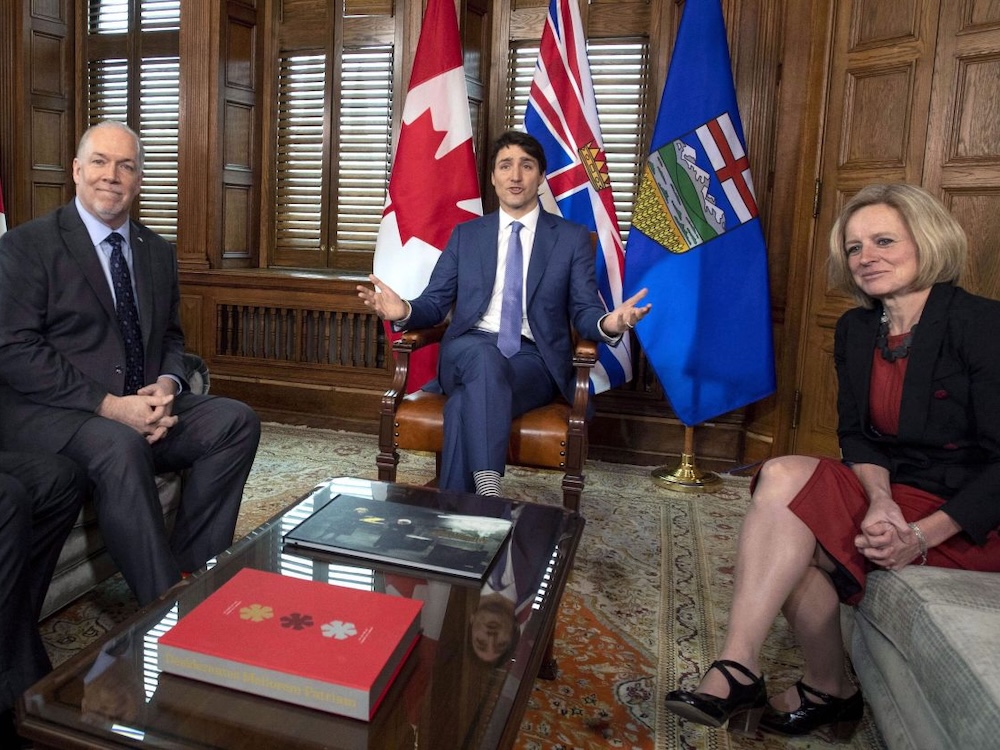
Another story about Kinder Morgan. Trudeau had just bought the pipeline, and he called Rachel and me to Ottawa. We flew all the way there and were stuck in his office, which I characterized as the principal’s office, for two and a half hours, just the three of us going back and forth. I was not moving from our opposition to the pipeline. I’d got nowhere to move. I was thinking we could have done this on the phone.
The meeting finally ended. It was agreed that I would speak to the media first, then the two of them would come out and beat me up. I was fine with that. As we were waiting for them to set up the press conference, I said, “Well, that wasn’t so bad. My only regret is that I missed the Vaisakhi parade.” Rachel said, “I missed it, too.”And Trudeau turns to us and says, “You had to bring up India, didn’t you? You just had to bring it up.This was after his famous trip to India where he’d been ridiculed by a lot of people for his costume changes.
Even though this was a difficult day, it showed me a side of Justin Trudeau that I liked. He was able to be self-deprecating and make light of what could only be described as a tense couple of hours between three progressive politicians. ![[Tyee]](/design-article.thetyee.ca/ui/img/yellowblob.png)
Read more: Books, Alberta, BC Politics



Notice about commenting changes
The Tyee’s commenting system will be moving to a new platform on Nov. 12. If you’re already a Tyee commenter you must register with the new system on or after Nov. 12 with your preferred username.More information can be found here.