


 SHARE:
For big art, you need a big book. 7IDANsuu James Hart: A Monumental Practice is a very big book, and it’s also extremely heavy. I can attest to this fact, having balanced it on my lap to take in the text, as well as the stunning visuals.
Curtis Collins, the director for the Audain Art Museum in Whistler and co-author of A Monumental Practice, puts it this way: the book was meant not to capture every single piece that Hart has created over the course of his remarkable career, but rather to present the biggest, most impactful works.
“The place is the book,” says Collins, meaning that a physical exhibition would be impossible to present given that Hart’s large-scale work is all over the world, in both private and public collections.
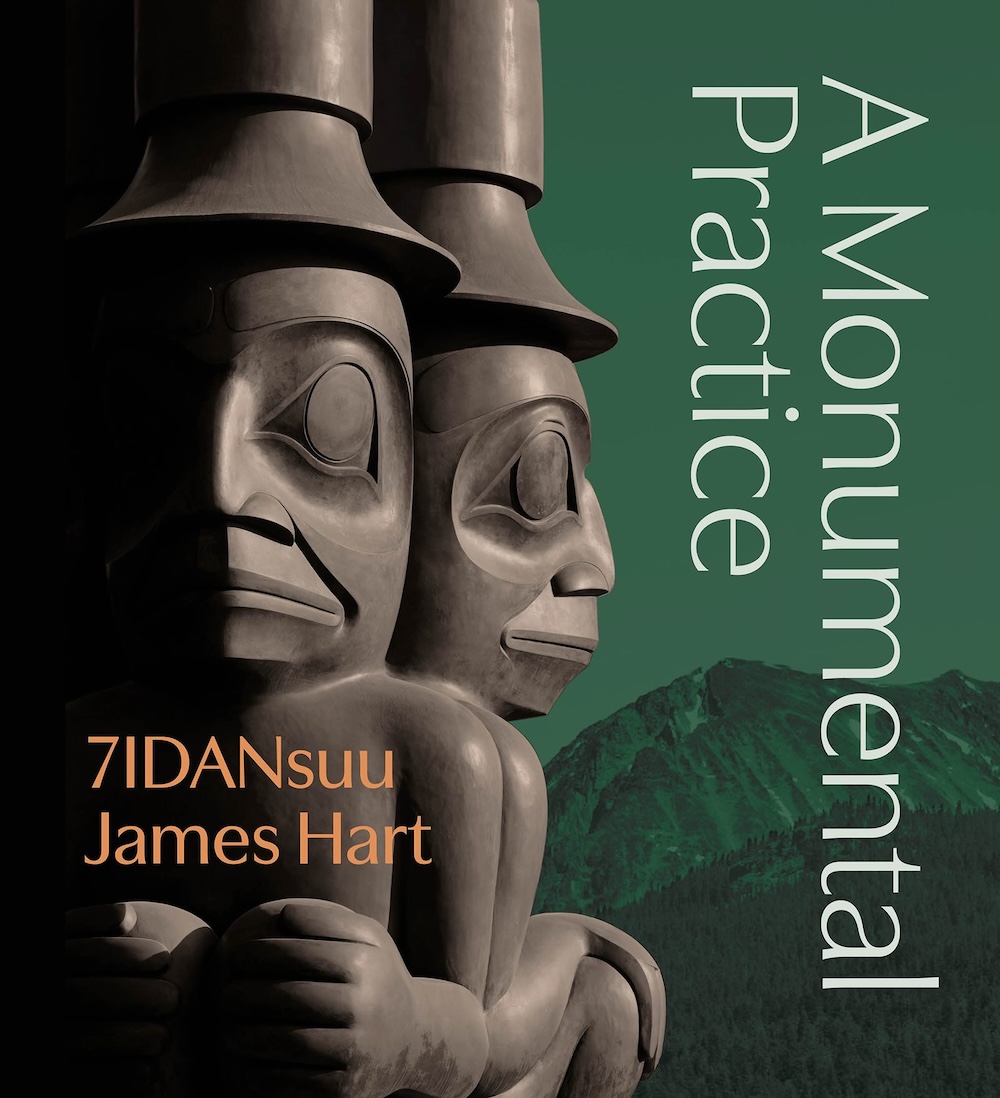
In addition to being an internationally celebrated Haida artist and Hereditary Chief, 7IDANsuu James Hart is also a husband, a father and a grandfather. Family figures large throughout the book, whether in the form of stories, personal photos, memories or shared jokes. In amongst the images of enormous sculptures he is famous for, this written intimacy gives the book a deep warmth and immediacy, akin to hanging out and talking.
Alongside Hart’s voice, A Monumental Practice features essays from philanthropist Michael Audain, anthropologist Wade Davis and curator Collins, as well as Hart’s son Gwaliga Hart. It’s an encompassing, expansive approach, in keeping with the scope and heft of the book itself. Whether it’s from a collecting, curatorial or familial perspective, these different directions provide the fullest portrait of Hart’s oeuvre. They situate him simultaneously in the present moment and right in the midst of 10,000 years of Haida artmaking.
Collins cites a quip from the artist in his own essay, explaining that whenever he asked Hart how long it took him to learn how to carve, the answer, offered with a grin, was always “About 10,000 years.” “Eventually, I stopped asking,” says Collins.
Time is another element that runs like an underground river throughout the book, tying Hart not only to the work of his direct predecessors, artists like Robert Davidson and Bill Reid, but also to the greater continuity of culture and inheritance passed down through generations of Haida people.
An extraordinary undertaking
Long before he came to international prominence, Hart was a kid, growing up on Haida Gwaii, then known as the Queen Charlotte Islands. His mother Joan and father Jim settled there and raised their family. In his essay entitled “Early Days,” the artist shares his childhood and young adulthood memories, everything from fishing with his grandfather Chinni to meeting the woman who would become his wife after chasing off her then-boyfriend.
It wasn’t until Hart was in his teens that he became fascinated by Haida cultural history and the rich tradition of artmaking. Under the mentorship of Bill Reid, Hart learned the techniques that would enable him to create his own masterpieces. Many of these works dot the south coast of B.C. One of his works guards the entrance to the Audain Art Museum in Whistler; others face out to the Pacific Ocean at the University of British Columbia’s Museum of Anthropology.
In addition to his large-scale work in bronze and cedar are smaller, more intimate pieces like jewelry, argillite sculptures and copper pieces, made for family and friends. This form of winnowing in and out, from massive to miniature, is another theme threaded throughout the text.
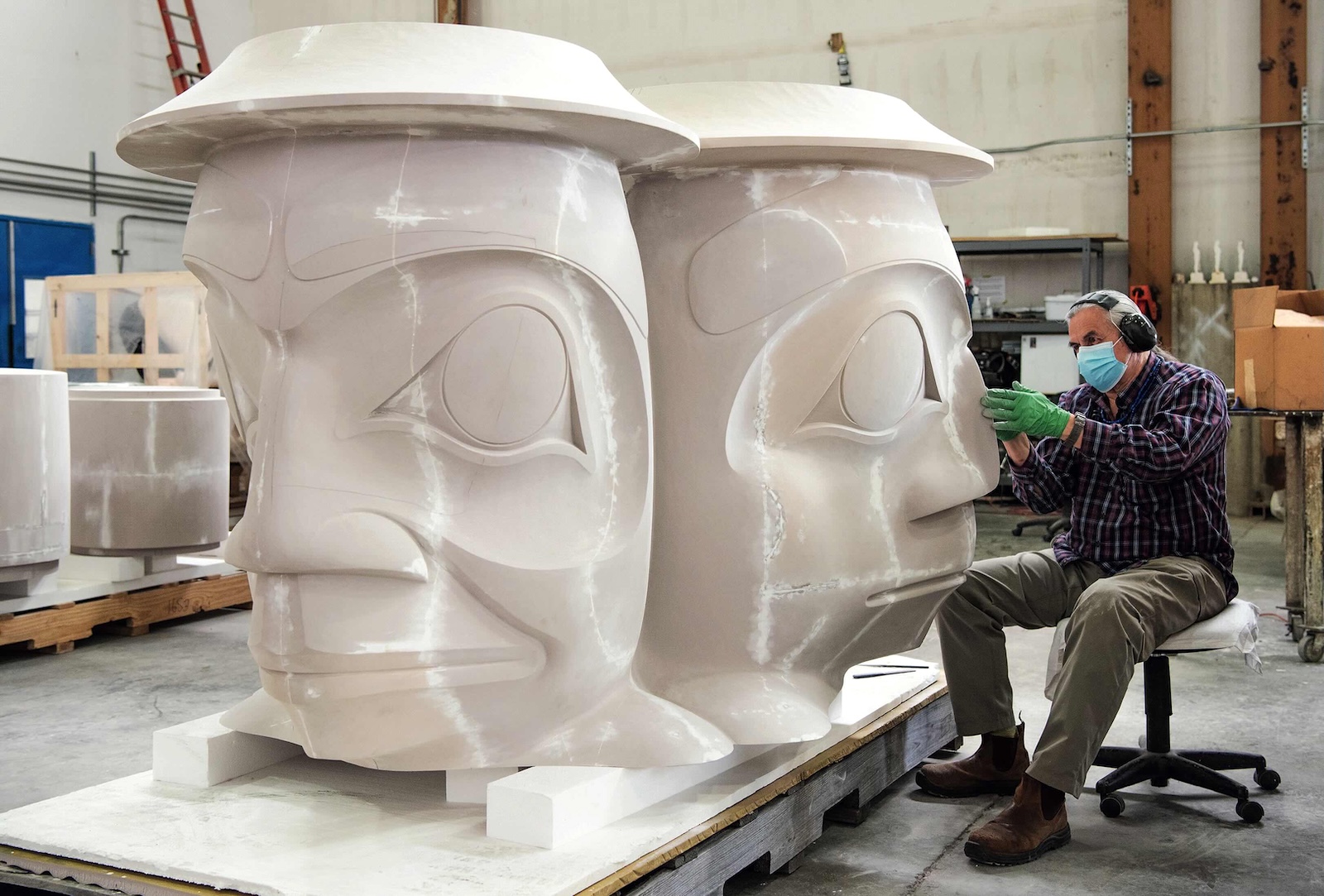
As Collins explains, the book itself was something of a monumental undertaking, requiring about 10 different trips to Haida Gwaii, countless interviews, wrangling photos and even employing a drone to get a different perspective on Hart’s home on Haida Gwaii. The project has been in the works for Collins for “about six to seven years,” he says. “But pouring it on for the last four years.”
In his introductory essay, “Coming into the World,” anthropologist Wade Davis covers millennia of Haida history, including their near extinction in the 20th century when disease, resource extraction (rapacious logging and overfishing) and government and religious rule almost wiped out repositories of Indigenous knowledge.
In seeking to entirely obliterate Haida people, colonial forces took aim squarely at artists, forbidding songs, dances, ceremonies and the creation of any artwork, right down to household objects like bentwood boxes.
It’s a grim picture that Davis unearths:
In the early years of the 20th century, as Haida artifacts went on display in the grand museums of the world, academic curators informed all who would listen that the Haida language has no word for “art”; it was just something that Indians did, a common set of design motifs curiously applied to utilitarian objects — spoons, benches, storage boxes. This assertion, oft repeated to this day, suggests something darker than a simple misunderstanding of the Haida language, or a failure to appreciate artistry that, as every work celebrated in this book affirms, clearly ranks among the highest expressions of humanity. Playing with words to relegate the tradition to “craft,” as opposed to “art,” is to deny its place at the very heart of Haida social, spiritual, and political life.
In this time and place of absolute zero, artists offered a rebirth of the Haida spirit. As Davis explains, “In the darkest years, Haida genius resided within true culture heroes, men and women who have never been forgotten.”
One of these people was the great Haida artist Charles Edenshaw. Another was Robert Davidson, who at the tender age of 22 set out to carve the first totem pole to be erected in the community of Old Massett in over 100 years.
The pole raising, done in the traditional way, with both Eagle and Raven clans working together to hoist the pole aloft using only people power, is documented in director Christopher Auchter’s short film Now Is the Time.
I’ve watched the film countless times, and it never fails to bring me to tears when Davidson recounts how the Elders celebrated the pole raising with homemade paper headdresses and regalia.
Another implicit element in Monumental Practice is the tension between tradition and innovation, a high-wire balancing act that finds expression in many of Hart’s most acclaimed works. No piece is more emblematic of this fusion of new and old than The Dance Screen (The Scream Too), arguably one of the true masterpieces of the Audain Collection.
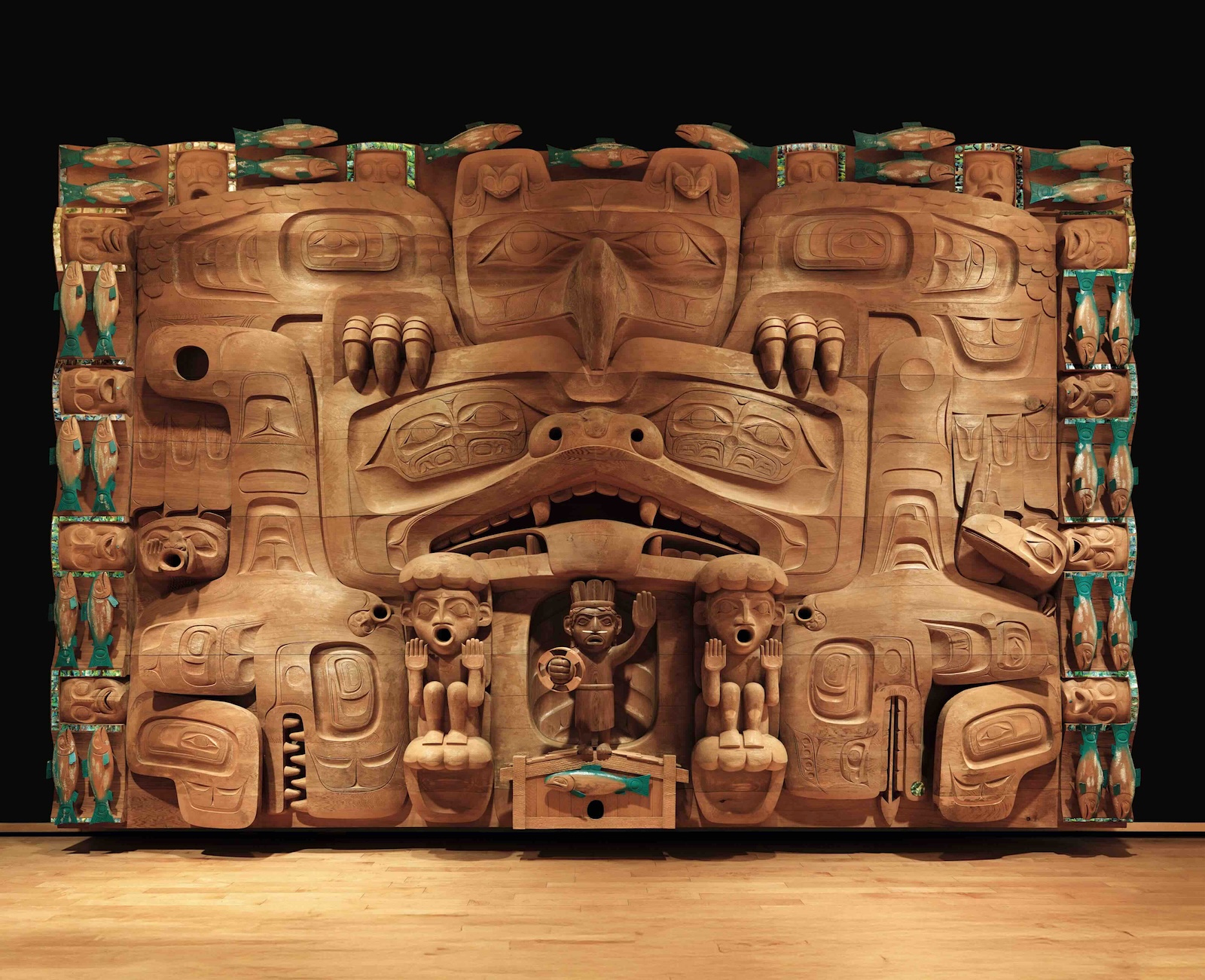
In the section dedicated to the creation and unveiling of the work, performance played a central role. It is a means to close the circle of creation of a work and, in essence, hand over the work to its public life. In situating Hart’s work squarely in the world of high art, Collins explains that Hart pulls directly from older forms but infuses them with a new kind of energy and expressiveness, “drawing forward, while rooted in tradition.”
In addition to images of 19 of Hart’s major works, the book is brimming with sidebar information about the processes involved in making smaller carvings, jewelry and prints, as well as thematic motifs that reoccur throughout different media. The Three Watchmen is only one example. In addition to the sculpture that marks the entrance to the Audain Art Museum, Hart has explored the motif of the three figures in a number of other works in Ottawa and the Plains of Abraham.
The role of artists in Haida culture has always been to bridge the sacred and the practical, collecting wisdom, understanding and continuity in the lines and forms of different creative mediums.
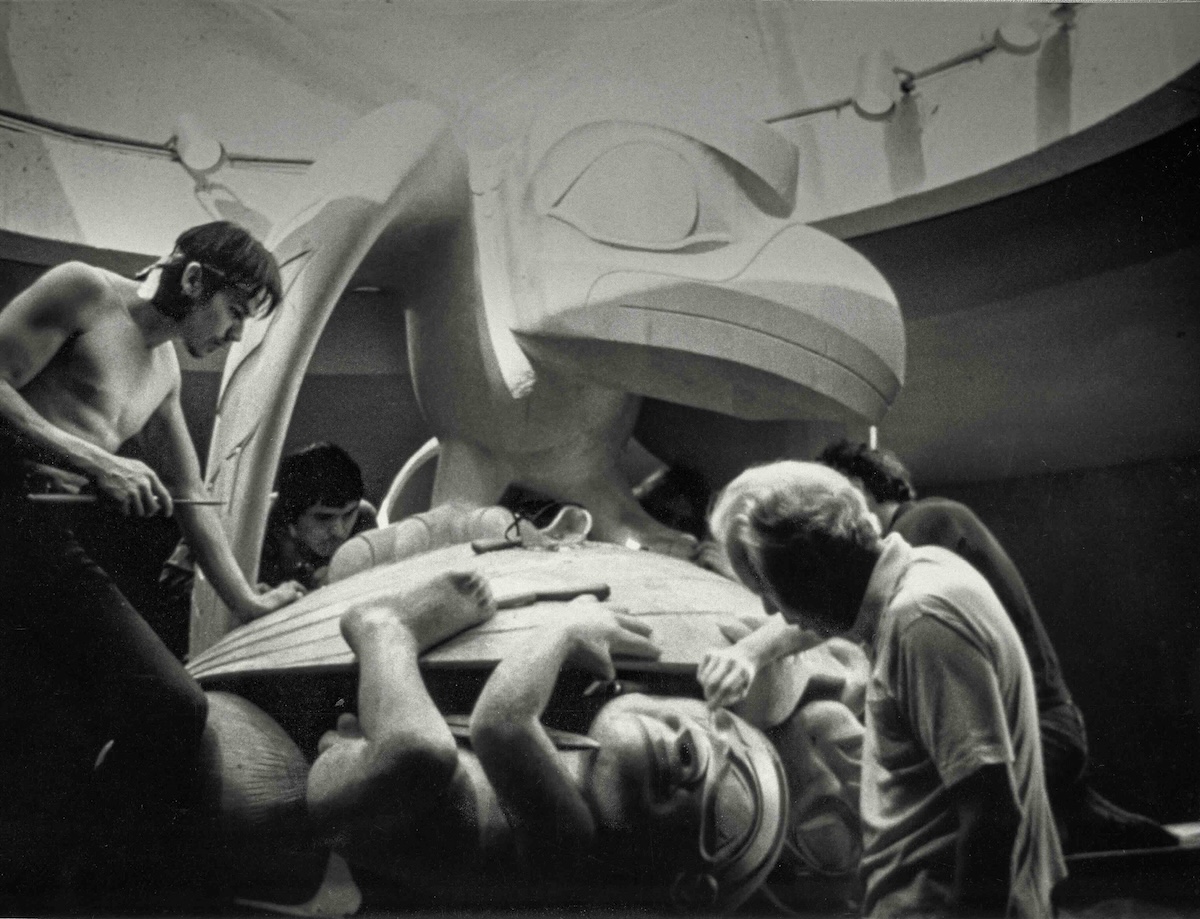
Wade Davis uses the term “axis mundi” to refer to the role that art occupies in Haida society. It is a connection handed down from one generation to the next.
It is fitting, then, that the book closes with a timeline of Hart’s relations as well as an essay from his son Gwaliga, who writes in his essay:
“When I think of my father, I think of his dedication to upholding the integrity of his Ancestor’s works and ways of life. His work and hereditary role are not just about remembering a people’s ways: he breathed life into what needs to be and strengthened the cultural continuance of the ways that live within our people. It’s the expressions and representations of our people; who we are, where we come from, and what we are about.” ![[Tyee]](/design-article.thetyee.ca/ui/img/yellowblob.png)
Read more: Indigenous, Books, Art










Notice about commenting changes
The Tyee’s commenting system will be moving to a new platform on Nov. 12. If you’re already a Tyee commenter you must register with the new system on or after Nov. 12 with your preferred username.More information can be found here.