


 SHARE:
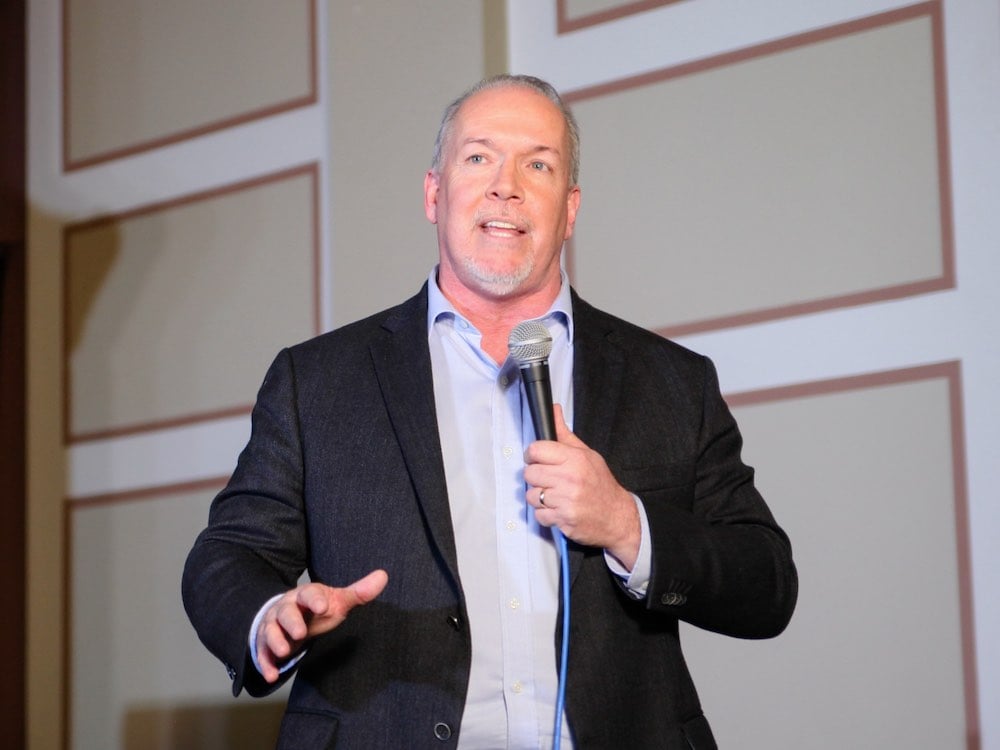
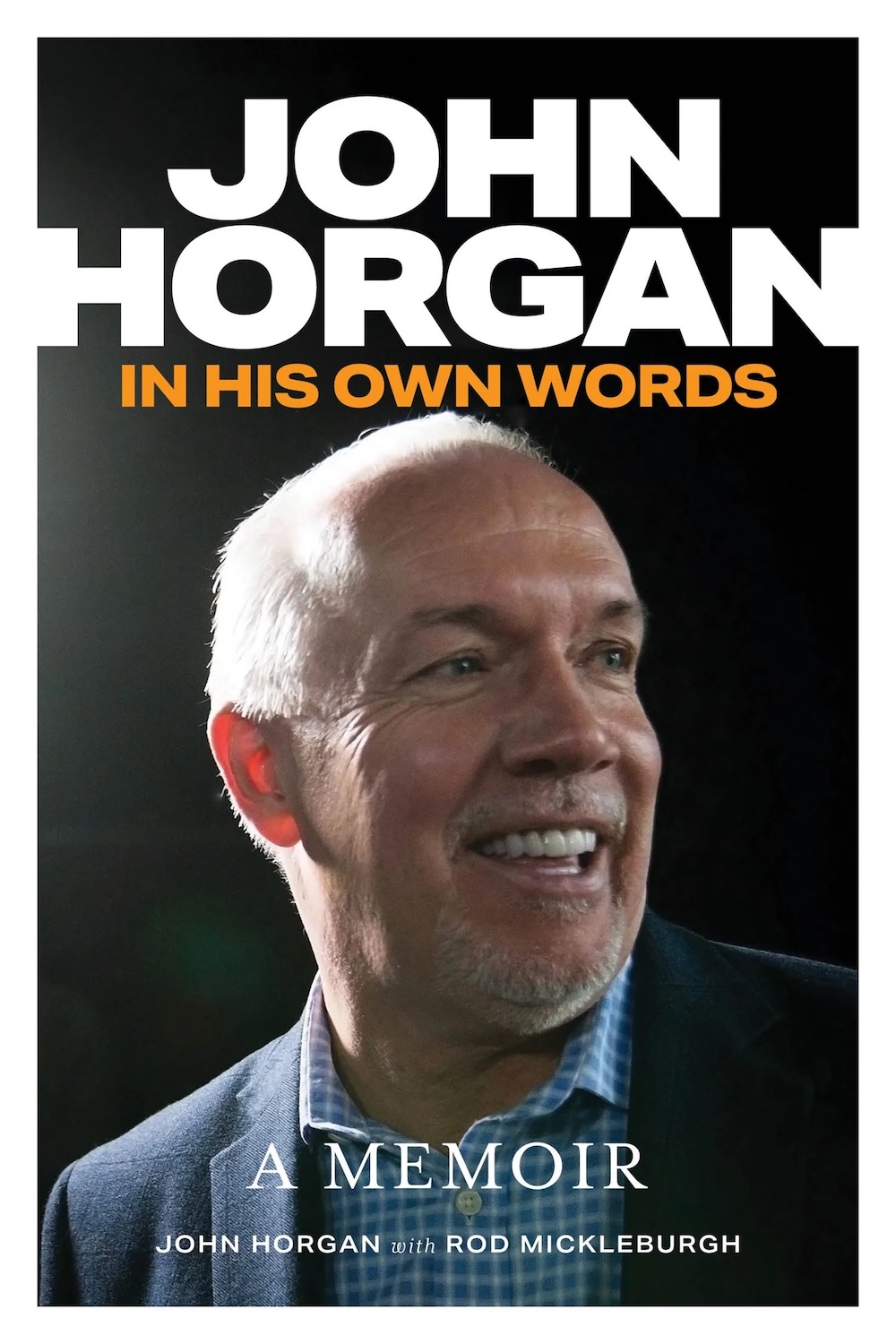
- John Horgan: In His Own Words
- Harbour Publishing (2025)
Not long before John Horgan left the British Columbia premier’s office, I asked him during a news conference what he figured he would be remembered for.
“I’m a historian,” he responded, “but I’m not going to do history from the podium.... Maybe we’ll have a chance to talk about that at another time.”
We never did get that opportunity. He died last November at the age of 65.
I made my own list of what I saw as the high points from his five years as premier, but I always wondered what Horgan himself would have pointed to once he’d had time to reflect.
The posthumous new memoir John Horgan: In His Own Words offered hopes of an answer, but much happened in his five years in office and it’s clear he was still sorting out what had really mattered.
“Did I leave the province a better place?” Horgan asks towards the conclusion. “I’ve talked about the museum. I didn’t make that better, but I did make the archives and collections a little better. I didn’t have the impact on mental health that I wanted to, but we made some progress.”
“We made strides in reducing costs for people in some areas, so more of their discretionary dollars could go toward housing, food and other things that were being battered by inflation,” he says. “Doing away with tolls for people who had to travel in the Lower Mainland was profound. So was reducing childcare costs for people who absolutely need to have care for their children. And so was moving away from medical services premiums. All these things we did had a significant impact.”
Earlier sections address increases to the minimum wage, changes that made it easier to organize a union, the decision to proceed with the Site C dam, ensuring proponents committed to building the LNG Canada plant in Kitimat and responding to the COVID-19 pandemic.
A chapter is dedicated to Indigenous issues and reconciliation, including the effort to adopt the principles of the United Nations Declaration on the Rights of Indigenous Peoples into provincial law, which in the long run may turn out to be the Horgan government’s biggest contribution.
In general there were incremental changes, decisions to continue or approve projects already underway and events to respond to, plus a few advances that could be described as bold undertakings. Budgets were mostly balanced, elections were fought and issues were managed.
Horgan provided competent leadership and appointed seasoned people like Geoff Meggs, Don Wright and Bob Dewar to key positions, then listened to what they had to say. He took a team approach and didn’t always need to be the MVP, though he clearly enjoyed the attention.
It was a moderate government led by a self-described moderate politician.
This is not a criticism of the memoir. The book itself is an engaging read that covers Horgan’s time in politics, but also his childhood and the experiences that shaped him.
It was written with Rod Mickleburgh, meaning the veteran labour reporter and author conducted a series of interviews with Horgan, then worked the material into a coherent narrative. His touch must have been significant, but it’s unobtrusive. Horgan’s voice comes through strongly and it feels very much like sitting down with him for a loose, rambling and amusing chat.
The downside of that looseness is that it results in some outright errors making it into the final text. There are also, no doubt thanks to the story being told completely from Horgan’s perspective, some debatable assertions that deserve closer scrutiny. Some of the flaws are more serious than others.
For example, Horgan writes, “The Pacific Cable station was the largest building on the west coast of Vancouver Island. It’s now the Marine Biology Station, connected to the University of Victoria.”
He gets the names wrong (it’s officially the Bamfield Marine Sciences Centre that’s on the site of the former Pacific Cable Board Cable Station) and neglects to mention that it is connected not just to UVic, but also to the University of British Columbia, Simon Fraser University, the University of Alberta and the University of Calgary.
A passing reference to “the firing of eight health researchers by the previous Gordon Campbell government” gets both the number of fired employees (the B.C. ombudsperson’s authoritative report into the matter said six were fired and a seventh was summarily dismissed) and who was premier wrong. By the time of the firings in September 2012 Christy Clark had been premier almost 18 months.
There’s another minor error when he writes about attending a rugby game with then-BC Green leader Andrew Weaver in 2017 as their two parties were negotiating an agreement that would allow the NDP to form government. “Dirk Meissner from Canadian Press snapped a picture of the two of us in our flowery shirts,” he says.
But flipping to the glossy centre pages where the photo itself appears, it’s the actual photographer, Chad Hipolito, who is credited with taking the photo for CP. And while Weaver is wearing a tropical patterned shirt, Horgan’s was thin blue stripes crossing on a white background.
On one level, who cares really. But getting those kinds of details wrong weakens a reader’s trust in the narrator.
In another section Horgan addresses Carole James’ final days in 2010 as leader of the BC NDP. “Carole had one more death-grip press conference. We were called in to be totems, which is when you come in, stand behind the leader and say nothing.”
The book leaves the impression he was present at that news conference held a few days before James resigned, but in fact he failed to turn up, as reporting at the time noted.
Interestingly Horgan does make it clear that while he publicly supported James, he privately saw it was untenable for her to continue as leader. “I told her, ‘Carole, I’ll go wherever you want me to go, but do you really need this? We’re a long way from another election. These people are going to be picking at you the whole time.’ There were going to be stories every couple of weeks about how rudderless we were.”
A passage about a big tree that got some attention on the internet includes both an error and a misleading conclusion. “There was some photo of a truck driving down the highway with one massive cedar log,” he wrote. “That’s manna from heaven for protestors. Even if the tree had been cut down in 2020, before regulations to protect special trees took effect, as a fundraising tool such a photo was priceless.”
While early reports had identified the tree as a cedar, it was later confirmed to be a spruce.
More importantly, while Horgan implies that the Special Tree Protection Regulation introduced later in 2020 would have saved the tree, it likely would not have. To be off limits to logging, a Sitka spruce on the coast would need a diameter greater than 283 centimetres at a person’s breast height. Any tree that big wouldn’t have fit on the truck in the photo since its maximum load width was 260 centimetres.
It’s the kind of assertion that needs some scrutiny, but that Horgan gets away with making unchallenged since it’s his own story in his own words.
The same is true of his claim that exporting LNG to Asia would result in lower carbon emissions overall. “We also felt we should get credit if China bought LNG and that reduced their carbon emissions through closed coal plants,” he wrote. “Right now, China gets all the credits for that, and we don’t get any.”
It’s a common argument from boosters of gas exports, and it’s one that ignores that shipping gas from B.C. may be just as carbon intensive as some sources of coal by the time one counts emissions from drilling the well, producing the gas, putting it in a pipeline, liquefying it, shipping it and then re-gasifying it, all with methane leakages at each stage.
Plus B.C.’s gas is just as likely to be replacing cleaner sources of energy like nuclear, wind and solar. Several times in the book Horgan refers to his own expertise on energy issues, but his knowledge didn’t stop him from oversimplifying when it suited him.
Perhaps the largest misdirection is the rationale Horgan gives for calling the 2020 election early, in the first year of the COVID-19 pandemic, and despite the continued co-operation of the BC Green Party.
In Horgan’s telling, “The other event which finished it off for me was the Greens’ opposition to a bill we wanted to bring forward that would allow hospitals to detain and provide medical treatment to young people for up to seven days following a drug overdose. That really, really bothered me.”
However he felt about the bill, it wasn’t important enough for him to reintroduce it after the NDP secured a large majority in the election and could have passed any bill it wanted to.
There were clearly other reasons to go to the voters, starting with that Horgan and the people around him must have seen a chance to win a large majority and snuff out the Greens, and it would have been nice to see that addressed more frankly in the memoir.
The book also complicates the specious idea that Horgan loved all the people of the province, as some have asserted since his death.
There’s this description he gives of the kind of people who come to town hall meetings: “It became clear to me pretty quickly that those were opportunities for blowhards to come and bitch about things they thought were important.... You’re always trying to manage the crowd so the nutters don’t dominate the microphones.”
Can’t you just feel the love?
Some individuals, particularly Adrian Dix, whom he blamed for unexpectedly losing the 2013 election, get a rougher ride. The criticisms are sometimes fair, such as Horgan’s dismay at Dix’s decision to avoid negative campaigning. “For a guy consumed by politics, it was so ironic that when he had the opportunity, he decided to be Gandhi. And, you know, Gandhi never ran for office, because he would have lost. It’s inexplicable.”
Others are unfair, like the jab that Dix had no friends outside of politics, which is both a cheap shot and untrue.
Horgan’s environment minister George Heyman “could be the biggest pain in the ass you’ll find anywhere,” and Claire Trevena was appointed transportation minister “for equity reasons” but proved herself despite coming into cabinet believing “nutty stuff” about the need to nationalize the ferries and make some of them free.
In the end one cuts Horgan some slack because, after all, he was Premier Dad and if he’s sometimes harsh, well, at least he was authentic. As he notes himself, when a person says “a billion” words as he did, some of them are going to be poorly chosen.
Any political memoir is limited by its author’s perspective and should be read with some skepticism, but what comes through in Horgan’s is that he was a human being doing his level best in the circumstances he found himself in.
He considered himself a very lucky guy, and with him gone too soon we’re lucky, despite the flaws, to have this account of how he saw his life. ![[Tyee]](/design-article.thetyee.ca/ui/img/yellowblob.png)
Read more: Books, BC Politics






Tyee Commenting Guidelines
Please note that email notifications for replies are not currently working due to a software issue which may be resolved in a future update.
Comments that violate guidelines risk being deleted, and violations may result in a temporary or permanent user ban. Maintain the spirit of good conversation to stay in the discussion and be patient with moderators. Comments are reviewed regularly but not in real time.
Do:
Do not: