


 SHARE:
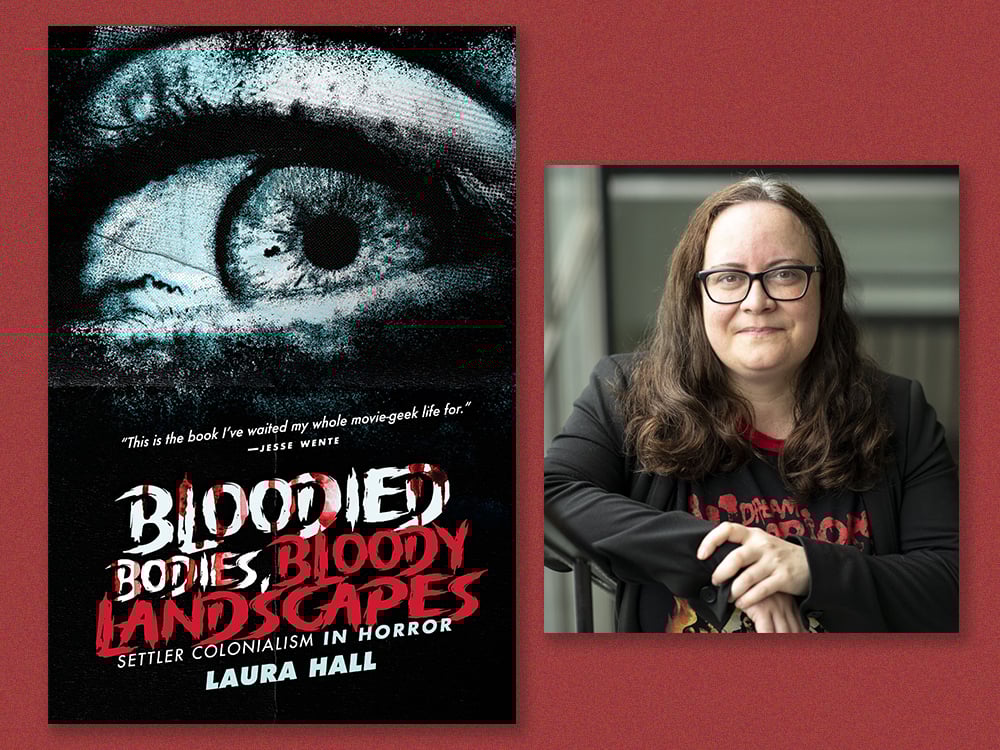
- Bloodied Bodies, Bloody Landscapes: Settler Colonialism in Horror
- University of Regina Press (2025)
“Horror,” writes the scholar Laura Hall in Bloodied Bodies, Bloody Landscapes, “is the genre of settler colonialism.”
The Carleton University sociology professor makes a bold claim, but there’s really no denying it, especially after 200-odd pages of Hall’s brilliant film criticism that comprises the book. It doesn’t take a doctorate degree to understand that much of what we see in Western horror is projection, or else paranoia, that the terror and trauma of settler-colonial violence could happen to white people too.
Hall was raised by a Mohawk mother and English-Canadian father, and her research interests include settler colonial theory, intersectionality and pop culture analysis — Bloodied Bodies sits at the intersection of those passions.
“Settler colonial society,” she says, “is indeed profoundly anxious about (its own) disappearance and destruction.”
In other words, when you watch scary movies where a madman (or his mom) emerges from the wilderness to murder with impunity, chopping up homesteaders, tourists and teenagers, justified by past events or just because he’s evil, you’re watching a settler-colonial nightmare that’s rooted in actual history.
“The suffering that the civilized endure is based on the real suffering of peoples they have colonized,” Hall explains. “This appropriation of suffering is central to horror.”
In Bloodied Bodies, Hall exposes the subtext embedded in nearly every scary movie ever made, from classics like The Birds (1963), The Shining (1980) and The Descent (2005) to the full Halloween and Scream movie franchises.
It’s masterful scholarship, and impressively thorough. Her deep understanding of horror is matched by an obvious love for the genre: only a true cinephile would have something to say about Nightmare on Elm Street 5: The Dream Child (1989).
In advance of her must-read new book, due Sept. 16 from University of Regina Press, Hall took a moment to chat with the Tyee about horror movie staples like the witch, the final girl and, of course, the “Indian burial ground” — a plot device whose overuse makes sense when viewed through a settler-colonial lens.
“Who, and where, are Indigenous people in horror?” asks Hall, towards the end of Bloodied Bodies. “The answer: everywhere and nowhere at once.”
This interview has been edited for length and clarity.
The Tyee: Congratulations on Bloodied Bodies, Bloody Landscapes! This book is going to facilitate some incredible and necessary conversations. I suspect a lot of folks who might not want to talk about settler colonialism, generally speaking, won’t mind as much in the context of classic horror movies.
Laura Hall: It’s a fun topic. I do a lot of community-based and social justice-based research, and this is a really good way to do that work, but put it in a fun conversation.
A while ago I wrote an essay that actually touched on the topic of settler colonialism in horror. I thought I was serving up cutting-edge discourse, but I had no idea how much had already been written. What can you just tell me about this field of scholarship and why it's so relevant now?
I’m of two minds about it. One is this thought that there hasn’t been enough work on settler colonialism and horror. This segues very quickly into the second thought: there is a depth of work on the Gothic and Indigenous representations, but a lot of that work tends to put the Indigenous question in the past.
I’m not the first person to say this. In Exiled in the Land of the Free, Oren Lyons, John Mohawk and Vine Deloria Jr. talk about how there’s this kind of strange memory problem: when the spotlight’s on Indigenous peoples, briefly, everyone remembers that Indigenous people are contemporary, and exist.
Then the spotlight fades and the dominant society just forgets. Settler colonial theory, or Critical Indigenous Studies, allows us to continually put that presence right back in what we’re reading, what we’re watching, even when they're trying to erase us.
Right. These are contemporary issues. To that point, I adored your analysis of The Shining, which considers the film, in your words, as “Rooted in the ongoing system of settler colonialism from which the colonizing family cannot escape.”
I don’t disagree, and that’s saying something. I’ve really nerded out on what this film has meant to mean over the years. I don’t think I’ve ever been fully satisfied by a reading of this movie, until yours, where the Overlook Hotel is the product of a genocide that happened long ago, but the violence continues to be perpetuated by generation after generation of settlers and so-called caretakers.
The Shining is one of my favorite movies because — and I’m careful not to diss Stephen King, because he’s got a lot of lawyers — I do feel like the book is trying to [humanize Jack], but the movie is like, no, you’re awful. You’re actually just awful. You broke your kid’s arm, man. You can’t just park that in the realm of, like, healing journey, alcoholism...
That’s in the past! It’s behind him!
It’s patriarchal violence, man. Of course you’re chasing your wife with a big knife… It’s always confused me a little bit that the ghosts in The Shining are white settlers. I’ve always been, like, if it’s on an Indian burial ground, where are the Indigenous ghosts? It’s as though the crappy behavior of white people and all the white settler violence is the fault of this Indian burial ground. But they’re the ones doing it.
I’ve always been fascinated by that, because it shows up everywhere. I’m writing a paper right now about Night of the Demons (1988), and they do the same trick where all this stuff is the fault of the Indian burial ground. And I’m interested in the ways that analysts look at The Shining. Why are you saying, like, Indians are in the past when clearly there’s a problem with this space; it continues to be an incredibly problematic hotel. The boiler itself wants to blow up, in the book.
Alternate title: The Incredibly Problematic Hotel. You think Jack’s in a bad spot? So is this stupid hotel, built in a stupid place for a hotel, where it’s unsurvivable for half the year. But we really like it in the summer!
You could ski here, but we don’t let you.
They’ve put this colonial mansion at the top of a mountain in the middle of the wilderness, and every year they send someone out there to, basically, keep the space colonized, like the whole place will Indigenize if there isn't a white man to vacuum the rugs. And it’s called the Overlook Hotel – they’re actively trying to overlook what it is, how it was built, what was done in order to secure it. But if you’re not addressing your own history, you are repeating your history.
I give a lecture every year on The Shining and a lot of white settler students get very uncomfortable when I say, no, this is ongoing. There’s a timelessness to this kind of problem. In the movie, [Stanley] Kubrick uses [Norval] Morriseau’s Mother painting, right at the start, when Jack is walking in and having his creepy interview. And then, when he’s throwing the ball against the sand art… there’s all this native art throughout the hotel.
A Eurocentric way of reading it is that it’s a symbolic nod to the past. But for us, our art is living. So whether he meant to do it or not, Kubrick put living Indigenous story into the hotel. You can’t erase that. And it has a way of working on the viewer. It’s Morriseau’s Mother!
You’ve got references to the original mother, to Indigenous cosmologies, and the land. This is a point I’m working on in my current work: the land is always in the movie. There’s no way you can not be in a place that is an Indigenous place.
Right. And “the settler family is never quite at home on stolen land,” you write, which goes a long way towards explaining why, in settler-colonial horror, and this is you again, “the land itself is a source of anxiety and terror.” That feels like maybe the most common theme in modern horror, often in conjunction with an ancient burial ground. I used to think that plot device was just lazy writing — like, come on, there can’t be Indian burial grounds everywhere. But then you read a little history and, well, actually…
It’s also been an area where I just wanted to see more scholarship, beyond the symbolic, symbolism, symbolic, symbolism… I want to know how the Indian burial ground operates, in terms of, like, shaping intersectional relationships.
In Night of the Demons, the demon possesses the young people because of the cursed land that’s underneath the house. It’s an Indian burial ground. It’ll drive you mad. It’ll drive you to kill. It’ll drive you to cannibalism. It'll root a demon. It starts not making any sense. It’ll make you a lesbian.
Seems fine.
It’s fascinating to me, because it’s sort of like, well, this is a really multi-purpose [trope]. This Indian burial ground will give you whatever. It’ll give you, like, a place to bury your pets or a place to reanimate zombies. It’s sort of this, like, very strange backdrop for any kind of Stephen King appropriation story, anything you want to make up on planet earth about demons that make no sense.
I suppose it can’t make sense. We don’t understand our environment anyway. The settlers came and killed or drove off everyone who knew the land, everyone who could help them have a healthy, holistic relationship with it. So now we’re like: Oh no, what's here? Ghosts? Monsters? Demons that make us all gay? We don’t know anything about this place. We could have. Instead, we’re all afraid of it because we threw out the instruction manual.
There’s no discussion with native people. There’s no native people in the movies half the time, but the Indian gets coded everywhere. So I think that theory is really interesting because Philip Deloria talks about it. Vine Deloria Jr, talked about it in his work. There’s, you know, lots of film theory that talks about the Indian as the monster. Then there’s the ‘Final Girl’… she also goes through this process where she sort of becomes the coded Indian.
Yeah, you talk about ‘Final Girls’ “Going native,” so to speak. In your words: “Settler colonialism continues to spin on the notion that white settlers are perpetually in a battle against savagery, both from within and without,” and ‘Final Girls’ are often where this theme comes to a head.
Especially in movies like The Descent, or Revenge (2017). You’re burning an eagle on your stomach. You’ve started carrying a Rambo knife — and Rambo, of course, is a Cherokee played by an Italian. I’m fascinated by how horror does that also. The Indigenous monster has been written about a bit more, but I don't know that the Indigenous hero has been [discussed enough].
I was fascinated by your examination of the ‘Final Girl.’ I think I'm also a little bit confused about the way that we tend to winnow down the cast to, like, the whitest, blondest woman, but then that character transforms, or reverts, to something primal. I’m never sure if we're supposed to view that as the horror, like, a bad thing that has happened to her, a so-called descent into savagery, or awesome, because she has adapted to survive in her environment.
I think it’s both. One of the things I’m finding really fascinating, and I’m not a psychoanalyst or anything, is the way that the settler-colonial imaginary sort of has its wires crossed. So this idea that the Indigenous woman is this… if you go back to these early wood carvings that were created, in which you see a Native woman, and she’s naked, and that’s supposed to mean something to the viewer right away, because the colonizer’s standing next to her, and he’s got clothes on, they’re really silly clothes, but they’re clothes, and she’s naked, which makes more sense in the climate, and he's probably dying of some kind of mold that’s growing on his leg, because he’s not in the right climate for the clothes that he’s wearing, and there’s a leg roasting in the background, and she’s going to eat the colonizer, but she’s also posing, and her breasts are out… So she’s a monster, but she’s desirable, she’s also freedom.
John Mohawk talked about this. Other scholars have talked about this. The Indigenous woman was seen as free, in addition to monstrous.
Which brings me to The Witch (2015). The movie’s treatment of Thomasin, the ‘Final Girl,’ is fairly perplexing — she meets a talking goat, who invites her to live deliciously — but it makes a lot more sense in this context. She meets the goat, Black Phillip, who is awesome, and then she kind of just wanders off into the woods and becomes a witch. I know they’re all white witches, but that whole scene is coded as “going native” too, right? The viewer is left to assume that she's abandoned the colonial project and become one with the wilderness, so to speak. Is that your reading of that?
For the most part. I think it’s interesting, because the witches are almost always white. I didn’t cover much about Tituba, who was a herbalist, and she was a slave. She’s sort of the catalyst for the paranoia in Salem that led to the witch trials. I don’t cover her because there's debate about whether she was of African descent or Native American descent. Was she mixed? She is a really important figure in terms of the construction of the witch.
I think it’s interesting when I watch Hocus Pocus (1993) or The Witch, movies I love, where I’m sort of going, okay, but what are you saying about witches? You’ve got cannibalism happening, which is a stereotype that was imposed to justify hunting witches, and which is silly and colonial.
But at the same time, the witches, you kind of cheer for their freedom at the end. You cheer for the Sanderson Sisters to be together and go off into the sunset, or come back, if there’s going to be a part three. You’re cheering for [Thomasin], whose family sucks, and you’re kind of like, yeah, you should become a witch. You should just fly. Fly and be naked and be happy.
What's your favorite recent horror movie?
Definitely Sinners (2025)… When I think about this sort of strange analysis of witches and witchcraft, that’s why I love [Annie] in Sinners so much. Because you do have a medicine woman. You’ve got a real medicine woman who's very, very attuned to, you know, she understands the spirit realm, she understands the material realm. We get to see her with her child on the other side. We see her say stop it to the other woman who's like, I'm letting them all in. She’s like, you are not doing that.
The witch is a funny character to me, because it’s so clearly based on a fear of women that don’t need men. And that fear has, I think, also been exploited by women, especially racialized women, to protect themselves from these men. In stories about, like, the spread of Voodoo in the Caribbean, it’s escaped enslaved people who were like, don’t come after us into this forest, we’re doing spooky magic in here. I’ve read some accounts as well of, like, settlers scared away by seemingly spooky Indigenous practices that, looking back, were just for show. Embedded in the concept of the witch, I think, is actually a defence against settler colonial violence. But I'm not a scholar of horror.
I like that a lot.
Any other horror films you think are saying new things, or rising above the ontology you examine in Bloodied Bodies?
Slash/Back (2022). It’s about a group of Northern Native youth. It’s basically a riff on The Thing (1982). So they see this invasion coming. They see that it's doing the weird shape-shift thing, with a polar bear instead of a dog, and they're like, oh no. They get themselves ready. And it's their hunting skills that help them in that moment.
It's their community togetherness. It’s the way the youth are resilient. As the adults are falling apart and going off drinking, the youth are the ones who are like, “No, we’re going to take care of this, and we know what’s happening, and we’re telling the truth.”
That resilience of Indigenous youth, seeing that on film, I still am just astounded when I think about that movie. ![[Tyee]](/design-article.thetyee.ca/ui/img/yellowblob.png)
Read more: Indigenous, Books, Media, Film












Tyee Commenting Guidelines
Please note that email notifications for replies are not currently working due to a software issue which may be resolved in a future update.
Comments that violate guidelines risk being deleted, and violations may result in a temporary or permanent user ban. Maintain the spirit of good conversation to stay in the discussion and be patient with moderators. Comments are reviewed regularly but not in real time.
Do:
Do not: