


 SHARE:
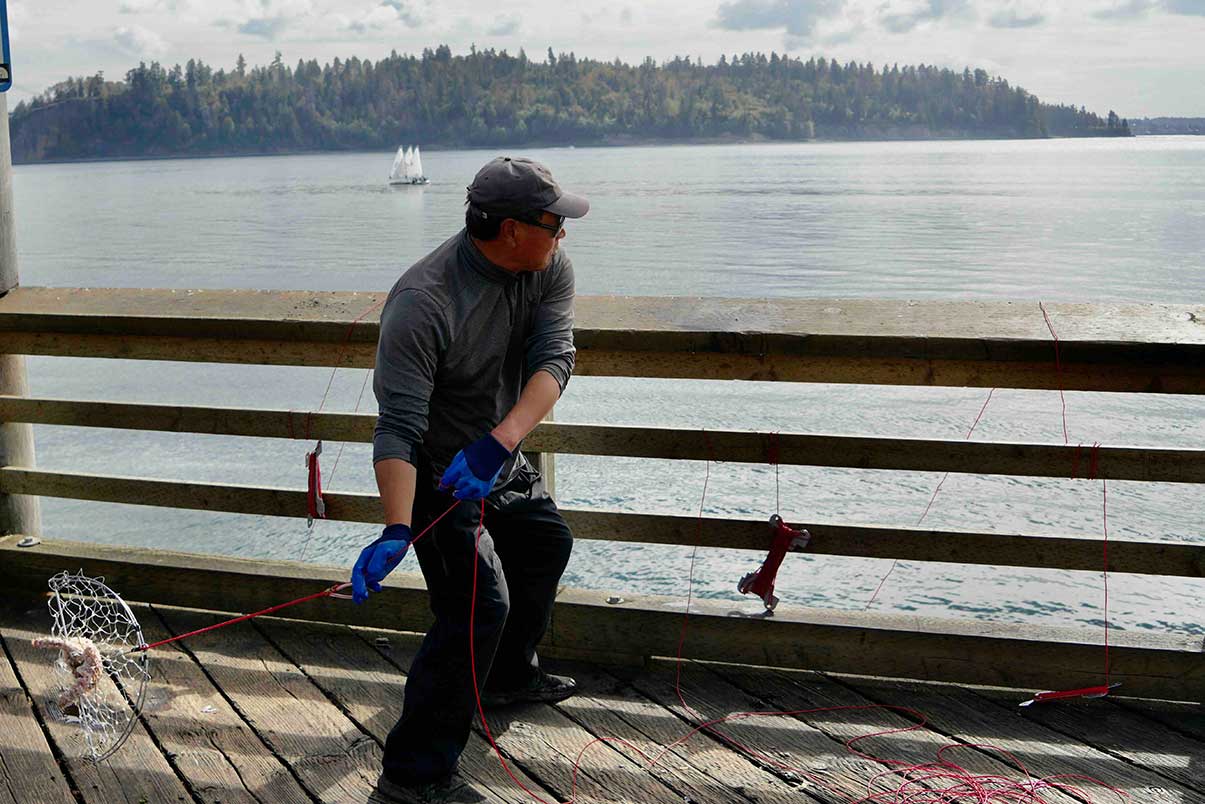
It’s a wet day in late November, and my partner and I toss some zip ties, a knife and a bag of chicken bits into a bucket. A neon tangle of trap lines sits haphazardly in the car’s backseat. We’re packing to head to one of the piers that dot the coastline surrounding Burrard Inlet, in the hopes of catching crabs for dinner.
After a 45-minute drive across the city, we arrive at təmtəmíxʷtən — also known as Belcarra Regional Park — to find an empty parking lot. The rain is unrelenting, making the fishing dock slick and unusually quiet. But despite the weather, we’re happy to have come. The dock offers a welcome buoyancy; the water, a winter clarity. It feels like a gift, to toss our traps out into a rippled ocean.
Hours pass and the sky darkens. All day we pull up undersized crabs, not big enough to legally harvest. But with their pincers pointing at us and their legs clinging to the chicken, even the smallest ones are fiercely alive. Seeing them is a reminder that the water contains a whole world at the edge of our own — one that, throughout my life so far, I’ve only glimpsed.
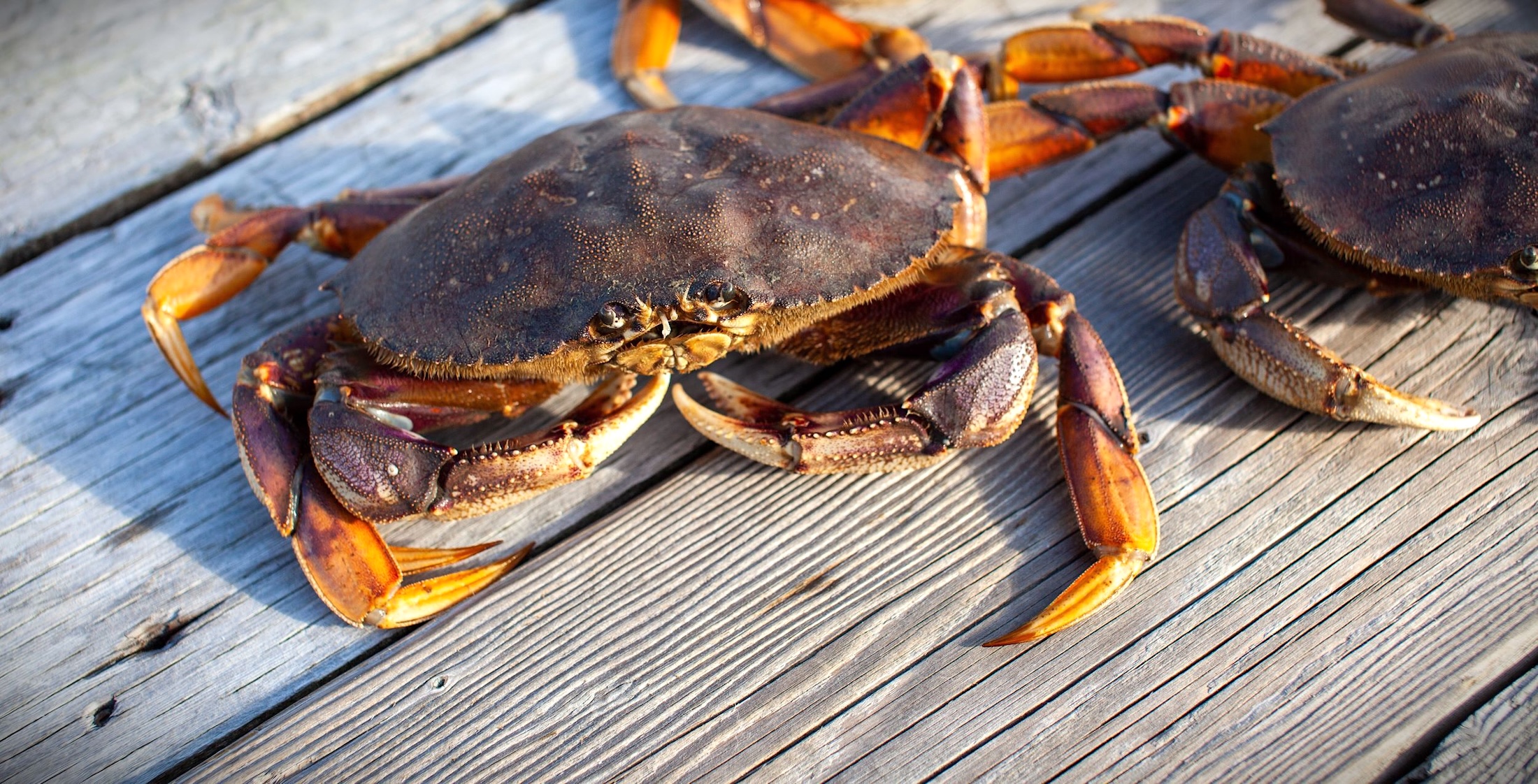
Crab fishing has long been associated with the Pacific Northwest. According to archeological data, in səl̓ilw̓ət (Sleilwaut) — the hən̓q̓əmin̓əm̓ name for the body of water most of us know as Burrard Inlet — the Tsleil-Waututh Nation has been harvesting crab for at least 3,000 years. The first recorded commercial crab landings in the Salish Sea were in 1885, and since then, the crab-fishing industry has become a major part of the province’s coastal identity. Today, Dungeness crabs make up the second-most valuable invertebrate fishing harvest on the West Coast of Canada.
Crab meat is popular all around the world, but it’s a luxury. At upscale restaurants, it tends to be one of the pricier items on the menu. Even live crabs, which come with all the guts and gore of having to process them yourself, are expensive. Here in Vancouver, the price of live Dungeness crabs currently hovers at around $26 per pound, which barely constitutes a one-person dinner.
But crab prices alone aren’t what attracted my partner and me to this pastime. We were drawn to the crab-fishing community itself.
On sunny days, I’ve seen upwards of 10 crab traps in the water at once, often with groups of friends or family behind them. People bring camping chairs and lunch spreads, and children run laps around the pier, only stopping their play to peek in fishers’ buckets.
Out of boredom or friendliness — and sometimes, rivalry — people take an interest in each other. They share casting tips and compare daily catches despite language barriers. The atmosphere on the piers is one I don’t often come across while living in the city, the effect of which runs deep. On the piers with wooden railings, there are now grooves from decades of pulling up crab-trap lines.
On that rainy day in Belcarra, we go home soaked and with nothing to show for it. But I’ve kept coming back to the piers.
The saying goes that good things come to those who wait, and in the case of crab fishing, this couldn’t be truer.
Here in Burrard Inlet, it’s becoming harder to catch crabs above the minimum size requirement. More often than not, the waiting is the prize.
A meeting with the ‘Crab King’
A fixture on the Ambleside Pier in West Vancouver, George Ying is known in local crab-fishing circles as the ‘Crab King.’ And one Saturday in early October, I go there to meet him.
The clouds are just starting to part as I arrive. “Are you George?” I ask a man in dark sunglasses and a ball cap. He sits perched in a camping chair beside a wagon full of half-moon shaped crab traps.
“Yes,” he replies, smiling widely with a piece of orange trap line in his hand. “Are you here to buy a crab trap?”
Relaxed and friendly, my first impression of Ying is that he’s the kind of amicable person who would be likely to find himself at the centre of a community. And, sitting there in the middle of the wooden pier, that’s exactly where he is. Throughout our conversation, Ying also keeps up his chit-chat with the other fishers, some of whom hover near us, curious about our interview. Meanwhile, his phone won’t stop buzzing; his customers are trying to reach him.
Ying was born and raised in Zhejiang, a coastal province in Eastern China. After graduating from university he lived in Beijing, where he owned a home renovation company. Then, in 2002, he and his family moved to Vancouver for a change of scenery, a transition that initially turned out to be difficult. In Beijing, he owned his own business, but he couldn’t parlay his work experience in Canada and struggled to find consistent employment. He spent most of his time at home.
In 2012, however, Ying’s life in Vancouver changed for the better. One day, while out walking, he caught sight of people crab fishing off the Jericho Pier — something he’d never seen before. Thirteen years later, he now spends most sunny days crab fishing on the piers, chatting with the robust community he’s found there, that wagon of traps by his side.
The traps are made by Ying himself. He orders the supplies online, then assembles them at home. Crab fishers say his traps are durable, making them the preferred choice over the ones sold at Canadian Tire.
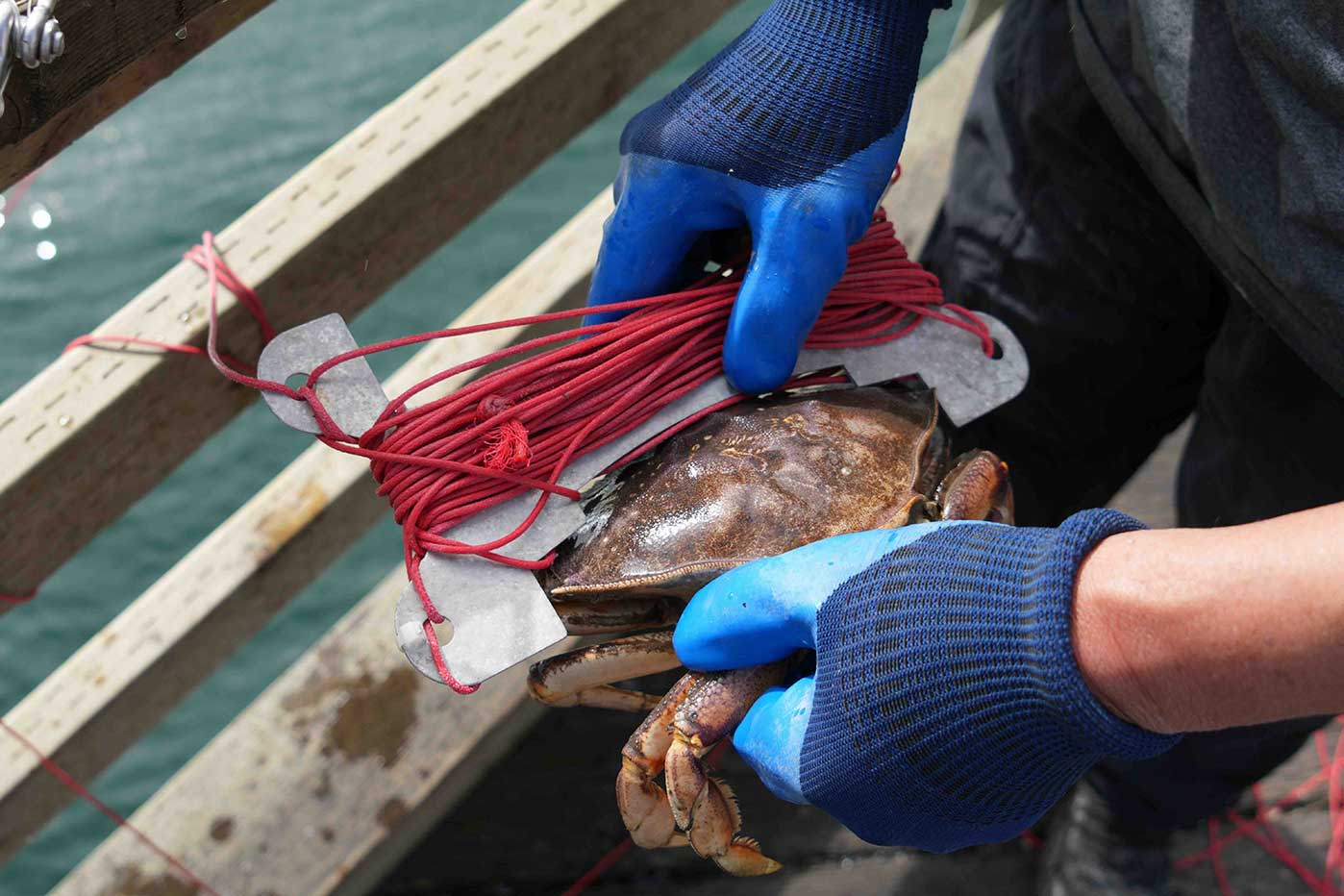
Ying thinks their built-in rulers also add an element of convenience to ensure the crabs people catch are “keepers,” meaning they meet the legal size limits of at least 165 mm in width for Dungeness and 115 mm in width for red rock crab.
In one year alone, he sells around a couple thousand of them, making them as much a fixture on Vancouver’s piers as he is.
If Ying’s sales alone don’t capture the popularity of crab fishing in Vancouver, the group chats he’s a part of do. Currently, he belongs to seven different group chats dedicated to crab fishing, each of which is made up of about 500 people.
Most group members are his customers, but even they only account for roughly one-third of his clientele. By these numbers, in Ying’s circle alone, there are at least 10,500 crab harvesters, and he thinks the community is only growing.
I’m a part of this wave of interest in crab fishing, but I’ve found it difficult to catch crabs that are above the legal size requirements. Apparently I’m not alone.
Ying tells me that when he first started crab fishing, he used to be able to catch four crabs — the maximum number of crabs that recreational fishers can legally harvest per day on the south coast — within a few hours. These days, he says, there are “no big ones.”
As economies expand, recreational fisheries grow
Before answering the question of why there are fewer keepers in the waters surrounding Vancouver’s fishing piers, we might first zoom out to look at how — in Burrard Inlet and around the world — crabs are under mounting pressure from all directions.
According to one study, the popularity of recreational fishing tends to go up in economically developed parts of the world. As economies expand, recreational fisheries grow, meaning they are more likely to occur in habitats that have already undergone — and will continue to undergo — considerable change caused by human activities. Burrard Inlet is just one such place.
In just 233 years of colonial contact, this long arm of water has gone from a place where Squamish, Tsleil-Waututh and Musqueum Peoples could harvest salmon, herring, anchovy, eulachon and shellfish in abundance, to a waterway where 700 contaminants were recently detected across samples of water, sediment, and fish and shellfish tissues.
Crabs harvested from the inlet are generally considered safe to eat because contaminants only affect their hepatopancreas — an organ located in the body cavity of crabs that functions as a liver and pancreas — but most other shellfish are not safe for consumption.
Habitat loss has been significant. According to three reports from the Tsleil-Waututh Nation, 80 per cent of the Capilano River estuary and 56 per cent of the Seymour-Lynn estuary were lost to development and erosion between 1792 and 2020. These ecologically sensitive areas, full of tidal marshes, eelgrass meadows and mudflats, are prime habitats for Dungeness crabs. Their devastation has had a significant impact on both the ecosystem and the availability of traditional Indigenous food sources.
Brian Hunt, an ecosystem oceanographer for the Institute for the Fisheries and Oceans at the University of British Columbia, says that shipping activities also have a lot to answer for.
Tanker traffic in the inlet has increased tenfold since the TMX pipeline finished its expansion in May 2024. The vessels pollute the water, but the noise they produce may have an even greater impact not just on marine mammals, but fish and crustaceans.
Crabs are also feeling the heat of our climate crisis. One-quarter of CO2 emissions are absorbed by our oceans, resulting in a phenomenon known as ocean acidification. As oceans become more acidic, it affects crabs’ shells and sensory organs, making it more difficult for them to survive.
It’s these kinds of developments that push on our ocean’s baselines — the very conditions from which some of us pull up crabs. But our fishing habits, too, have started to shift.
In B.C., both Dungeness and red rock crabs are managed by size, sex and season. This means that you can only harvest male crabs, which are identifiable by a triangular abdomen on their underside that is narrower than those on female crabs. They also have to be a certain size and can only be harvested at certain times of the year from some piers.
For a long time, this management style worked, says Heather Earle, a coastal ecologist with the Hakai Institute. But as fish stocks like salmon and herring have dwindled, the pressure on crustacean fisheries has increased. Crabs are getting fished harder by both commercial and recreational fishers, and local depletions are being noticed up and down the coast.
Brendan Aulthouse — a scientist with the Department of Fisheries and Oceans — says that crab fishing is on the rise across all user groups, especially in urban centres like Vancouver.
In 2000, local fisher Gary Soriano could head to the pier and reach his crab limit in 30 minutes or less. He echoes Ying when he says that, nowadays, it can take the whole day to catch a keeper.
From a conservation standpoint, Aulthouse says that recreational pier fishing is less concerning than both commercial crab fishing and recreational harvesting from boats.
Commercial crab fishers harvest in high volumes, while recreational fishers with boats have access to areas pier fishers don’t, opening more sites to potential depletion. But because adult crabs are homebodies — meaning they don’t move very far — the keepers near the piers get picked off as this activity becomes more popular.
The urban crab-fishing community then finds itself at an interesting moment in time. Overall, there seem to be far bigger threats to crab populations than families throwing traps off the dock. But due to the fixed nature of piers and a growing interest in crabs, these gathering places above the water, which once offered Dungeness or red rock in just 30 minutes, no longer do.
Still, people frequent them. There are other reasons to spend the day fishing.
‘You feel separate from the rest of the world’
Crab fishing is about more than just the catch. Take Ying for example: it turns out he’s allergic to all seafood. He’s never been able to enjoy the keepers he catches, giving them away instead to friends and family. And yet, he spends most of his free time out above the water, pulling on his crab-trap lines.
Crab fishing is “a joy,” he tells me. “When you get to the pier, the surrounding environment is beautiful. It’s quiet. You feel separate from the rest of the world, and you can reflect on yourself.”
When he does catch a crab, he feels a sense of achievement. It’s also socially meaningful, especially to people who have moved to Vancouver from other places with a strong culture of pier fishing. Many of Ying’s pier fisher friends are from China, Korea and the Philippines.
In the beginning, Ying hardly hung out with the people he met on the piers outside of their shared hobby, mostly due to language barriers. But then in 2017, he took it upon himself to organize a group fishing trip. He and his fisher friends split the cost of renting a commercial fishing boat and headed to the coast of Vancouver Island, where they fished for lingcod, greenling, cabezon, flounder and rockfish. It’s something they still do. The second time I met Ying, he’d just come back from a trip off the coast of Port Renfrew.
While Ying and I waited in a café for our translator to arrive, we watched an atmospheric river break loose over Vancouver, and he took out his phone to show me a photo of a brown, spikey cabezon. It was just one of the many fish he’d caught over the weekend, and sharing it with me made his face brighten.
Even in Port Renfrew, he said, people recognized him. Like most people in B.C. who know Ying, they’d once bought crab traps from him.
According to a 2020 study by a global team of fisheries scientists, while recreational fishing has many psychological benefits, interest in it is typically lower in urbanized areas.
In cities, people are less exposed to fishing as a pastime, and many are alienated from nature altogether. Access to fishing areas can also be limited, especially for people with time and financial constraints.
Even in Vancouver, a city known for its close proximity to nature, activities like camping, hiking and fishing aren’t accessible to everyone. The piers, then, provide an opportunity to recreate and enjoy the natural world without having to go very far.
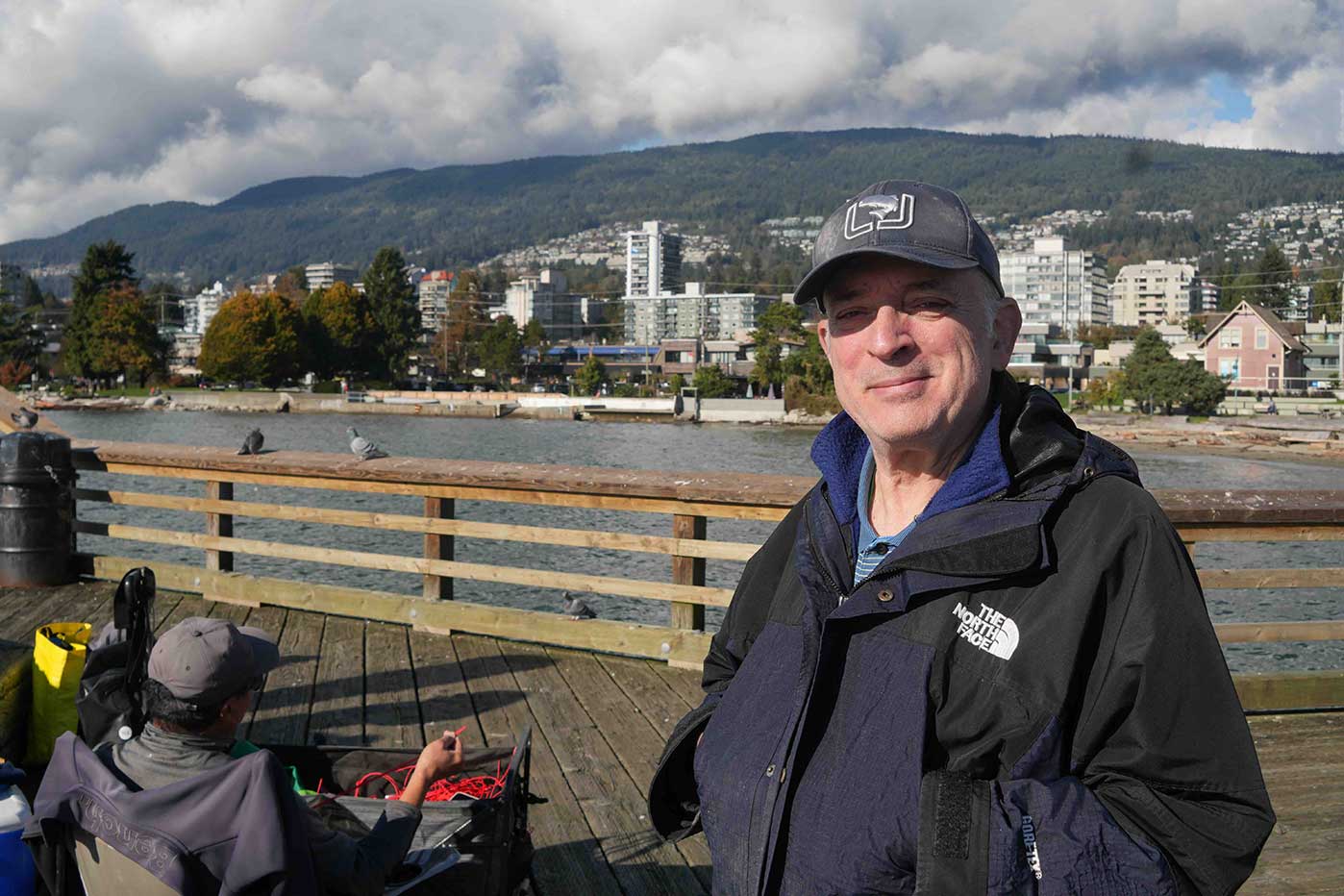
Tony Kondaks — a local fisher who I met through Ying — takes the bus from East Vancouver to Ambleside three days a week just to go crab fishing, with all of his gear in tow. Originally from Montreal by way of Arizona, this activity has become an important part of his life since moving to Vancouver. For him, having the opportunity to catch fresh seafood just 45 minutes away from where he lives has been thrilling.
Part of it is the fun of the hunt, he told me, and the excitement he gets from feeling the weight of a heavy crab trap move through the water. It also provides him with meaning as a retired person living in the city.
“I'm 69 years old and it’s either that or watch reruns of Gilligan’s Island. It gives me something to do,” he said. He’s disappointed when he doesn’t catch anything, but the trips are still worth it. When he does catch a keeper or two, he shares them with his landlord and roommates.
Gary Soriano, the pier fisher who observed the decline in keepers since 2000, is a truck driver for Sysco raising a family in Surrey. For him, fishing has never really been about the catch. Mostly, it’s a stress release that helps him to unwind and stay connected to the natural world.
When he’s out on the water, “I feel at home,” he said. Nowadays, he mainly fishes from his boat up Indian Arm, but his fishing roots can be traced back to the piers.
At 16, Soriano immigrated from the Philippines to join his mother who was already working here in Vancouver. Shortly after arriving, he took up crab fishing off the pier in Burnaby’s Barnet Marine Park. He’d sometimes bring his friends and family along, and they’d have a picnic right beside the pier, barbecuing together and enjoying the crabs they caught. When he eventually became a parent, he made a point of bringing his kids to the piers, too.
Pier fishing is popular around the world. In California, which has an extensive public pier system, people can even fish from piers without a license. This accessibility has made them welcoming destinations for people of all different backgrounds. In his review of American piers for the Nature Conservancy, Matthew L. Miller wrote that he believes pier fishing might be the most diverse outdoor recreational scene in the United States.
Diversity might also be an indication of something bigger. A 2020 case study in Santa Barbara County, Calif., found that many pier fishers were from lower-income, Latino, Asian and Pacific Islander communities.
Nearly all fishers interviewed for the study consumed their catch at least once a week. Yet while food was a motivator, they were more motivated by the social dimensions of pier fishing.
The study emphasized that consuming one’s catch can’t be separated from the shared experience of fishing. For anyone facing food insecurity, or who finds themselves socially isolated, the piers can be especially meaningful.
When I first took up crab fishing, I was looking to spend an easy afternoon or two outside of the whirlwind of city living. But rather than separate me from those conditions, I’ve found that crab fishing has connected me to them in a new way.
Out on the piers, facing where I’ve spent most of my life — the water, the many cultures, the tankers — I’ve been able to think more deeply about this place I call home.
It’s hard not to notice the dysfunction. Development in Burrard Inlet only continues to ramp up. So do the demands of modern life, which might contribute to both the popularity of crab fishing and the resulting pressure on crab populations.
That we have to escape our daily lives, and that we sometimes feel we don’t belong otherwise — to nature or with each other — speaks to the disconnection those contemporary demands burden us with. And so we bring ourselves to the piers, and in return, they tether us to something bigger. Maybe it’s to the ocean, or to each other, or to the simple joy of waiting.
The day I meet Kondaks at Ambleside, Ying also happens to be there. Kondaks is pulling up his crab trap, and Ying greets me with a warm welcome. “Emily!” he yells, walking to join me and Kondaks. We’re both just in time to see him bring in his catch.
As Kondaks pulls on his line, a small crowd gathers around. The water, glistening, is clear enough to watch the trap make its way up to the surface. To everyone’s delight, it’s full.
Kondaks lifts it over the railing and sets it down on the pier’s wooden boards. Just by looking at the crabs, Ying can tell that none of them are keepers. But it doesn’t matter. The wind smells of salt, and everyone is smiling. ![[Tyee]](/design-article.thetyee.ca/ui/img/yellowblob.png)
Read more: Environment







Tyee Commenting Guidelines
Please note that email notifications for replies are not currently working due to a software issue which may be resolved in a future update.
Comments that violate guidelines risk being deleted, and violations may result in a temporary or permanent user ban. Maintain the spirit of good conversation to stay in the discussion and be patient with moderators. Comments are reviewed regularly but not in real time.
Do:
Do not: