


 SHARE:

Vancouver-spawned technical apparel giant Lululemon recently launched a lawsuit that aims to stop Costco from selling a super-cheap dupe of its testicle-friendliest pants.
The pants are called ABC trousers, and the abbreviation stands for “Anti-Ball-Crushing” technology. Sold in 40 varieties ranging from slim-fit business casual trousers to shorts and joggers, the ABC pants are the linchpin of Lululemon’s 11-year goal to snatch the market on menswear the same way it cornered the market on yoga apparel for women two decades ago.
As business casual apparel, the ABC trouser is basically a super-stretchy chino with a twist.
Most chinos have a seam right up the middle; these ones don’t. Engineered to give “the family jewels room to breathe,” the pants feature a wide-panelled, gusseted crotch, like a bra, but for balls.
The ABCs promise freedom of movement you wouldn’t expect from a chino. They’re perfect for the businessman who rides a horse to work.
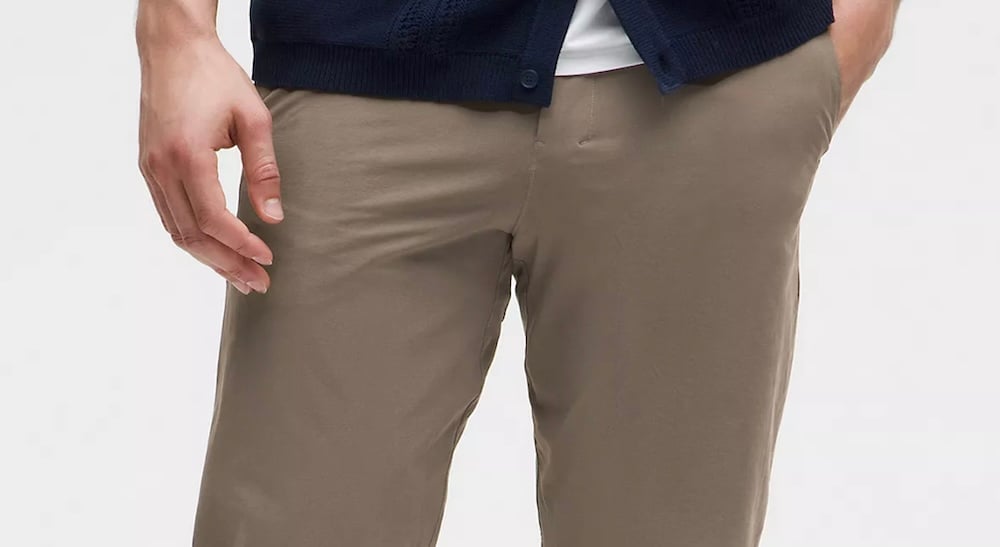
“These pants are magical,” said typical Vancouverite Michael Coyle, whose July 5 Bluesky post about his favourite pants inspired this piece. “I've ridden 20-km round trips on my bike, roofed a cabin, paddled a canoe, hiked the Chief and had dinner at restaurants in them,” Coyle wrote.
I have a pair, too. They’re comfy! I’ve never really thought about the way they treat my junk, but I suppose that’s to their credit. If they did a poor job, I’d have noticed.
For instance: I recently bought a pair of Adidas compression shorts to combat chafing on long-distance runs. They turned out to be from the women’s collection, which might have been fine for a looser base layer. In this case, however, the middle seam made for a lot of unwanted lift and separation.
The corresponding undershorts for men are gusseted.
Compression tech is meant to be tight, though. Business casual wear like the ABC pants, not so much.
“I've never tried them on,” menswear guru Derek Guy told me Tuesday when I called him up to talk testes. “I can't attest to whether or not they are less ball-crushing. My personal feeling is that when you make pants that tight, then maybe you need a gusset, because you've made the pants suction-fit.”
This is less of a problem, Guy added, “if you wear pants that aren't so tight — that is, by definition, not very ball-crushing — because you’re not wearing leggings.”
It’s summer 2025 and the skinny jeans era is long gone. A gusseted groin seems a little superfluous, sure, but there’s more going on with the ABC pants than testicular comfort.
“This is obviously partly marketing, right? I think a lot of men have trouble with the idea of buying clothes based on joy, or self-fashioning, or looking good,” Guy said.
Men tend to be more persuaded, he added, by “ideas of technical performance or new technology.”
Ballsy innovation
Maybe you’ve noticed the streak of innovation in the field of men’s boxer briefs over the past decade. Dare I say we’re living in the golden age of testicular technology, as menswear and underwear brands seek to assure male consumers that the brightest scientific minds in balls are on the case.
Back in the day, men’s underwear tech went as far as a peekaboo flap for quick urinal access.
Nowadays, if you don’t have a hammock for the fellas, it’s a bit of a red flag.
For roughly a decade, ball pouches have been all the rage. A quick search of Google Trends notes that the phrase “underwear pouch” had a brief spike in February 2009 following the arrest of the infamous underwear bomber. It spikes again in the mid-2010s, when Lululemon went all in on testicle padding for casual Fridays, and pouches were suddenly crucial men’s underwear tech.
Right around then is when Norwegian apparel company Comfyballs was denied a brand trademark for reasons of vulgarity. Apparently, the word “balls” is a bridge too far for the United States Patent and Trademark Office.
Vancouver’s Saxx Underwear had more luck in 2018 with its patented “BallPark Pouch.” The “hammock-like crossover pouch” is designed, per the website, “to cradle your beans.”
Last fall, I stopped by Blue Sky Clothing on Commercial Drive. The B.C.-based company specializes in natural bamboo apparel for women, but recently launched a line of men’s underwear. I saw it and stifled a scoff. For one thing, the waistband read “Blue Sky Guy,” which rhymes, but otherwise seems as descriptive as something like “Hanes for her for him.”
It made me wonder if they knew what they were doing. So I looked inside. That’s when I saw the special pouch — the proof they’d done their research. Confidence restored, I bought two pairs. In hindsight, I can’t believe I’m such an easy mark.
When Lululemon branched into menswear in 2014, it seemed like a pretty big risk. Buying apparel from women’s stores, or brands closely associated with women, is a tough sell for many men. Sometimes, as when men complain the Lululemon logo is too feminine, it’s misogyny. Other times it’s simply lack of trust in the product; one might wonder, what does a women’s athleisure brand know about menswear?
The answer was to go all in on testicle technology. Having perfected the party in the back, Lululemon turned its attention to the business in the front. It worked. It really worked. Things are going so well that Lululemon released a full business suit in the spring, and Costco is selling a Kirkland-brand knock-off of the trendsetting ABC pants for $100 less.
That’s success, even if it hampers Lululemon’s stated mission to double men’s business by 2026.
Regardless of the way the lawsuit shakes out, however, one has to assume they’ll be fine.
After all, they know the secret: if all else fails, go for the groin. ![[Tyee]](/design-article.thetyee.ca/ui/img/yellowblob.png)
Read more: Fashion, Gender + Sexuality











Tyee Commenting Guidelines
Please note that email notifications for replies are not currently working due to a software issue which may be resolved in a future update.
Comments that violate guidelines risk being deleted, and violations may result in a temporary or permanent user ban. Maintain the spirit of good conversation to stay in the discussion and be patient with moderators. Comments are reviewed regularly but not in real time.
Do:
Do not: