

 SHARE:

Québec politics is never boring and Monday's provincial election produced lots of drama. Its results promise to influence Canadian policy and politics in three significant ways: more risks to national unity and social cohesion, louder voices for conservative policies and discourse, and a new challenge for Prime Minister Mark Carney's strategy on federal-provincial relations.
First, an election recap. The sovereigntist Parti Québecois (PQ) will return to power for the first time since 2014. It is only the second election the party has won this century, and once again the PQ will settle for leading a minority government, having won 59 of the 127 seats in the province's National Assembly. Its leader, the pugnacious Paul St-Pierre Plamondon, will become premier.
Three other parties won seats. The federalist Liberals -- with no relationship to the Liberal party led by Carney -- will serve as the Official Opposition after winning a surprising 40 seats, largely ridings on the Island of Montreal. The constitutionally ambiguous Conservatives -- also with no affiliation to the federal party of the same name -- will have voices in the assembly for the first time having won 19 seats, while the progressive and sovereigntist party, Québec Solidaire, elected nine members.
The governing Coalition Avenir Québec, led by Christine Fréchette, lost all its seats, a result worse than even the two seats won by the incumbent federal Conservative Party in 1993. Notably, both results occurred under female leaders who had recently taken over from their deeply unpopular male predecessors.
The election's dominant storyline, meanwhile, particularly outside Québec, is the PQ's commitment to hold a third referendum on sovereignty. Notwithstanding near-historic lows in support for sovereignty, Plamondon has pledged to proceed while also promising to delay a vote until after U.S. President Donald Trump is out of office. If Plamondon is counting on a two-year timeline for Trump's scheduled departure though, he should re-watch the footage from January 6th.
While such a referendum, if indeed eventually held, would serve as a dramatic story climax, Canadians can expect many other troubling plot twists along the way.
The return of painful trips to the dentist
Former PQ leader Jacques Parizeau -- the Québec Premier during the last sovereignty referendum -- once compared the rest of Canada's resistance to Québec separation to a never-ending visit to the dentist. With due respect to the profession, the current PQ leader's plans conjure a similar anxiety.
Aside from the specific threat of a costly, time consuming, and divisive referendum, there are numerous ways that a PQ provincial government could wreak havoc on the federation.
Plamondon is a politician who likes to pick fights and make others uncomfortable. He has opposed multiculturalism, questioned the legitimacy of systemic racism, and once referred to an Indigenous land acknowledgement given prior to a Montreal Canadians game as a "mistake,” stances that place him on the fringes of political influence, not at the centre of power.
During a 2022 election debate, the-then rookie leader successfully dared the Québec Solidaire co-leader at the time, Gabriel Nadeau-Dubois, to repeat his use of the N-word -- all in the presence of the Black woman leading the Liberal Party in that election, Dominique Anglade.
Ethnic nationalism is not new to Québec politics and certainly not to the PQ, but in its current anti-wokisme iteration, the party and its leader can be expected to add rhetorical fuel to already fiery national debates on immigration and inclusion.
Legislatively, a Plamondon government has promised to widen the scope of secularism measures the CAQ adopted during their term, including preventing elementary school students from wearing religious clothing such as the hijab.
A clash with the federal government and Supreme Court appears inevitable as the Court is expected to soon rule on the constitutionality of Québec's existing religious symbols law while also responding to the federal government's factum on the pre-emptive use of the notwithstanding clause to override Charter rights, a tactic the CAQ government used regularly including in context of its religious symbols law. Plamondon has pledged to oppose any attempt to invalidate this law.
It is not only Charter rights the PQ seeks to undermine, Plamondon is planning a confrontation over the role of the monarchy in Canada, promising to interfere with the constitutionally-determined role of the Lieutenant Governor in Québec's government.
Finally, the PQ seeks to disrupt important federal policies that are mostly outside the province's jurisdiction but that will nonetheless wreak political havoc and cause public harms while sowing national and regional divisions in the process.
For example, Plamondon has promised to block the federal high speed rail project in Québec and wants the Carney government to direct the saved funds to the province for spending on roads instead. He has raised the possibility of renegotiating the recent clean energy agreement between Québec, Newfoundland and Labrador, and the federal government concerning Churchill Falls. And Plamondon also seeks more provincial autonomy over immigration, along with plans for drastic reductions in the numbers of new arrivals.
As with most issues in Canadian politics, these tensions are magnified by the spectre of a menacing and unpredictable U.S. President who has stated his desire for Canada to become the 51st state. It is in this context that a media report in the closing days of the Québec election campaign becomes more worrying. In the report, the PQ is said to have sought a meeting with the Trump administration, a claim Plamondon has denied.
Given how members of Trump's cabinet and the President's allies have inserted themselves into Alberta's independence debate, it is a report that Canadians, within and outside of Québec, should monitor.
With Plamondon's affinity for division and team Trump's effectiveness at disinformation, Canadians' resolve to keep their country together will need to encompass more than a tolerance for dental visits.
The rise and potential influence of a Conservative Québec
Not since the Duplesis era has Québec's political landscape appeared so conservative. From economic and social policy to freedom and democracy to inclusion and environment policy, the Québec election has produced a surprising result bound to inform larger, Canada-wide political debates.
Previously, when the PQ formed government, Québecers had to prepare for the uncertainty of constitutional debates, the tediousness of existential questions, and the tension of nationalist rhetoric. Somewhat incredibly, those realities were often mitigated by good policies. For example, policies such as electoral finance reform, accessible childcare, and modest pharmacare all originated from PQ governments and went on to be celebrated nationally and replicated by other governments within the federation.
But this is not the interventionist, big government PQ of old. Consider key elements of the party's campaign platform and promised governing priorities: decreasing annual net spending, shrinking the civil service, cutting corporate taxes, creating a "Secretariat for Government Efficiency and Regulatory Streamlining", health care reform that does not address privatization, lowering of the gas tax, and reducing contributions to the province’s climate change fund to save $450 million.
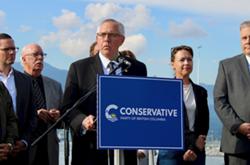
The Conservative Party of Québec, meanwhile, aims to push the PQ further right. The party's leader is Éric Duhaime, a former “poubelle” radio host and contributor to the far-right outlet Rebel Media. He has previously championed school funding that is directed by parent “choice.”
The Conservatives' current agenda includes seeking to reduce government spending by $12 billion, eliminating more than 20,000 civil service jobs, and making significant income and corporate tax cuts. The Conservatives also plan to abolish a government fund dedicated to fighting climate change, eliminate the greenhouse gas cap-and-trade system, allow natural gas exploitation, and suspend the consumer gas tax for one year.
This political shift, on the heels of one of the most conservative Québec governments in generations and with the official opposition Liberals historically skewing more right of centre than left, will have major consequences for Canadian policy debates, including on issues like fair taxation and climate change. It is a particularly sobering predicament for environmental activists. If the undermining of climate measures in favour of pro-fossil fuel policies cannot be prevented in Quebec, a province known for massive pro-climate action rallies, where in Canada can it be?
In this context, progressive policy advocates may wish to spend less time litigating the intricacies of our present electoral system and more effort on helping to bolster the remaining progressive measures in Québec. At the same time, these advocates should begin identifying and developing new ideas, champions, and voter constituencies throughout the country.
Carney's contradiction
If the PQ does proceed with a Québec referendum while Carney is prime minister it will be the first time such a vote has happened with a non-Québecer representing Canada to the province. That fact, coupled with Carney's modest communication ability in French, poses a challenge to the federalist side but not an insurmountable one. More complicated is the risk of contradiction in the Prime Minister's "flexible federalism" strategy, particularly if it is perceived that Québec is being treated less fairly than Alberta.
Consider, over the past year and a half Carney has repeatedly and substantially rolled back federal climate policies -- at enormous health and economic consequence -- due in no small part to appease Alberta Premier Danielle Smith's separation threats and positioning of Alberta as an aggrieved party.
In his "forward guidance" video seeking to justify these Liberal government rollbacks, he sympathized with, and repeated, the framing by Alberta conservatives and American oil companies on past federal policies and their impacts on the province. Carney specifically referenced the National Energy Program of the 1980s and showed a newspaper clipping from the time featuring a photo of former Liberal Prime Minister Pierre Trudeau along with the headlines "Ottawa stakes energy claim" and "Alberta, oilmen rocked.” Carney said he remembers "how Ottawa made Albertans feel like our resources weren't our own."
Now imagine the prime minister, faced with a more experienced nationalist movement in Québec that is motivated not by the potential value of a single resource but the protection of a minority language spoken by millions, delivering a similar talk. Would Carney feel obliged to announce the reopening of the constitution to meet longstanding demands around federal spending powers, jurisdictional policy responsibilities, and the designation of the province as a distinct society? Might he support weakening minority language protections within Québec, justifying it by holding up a newspaper clipping about the so-called "night of the long knives" from the federal-provincial constitutional deliberations of the 1980s?
Whatever concessions Carney provides to Alberta to address its supposed grievances, he will be expected to offer equivalent measures to Québec. Another round of appeasement federalism risks a Mulroney-like constitutional mess, whereas uniquely saying no to Québec might be the one factor that could drive up the stalled support for sovereignty. It is a predicament that may be too late to avoid but one the prime minister and his team should at least plan to mitigate. Importantly, they should involve a broader range of Canadians in those plans.
Another divisive lurch to the right
Canada is facing threats from all directions. The country does not really have the time and resources to devote to a new chapter debating Quebec's place in Canada. Yet neither can the country afford to lose Quebec, or Alberta for that matter, from the federation.
And while circumstances -- and a minority PQ government -- may keep a referendum in that province on the back-burner for a while, Canadians should not overlook the more immediate lessens from the Quebec election and the related risks to our country: the rise of yet another divisive leader seeking to succeed through subtraction; a rightward political shift that threatens deeper inequality and insecurity, and a prime minister whose political inexperience and personal blind-spots may have led him to overplay his hand on federal-provincial relations.
Canadian citizens and their political leaders should take some time to reflect on these lessons and then get down to work. ![[Tyee]](/design-article.thetyee.ca/ui/img/yellowblob.png)



Tyee Commenting Guidelines
Please note that email notifications for replies are not currently working due to a software issue which may be resolved in a future update.
Comments that violate guidelines risk being deleted, and violations may result in a temporary or permanent user ban. Maintain the spirit of good conversation to stay in the discussion and be patient with moderators. Comments are reviewed regularly but not in real time.
Do:
Do not: