


 SHARE:
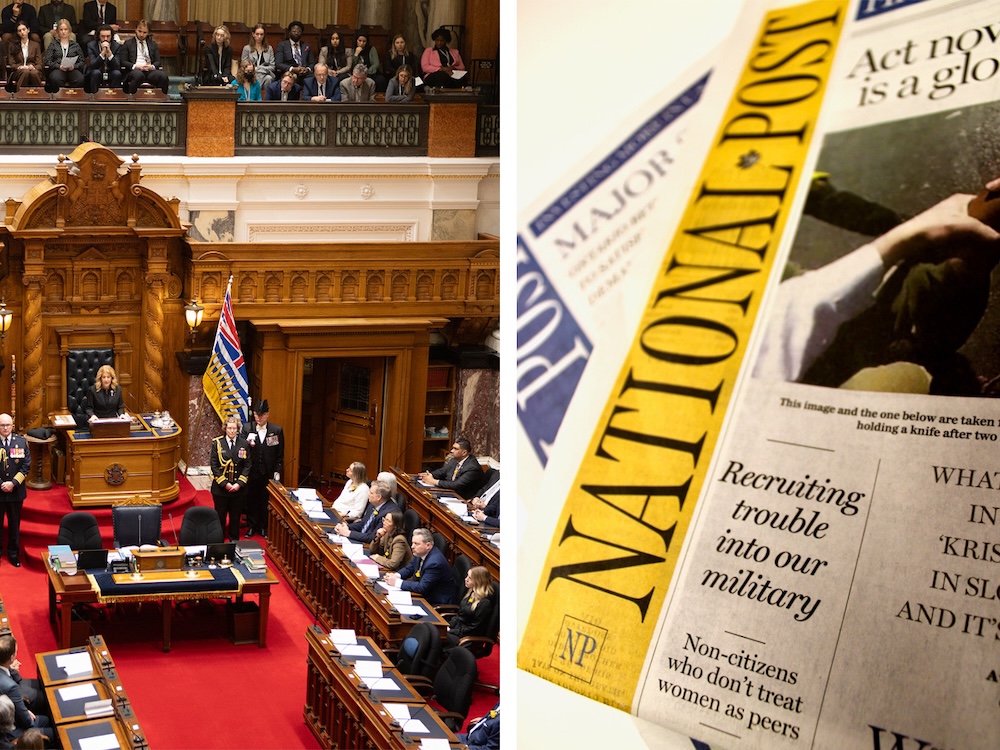
On April 23, B.C. MLA Tara Armstrong used the Nazi phrase “blood and soil” in the provincial legislature when speaking in opposition to Indigenous rights.
The same week, a review of a dystopian novel that is beloved by neo-Nazis appeared in the National Post, a national newspaper owned by Postmedia. The corporation’s 130 outlets include the major daily newspapers in Vancouver, Calgary and Edmonton.
Newer right-wing media outlets have been flirting with white nationalism for a while.
In February, former Alberta premier Jason Kenney publicly objected to Juno News interviewing Daniel Tyrie, the leader of the Dominion Society — a group that extremism experts describe as white nationalist, although Tyrie disagrees with the label. (Kenney bluntly called Tyrie “a racist.”)
In March, the Western Standard interviewed Alex Vriend, the leader of a white nationalist group called Second Sons, in response to an investigative story published by The Tyee.
The Western Standard’s story did not mention that Vriend has frequently made antisemitic and racist comments, called for a “race war” and made statements like “The Nazis were right.” (Recently, Western Standard writer Alex Zoltan shared a post from an X account that repeatedly praises Hitler; he told The Tyee he does not like or endorse Hitler and his “retweet was solely about the protection of women’s and girls’ single-sex spaces.”)
The National Post’s review of The Camp of the Saints and Armstrong’s use of the phrase “blood and soil” are notable escalations in mainstreaming the language of white supremacy, says an expert who studies the far right.
“It is very significant,” said Carmen Celestini, a lecturer at the University of Waterloo who studies religion, extremism, conspiracy theories and politics in North America. “It is giving validation to these ideas.”
The Tyee contacted the Western Standard and the National Post for comment for this story. They did not respond.
Celestini said the ideas and language being platformed are piggybacking on existing political concerns about Canadian immigration and fears about Indigenous rights overriding the rights of non-Indigenous people.
Both the book review and Armstrong’s comments in the legislature and on social media reflect the white nationalist take on these issues, Celestini said. Both examples reflect a dehumanizing, white supremacist view of immigrants and Indigenous people and present immigration and Indigenous rights as a threat to Canadian society, she said.
“It validates those ideas — that not only is this something that we're suffering through at this point, this is actually an existential threat to the nation,” Celestini said.
What is ‘The Camp of the Saints’ and why is it a big deal?
The Camp of the Saints was written by the French author Jean Raspail in 1973. Celestini describes it as a dystopian novel about a caravan of immigrants coming to Europe by boat from an unspecified South Asian country.
The migrants are depicted in an unambiguously racist way: as rapists, as people who sell their children for money and do other degrading acts and as a threat to European society.
“And it happens over Easter weekend, so it's not just a destruction of western civilization but also a destruction of Christianity, a destruction of all that is good and the values of morals of western society,” Celestini said.
The book regularly appears in lists of books white supremacists recommend to one another, and the book’s title is often referred to in forums where white supremacists talk about the dangers of immigration, Celestini said.
Speaking with NPR in 2019, Chelsea Stieber, a professor of French and francophone studies at the Catholic University of America, described the novel’s key themes as “white supremacy and the end of white civilization as the West knows it — infestation, invasion, hordes of nameless, faceless migrants who come to indeed invade the West and bring about its end.”
The book has been referenced by Stephen Miller, the architect of the Trump administration’s brutal attempt to increase deportations and imprisonment of immigrants in U.S. cities. Steve Bannon, a former strategist for U.S. President Donald Trump, has also talked about the book.
The National Post’s review of the book acknowledges that the novel is “generally considered a racist book towards Indians.” But the bulk of the piece is devoted to arguing the book’s ideas and warnings about “third-world migration” have merit and should be more widely read.
The review also expresses concern that the book is not stocked in Canadian libraries or bookstores and was taken down from Amazon for one day, arguing freedom of speech was threatened.
Celestini said it was disappointing to see Kenney protest the book’s short-lived disappearance from Amazon. In a post shared to X on April 20, the day the book was unavailable on the online store, Kenney called on freedom of expression advocacy group PEN Canada to defend The Camp of the Saints. He compared the issue to PEN’s advocacy for books recently banned from Alberta school libraries because they include depictions of sex.
“I have never read Camp of the Saints (although I am now moved to do so),” he wrote, “so offer no judgment of its merits. But there is no denying that it is a widely read novel with a significant cultural impact on France, and around the world.”
Celestini said Kenney’s defence of the racist book stands in contradiction to his earlier condemnation of Juno News for interviewing Tyrie, whose organization calls for the deportation of five million to nine million immigrants — up to 21 per cent of Canada’s population — according to the Dominion Society’s website.
The Tyee contacted Kenney for comment for this story but did not hear back.
‘Nazi rhetoric’ in the BC legislature
Independent MLA Armstrong, who represents the riding of Kelowna-Lake Country-Coldstream, started off as a B.C. Conservative but then joined a new party called OneBC after MLA Dallas Brodie was ejected from the Conservative caucus for mocking residential school survivors.
Amstrong left OneBC last December after a disagreement over a staffer, Othman Mekhloufi, who had expressed extreme-right views, including allegedly using the Nazi phrase “blood and soil” in discussions with other party staff. Armstrong supported Mekhloufi; Brodie wanted him fired.
“Blood and soil” was an early Nazi slogan in Germany, used to evoke the idea of a pure “Aryan” race and the territory it was entitled to claim.
Amstrong herself used the phrase in the legislature on April 23. Speaking in opposition to legislation to advance a treaty with the K’ómoks First Nation, Armstrong said the treaty act “promotes UNDRIP’s blood and soil theory that people with Indigenous ancestry have their own inherent rights, based upon what are described as inextricable links to the land.” (UNDRIP refers to the United Nations Declaration on the Rights of Indigenous Peoples; the Declaration on the Rights of Indigenous Peoples Act, or DRIPA, is a law adopted by British Columbia in 2019 that commits the provincial government to align its laws with UNDRIP.)
Premier David Eby immediately denounced Armstrong’s language, calling it “Nazi rhetoric.”
The Tyee asked Armstrong to respond to criticism of her use of the language.
A member of her staff, Tim Thielmann, responded via text: “I’m sure [The Tyee’s news story] will definitely not be a ridiculous hit piece that runs cover for the ethnic nationalism of the UNDRIP being embedded by the NDP into modern treaties. I’m sure you will focus on the fact that MLA Armstrong is calling for an end to all racist laws within British Columbia, contrary to the political parties that support DRIPA and aboriginal title and the Indian act. Very much looking forward to it!”
While Armstrong claims she used the phrase to accuse the provincial and Indigenous governments of being racist, Celestini said the way Amstrong used the Nazi phrase is problematic for two reasons.
It serves as a dog whistle to people who already hold white supremacist beliefs, and Armstrong is using the language to “strengthen conspiracies and fears against Indigenous communities,” Celestini said.
“In using the phrase in reference to the K’ómoks Treaty Act legislation... she is reinforcing the notion of what some perceive as ‘special’ rights for Indigenous communities, that ‘harm’ or ‘oppress’ whites,” Celestini said. “For those outside of these ideological circles it is obviously a dog whistle to white nationalism, while engaging in conversation about Indigenous communities.”
In response to Armstrong’s use of the phrase, Nico Slobinsky, vice-president for the Centre for Israel and Jewish Affairs, wrote an opinion piece for a news site called Sitka Media in which he warned that “frivolously invoking the words used to dehumanize [Holocaust survivors] more than eight decades ago cheapens their impact, erodes our collective understanding of history, and numbs the public to the very real antisemitism our community faces today.”
When a Nazi phrase is used in the highest levels of provincial politics, Celestini added, it opens the door to this language entering the mainstream, where people in authority can increasingly adopt such terms “with no repercussions, or accountability.
Celestini said white nationalist groups like Second Sons and the Dominion Society use language that suggests Indigenous people in Canada “were conquered, not colonized,” to try to erase the need for Canada to make amends for racist colonial policies that continue to affect Indigenous people and illegal acts by government. It tries to establish Canada as a “European” nation.
“We’re not giving land back to the indigenous,” the Dominion Society posted to X in October. “Canada didn’t exist until European settlers built it.”
After using the Nazi phrase in the legislature, Armstrong continued to post on X on April 23, describing Indigenous culture before colonization as “slavery, cannibalism and brutal warfare.” It was a call to the centuries-old trope that Europeans were justified in colonizing other cultures and lands because the people who lived there were less civilized.
OneBC has gone across the province to promote a documentary, made with taxpayer funds, that questions whether residential school abuses actually happened.
“In B.C., because there's so much fear that people are going to lose their homes and lose their land and then it's just going to be taken away from them, it adds to that existential threat that leads more people to go to the right and to believe these conspiracy theories,” Celestini said.
The effect of mainstreaming white supremacist language
The Tyee has previously reported on efforts by extreme-right figures to influence mainstream Canadian political parties.
The cumulative effect of white nationalists and white supremacist language being pushed into the mainstream is to make these ideas more palatable to Canadian voters, Celestini said.
“We're seeing these people who might be on the edge or might be hanging out on X, who may not necessarily perceive themselves as being racist or wanting to see some of this horrible stuff happen, but also feeling this victim status with what's happening with the economy, with jobs and everything that's going on,” Celestini said. “So it makes it seem more palatable — it seems OK to join those groups.”
Celestini said it’s important to explain how these ideas are being spread and the real damage done by the promotion of books like The Camp of the Saints.
“If we ignore it, then we're sort of validating it too. It's almost like complicity by not saying something.” ![[Tyee]](/design-article.thetyee.ca/ui/img/yellowblob.png)
Read more: Rights + Justice, Politics, Media











Tyee Commenting Guidelines
Please note that email notifications for replies are not currently working due to a software issue which may be resolved in a future update.
Comments that violate guidelines risk being deleted, and violations may result in a temporary or permanent user ban. Maintain the spirit of good conversation to stay in the discussion and be patient with moderators. Comments are reviewed regularly but not in real time.
Do:
Do not: