


 SHARE:
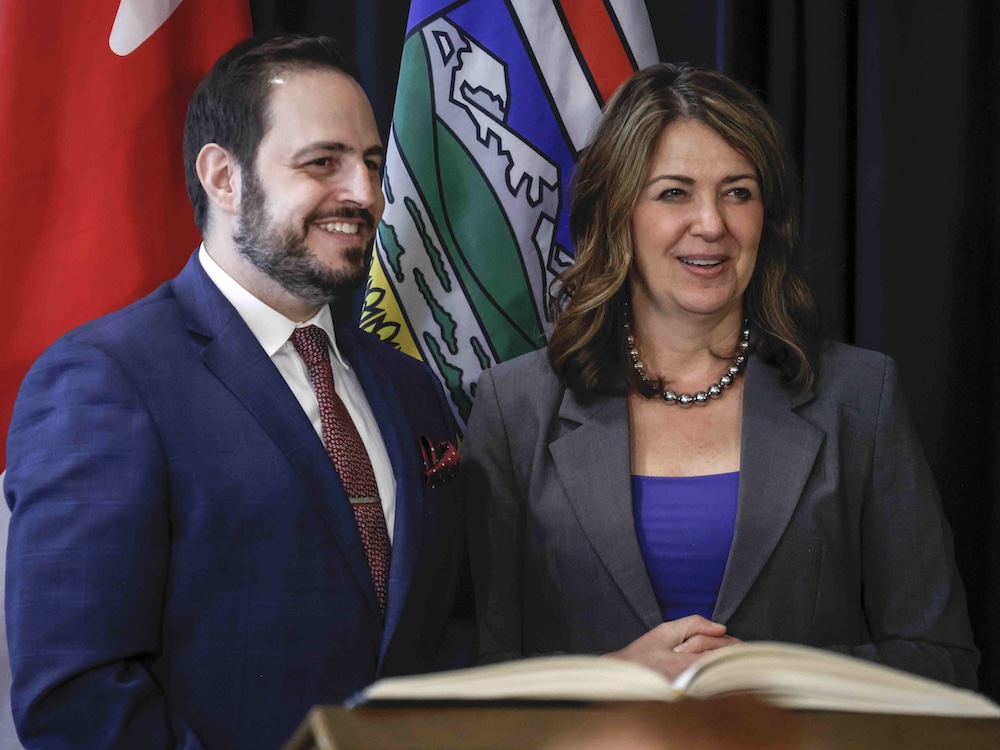
Alberta Premier Danielle Smith has expressed fondness for Florida Gov. Ron DeSantis, most recently wagering a friendly public bet on the NHL hockey playoffs. In 2023, she said she wanted Albertans to enjoy some of the same freedoms available to citizens in certain American states, including Florida.
Her government’s latest proposal aims to take more than a page from DeSantis’s playbook, setting its sights on how Florida has targeted school library books, effectively purging and banning many.
Alberta Education Minister Demetrios Nicolaides recently announced the province will move ahead to develop provincial standards “to ensure the age-appropriateness of materials available to students in school libraries.” This followed a public engagement survey related to what he said were concerns about “sexually explicit” books in Edmonton and Calgary schools.
The province says the survey results show “strong support ” for a school library policy, even while the majority of respondents don’t want the government setting standards for school library books.
This marks the Alberta government’s latest effort to restrict the rights of LGBTQ2S+ children and youth.
A focus on age-appropriateness and parental choice
Like Florida’s statute on K-12 instructional materials, Alberta’s proposal centres on age-appropriateness and increasing parental choice in learning materials.
Despite claiming a need for new standards, Nicolaides has acknowledged there are already mechanisms in place in Alberta’s school jurisdictions for parents to challenge materials. Many school boards already have policies governing school library materials.
Additionally, librarians are trained professionals who follow established practices around organizing materials that reflect developmental appropriateness.
In Florida, educators are self-censoring
Florida’s statute, framed by DeSantis as empowering parents to object to obscene material, has targeted 2,700 books. More than 700 were removed from libraries in 2023-24.
Confusion and a climate of fear caused by the bill have led Florida teachers and librarians to self-censor. The Florida Department of Education urged districts to “err on the side of caution” to avoid potential felony charges.
Such fear and surveillance lead to unnecessary restrictions on students’ rights.
What ‘singling out’ a book implies
Nicolaides has emphasized that developing the new standards in Alberta is not a question of “banning certain books” and has acknowledged he does not have that authority.
However, as PEN Canada notes, the implications of the proposed policies raise alarm bells, with the government’s actions “paving the way to a new era of government-sponsored book banning.”
Singling out books has the same effect as a ban, according to the CEO of the St. Albert Public Library.
By labelling four books as inappropriate — three of which include LGBTQ2S+ authors and themes — Nicolaides suggests these books don’t belong in K-12 schools. One of the books, the graphic novel Flamer, has won several awards, including the Lambda Literary Award for LGBTQ Young Adult Literature in 2021.
The education minister refuted the idea that singling out the books is anti-queer or anti-trans, and did so in an inflammatory manner, characterizing concern as being about protecting children from seeing porn, child molestation and other sexual content.
Nicolaides also said the proposed policy is focused on sexual content, so themes and depictions of graphic violence are “probably not” an issue.
Rolling back trans and queer rights
Alberta has already rolled back the rights of trans and non-binary children and youth to use different pronouns, access gender-affirming care and participate in sports.
Queer and trans identities are also absent from all subjects in the K-12 program of studies, including the recently updated K-6 curriculum. New sexual health resource guidelines prohibit the use of learning materials that primarily and explicitly address sexual orientation or gender identity unless they have been vetted and approved by Alberta Education (except for use in religion classes).
Exacerbating a moral panic
Through specific communication tactics, the minister’s public engagement works to exacerbate moral panics about sexuality as a threat to childhood innocence. This influences broader messages about LGBTQ2S+ inclusion.
The government-created survey shared illustrations and text excerpts on their own, without context or consideration of their narrative purpose in each book. Although the excerpts flagged by the minister make up between 0.1 to two per cent of the total page count in each book, the books as a whole are labelled “extremely graphic.”
In a media appearance, Nicolaides stated the books in question were available to “elementary-aged” students. This is misleading because K-9 schools include junior high students.
In a social media post, the minister’s press secretary said “these problematic books were found in and around books like Goldilocks,” suggesting targeted books are alongside children’s storybooks.
But the image he shared showed Flamer near the graphic novel Goldilocks: Wanted Dead or Alive, aimed at middle-grade readers aged nine to 12 years old.
The survey reported 77,395 responses by demographics, including parents, teachers, school administrators, librarians and other interested Albertans.
Forty-nine per cent of parents of school-aged children were not at all or not very supportive of the creation of government guidelines, compared with 44 per cent of the same demographic who were somewhat or very supportive (eight per cent were unsure). Across each other demographic, most respondents expressed that they didn’t support the creation of new government standards. But the ministry plans to move ahead anyway.
Why we’re worried
The Investigative Journalism Foundation reports two conservative activist groups have taken credit for giving the Alberta government names of books believed to be inappropriate.
Parental rights groups and far-right activists have long asserted that LGBTQ2S+ inclusion in schools “indoctrinates” and sexualizes children.
We’re concerned the Alberta government may be reinforcing this message to manufacture a greater public consensus in support of wider policies against LGBTQ2S+ rights.
Since at least 2023, United Conservative Party members have embraced socially conservative “parental rights” rhetoric and supported motions for purging school libraries and mandating parent approval of changes to kids’ names and pronouns.
Far-right activist groups like Take Back Alberta have shaped the UCP government’s policies alongside special interest groups like Action4Canada and Parents for Choice in Education.
A common thread among such groups is parental authority over one’s own children framed in traditionalist or hetero-normative terms. Significant mobilizing has happened against the inclusion of sexual orientations and gender identities in school curriculums, trans-inclusive health care, drag shows, conversion therapy bans and more.
Queer and trans identities are viewed as a social contagion threatening to change anyone exposed to them, and efforts for inclusion are labelled “gender ideology.”
These misconceptions, combined with political and religious biases, frame queerness and transness as “adult topics” that will confuse or harm children. However, research confirms ignoring these topics is of far greater concern when children may already experience discrimination about their gender expression by the age of five.
Earlier learning about diverse forms of gender expression and relationships can reduce victimization and prevent young children from becoming perpetrators of, or bystanders to, anti-LGBTQ2S+ harassment and violence.
The United Nations recognizes that governments need to resist political pressure “based on child protection arguments to block access to information on [LGBTQ2S+] issues, or to provide negatively biased information.”
Access to self-selected literature is important for all students, and can be a lifeline for LGBTQ2S+ students who don’t see themselves in the curriculum.
If Alberta Education will not prepare students for the world they live in — where we queer and trans people exist, flourish and are loved — then students should be able to seek out stories that reflect that world. It’s a matter of protecting their freedom of expression.
![[Tyee]](/design-article.thetyee.ca/ui/img/yellowblob.png)
Read more: Rights + Justice, Education, Alberta, Gender + Sexuality






Tyee Commenting Guidelines
Please note that email notifications for replies are not currently working due to a software issue which may be resolved in a future update.
Comments that violate guidelines risk being deleted, and violations may result in a temporary or permanent user ban. Maintain the spirit of good conversation to stay in the discussion and be patient with moderators. Comments are reviewed regularly but not in real time.
Do:
Do not: