

 SHARE:
Canada is currently enduring an aggressive and disruptive protest movement that calls itself the “freedom convoy.” It began as a protest against federal vaccine mandates but has since evolved to represent a number of other views. Ottawa’s police chief has described the level of disruption it’s caused as a “siege.”
So when I recently encountered a different protest, this one at the public board meeting of the Carnegie Community Centre in Vancouver’s Downtown Eastside, the contrast was striking. It reminded me of what civilized protest and debate can do for a community, and the proud tradition it’s always had in a community like this one.
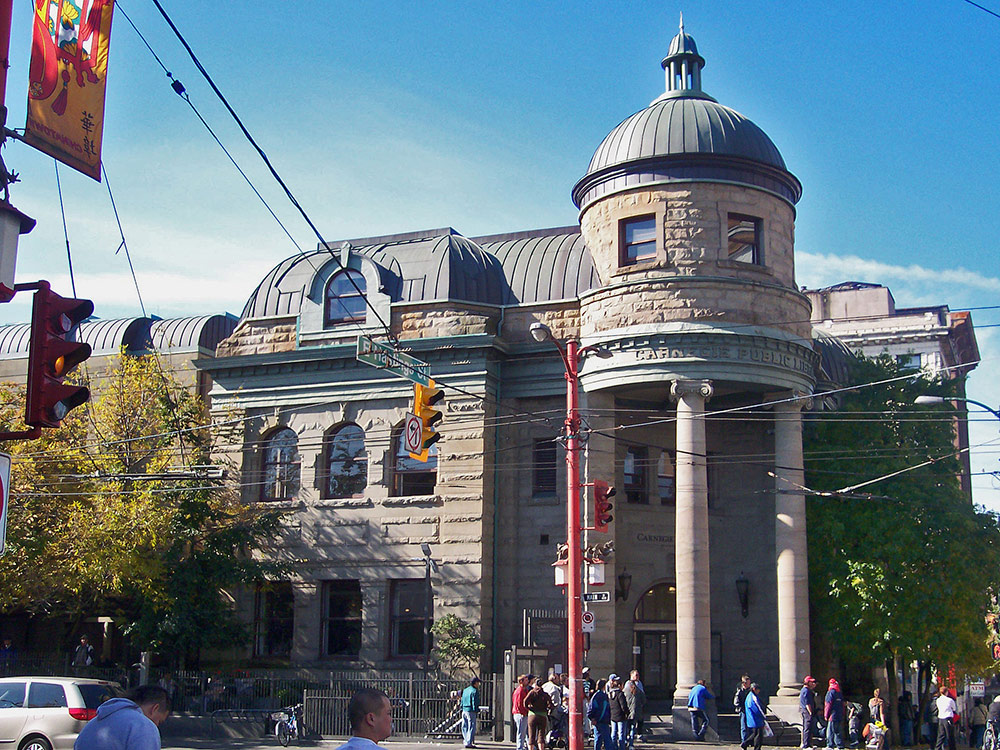
The Carnegie is a beautiful old sandstone building located at the heart of one of Canada’s poorest neighbourhoods. Before the pandemic, around 2,000 people poured through its doors every day for things like events and meal programs, or to visit the library, but COVID-19 forced a reduction in services. The community has seen far more deaths caused by toxic drugs than COVID in the last two years.
As an ex-officio member of the board, I was there to attend the meeting. When I arrived, I saw that a group of people, mostly men who don’t usually attend these gatherings, waited in the hallway outside the theatre for the meeting to start. They were a diverse group, which is typical for the neighbourhood. The board expected them, having been told there were protesters coming to the meeting. Once allowed entry, they took their places in the distanced chairs provided. They were clearly together. I heard murmurs of, “Okay, we’re all here.”
They were there to air their concerns regarding the reduced programming and space available to them at the Carnegie over the last two years. This is one of the few organizations in the neighbourhood that was able to serve the community continuously for the duration of the pandemic, but nevertheless there have been serious limitations.
When given the opportunity to speak, one member of the group, an older man who seemed to have a leadership role, stood and spoke for some minutes. He asked why other community centres have opened their weight rooms, gyms and pools, when the poorest people in the city, who need those services to support their mental and physical health, were not given access to those amenities at the Carnegie. He said the virus was one issue, but that there were other issues of equal importance. He wanted to know why the decision was made to keep the whole lower floor of the centre closed.
Another member of the group stood and quietly but insistently explained that he needed the gym and the weight room, and without an opportunity to exercise his body was getting sore.
They made the case that their community is suffering more from toxic drug deaths than COVID infections and shouldn’t see their own health and the health of their neighbours further eroded because of social distancing rules. They were articulate and passionate and right.
They were also polite and kind to those who were listening, including the community board members they were petitioning. They gave each other room to speak one at a time.
When it was explained to them that renovations were the issue, and when the director of the centre offered to meet with them to make a plan for orderly opening of services, they were patient and agreed to work with her, without giving up their insistence that something needed to be done quickly. When they left, they thanked the board for their service to the community and for listening to them.
I wasn’t surprised by their dignified approach, having spent 12 years as director of the Carnegie Centre. I’ve seen many Downtown Eastside residents do the same, displaying good manners and goodwill when advocating for themselves, in stark contrast to those who publicly bully, claim space and try to force their will on others.
While I agree that one of the issues contributing to angry populism here in Canada and elsewhere in the world is a sense of abandonment and loss experienced by those who are denied a share in our wealthy society, how do you explain these good, sane people in the Downtown Eastside who stand up for themselves in a way that doesn’t trample on anyone else?
To answer that question, I suspect we’d use the same descriptors we’d use for any other rational, balanced, mature group of citizens. Regardless of the circumstances of their lives, they have healthy egos and only expect a reasonable response to their reasonable demands.
It may be that people in the Downtown Eastside have often had to protest unfair circumstances and learned a way to do so that’s more likely to be heard. It may be that the people in the room, including the board members, all belonged to the same community, and everyone recognized that.
After watching what’s going on across the country right now, and what’s gone on in America in the last years, it was a relief and a privilege to witness this kind of respectful exchange. The protesters at the Carnegie meeting were an example of citizen participation that sought the common good, as opposed to chasing fantasies of libertarian “rights.”
I was left with the feeling that their approach to others in their community, a balance of humility and pride, was an example that members of the “freedom convoy” could benefit from. ![[Tyee]](/design-article.thetyee.ca/ui/img/yellowblob.png)
Read more: Rights + Justice, Politics


Tyee Commenting Guidelines
Comments that violate guidelines risk being deleted, and violations may result in a temporary or permanent user ban. Maintain the spirit of good conversation to stay in the discussion.
*Please note The Tyee is not a forum for spreading misinformation about COVID-19, denying its existence or minimizing its risk to public health.
Do:
Do not: