
BC's Black Pioneer Women
Even the best educated woman in gold rush days faced racist harassment.
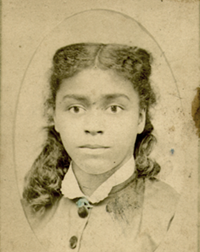
Emma Stark became a school teacher.
- Go Do Some Great Thing: The Black Pioneers of British Columbia, 2nd Ed.
- Commodore Books (2008)
[Editor's note: This is the second of three excerpts from the second edition of Crawford Kilian's Go Do Some Great Thing: The Black Pioneers of British Columbia, published in September by Commodore Books. Yesterday's told the story of the liberation of Charles Mitchell. The last excerpt runs Monday.]
Thirty years ago, when I first researched the black pioneers of British Columbia, I admired the men but worshiped the women.
Revisiting the pioneers for the second edition of Go Do Some Great Thing, I fell in love with the women all over again.
The black men of the 1850s and 1860s had grown up in a world that despised and brutalized them, but they had carried on and built lives for themselves and their families. The women of those families sometimes had to battle their own men, as well as the contempt of white society.
Many of the women had been slaves in the United States, freed thanks to their husbands' and fathers' hard work. Sylvia Estes' father paid the equivalent of about $40,000 in today's dollars to buy his own freedom. He paid another $75,000 for his wife, son, and Sylvia. He then took his family to California, where Sylvia met and married Lewis Stark.
The Estes and Stark families migrated north to British Columbia, where Sylvia and Lewis built a farm on Saltspring Island. It was a brutally hard life. Lewis fell desperately ill in the smallpox pandemic of the 1860s, and three other black settlers were murdered. Yet Sylvia would live to the great age of 104.
The best-educated woman in BC
The leader of B.C.'s black pioneers was Mifflin Gibbs, an ambitious, self-educated entrepreneur. After making a fortune as the Hudson's Bay Company's first competitor in gold-rush Victoria, he returned to the U.S. to court and marry a brilliant young woman, Maria Alexander, in Oberlin, Ohio.
Given her years at Oberlin College, Maria Gibbs was doubtless the best-educated woman in gold-rush British Columbia. But she had no one to share her ideas and experience with. Black and white women met in a couple of integrated churches, but never socialized.
Heavily pregnant with her first child, Maria was doused with flour when she and her husband took their seats in the dress circle of a Victoria theatre. Furious, Mifflin Gibbs got into a fistfight with the assailants.
Living well was better revenge: He went on to become a Victoria city councillor, a property developer, and even the manager of a coal mine in the Queen Charlottes.
Meanwhile, Maria bore him five children, four of whom lived to adulthood. But after a decade in Victoria, she left Gibbs and took the children back to Oberlin. We don't know why they separated, but his restless love of adventure must have made him hard to live with.
Black women worked in Barkerville, the biggest town in the Cariboo gold rush of the 1860s. Rebecca Gibbs, possibly Mifflin's sister-in-law, was a laundress who also published verse; she lost her home in the 1868 Barkerville fire.
Matriarchs of Saanich and Saltspring
Most of the black pioneer women settled in Victoria, on Saltspring Island, and later in Vancouver. Wellington Moses' wife was considered the best housekeeper in Victoria, and provided accommodation for Lady Franklin, the widow of the lost Arctic explorer.
Nancy Alexander of Saanich was the matriarch of a large and prosperous family; her descendants still live in B.C. Clarissa Richard, wife of Victoria shipwright Fortune Richard, was politically active into her old age, when she signed a petition in 1885 demanding the vote for women.
Annie Robinson arrived in B.C. as a baby in 1858. On Saltspring, she grew up, survived an alleged sexual assault as a child, and married a Portuguese known as John Norton. She would bear him 12 children before dying in 1903 at age 46. The Nortons helped found a Saltspring tradition of interracial marriages.
At Moody's Mill in what is now North Vancouver, Josephine Sullivan lived with her husband Arthur, a steward at the mill. Their son Arthur, baptized in New Westminster in 1861, grew up to be a respected merchant in early Vancouver.
All these women lived in a world that defined everyone, and demonized most, in terms of race and gender. They had to work, to bear children, to support their overworked and insecure menfolk, and to put up with, at best, the patronizing condescension of their white neighbours. Their marriages did not always survive, yet they kept going.
The Starks, like the Gibbses, broke up. Lewis decided to move the family to a new home near Nanaimo. Sylvia and the children followed him, but before long she returned to their Saltspring property and stayed there. Lewis died mysteriously in a fall from a cliff after refusing a coal-mining company's offer to buy his land.
A teenage schoolteacher
Their daughter Emma Arabella is the pioneer woman I mourn the most. She had been born in the U.S., and was a toddler when the family arrived on Saltspring. She survived all the hardships of bitter winters, smallpox, native wars, and the breakup of her family.
Emma gained an education, much of it in the log-cabin classroom of John Craven Jones, another black Oberlin graduate. She herself became a Vancouver Island schoolteacher as a teenager in the 1870s, and in 1878 she married a man named James Clark. In 1890, at the age of just 33, she died. We don't know why.
The one photograph we have of Emma Stark shows us a beautiful young woman with very sad eyes. Growing up in 19th-century British Columbia, she had reason to be sad.
But she had also grown up in a family that would somehow find a way out -- if not for the parents, then for the children or grandchildren. Her father had physically battled his land to wrest a living from it. Sylvia must have been enormously proud of her daughter's decision to become a teacher.
So Emma had taught the children of rough, half-educated settlers, to pass forward the favour that her parents and John Craven Jones had given her. May today's teachers hope to match her achievement.
On Monday, Wellington Moses and the case of the gold-nugget stickpin.


16
Login or register to post comments
ME2
3 years ago
In appreciation
Thank you Killian for another account of people who against the odds have retained and demonstrated their dignity without appealing to the pity and guilt of others.
PatrickMcEvoyHalston
3 years ago
Frontier Myth
Frontier romance. You find every way to romance your subjects. No doubt because he's black, even the abandonning father comes out okay--"We don't know why they separated, but his restless love of adventure must have made him hard to live with."
But best is this: "All these women lived in a world that defined everyone, and demonized most, in terms of race and gender. They had to work, to bear children, to support their overworked and insecure menfolk, and to put up with, at best, the patronizing condescension of their white neighbours. Their marriages did not always survive, yet they kept going." Obviously this is the furthest thing from your mind, but this is possibly racist: for the heroine you want to make depends upon an environment full all these nasities to make her look so strong, rugged, persevering, and noble. The real story, of course, is that people who are subject to a whole lot of abuse inevitably become more monstrous-seeming than they do angels: but we continue to surrect the idea of character building, Great Frontier, and even, the mythical powers of the Victorian hard working, self-denying, "Angel in the House."
Jeffrey J.
3 years ago
Frontier Reality
What a fascinating part of our history. Like Jean Barman's work with BC's early Hawaiian's, BC's early black pioneers are often overlooked.
What these people endured is almost beyond our imagination. But it takes only a moment of empathy to realize how much they suffered compared to what middle class Canadian experience today.
Even in 2009, for those of us who work with disadvantaged Canadians, I remain continuously impressed with the moral character and fortitude that so many people (mostly women I might add) demonstrate in trying circumstances.
It is always disheartening when we are confronted with those are unable to empathize with those more unfortunate than ourselves. However, with ongoing education and publications like Mr. Killian's and the Tyee, society will continue to advance social justice.
PatrickMcEvoyHalston
3 years ago
Jeffrey J.
Saying how impressed you are by (mostly) women's ability to demonstrate such admirable moral character and heroic fortitude 'midst trying conditions, amounts to a plug for the kind of (ostensibly) character testing, trying conditions, regressive Harper-folk would just love to continue bringing about.
Remember, conservatives believe that government social welfare programs breed a weak, morally lax, dependent society. And since the voice we hear in this article--with its championing of frontier hardships over middle class, modern easness, very much is the conservative one--if you'd like to see the expansion of government outreach and empowerment programs, you might do well in future to not too readily find agreement with articles like this one.
ME2
3 years ago
More frontier reality (thanks, Jeffrey J)
Well, Mr McEvoy, while there may indeed be around today those people who see a goal and pursue it through thick and thin, denying themselves momentary pleasures in their bid to achieve it, I would submit there are far less - proportionately - today than in times past.
I would further suggest that among this latter group, immigrants and their children form the larger part, and many, such as Asians, have struggled with similar "assimilaion" problems as were faced by Killian's Blacks. Their stories are not too unlike those of many of our own immigrant forefathers.
And so also the stories of the early settlers who chose farming as their venture, many of whom faced - and bested - privations which included near-starvation, stories more than equalling even those of Northern FNs.
Of interest to me is Killian's noting the acceptance of Mifflin Gibbs in the 1870s :
"Living well was better revenge: He went on to become a Victoria city councillor, a property developer, and even the manager of a coal mine in the Queen Charlottes."
Britain had abolished slavery in 1833, 32 years before the Americans, and Canadians, having never been economically dependent upon slavery, did not look upon freed Blacks with the racist hatred common to Americans. Rather, they were seen as mentally inferior, as were all people of colour even into the 1950s.
But persons who demonstrated otherwise through hard work, intelligence and honesty, such as Mifflin Gibbs, were accepted, as were the Gulf Islands people Killian also noted, something which could not have happened at that time in the US. Similarly, many FN men crewed aboard sailing ships, some becoming First Mates.
Although recognised for their contribution, women of any colour were not singled out for their stellar performance, as were men in that man's world, any more than now. That is changing, but not with any help from people such as Mr McEvoy.
IMHO, we need more straightforward stories such as Killian's which emphasize the power of the human spirit in overcoming adversity that don't employ gushy sentimentaliy - stories from which we can take heart as we pursue our own endeavors.
We can stand far fewer stories - thank you very much anyway - about how we are singling out this or that particlar group for abuse.
anarcho
3 years ago
No contradiction!
There is no contradiction between voicing our respect for people like Emma Stark who triumphed in the face of adversity and being in favour of a more humane society. For every Emma Stark, there were a thousand people who were ground down and destroyed by the cruelty of the times. For Patrick MacEvoy to use Emma's story as a club with which to beat progressives only shows how low a reactionary can sink. And isn't it odd that a better situation makes working people "weak" and "lax", yet luxury and a pampered life is necessary to impel the rich and powerful!
PatrickMcEvoyHalston
3 years ago
The story of one white bigot, in an intolerant, PC time
Called a low-life, a reactionary, an obstacle to progress, racist, anti-woman (and even, pro-rape), in an environment where offering anything other than a loud cheer (or should we just say, offering up a Jeffrey J.!--Great stuff, Tyee!) when encountering any subject matter which comes within a thousand miles of what might be construed, even in a thick pea soup, foggy day, as PC, Patrick McEvoy (-Halston) could not be broken: taking heart in others--such as Emma Arabella--who kept going (when others might not have) despite the daily cruelties the cruel world offered her, Patrick kept hope that he might one day succeed in showing future would-be low-life, anti-progress, reactionist, racist, anti-woman (and even, pro-rape)ists, how, with a strong belief in yourself, and a little pluck and luck!, you really can succeed, despite it all.
- - -
You know M2, this could work for me: I think you might be right that narratives like this one--despite their evident sillinesss--can help those struggling for fair recognition keep on at it. (Anyway, I certainly hope so, for it would be a pity if the world wins and we are left with only one acceptable/permissable narrative line, and with true progressives left on the out by properly "clothed" conservatives [if Harper could transmogrify himself into a black woman, he would], wondering what the hell just happened.)
PatrickMcEvoyHalston
3 years ago
Sorry, in the above post, I
Sorry, in the above post, I didn't say what would happen to you if you "offer[ed] anything other than a loud cheer." Sloppy post. Sorry about that.
anarcho
3 years ago
Meaning exactly what?
Patrick, what exactly does the jumbled mass of words you threw together mean? Perhaps you ought to learn how to write first before posting? Try for shorter sentences, clarity and logical construction of arguments, please.
PatrickMcEvoyHalston
3 years ago
I'm a flaneur, sir, not a frontiersman
It sure is a loaded sentence, I agree, but it's my style, and if I hadn't accidently edited out the missing words, I would have been quite happy with it. You do know that the moderns favoured the short, simple, and direct, because they found Victorian flourish, all their sentences, with all their endless qualifiers, that never seemed to end, very feminine, right? That is, you are aware that there are some feminists out there who identify this particular writing philosphy you support, as arms of a masculinist culture that aims to stigmatize prose/thought that might play a part in creating a world which truly values/respects the feminine--that is, prose which encourages discussion rather than confrontation, imprecise but suggestive intuition over brute fact and deductive logic, the personal and affective/sentimental over stoic, blank-faced, reservedness--right?
I'll take the french salon over the frontier, anyday. If you truly aim to speak to me, then please try and find some virtue in rhetorical fourish, language play, dissemination, imprecision, and conversations that go on and on and on, in all their tittery, glittery, gossipy, glory: I'll be more apt to listen to you in a way which might encourage me to change, if you speak to me in my own langauge.
anarcho
3 years ago
Don't flatter yourself!
I have read plenty of 18th and 19th Century writers and enjoy their prose. Think of Dickens or Tolstoy, or Marx for that matter. But their writing made sense, as well as being beautiful. What is the point of what you have been writing here? What are you really trying to say?
ME2
3 years ago
anarcho
Psychobabble, anarcho. He spends his free time at Banyan Books reading dustjackets.
PatrickMcEvoyHalston
3 years ago
anarcho
Anarcho: 1920s Moderns reacted against Victorians, and made fun of their prose style. They deemed it sentimental and florid; they argued their writers catered to the tastes of their female readership; and argued in favour of (in Raymond Chandler's phrase) "brutal honesty": masculine, straightforward prose that was simple, direct, and clear--what you are asking from me, what most teachers of writing ask from their writers. It is a masculine prose style. It was fashioned by moderns, deliberately, to help beat back the overbearing Victorian Matriarch "bitch". And its predominance has made it so that today, even if you like Victorian prose, you had better not imitate the style when you write papers/essays--you'll be killed for it.
I'd have to do research to find out what they specifically thought of Dickens and such, but I know of Henry James (someone whose prose bridges both periods) that Fitzgerald and Hemingway tended to make fun of his genteel, femmy, prose-style.
I'm genuinely sorry my writing amounts to a mass of words for you. Not much fun if I can't communicate even the sense of what I was after.
ME2: I've very well educated. Specifically, I'm a frequent visitor of Itunes U, and by now I bet I have the equivalent of ten or maybe twelve degrees. When they decide to credit this, I'll put down those dustjackets (how did you know?), and spend my time admiring all the degrees papering my bedroom walls.
ME2
3 years ago
Patrick M
Your reasoned response puts me to shame, Patrick, my apologies.
So may I suggest, a la anarcho, that you either deal with one point per post, or break down what you write into more digestible, bite-sized chunks.
You'll be surprised how one's own thoughts become clearer and more focused whem one writes bearing in mind the limitations and/or differences in perspectives and POVs which others hold.
I've learned that we're ALL somewhat crazy, and that the only way we can chart our way is by testing our bearings against those of others.
cheers
PatrickMcEvoyHalston
3 years ago
Thanks for the response,
Thanks for the response, ME2. For whatever reason, and regardless of my talk of dissemination and flourish, I am really more attracted to super dense prose right now. Something about protection, maybe--like I'm offering up tightly, packed, balls of energy, for the purposes of backing people off.
cheers to you as well, and have a lovely day.
Peter Evanchuck
3 years ago
Canada's treatment of Blacks and Ukrainians
The cruelity of those times is not only reflected in how early Canada treated the Blacks and the Indians but also how they treated the Ukrainian Canadians. First inviting them over here to live in holes in the ground out west then during WWI enacting the war measures act that declared 180,000 Ukes as enemy aliens and forcing most to report to parol officers, confiscating all property from others (never returned), placing thousands into 26 concentration camps (gulags) across Canada. As well as making many work as slave labour for coal and mining companies in New Brunswick and Nova Scotia, building Banff and Jasper and so on. This disgrace on Canada's past has never been recognized or has the government apologized for it.