

 SHARE:
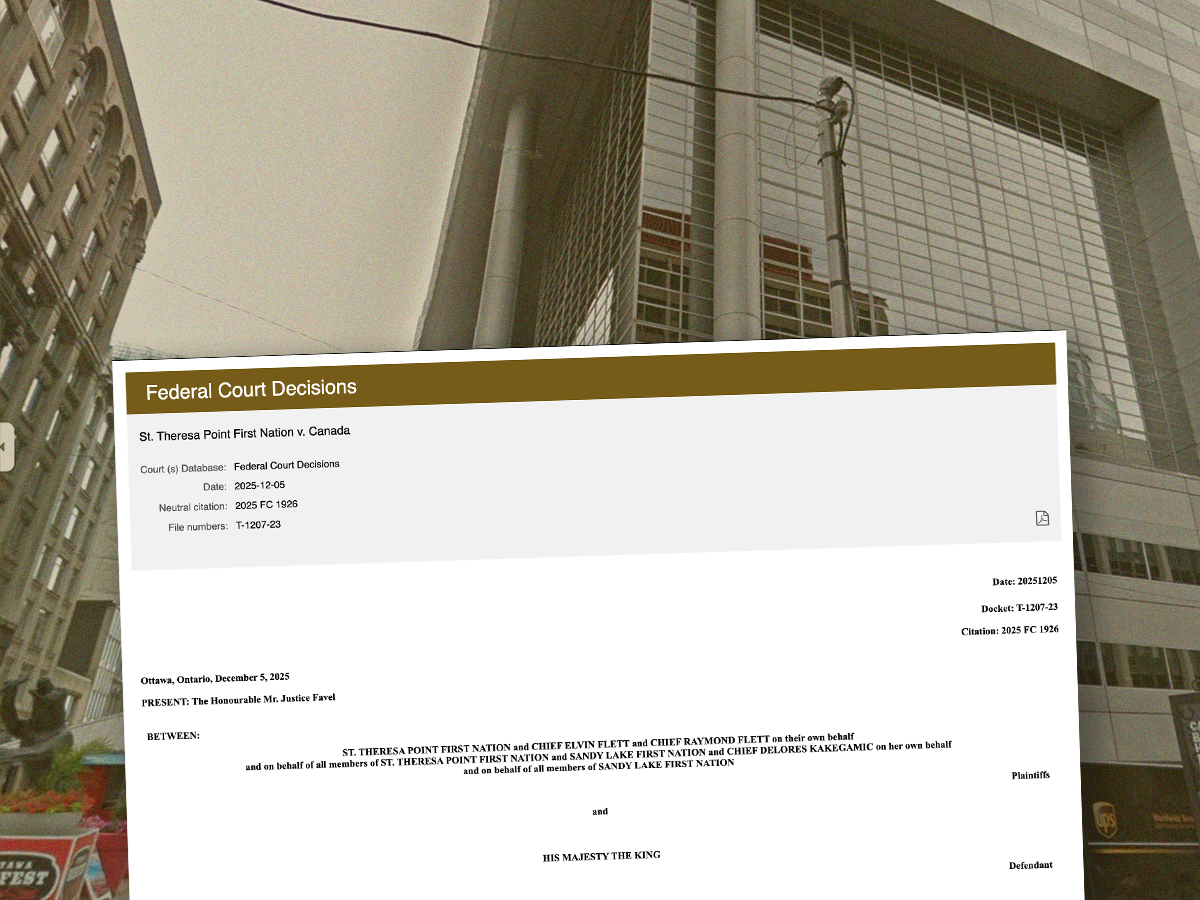
For more than 40 years the federal government has denied responsibility for on-reserve housing, characterizing its role as merely advisory and financial. Yet it was Canada that designed, imposed and controlled the on-reserve housing system — one that has harmed First Nations and restricted their ability to create safe, adequate housing for their people.
We believe they now have the obligation to step aside and transfer jurisdiction and sufficient and sustainable resources to First Nations so they can lead the creation of a new, self-determined housing system.
After decades of underfunding, restrictive policies and deteriorating housing conditions, legal action became the only remaining path to accountability.
In 2023, St. Theresa Point First Nation in Manitoba and Sandy Lake First Nation in Ontario sued the Crown. Over 100 First Nations then opted in to their class action. The lawsuit, which was seeking $5 billion in compensation, made the case that the federal government “deliberately underfunded housing on reserves” while putting policy restrictions on First Nations’ ability to provide housing for themselves.
On Dec. 5, 2025, Justice Paul Favel sided with the First Nations. His decision was historic. He found that Canada has a legal duty grounded in fiduciary obligations and a common-law duty of care to ensure housing is safe and adequate, and that Canada breached Charter protections by maintaining unsafe and discriminatory housing conditions.
Justice Favel concluded that Canada “created a dependency” by exerting “power, authority and control over all facets of First Nations’ life.” Including control over financing for housing.
Two different Canadian housing systems
Over the years, the federal government created two discrete housing systems in Canada: one system for First Nations, and one for everyone else.
The mainstream system is designed to produce high-quality houses, jobs and easy access to financing for as many Canadians as possible. It is optimized to generate wealth through housing.
For First Nations, the federal government designed a housing system based on welfare distribution. The system imposed on First Nations relies on restrictive, welfare-based funding and limits communities’ ability to access financing, make local decisions and build needed infrastructure. It produces poverty.
As federal programs replaced mortgages and access to private capital, First Nations were prevented from building equity or using financing tools available to other Canadians. This forced communities to rely solely on insufficient federal grants, resulting in chronic housing shortages and inadequate construction.
The structural differences between the two housing systems ensure that one system builds prosperity while the other entrenches inequality.
The First Nations housing system was, and still is, a total failure.
What’s next?
In summarizing the effects of substandard housing on reserves, Justice Favel wrote, “Children are unable to regularly bathe, their sleep is disrupted due to overcrowding, they are frequently ill due to cold, damp conditions and because of severe mold and pest infestations. These conditions impact their mental, emotional and physical well-being as well as their education.”
Justice Favel’s decisions deal with the first stage of the class-action lawsuit: Canada owes sui generis and ad hoc fiduciary duties and a common-law duty of care in relation to on-reserve housing.
In other words: if Canada controls housing programs and housing funding and restricts access to financing and opportunities for First Nations to provide housing for themselves, then Canada has an obligation to ensure housing on reserves is safe and adequate. Canada’s failure to do so is a breach of its obligations.
The next stage of the lawsuit will deal with the scope or existence of the breaches, including Charter rights infringements, as well as potential remedies.
While the federal government has a responsibility to reconcile their past actions, it is critical to focus on what is next. It is unacceptable to maintain systems and programs that have proven to be so destructive to First Nations people and communities.
The auditor general has repeatedly concluded that federal on reserve housing programs are ineffective and have shown little improvement over decades. These findings underscore the systemic failure of the current housing framework.
The welfare-based housing system has created dependency on reserves for decades.
It is time for a new paradigm grounded in Indigenous jurisdiction, where housing is informed, designed and led by the people who will call these houses home.
The auditor general agrees. In its 2024 report it recommends that Indigenous Services Canada, in collaboration with First Nations, should finalize the overarching policy framework for the transfer of departmental responsibilities to First Nations.
It is impossible to enumerate the socioeconomic cost of the First Nations housing system that has driven such deep and lasting poverty. While the class action settlements will most likely cost billions, the financial burden is only one part of a much larger legacy of harm.
There are viable alternatives to the failed, conflict-ridden approach and it is time for the federal government to accept responsibility for its actions and finally dismantle the system it created. ![[Tyee]](/design-article.thetyee.ca/ui/img/yellowblob.png)
Read more: Indigenous, Housing











Tyee Commenting Guidelines
Please note that email notifications for replies are not currently working due to a software issue which may be resolved in a future update.
Comments that violate guidelines risk being deleted, and violations may result in a temporary or permanent user ban. Maintain the spirit of good conversation to stay in the discussion and be patient with moderators. Comments are reviewed regularly but not in real time.
Do:
Do not: