


 SHARE:
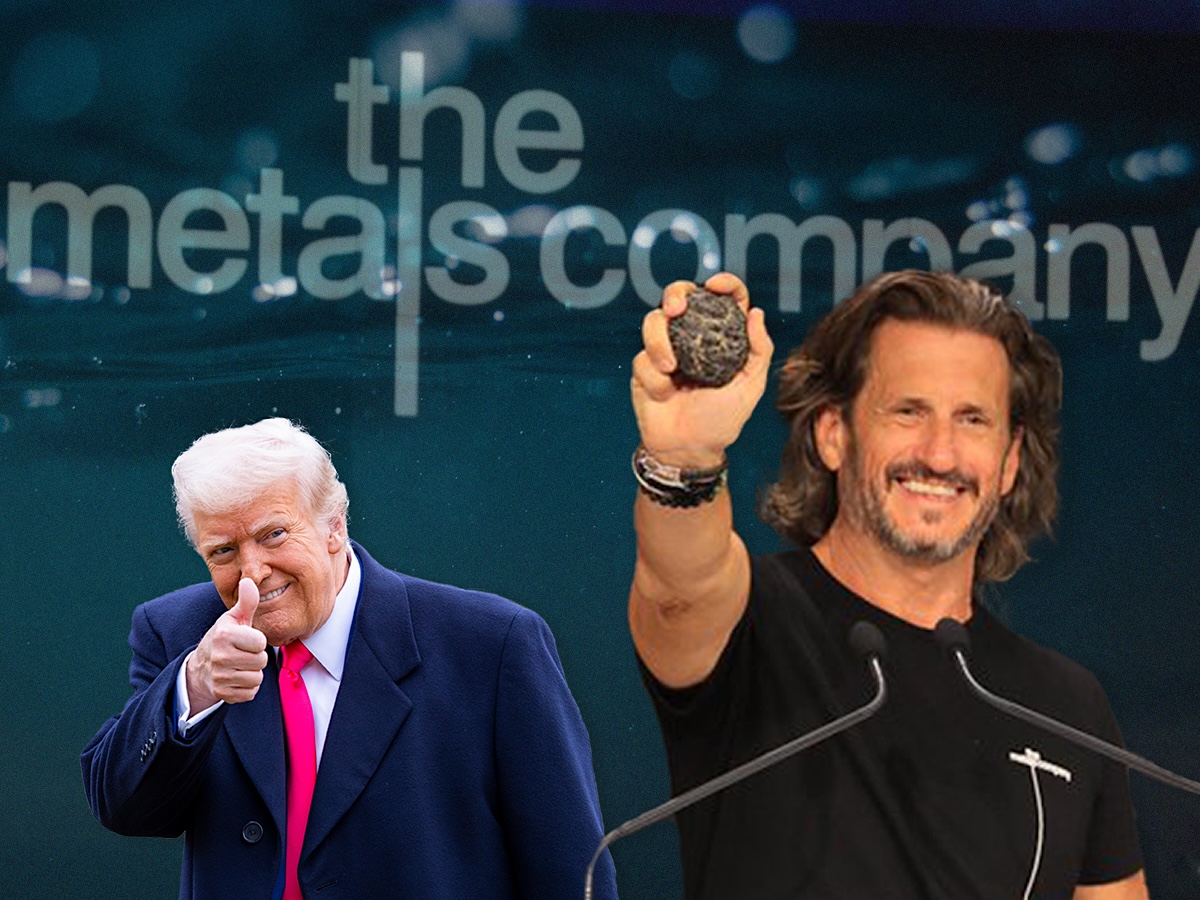
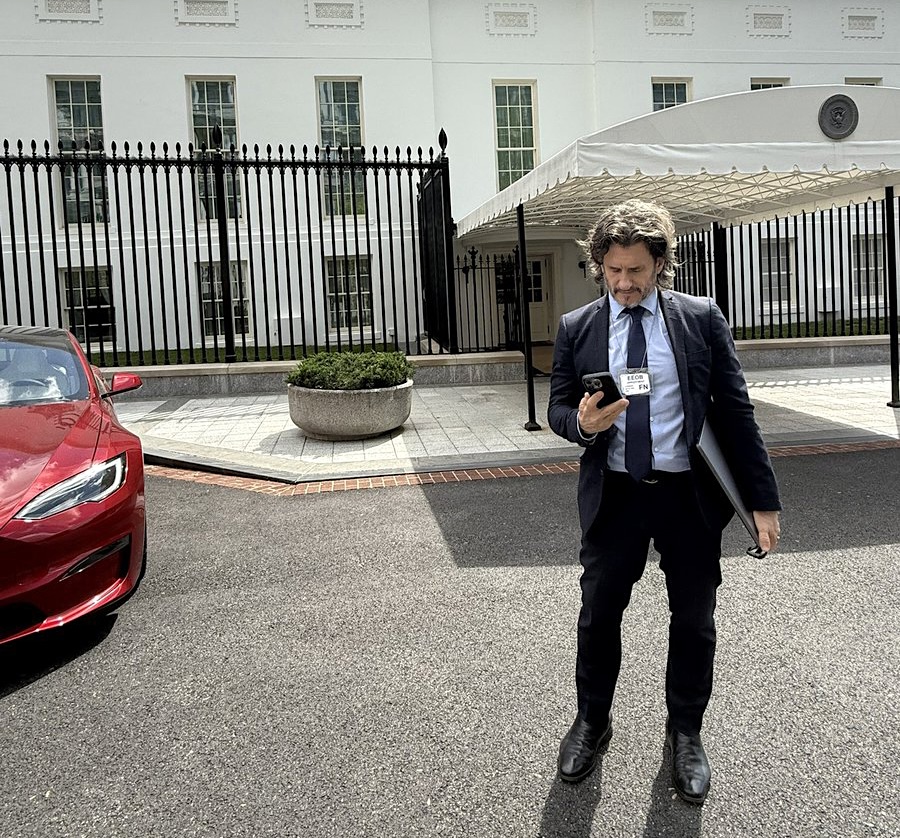
Gerard Barron, CEO of the Metals Co., a deep-sea mining corporation headquartered in Vancouver, appeared to be feeling optimistic. As Barron left the White House on a sunny day in April 2025, he posed for a photo at the West Wing with a red Tesla in the background.
The Metals Co., Barron posted to the social media platform X, was “preparing to work diligently alongside” the Donald Trump administration and federal agencies to promote critical minerals security for the United States. “Nice to see President Trump’s new red car!!” Barron added, along with a U.S. flag emoji.
Barron was at the West Wing to meet with undisclosed senior U.S. officials and discuss the Metals Co.’s readiness to become the first corporation to commercially mine the ocean floor.
Barely a week after Barron’s post, Trump signed an executive order that sent the Metals Co.’s shares skyrocketing, bolstered the president’s reputation as a rogue actor on the global stage and put Canada in a very tricky position.
The order, “Unleashing America’s Offshore Critical Minerals and Resources,” expedites deep-sea mining in U.S. domestic waters.
But, in keeping with Trump’s “America First” strategy and unabashed territorial ambitions, the order goes much further. It allows the United States to unilaterally expedite mining in the international seabed — widely considered the common heritage of humankind.
When Trump signed the order, Barron and his colleagues sent the president a gift: a metals-rich rock that the Metals Co. had vacuumed up from the Pacific Ocean floor, encased in a block of glass and engraved with the company’s logo and a U.S. flag.
The five-million-year-old rock found a home on the storied Resolute Desk in the Oval Office, Barron told U.S. podcast and YouTube show host Shawn Ryan last August, noting, “Here we are, in the final stretch, before the industry becomes big and commercial.”
Days after Trump signed the order, the Metals Co.’s U.S. subsidiary — where Barron is also CEO — applied to the Trump administration for permits to explore and commercially mine the seabed floor in the Pacific Ocean between Mexico and Hawaii.
In late April, the National Oceanic and Atmospheric Administration determined that one of the Metals Co.’s applications — for a permit to explore and commercially mine an area more than twice the size of Vancouver Island — was in full compliance with regulations and could proceed. In May, the oceanic administration also certified a separate application from the Metals Co. for a permit to explore a Pacific Ocean seabed area that is considerably larger than Iceland.
Snubbing the United Nations Convention on the Law of the Sea, which prohibits unilateral deep-sea mining in international waters, the Metals Co. says it expects to begin commissioning its mining system later next year, once it receives final approval from the Trump administration.
“We’re talking about a resource that's approaching a trillion dollars’ worth of value,” Barron told Mining.com in January. “And the thing that stands in the way of us unlocking that value is the permit to be able to go and extract them and sell them.”
This plan raises thorny questions for Canada. Is the Metals Co. violating international law? Can Canada — one of 43 countries calling for a moratorium on deep-sea mining — prevent the Metals Co. from mining in international waters? And why did the Metals Co. choose Vancouver for its headquarters?
So far, Canada has said nothing about Trump’s deep-sea mining ambitions, which come as the U.S. president continues to squeeze Canada economically and repeats his desire to make his resource-rich neighbour the 51st American state. Nor has Mark Carney’s government challenged the Metals Co.’s gambit to become the world’s first commercial deep-sea miner.
“It’s very problematic for Canada not to be speaking up about this,” Sara Seck, a professor at Dalhousie University’s Schulich School of Law, who focuses on the mining sector and ocean law, told The Tyee.
Unlike the United States, Canada is a party to the United Nations Convention on the Law of the Sea, and Carney’s government “really does have an obligation to step up here,” Seck said.
A Vancouver address
The Metals Co. lists its address in a premium office tower in Vancouver’s tony downtown financial district.
But when The Tyee made an impromptu visit, we didn’t find an office. The floor listed as the Metal Co.’s address houses DuMoulin Black, a boutique law firm that specializes in corporate and securities law. DeMoulin Black has advised the Metals Co. on major corporate transactions, including securities purchase agreements.
Barron, an Australian, has a residence in Dubai and, based on his social media feeds and comments to media, rarely seems to spend time in Canada. He refers to himself as a “frequent traveller” — visiting places such as Seoul, New York, Washington and San Francisco in his continuing quest to raise capital for the Metals Co. and garner buy-in to mine the ocean floor.
Catherine Coumans, research co-ordinator for Mining Watch Canada, said Canada is an attractive place for mining corporations like the Metals Co. to set up shop because the country’s long mining history means that technical, legal and international expertise is readily available. Canada is also a favourite place for mining companies to raise capital, she notes.
When The Tyee asked Rory Usher, senior communications manager for the Metals Co., why the company chose Vancouver for its headquarters, Usher said he wasn’t the best person to answer. The company, which has not said anything public about its decision to list Vancouver as its address, didn’t respond to a followup email by press time. The Metals Co. is not listed as a member of the Mining Association of Canada. But the company has successfully raised capital from its base in Canada.
Why mine the deep sea?
In a quirk of nature, fist-sized rocks called polymetallic nodules are scattered across millions of square kilometres of the seabed in all five of the world’s oceans. These nodules formed over millions of years, as metal ions dissolved in sea water and collected around a tiny nucleus such as a shell fragment or a shark’s tooth.
Concealed in the nodules are nickel, copper, cobalt, manganese and rare earth elements. The metals are critical for the artificial intelligence sector and national defence — think of drones and bombs and fighter jets — as well as for the necessities of modern-day life, such as cellphones and laptops. They’re also needed for the long-promised, yet still elusive, energy transition to wean the world off fossil fuels. Copper is used to make solar panels and wind turbines, while electric vehicle batteries require cobalt, nickel and manganese.
The nodules are especially plentiful in a relatively flat area of the international seabed between Mexico and Hawaii known as the Clarion-Clipperton zone. It’s here that the Metals Co., with the backing of the Trump administration, plans to mine.
“It’s almost unbelievable good fortune that you would have the planet’s largest source of nickel, copper, cobalt and manganese all sitting in one relatively small area,” Usher told The Tyee.
While the company initially plans to mine a 65,000-square-kilometre area, Usher pointed out that it’s only a small fraction of the global sea floor. “It’s not big relative to other oceans,” he said.
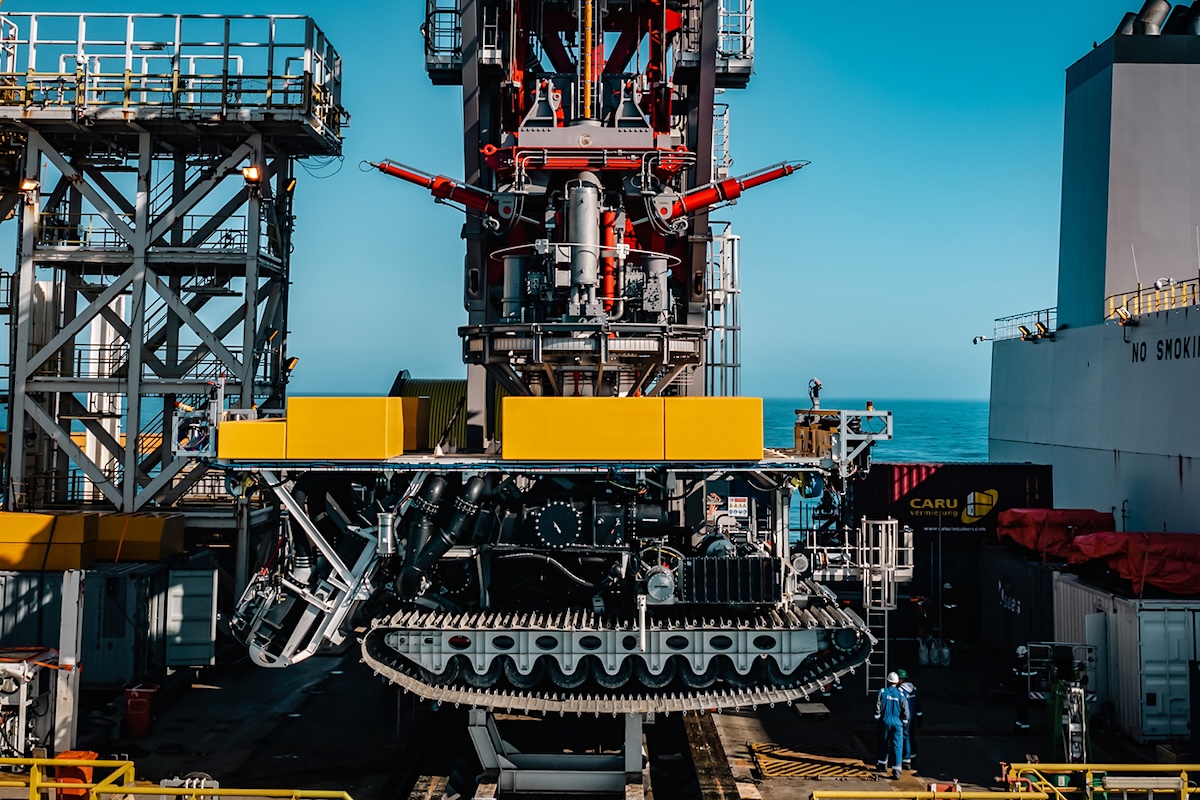
To gather the nodules, the Metals Co. plans to lower a remotely operated collector vehicle the size of a bus about four kilometres to the seabed floor. The robotic vehicle, which has wide treads for crawling along the ocean floor, will be attached to a mother ship at the surface by an umbilical cord-like pipe.
As the machine advances, it will blast sea water at the nodules to loosen them and then vacuum them up into a hopper. Pumps inside the hopper will separate the nodules from sediment, discharging the sediment back into the sea. Air pumped down a pipe called a riser will equalize the pressure, and the nodules will shoot up to the mother ship, where a centrifuge will separate them from the remaining sea water and a conveyor belt will deposit them into the ship’s hold.
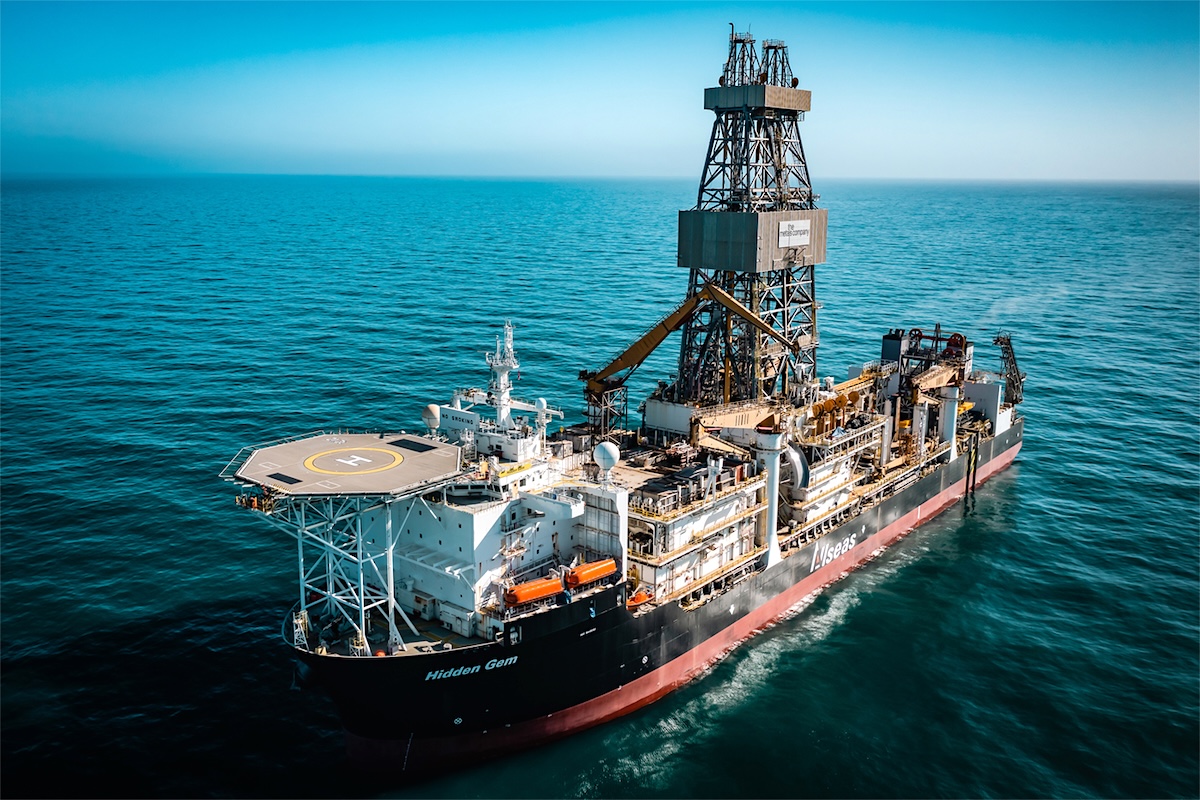
The Metals Co. transformed a drill ship from the offshore oil and gas industry into a nodule collection vessel it has named the Hidden Gem. On a trial run in the fall of 2022, the Hidden Gem collected more than 3,000 tonnes of nodules.
To put that into perspective, a single tonne of nodules from the Clarion-Clipperton zone yields about 13 kilograms of nickel, 11 kilograms of copper, 284 kilograms of manganese and two kilograms of cobalt.
A typical electric vehicle requires about 40 kilograms of nickel and 50 kilograms of copper, while a modern fighter jet needs about 100 to 400 kilograms of copper for wiring and electronics.
Why not to mine the deep sea
Usher argues that the world will quickly need more metals, and mining the deep sea will have fewer environmental impacts than mining on land.
“There’s no free lunch,” he told The Tyee. “There are impacts in the deep sea, and there are impacts for terrestrial mining ecosystems. The question is which of those choices — that we must make, obviously — presents the lightest possible impact.”
He pointed to mining in Indonesia, which accounts for about 60 per cent of the world’s nickel production. Nickel mines have destroyed large tracts of Indonesian rainforest, including in biodiversity hot spots, and runoff is contaminating coral reefs and destroying coastal marine ecosystems.
It makes sense, Usher said, to source metals “from the part of the planet where there is the least life, not the most.” The area where the Metals Co. plans to mine has “no humans... no birds... no trees,” he said.
In one of Barron’s short social media videos, which was viewed by The Tyee but has since been deleted, he stood on a barren, windswept lava field in Iceland, framed by sombre grey skies. “As you can see, there are no plants, there are no animals moving about,” Barron told viewers. “It’s a pretty lifeless area,” he added, comparing it to the Clarion-Clipperton zone.
There’s just one problem: the deep sea is one of the world’s most vital carbon sinks, and it’s teeming with life. It just looks a little different than life on land.
The deep sea is home to fantastical creatures that produce their own light, consume bacteria and thrive in pressures that can crush a car. The world’s deepest-living octopus makes its home in areas that could eventually be slated for deep-sea mining, including in the Clarion-Clipperton zone. Named after the cartoon elephant that uses its oversized ears to fly, the small Dumbo octopus swims by flapping prominent fins on each side of its head.
Colourful sea cucumbers, graceful jellyfish, tiny anemones, yellow sea lilies and slow-growing sponges all live near the nodules. One newly discovered sea creature called Relicanthus sp. — it looks like an ivory kite flying through the ocean with a profusion of stringlike tails — lives on sponge stalks attached to nodules in the Clarion-Clipperton zone. A 2023 study detailed more than 5,000 species new to science in the Clarion-Clipperton zone.
The Metals Co., which has carried out publicly available environmental studies of deep-sea mining, says deep-sea mining will create fewer carbon emissions than land-based mining and that plumes from disturbed sediment will be localized. The company also says it plans to leave behind nodules to provide habitats for organisms to recolonize areas after mining.
Yet more than 1,000 marine scientists and policy experts worldwide have signed a science statement outlining concerns about deep-sea mining and pointing out that its impacts on biodiversity, ecosystems and human well-being are not yet understood.
The Deep Ocean Stewardship Initiative, a network of global experts in fields such as science, technology and economics, says that nodule fields are an important deep-sea ecosystem that hosts a diversity of life and directly benefits humans by helping to regulate the climate.
Studies have also found that deep-sea mining could threaten commercial fisheries. And a 2025 study found that sediment plumes and other impacts from deep-sea mining could threaten at least 30 species of sharks, chimeras and rays, many already at risk of extinction.
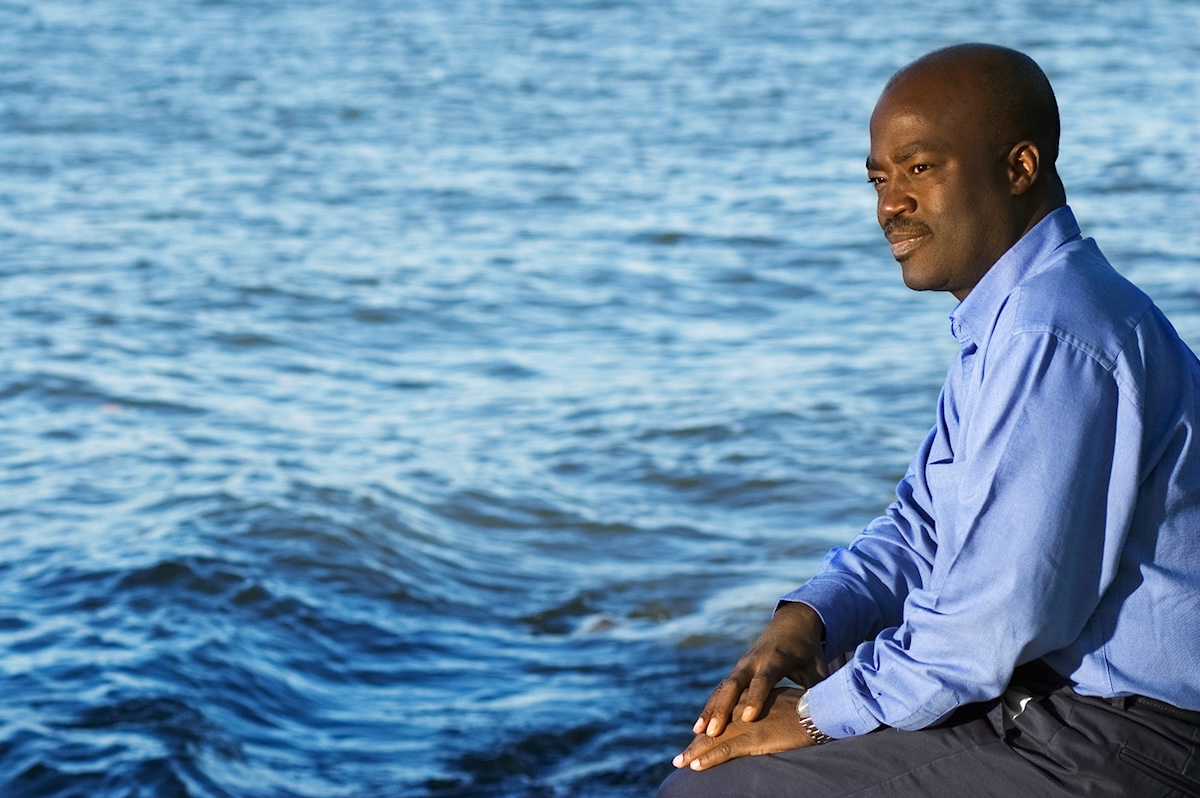
“If you want a regenerative blue economy, then deep-sea mining is not part of it,” Rashid Sumaila, an economist who teaches at the University of British Columbia’s Institute for the Oceans and Fisheries, told The Tyee.
Sumaila and other researchers have concluded that deep-sea mining poses significant environmental, social and economic risks that could have far-reaching consequences for coastal communities and small island developing states. They also found that deep-sea mining is likely to negatively affect the business community, including insurers and investors.
Sumaila points to the tuna industry, noting that the Clarion-Clipperton zone is one of the richest tuna fishing areas in the world. Deep-sea mining, he said, can potentially disrupt tuna habitats and alter migration patterns by creating sediment plumes, generating noise and light pollution and discharging water with higher concentrations of metals.
“Fish don’t need visas,” he said — and the tuna make their way to Canada, where they are caught commercially. “We all have a stake in the ocean,” Sumaila said.
Instead of increasing the world’s supply of critical minerals, Sumaila said, we should be looking at how to reduce our need for them.
“If we just go, ‘Oh we need more, we need more,’ where are you going to stop?” he asks. “This shouldn’t be a question of only supply; it should be a question of demand.”
Trump’s plans called ‘unlawful and illegal’
Under the United Nations Convention on the Law of the Sea — ratified by 171 countries and the European Union — an agency called the International Seabed Authority is responsible for managing mineral resources in the deep ocean floor beyond areas of national jurisdiction.
The authority, which is headquartered in Jamaica, has spent more than 10 years hashing out rules for seabed mining, including environmental and liability regulations.
Over the years, the authority has granted the Metals Co. and 20 other contractors a total of 31 exploration leases worldwide, including in the Clarion-Clipperton zone. The Metals Co. partnered with the tiny Pacific Island countries of Nauru and Tonga, where it has subsidiaries, to secure its seabed authority exploration contracts.
The company’s permit applications to the U.S. government substantially overlap with its exploration licences from the seabed authority. The company has conducted its research in the seabed authority exploration areas, and its 2022 nodule collection also took place in the area overseen by the authority.
Barron said he turned to the Trump administration last year because the seabed authority was taking too long to finalize deep-sea mining rules for commercial extraction and failed to meet its own deadlines.
“I depend on shareholder support,” Barron told Ryan, the podcast and YouTube talk show host, “and unfortunately shareholders would not have been willing to give me another five years to sit around and see what happens.”
Yet, as the Metals Co.’s U.S. subsidiary pursues unilateral mining, the company’s Nauru and Tonga subsidiaries have maintained their seabed authority exploration contracts. The seabed authority has now launched an investigation into their actions.
Trump’s plans to push ahead with unilateral mining in areas under the seabed authority’s jurisdiction have rankled countries around the world, including China, France and Russia.
France’s special envoy to the seabed authority says the United States is violating the principle of non-appropriation of the high seas and weakening the framework of the international law of the sea “to the detriment of all.” International Seabed Authority president Leticia Carvalho told Australian broadcaster ABC that the Trump government’s decision to issue permits is “unlawful and illegal and challenges the rule of law and the unilateral order.”
While the United States hasn’t ratified the international law of the sea convention, it has accepted most of its provisions, including freedom of navigation and the ability to fish in international waters, as customary international law.
Where Canada could, or should, come in
Seck, the Dalhousie law professor whose research focuses on the mining sector and ocean law, told The Tyee that there are good reasons to believe the Metals Co.’s applications to the U.S. administration violate international law.
And specific provisions in the law of the sea convention suggest that Canada “does have an obligation to make sure that they are in no way supporting this company... and in no way enabling illegal activity,” she said.
Yet both Seck and Neil Craik, a law professor at the University of Waterloo with expertise in deep-sea mining, say the situation is complex because the applications to the U.S. government for deep-sea mining were made by the U.S. subsidiary of the Metals Co.
Craik said the Carney government, “at a minimum,” should be asking questions about the relationship between the Metals Co. and its U.S. subsidiary.
Is the subsidiary independent, or “is the Canadian parent, in some ways, a directing mind of the company?” asks Craik, whose work focuses on environmental regulation and liabilities for deep-sea mining in areas beyond national jurisdiction.
If the U.S. subsidiary is relying on data and technology developed by the Canadian parent company, Craik said, the two may be acting as a cohesive enterprise and “Canada may have positive obligations to ensure that that company is acting in accordance with international law.”
Global Affairs Canada did not respond directly to The Tyee’s questions about the Metals Co. and international law.
Instead, media relations spokesperson John Babcock said Canada is aware of recent developments related to seabed mining applications and “continues to engage constructively with partners on the issue of deep seabed mining in areas beyond national jurisdiction.”
Babcock said Canada, as a general practice, does not comment on the corporate structure or operations of specific companies, adding that Canadian companies operating internationally are “expected to comply with applicable laws and align with international standards and best practices.”
He said Canada is actively participating at the International Seabed Authority “to advance negotiations and support the timely development of commercialization regulation” for deep-sea mining. During the seabed authority’s March 2026 meeting, Canada contributed to discussions aimed at ensuring strong environmental protections are embedded in the regulatory framework, Babcock noted.
Canada takes its obligations at the seabed authority seriously and continues to advocate for a “robust, science-based regulatory regime that includes strong environmental protections, transparency and accountability,” Babcock said, adding that Canada will continue to monitor developments closely.
He also confirmed that Canada still supports a moratorium on deep-sea mining, which is welcome news for Mining Watch Canada and other organizations.
“This is an ecosystem that cannot be mined in any way responsibly, and we’re better off sticking to mining on land and trying to do that responsibly, rather than to destroy another entire area,” Coumans said. ![[Tyee]](/design-article.thetyee.ca/ui/img/yellowblob.png)
Read more: Politics, Environment









Tyee Commenting Guidelines
Please note that email notifications for replies are not currently working due to a software issue which may be resolved in a future update.
Comments that violate guidelines risk being deleted, and violations may result in a temporary or permanent user ban. Maintain the spirit of good conversation to stay in the discussion and be patient with moderators. Comments are reviewed regularly but not in real time.
Do:
Do not: