


 SHARE:
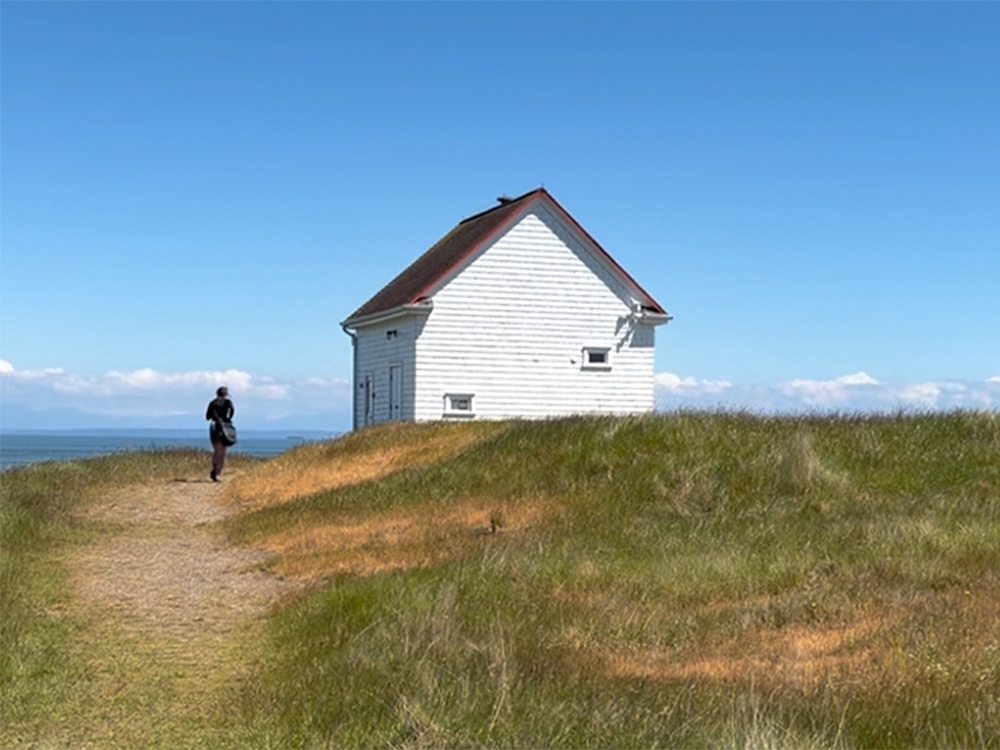
It’s the May long weekend, and David Osborne walks down to Saturna Island’s East Point Regional Park. As hikers and bike-packers mill around the grassy knoll that gives way to tafoni rock slopes resembling Swiss cheese, Osborne unlocks the white brick heritage building centred on the point.
Despite the sunny sky and natural beauty around, it’s a bittersweet day for Osborne. He doesn’t know how many times he’ll be able to open the Fog Alarm Building this year.
First constructed for foghorns to signal to ships, the small structure has been converted to serve as a testament to the community settled on Saturna Island. Now, its walls display articles about the island’s history, a locally known orca and the community’s annual lamb roast.
Normally, Osborne says, a local student would staff the Fog Alarm Building. They would show guests around the small museum and help them better understand the area’s unique geography and the plethora of wildlife that filter through East Point — including orcas, grey whales, sea lions, hawks, eagles and garter snakes.
Some students also helped preserve some part of the community’s history. On a small shelf in the corner sits a booklet about local food and foraging, and several self-published volumes chronicling the lives of longtime residents — like the woman who runs the island’s general store.
“It's a fantastic place to visit,” Osborne said. “So it was a really depressing thought that after 15 years we weren't going to be able to do our thing here.”
This year, the small museum won’t be able to afford a summer student. Osborne, a volunteer, usually relies on a federal grant to fund the position.
But for the first time in about a decade, the museum’s request for funding was denied. And without a student, Osborne said he wasn't sure the museum would be able to open for visitors — much less continue documenting the island’s history.
Osborne isn’t alone. Federal funding for these positions has remained flat for years despite rising minimum wage and inflation, according to the Canadian Museums Association. And at the provincial level, that means small institutions across B.C. are struggling to find staff and run the programming that keeps them afloat.
“Museums are the caretakers of place and stories,” said Leia Patterson, interim executive director for the BC Museums Association. “When we can't tell our stories because we can't be open for our busiest season, everybody loses.”
According to Patterson, more than half of the 450 member institutions are small museums that are often run by one to two staff members, a few part-time staff members and summer students. These include heritage sites, Indigenous-run cultural centres and botanical gardens.
Oftentimes, Patterson added, these museums serve as community centres. Some are cooling centres during heat waves, and some host community gatherings and events.
“When you expand your thinking about museums as places of community, they serve so many purposes,” she said. “They do all of this extra work on the side rather than just caring for old things.”
These institutions remain open thanks to a patchwork of donations from the public, revenue from programming, and grant funding from the government, said Dnyanesh Kamat, senior manager of advocacy at the Canadian Museums Association.
But Kamat said all funding for museums, including the Young Canada Works grant funding that allows them to hire summer students, has plateaued for about five years. The result is that each year, fewer positions can be filled.
“If you hold the funding envelope constant and there's rising inflation, then by default, that's a funding cut,” Kamat said.
He said that in 2026-27, the grant was able to fund only 1,219 museum positions across Canada — despite 2,136 applications for summer students. That’s down from 2023-24, in which Young Canada Works was able to fund 1,329 museum positions.
But the marginal drop in numbers doesn't tell the whole story. From B.C., Patterson said members are reporting less in grant funding for each position. That means they’re able to hire summer students only on six-week contracts or on reduced hours, instead of as full-time staff members for the season.
“That doesn't fulfil a summer of work, nor does it pay your tuition for the coming year,” Patterson said.
The result, Kamat said, is that fewer young people are able to work in heritage. He added the sector is aging and needs young people coming in and replacing those who retire. He said he plans to file his organization’s numbers to the federal government’s Standing Committee on Finance ahead of the budget this fall.
Martine Courage, a Department of Canadian Heritage spokesperson, said in an email that in Budget 2025 Ottawa renewed $308 million over two years for the horizontal Youth Employment and Skills Strategy, starting this year. That strategy includes funding for the Young Canada Works program.
Spending on defence and AI, cuts elsewhere
The federal government’s last budget also included a surge in spending on defence and artificial intelligence, while most other departments, including Canadian Heritage, saw a 15 per cent cut in spending.
It’s not just museums struggling to hire students. Jairo Yunis, director of policy at the Business Council of British Columbia, said small and medium-sized businesses are struggling to hire young people this summer.
The youth unemployment rate ticked up to 15.3 per cent in May, continuing an upward trend that started four years ago in 2022.
Yunis said that’s because small and medium-sized businesses are facing three pressures making it harder for them to hire students, including a surge in immigration in recent years, a rising minimum wage and high payroll taxes on employers. According to the Canadian Federation of Independent Business, B.C. has the highest rate of payroll taxes of any province besides Quebec.
“In B.C., these pressures happen at the same time, and we're seeing that translating into not-so-great labour market outcomes for young British Columbians,” Yunis said.
For Osborne, the loss of a summer student was monumental. Besides one student, the Fog Alarm Building is run mostly by volunteers. In May, that meant he wasn’t sure how he’d keep the building open.
A month later, in June, Osborne told The Tyee he’s been able to drum up some volunteers to come staff the museum for three or four hours every weekend.
“We began to scramble around,” he said. “We've actually been able to open the weekend since the May long weekend using volunteers.”
Meanwhile, the local community resource centre on the other end of Saturna Island was able to hire a summer student. Osborne said they made a deal to get the student to spend a couple of extra days per week to open the small museum.
But it’s a temporary fix. For now, Osborne is juggling a spreadsheet of everyone who has put their hand up to volunteer to run the museum. And this December, he plans to apply once more for summer student grant funding.
“It’s a pretty good solution for this summer, if we can make it work,” he said. “What the future holds is completely uncertain.” ![[Tyee]](/design-article.thetyee.ca/ui/img/yellowblob.png)
Read more: Labour + Industry










Tyee Commenting Guidelines
Please note that email notifications for replies are not currently working due to a software issue which may be resolved in a future update.
Comments that violate guidelines risk being deleted, and violations may result in a temporary or permanent user ban. Maintain the spirit of good conversation to stay in the discussion and be patient with moderators. Comments are reviewed regularly but not in real time.
Do:
Do not: