

 SHARE:
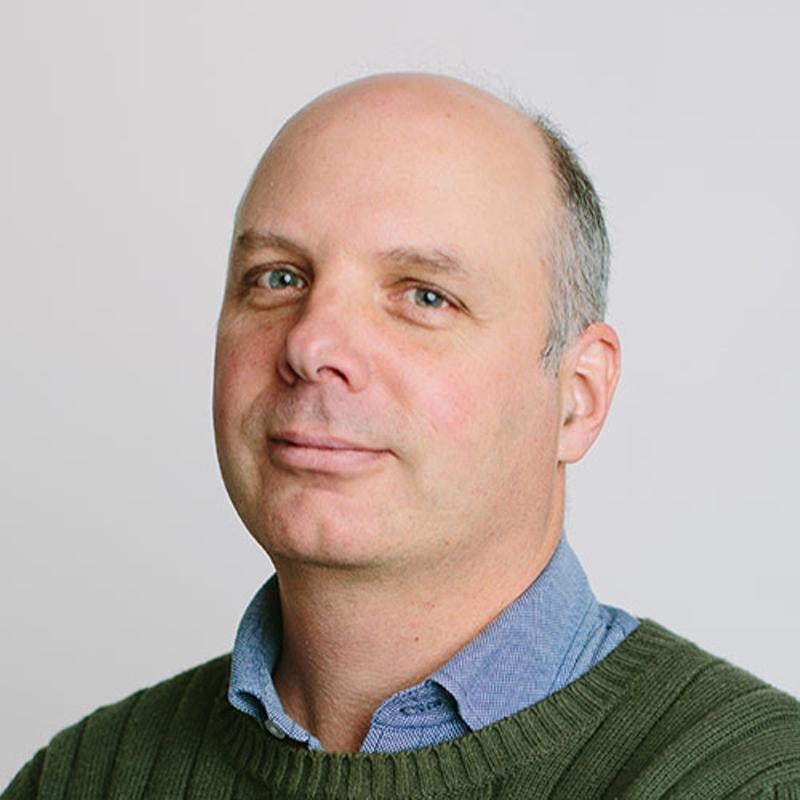
New chief treaty commissioner George Abbott says the battle over two First Nations treaties being debated in British Columbia’s legislature shows the need to address shared territories and overlapping claims.
“It’s not a new issue,” said Abbott, a former BC Liberal cabinet minister and author of the book Unceded: Understanding British Columbia’s Colonial Past and Why It Matters Now.
“It is one that I am going to devote some time and attention to as chief commissioner,” he said. “One of the highlights of a decade of work for treaty nations is the presentation of their treaties in the legislature and in the Canadian Parliament, and I always think it’s unfortunate when there’s a bit of a dark cloud over that because there’s unhappiness from some nations about whether their overlap and shared territories claims have been adequately dealt with.”
In mid-April the government introduced bills to implement treaties with the Kitselas First Nation near Terrace and the K'ómoks First Nation on Vancouver Island.
Negotiated over decades and already ratified by members of the two First Nations, the treaties are wide-ranging agreements that cover self-governance, Aboriginal rights, transfer of some land and money, some ongoing funding and continued public access to non-private treaty lands for recreational use.
Both treaties were celebrated by the nations and the provincial government when the bills were introduced.
And both treaties have raised concerns from neighbouring nations and the Union of BC Indian Chiefs.
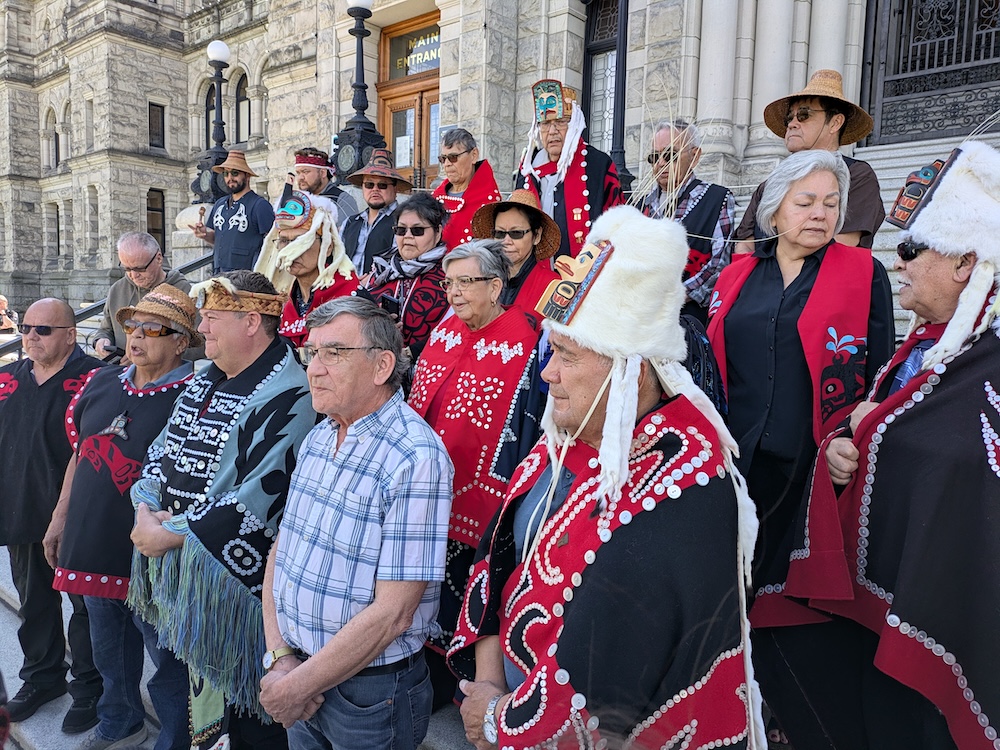
Garry Reece is the elected mayor of the Lax Kw'alaams Band, which neighbours and shares territory with the Kitselas First Nation and opposes the treaty.
The people he represents support treaties, he said on the front steps of the legislature April 20, but “when they reach into our territory claiming our territory, we do not agree with that.”
Reece said that while the province thinks the Kitselas treaty will create certainty, it will do the opposite, citing Lax Kw’alaams’ ability to stop major projects and to block rail and road movement through their reserve on Highway 16 near Terrace.
“I can’t stop my people if they’re going to set a roadblock up there,” Reece said. “That’s what my people want to do now because of this treaty.”
The Nine Allied Tribes of Lax Kw’alaams, a coalition of Tsimshian tribes, have also called for a pause on the Kitselas treaty ratification, as has the Haisla Nation.
Chris Roberts, the Chief of the Wei Wai Kum First Nation, said the K'ómoks treaty needs to be paused until his nation’s concerns are dealt with through meaningful consultations. “Our people are growing restless,” he said. “Our people are concerned for the future of what this means.”
On Wednesday leaders of the Lax Kw'alaams Band, the Nine Allied Tribes and Wei Wai Kum First Nation released a statement saying they are seeking a meeting with Premier David Eby and want a 180-day pause on the bills to allow for engagement to address the overlaps.
The Union of BC Indian Chiefs, or UBCIC, added its voice to calls for the two treaties to be paused until boundary issues can be resolved.
“Reconciliation cannot be achieved through incomplete or unilateral processes,” UBCIC president and Grand Chief Stewart Phillip said in a statement.
“Moving forward without resolving shared territory and overlap issues risks undermining relationships between Nations and creating long-term uncertainty,” he said. “The concerns raised by impacted Nations reflect long-standing issues with Crown negotiation practices, including those consistently raised by the UBCIC Chiefs Council, and advancing treaty legislation with unresolved boundary issues is irresponsible and will be challenged.”
The province has committed to support work led by First Nations to address territorial overlaps and shouldn’t move ahead on treaties until that work is done, he said.
UBCIC vice-president and Chief Councillor Linda Innes said the organization supports First Nations’ inherent rights to self-determination, but “the Crown must not advance agreements that affect multiple Nations’ territories without ensuring meaningful consultation, accommodation, and the free, prior, and informed consent of all impacted Nations.”
Asked about overlapping territories, Cyril Bennett-Nabess, a Kitselas First Nation councillor, said that prior to entering the treaty the nation had 10 reserves spread across a wide area. “Those reserves span from the Upper Skeena, 140 kilometres from the mouth, and at the confluence of the Skeena and the Ecstall River.”
In contrast, he said, the treaty settlement areas are limited to parcels within Terrace and the surrounding area.
The treaty will provide certainty and establish a new relationship for the 1,100 Kitselas members, Bennett-Nabess said. “The treaty provides the means of a path forward for our community, and when I say ‘community’ I mean Kitselas, British Columbia and Canada.”
Discussions with neighbouring nations will continue, he said. “We are very willing to meet with our neighbours and come to a protocol agreement that would speak to their concerns, not only their concerns but our concerns.”
K'ómoks First Nation Chief Councillor Nicole Rempel said there are about 18 overlaps within her nation’s territory, so it’s unsurprising that there are disagreements. “This is to be expected,” she said. “We are working towards protocols with all of our neighbours.”
There have been recent meetings with some neighbours, and K'ómoks is committed to working with respect to honour both their history and its own, she said.
The nation has about 350 members, and the land included in the treaty agreement is a tiny part of its traditional territory.
Indigenous Relations and Reconciliation Minister Spencer Chandra Herbert said that in the regions where treaties are entered, they can bring prosperity, certainty and predictability.
“I think really they are the answer that people are looking for in terms of how we as a province are recognizing First Nations rights, recognizing community interests, and bringing us together,” he said.
There are neighbouring nations that support the K'ómoks treaty, Chandra Herbert added, and discussions will continue with those that don’t. “We’ve had good conversations with Wei Wai Kum Nation and those conversations need to continue. The introduction of treaty legislation is not the finish, in fact it continues the process.”
Concerns from neighbours of the Kitselas First Nation are an indication that there’s more work to do, he said, suggesting that the treaty would help as nations work towards protocol agreements with one another.
“This is the path to reconciliation, working it through conversation by conversation, having the hard discussions,” he said. “You don’t get it right all the time right away, but you lean into that work and then you find that togetherness. I think that’s how neighbours do it, that’s how businesses do it, that’s how communities do it. You listen to each other and you find that path of togetherness.”
If the treaty bills pass in the B.C. legislature, the next step is ratification by Parliament, which is expected to happen within a year. The treaties are the first to make it to this stage since the Tla’amin treaty, which was brought into effect in 2016. Another, with the Kitsumkalum First Nation, is expected to come to the B.C. legislature soon.
There have previously been four modern treaties reached and implemented through B.C.’s treaty process. A fifth, with the Yale First Nation, was ratified in 2011 by the provincial government and in 2013 by the federal government but was never implemented. It stalled as Yale tried to resolve overlapping fishing rights with the Stó:lō Nation.
Abbott, who was in government when the Yale treaty moved through the legislature, said he intends as chief treaty commissioner to work on improving how the treaty process deals with shared territories and overlapping claims.
“Maybe it’s going to be impossible to improve the process,” he said, “but one of the benefits I have of working for a long time in government is that I’ve seen more than a few difficult problems and I always want to try to find ways to improve on process and hopefully get better outcomes as a result.”
In the case of Kitselas and K'ómoks, Abbott said, the nations have been working to resolve the overlap issues and those efforts will continue after provincial ratification. Implementation is at least two years away, he said.
A generation has grown up in the 30 years that the process has taken, missing out on the opportunities and benefits treaties will bring, Abbott said. “I don’t want to see them wait any longer than we absolutely need to for provincial ratification and for federal ratification of their treaty.”
Abbott’s term is for three years, with the possibility of a renewal.
“Hopefully three years from now it feels very much more an achievable reality to move to treaty and non-treaty agreements that are effectively reconciliation of some of the injustices that we’ve inherited from the past,” he said. ![[Tyee]](/design-article.thetyee.ca/ui/img/yellowblob.png)
Read more: Indigenous, BC Politics





Tyee Commenting Guidelines
Please note that email notifications for replies are not currently working due to a software issue which may be resolved in a future update.
Comments that violate guidelines risk being deleted, and violations may result in a temporary or permanent user ban. Maintain the spirit of good conversation to stay in the discussion and be patient with moderators. Comments are reviewed regularly but not in real time.
Do:
Do not: