


 SHARE:
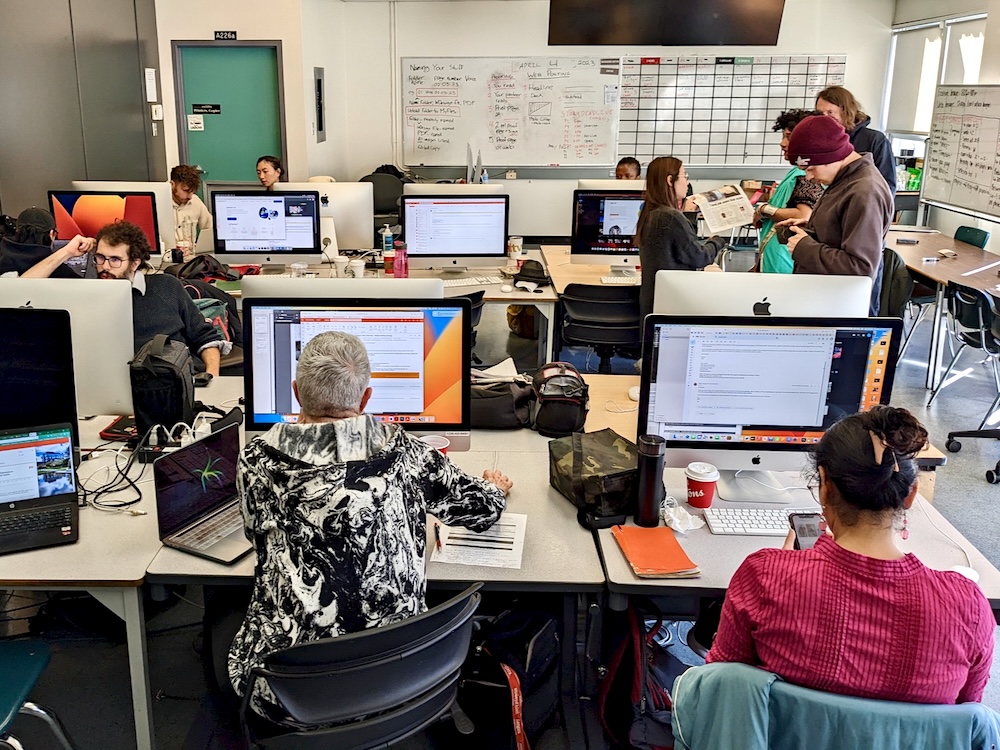
The year was 2011. I had two children under four, who had been hurriedly stashed at daycare earlier that morning, and I was running up the steps of a concrete community college building. If I was late to my morning copy-editing class, I’d get a zero on the test that was handed out promptly at 8:30 a.m.
For students like me and hundreds of others since Langara College’s journalism program opened in 1965, this practical course — taught by instructors who were often also working journalists — provided an entry into a career as a reporter, photographer or editor. In contrast to graduate-level university J-schools, Langara’s program was relatively affordable and had an eight-month option for students who had already completed a bachelor’s degree.
It’s common to hear local journalists say they would never have been able to work in the industry if Langara’s program didn’t exist. But it’s no secret that newspapers and broadcasters have shed thousands of jobs in the past 20 years, while newer digital news sites have also struggled to stay in business. Canadian journalism has been shaken by changing business models, with once reliable ad revenue sucked up by companies like Google and Meta, and has struggled to compete with social media, podcasts and other channels for audience.
Barry Link, the current chair of Langara’s journalism program, said enrolment in the program has been declining and graduating students are often getting work in communications roles in companies and non-profits rather than in newsrooms. (Link worked as editor-in-chief for The Tyee from 2017 to 2018, guiding our newsroom through former editor-in-chief Robyn Smith’s parental leave.)
But Link said the college’s decision to shutter the program is symptomatic of a wider problem for post-secondary schools across Canada — a sharp drop in revenue after the federal government dramatically cut the number of international students starting in 2024. Across the country, more than 850 post-secondary programs have been suspended or cut as colleges and universities struggle to balance the books.
The Tyee caught up with Link (who himself completed the Langara journalism program in 1992) to talk about the impact of shutting down one of Western Canada’s oldest J-schools. The interview has been lightly edited for length and clarity.
The Tyee: Can you explain what exactly is happening with the program?
Barry Link: The eight-month certificate program was basically pulled about a year ago. The college does what they call a pause, which means basically they put it in mothballs. We still had the diploma, which is a two-year program. But this fall they are pausing intake of new students, which means we won't be accepting any new students into the diploma program in September. That means we will only have second-year students, and we will teach those out so that they can graduate in the spring of 2027, and then that's it. And we're done.
But it's gone. It’s not going to come back.
Can you tell me why you say that?
Enrolment in the program itself is down; it's lower than it was 10 years ago. If this had happened 10 years ago, we could see the college saying... “What can we do to fix this? What can we do to turn it around?”
Now, because there's no money, like, there's absolutely no money, they're not willing to do that. They have negative money basically at the moment, and that is the result of the drop in international student enrolment — which has hammered post-secondary education finances. It's just slaughtered the budgets.
Can you explain to me the role that Langara's journalism program played in the local journalism industry in B.C.?
I think it's been fundamental. It's been around for 60 years, so it’s one of the oldest journalism programs in B.C. It has graduated hundreds of journalists over the years who've worked throughout the industry, particularly in newspapers in B.C. And so that pipeline now is gone.
You worked at the Vancouver Courier as editor, then during the COVID-19 pandemic, that community newspaper was shuttered. Can you talk about your experience in journalism? It’s a precarious industry! Why do you keep persisting?
It is a precarious time. It's a weird time. It's a time of great change. I remain actually, and this week it's hard to, but I remain optimistic because I think that there is going to be a demand for information and for information that is in the public interest and that is done with the practices and the rigour and the ethics that journalists have taken some time to figure out and to develop.
And that's at risk in the age of YouTube influencers and podcasters, almost none of whom do any reporting and very few of whom seem to have an understanding of ethics when they approach stories or information.
I think the public still wants journalism, but we haven't figured out a way to pay for it, and that's the puzzle. Who pays the money to do this kind of work? Because reporting has never paid for itself.
When people who want to get into journalism ask you for advice, what do you tell them these days?
One is they've got to be willing to move, because the chances of finding a job in your particular community will be lower than it might have been before.
The second thing is you have to have a broad range of skills. You can't just be one thing anymore in terms of what you can do. If you can write, if you can take photos, if you can do video and audio, and now if you can work with AI, that will make you much more employable.
And then the third thing I say is we are teaching a tradition of skills, and these skills are actually transferable to other kinds of jobs. We've had students who've gone on to work for sports leagues, not in a traditional journalist role, but they’re doing stories and information for them. Other people are working for non-profits doing the same thing.
I find that fewer students want to be a traditional reporter. And that is one of the things that I think journalism as an industry has to figure out. How people, especially young people, process information, how they share it, how they communicate, and what they see as journalism has changed. It's very different than what we came up with. ![[Tyee]](/design-article.thetyee.ca/ui/img/yellowblob.png)
Read more: Education, Labour + Industry, Media










Tyee Commenting Guidelines
Please note that email notifications for replies are not currently working due to a software issue which may be resolved in a future update.
Comments that violate guidelines risk being deleted, and violations may result in a temporary or permanent user ban. Maintain the spirit of good conversation to stay in the discussion and be patient with moderators. Comments are reviewed regularly but not in real time.
Do:
Do not: