


 SHARE:
When a new feature went live on X on Nov. 22, it didn’t take long for U.S. social media users to notice something: many popular anonymous MAGA accounts didn’t appear to be located in the United States.
In Canada, political figures have used the new feature to lob accusations of foreign interference at their opponents when account locations have shown up as “United States” or “Germany.”
Screenshots initially showed the X accounts for the BC NDP, BC Green Party and Conservative Caucus of BC initially displayed non-Canadian locations. In response, OneBC posted: “Apparently OneBC is the only party not subject to foreign influence. Interesting!”
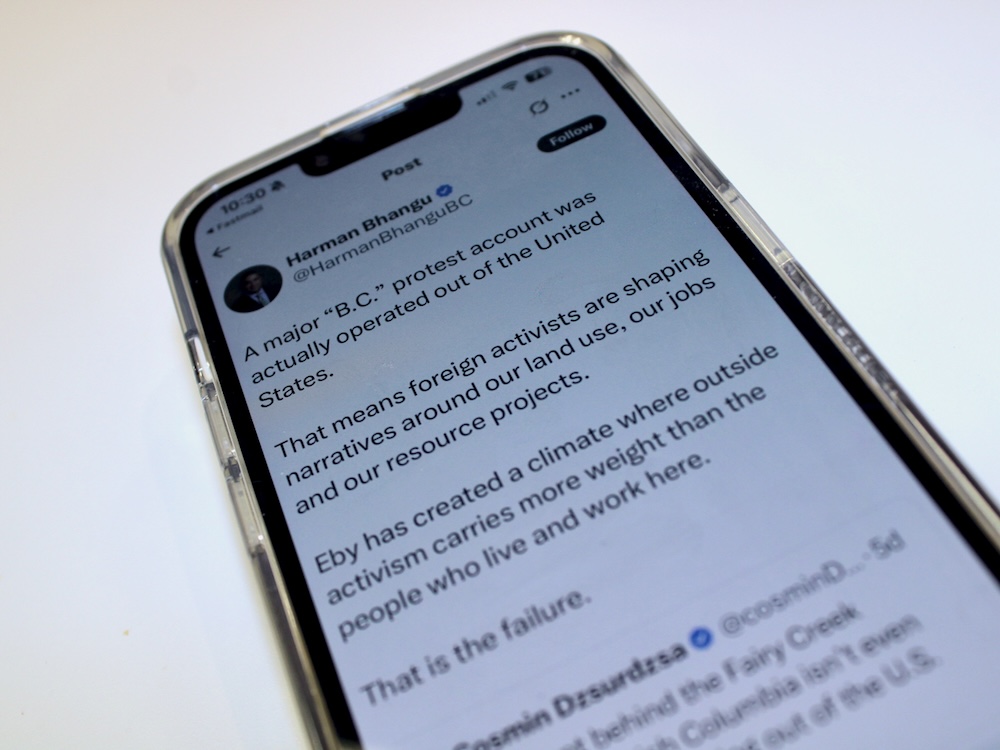
Harman Bhangu, a Conservative MLA, posted a screenshot from an account associated with the high-profile anti-logging Fairy Creek protest.
Because the account’s location data showed “United States,” Bhangu said, “that means foreign activists are shaping narratives around our land use, our jobs and our resource projects.”
Bhangu retweeted a screenshot that omitted an exclamation symbol that X is using to indicate the location may be inaccurate because of the use of virtual private networks, or VPNs.
Nikita Bier, head of product for X, said in an X post that the feature was being rolled out as a “first step to securing the integrity of the global town square.” He wrote that the company plans “to provide many more ways for users to verify the authenticity of the content they see on X.”
An image Bier included with his post says the feature is supposed to reduce “inauthentic engagement.”
But social media researchers are warning that the new location feature can’t be taken at face value.
Philip Mai, a researcher with Toronto Metropolitan University’s Social Media Lab, found that his location showed up as Germany — a place he recently travelled to. That’s because he used a VPN to connect securely to the internet while he was outside of Canada, a service commonly used by people when they’re travelling.
You can view the new feature by going to a user’s profile and clicking the link that shows when the user made their account.
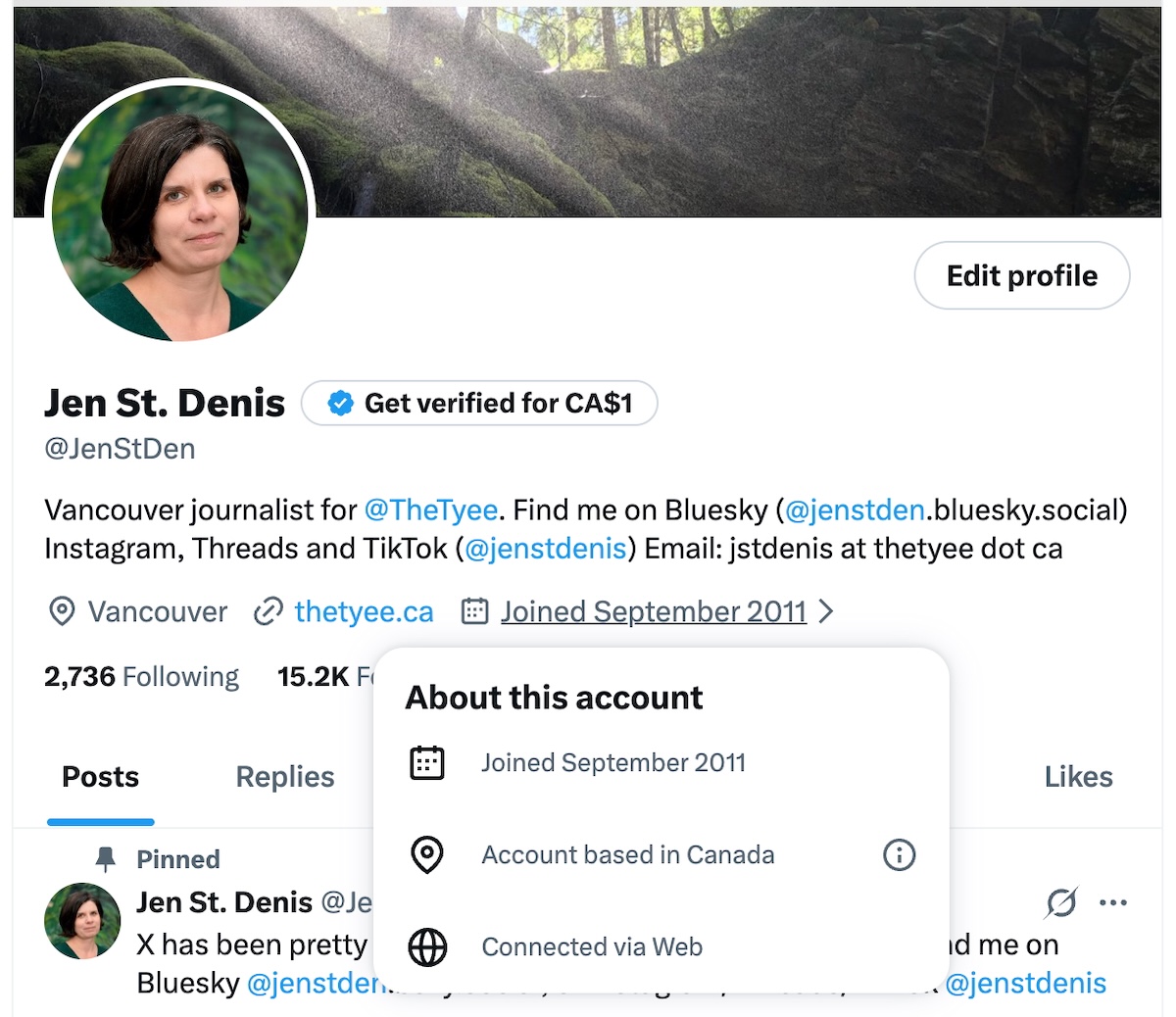
The location feature is now automatically displayed by X, but it’s not a new idea. Back when X was still known as Twitter, Mai said, the feature was first implemented internally as just one data point among several others. The information was used by the company’s trust and safety team to decide whether to ban an account for bad behaviour.
“After the 2016 [U.S.] election, there was so much concern about foreign interference, and there has been a push since then to provide the public with additional information to decide whether to trust an account,” Mai explained.
Elon Musk acquired the company in 2022 and made drastic changes, including gutting the previous trust and safety team. Under his ownership the platform was rebranded from Twitter to X and has become a haven for hateful and abusive speech. Musk has used his own X account, which has 229 million followers, to promote anti-immigrant, white nationalist, racist and transphobic messages — and to promote the Donald Trump administration and attack its opponents.
Journalist Craig Silverman, who specializes in digital investigations, wrote in his Indicator newsletter that anyone using this information needs to be aware there’s a difference between profile “information that’s supplied by the user, versus information provided by the platform.”
User-provided information, such as where they’re located, may or may not be accurate — users can choose to provide accurate location information, leave the field blank or insert information that’s either a joke or is deliberately false. For researchers or investigative journalists, “it’s useful information to review and collect, but you can’t treat it as 100 per cent accurate,” Silverman advised.
While other information provided by X about a user — such as the date an account was created — is accurate, the same can’t yet be said for the location data.
The interest in the location data has shown there’s still a lot of concern about foreign interference in politics. But Mai pointed out that various social media platforms, including X, have developed financial incentives that reward high-engagement posts about political topics that tend to stoke emotions like anger and disgust.
Mai said it’s no surprise that content creators from other countries are making social media posts to tap into the very large U.S. market for this type of content. It’s a phenomenon the news site 404 Media recently described as “America’s polarization” becoming “the world’s side hustle.”
“X, since Musk took over, has gamified and rewarded engagement,” Mai said. “So these rage farmers from these countries are making money, on serving up rage-bait. The system is designed so that people like this are rewarded.”
Mai also predicted that social media users will continue to interact with accounts that are pushing a world view that matches their own opinions and emotions, no matter where those accounts are located.
“A lot of these accounts will not disappear because they have no shame, right?” Mai said. “And they will just simply roll with it.” ![[Tyee]](/design-article.thetyee.ca/ui/img/yellowblob.png)








Notice about commenting changes
The Tyee’s commenting system will be moving to a new platform on Nov. 12. If you’re already a Tyee commenter you must register with the new system on or after Nov. 12 with your preferred username.More information can be found here.