


 SHARE:
[Editor’s note: Place names in this piece are in quotation marks to honour the style of the source publication, IndigiNews.]
The fisheries department of the Okanagan Nation Alliance, or ONA, is warning the community of a limited harvesting season of sc̓win (sockeye salmon) in the coming weeks, due to a forecast predicting low fish returns.
Although the alliance is not asking its syilx Nation members to stop fishing for sc̓win entirely during the upcoming season, they are asking fishers to limit harvesting activities and “please only take what you need,” to allow as many fish as possible to survive and spawn in the fall.
Chad Fuller, manager of ONA’s fisheries program, said the nation won’t be co-ordinating a harvest for community distribution or food fishery events this year either.
“We have to be careful,” Fuller said. “We have to let our members know that the fishing access is going to be curtailed, because there’s not a lot of fish.”
He added the ONA’s aim is to “bring the fish back” for the benefit both of the species and of the nation. But he acknowledged any reduction to sc̓win harvest would impact syilx families.
“Obviously, we’re very concerned about members not getting access to the food,” he said.
Fuller explained that warm river conditions in the Okanagan River, downstream from Osoyoos Lake, are impeding the species’ ability to migrate back upstream to spawning grounds throughout the river’s network of waterways.
Last year, 491,000 sc̓win made it over Wells Dam in “Washington” along the Columbia River, Fuller said. This year is predicted to see just 12 to 16 per cent of that number.
The ONA is forecasting that only 60,000 to 80,000 sc̓win will pass through Wells Dam, most destined for the Okanagan River system.
The dam is located downstream from what is known in the “U.S.” as the Okanogan River, which feeds into Osoyoos Lake south of the border.
Fuller did highlight that sc̓win runs destined for the Okanagan have historically struggled in the odd years, noting that the runs in 2015 and 2017 experienced different issues.
“That is anticipated, No. 1. However, it is shaping up a little lower than what was forecasted,” he told IndigiNews of this year’s predictions.
“We actually forecasted potentially up to 100,000 over Wells. And it looks like we’re not gonna achieve that.”
While this year’s run won’t likely impact next year’s numbers, the low returns still affect future generations of fish, he said.
“There’s just less fish contributing. There’s less eggs laid in the river. We know then that in four years’ time, we’re gonna have a lower run again,” he said.
“Remember, the Okanagan sockeye population is in a recovery. We’ve been trying to recover the population for quite a number of years, and it’s been very successful.”
As of July 14, 50,000 sc̓win have already made it past Wells Dam. But river temperatures on the river in “Washington” have exceeded 22 C, according to Fuller.
This has left the water too warm for fish to migrate through — a natural phenomenon known as a thermal barrier. If water temperatures exceed 18 C, he explained, “the fish sort of slow down migrating”; just another two degrees hotter, they generally “stop migrating” altogether.
Warmer water temperatures a cause for concern
Before they return to their spawning grounds in October, Okanagan sc̓win migrate up to cold-water areas, where they hold over the summer and later move upstream to Osoyoos Lake throughout August and September.
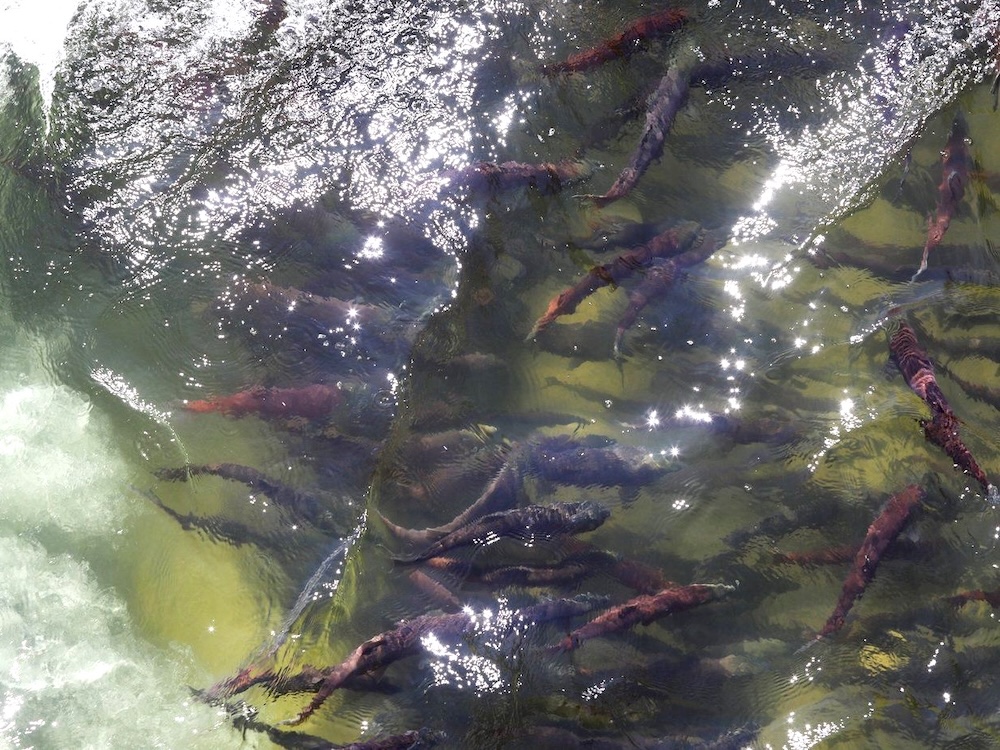
But since the river is too warm south of the lake, Fuller said, the fish are currently stalled — congregating in a large pool of deep cold water at the confluence of the Columbia River, near “Brewster, Washington.”
The thermal barrier impeding their migration happened this June, nearly a month earlier than last year.
“That was a little bit worrying to us,” Fuller said, “because the thermal barrier set up early.”
These warmer water temperatures have been cause for concern, particularly a decade after hot and dry weather in 2015 caused a 95 per cent mortality rate for sockeye in the river, he said.
“The fish couldn’t move,” Fuller recalled. “They held for as long as they could, and then they just died.... We could be facing a catastrophic loss of the whole run this year; we get worried about that.”
The delay caused by warm water depletes the migrating species’ energy reserves, and increases their susceptibility to disease, predators and death before they can spawn — “jeopardizing the success of the entire spawning season,” the ONA said in a July 22 statement.
The driving force behind the river’s warm water temperatures is drought, Fuller said. He noted that the Similkameen watershed — which provides the river with cool water before it flows north into Osoyoos Lake — is experiencing all-time lows.
The watershed’s snowpack was “significantly reduced” this year, Fuller explained, followed by a “really warm, dry” June.
“Any time we have a really low snowpack, there’s always going to be a concern,” he said. “That’s the cool water throughout the year that gives us the water that helps the fish.”
Additionally, both licensed and unlicensed water withdrawals in waterways across the Okanagan watershed are significantly reducing how much water is in the river, he said.
“To maintain our ecosystem here, we’re going to have to look at how we manage things differently with our water,” he warned. “These are going to be systematic, system-based changes — not short-term fixes.”
Despite the forecasted low return numbers, Fuller said the department is holding out hope for good survival rates for sockeye, thanks to a number of rainfalls adding cold water earlier this month.
“When we get a cold raining event, you get these pulses of fish coming up,” he said. Despite a thermal barrier in the river last July, by late August the weather had cooled suddenly.
“We saw thousands of fish moving up into that first week of September,” he recounted. “There was this massive movement.”
But this summer’s projected low return for the fish “is not good,” he cautioned.
Fisheries and Oceans Canada has set the number of salmon allowed to survive unharvested to spawn — known as the escapement goal — for Okanagan sc̓win at 35,500 fish.
“The worry is, if you get 50 per cent mortality, we might not make that number. It’s on the border,” he said.
“We need these fish to come and return to their home. Because they’re the ones who heal the land. Our responsibility is to help them and show them the way. That’s what we’re trying to do.” ![[Tyee]](/design-article.thetyee.ca/ui/img/yellowblob.png)
Read more: Indigenous, Environment












Tyee Commenting Guidelines
Please note that email notifications for replies are not currently working due to a software issue which may be resolved in a future update.
Comments that violate guidelines risk being deleted, and violations may result in a temporary or permanent user ban. Maintain the spirit of good conversation to stay in the discussion and be patient with moderators. Comments are reviewed regularly but not in real time.
Do:
Do not: