


 SHARE:
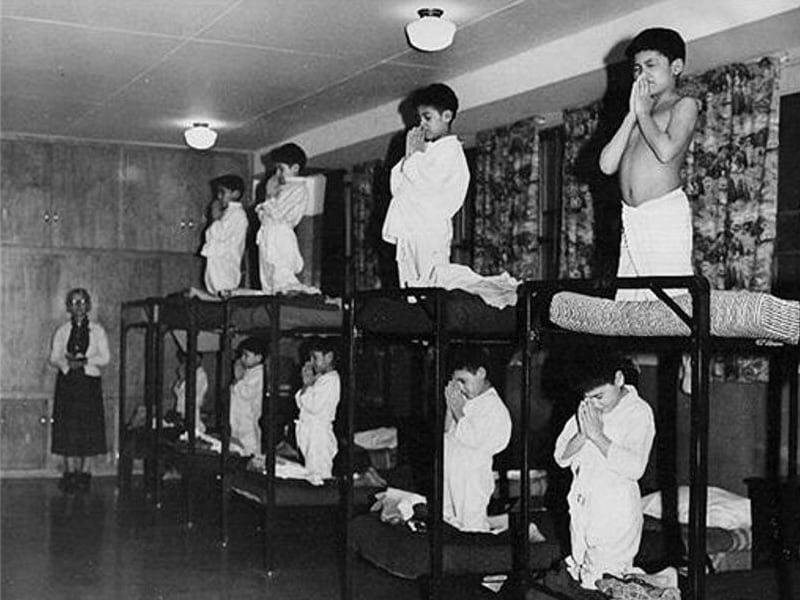
Less than an hour into Transport Canada’s online presentation for employees on the legacy of residential schools, things went wrong.
The October event was the first in a series to provide the department’s staff across the country with information on the history and impact of residential schools.
But it was quickly derailed as attendees made comments denying or minimizing the effects of residential schools in the video call’s chat channel.
According to internal emails obtained by The Tyee, about 40 minutes into the session an employee messaged Nicole Nel, Transport Canada Ontario marine safety and security director, to say the meeting “seemed to be going south quickly.”
“I ended my meeting and joined the Indigenous Voices session immediately after that message. I could see from the chat messages that we had an issue,” Nel said in an internal email. “After the session I had people come to see me in tears.”
Ontario regional director general Duwayne Williams shared disappointment in a draft internal memo hours after the event.
“The opinions shared were offensive, misinformed and displayed a complete disregard of Indigenous history.”
Researchers on inclusivity and Indigenous issues say the response highlights problems in the public service and more widely in society as a backlash against diversity, equity and inclusion, or DEI, is fuelled by right-leaning politicians.
After an anonymous tip from a person who attended the online meeting, The Tyee filed a freedom of information request for relevant documents.
They show Transport Canada organized a series of presentations about residential school history for employees across the country in October.
The department hired a speaker from the National Centre for Truth and Reconciliation to host three presentations over three weeks. The presentations included a one-hour session in English in the morning and a one-hour session in French in the evening. It’s not clear if the other presentations went ahead after the problems with the first event.
Transport Canada says it condemns the racist comments and is investigating the incident.
The first English presentation — titled “The Ugly Truth” — started at 11 a.m. on Oct. 10.
It’s not clear exactly what attendees said during the session. The presentation was not recorded, according to internal documents, and Transport Canada did not disclose the comments made.
That evening, Williams sent an email to Transport Canada senior staff about the “inappropriate and distressing comments” made about residential schools.
“What happened today is completely against our values as public servants and as an organization, and we must always ensure that Transport Canada is a safe space,” Williams wrote.
Williams added the incident highlighted the need to continue holding reconciliation events and training within the department.
Simon Rivet, a spokesperson for Transport Canada, told The Tyee in an email the department is investigating the comments.
“The comments posted in a meeting chat were inappropriate, disrespectful and distressing to Indigenous and non-Indigenous employees, as well as to the speaker,” Rivet said.
“Transport Canada unequivocally condemns these harmful comments and is committed to ensuring it does not occur again in future events.”
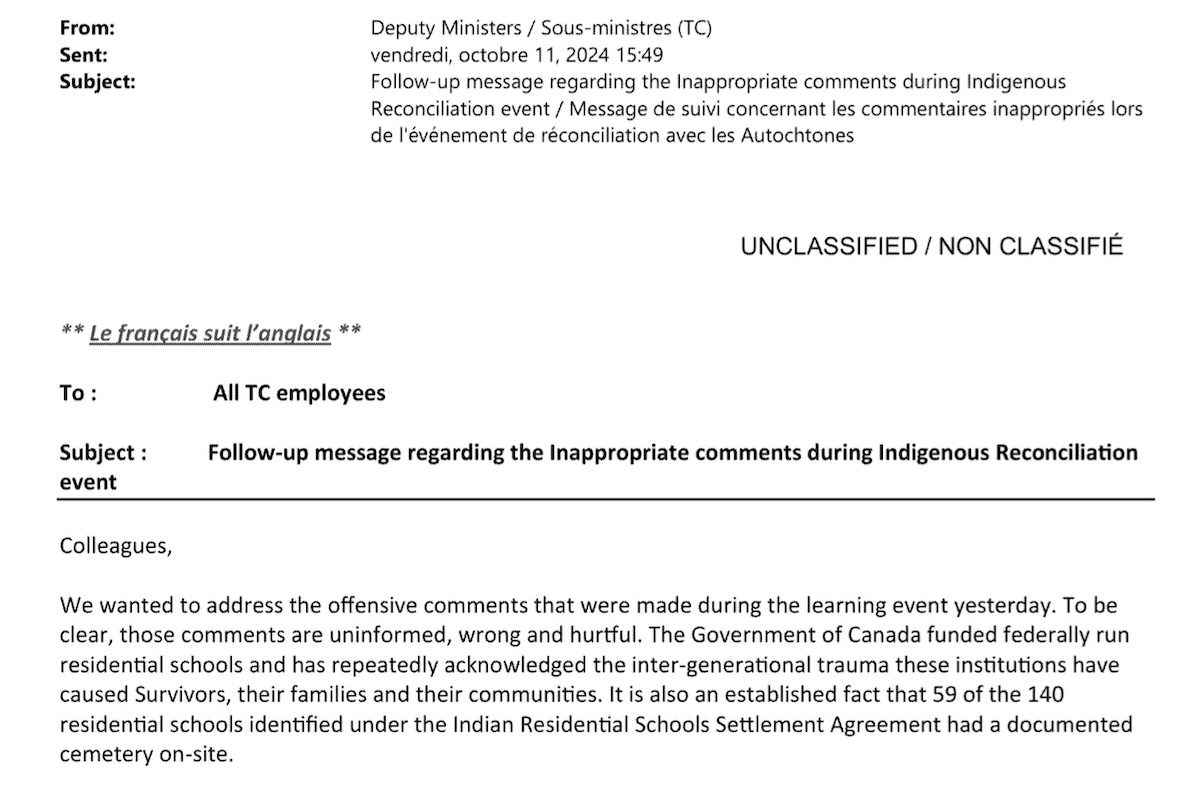
Rivet added the department will take “disciplinary measures including dismissal” against employees who have breached its code of conduct.
According to the internal documents, the department held a healing circle one month after the event, for affected employees to discuss what happened.
Transport Canada did not disclose whether any disciplinary action has been taken.
A broader issue
“It's good to hear that Transport Canada is having these difficult conversations,” said Robert-Falcon Ouellette, a University of Ottawa associate professor of education and former MP. “But this becomes a moment of reflection for everyone within the organization.”
Ouellette said he was surprised to hear this happened within the public service and that it proves the department needs to continue education about Canada’s history with Indigenous residential schools.
“It highlights that there is a problem, because if one person is willing to say it... how many others also agree with them?” he asked.
He added employees within the department are responsible for carrying out important services, including consulting Indigenous Peoples on infrastructure development.
“If employees hold racist viewpoints, not only against Indigenous people, but newcomers or people who are minorities, this might have a huge impact on carrying out government policy,” he said. “It can undermine trust in the government.”
There has been a rise in rhetoric against inclusive training and hiring practices in the workplace, Ouellette said.
“With the pandemic and the current political environment, especially with Donald Trump in the United States, there's this anti-woke philosophy that's taking hold,” he said. “It comes in waves, these moments of great anger, and then it subsides.”
U.S. President Donald Trump has dismantled DEI efforts.
Conservative Leader Pierre Poilievre has vowed to defund “woke ideology” in research and the public service.
Camellia Bryan, an assistant professor of business at the University of British Columbia, said the rising tide in anti-woke rhetoric may have encouraged employees to push back against the training.
“That person in a government job invalidated part of an Indigenous person’s experience, and they felt confident and emboldened enough to do that,” she said. “When people see backlash in the media, it can embolden some people to feel more comfortable saying these thoughts.”
Bryan said the incident suggests Transport Canada needs to better understand how employees think about inclusivity training before advancing efforts to educate staff.
“There needs to be a lot more dialogue and education,” Bryan said. “Ultimately, you don't just want them to not say it. You want employees to understand why you're doing this and hopefully start to change their mind.” ![[Tyee]](/design-article.thetyee.ca/ui/img/yellowblob.png)
Read more: Indigenous, Rights + Justice, Labour + Industry











Tyee Commenting Guidelines
Comments that violate guidelines risk being deleted, and violations may result in a temporary or permanent user ban. Maintain the spirit of good conversation to stay in the discussion and be patient with moderators. Comments are reviewed regularly but not in real time.
Do:
Do not: