



 SHARE:
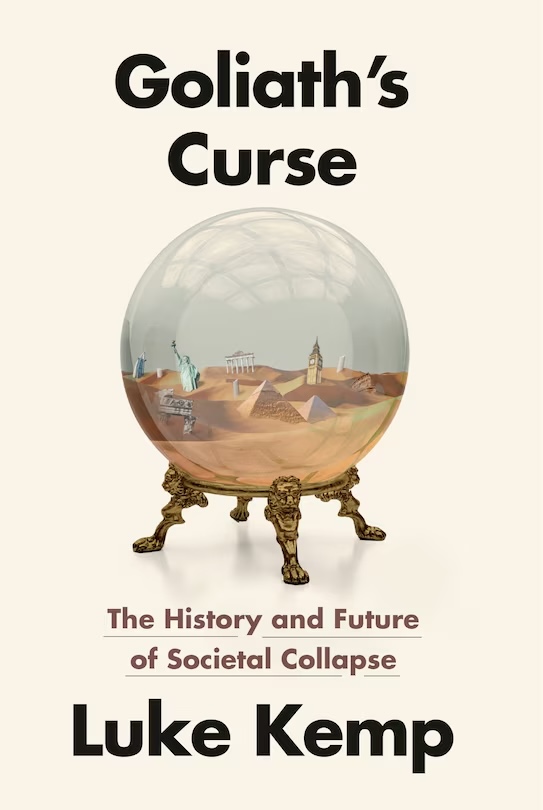
Goliath’s Curse: The History and Future of Societal Collapse
Luke Kemp
Knopf (2025)
Many of us are familiar with the Overton window, a clever metaphor for the range of political ideas that a society is willing to consider at any given time. People sometimes talk about moving the window to the right or left, making new ideas discussable.
In Goliath’s Curse: The History and Future of Societal Collapse, Luke Kemp smashes the Overton window out of its frame, then knocks down the whole wall around it. Quite a panorama comes into view as a result: ruined empires, endless revolutions and oddly happy “dark ages.”
Kemp, a researcher at the Centre for the Study of Existential Risk at the University of Cambridge in the United Kingdom, demands that we change our definition of “civilization.” He sees big cities and big monuments as the ego trips of gangsters and racketeers, oppressing and impoverishing the people they rule — whether in ancient Egypt or in modern Washington, D.C.
He argues real civilization was the way humans lived up until 10,000 years ago. We lived in small groups of hunter-gatherers with extensive trade and social connections to other groups, providing mutual aid when needed.
The groups were mostly egalitarian, Kemp argues, though sometimes an individual would emerge who tried to dominate the group. Such people usually failed because their group (and allied groups) didn’t like being dominated. Kemp says only about one per cent of Stone Age skeletal remains show signs of violent death, and many of those were likely men who wanted to be kings before kings even existed.
Life in hunter-gatherer societies was no Hobbesian war of all against all, Kemp says, because no one had anything worth fighting for. It made more evolutionary sense to get along with other people because it was easier to survive that way.
Only with agriculture did the state arise; even then it took about 3,000 years, Kemp estimates. With farming, societies now had “lootable resources” in the form of rice, wheat, livestock or trade goods. Once looted from their producers, such goods could support classes of warriors, priests and bureaucrats.
Labour was also lootable in the form of slavery; energy was extracted from both food and labour.
No exit
Information was another resource whose control was essential to power. Technology delivered “monopolizable weapons,” first of bronze and then of iron.
Geography ensured the population had no “exit options” — they were effectively “caged” by geography, like ancient Egyptians and Mesopotamians living on rivers surrounded by deserts. (In The Decline and Fall of the Roman Empire, 18th-century historian Edward Gibbon notes that a Roman in trouble with the authorities would have serious problems escaping them. Rome was a kind of information cage.)
All these resources enabled one group to dominate other groups and thereby gain status — expressed often in monuments like the Egyptian pyramids, the Colosseum and Donald Trump’s ballroom.
We call these early despotisms “civilizations,” but Kemp calls them “Goliaths” after the Philistine warrior in the Bible. Goliath was big, armoured in bronze, but killed by a single stone from the sling of David. Most Goliath societies have been equally fragile and not very long-lived.
As Kemp puts it:
A state is a set of centralized institutions that imposes rules on and extracts resources from a population in a territory, whether that be ancient Egypt or the U.S. today. All states throughout history have eventually ended. The average lifespan of a state is 326 years. The largest states — mega-empires covering over a million square kilometres — are more fragile, lasting on average just 155 years. But these averages obscure a staggering range, from the fleeting four-year reign of the Later Han Dynasty in China to the Byzantine Empire of the Mediterranean, which lasted over 1,000 years.
Such societies usually end with a change of rulers, and life goes on in the new state. Societal collapse is different. It involves the sudden loss of hierarchical government, of great amounts of energy and of dense urban populations. It can even mean the loss of writing, which of course means loss of information control.
“Goliaths contain the seeds of their own demise; they are cursed,” Kemp writes. “That is why they have repeatedly collapsed throughout history.”
Not such dark ages
Historians call such collapses “dark ages,” and so they were for the kings and priests and warriors who lost power. For ordinary people, life was often better.
For example, Kemp cites the collapse of the eastern Mediterranean Goliath states around 1,200 years before the Common Era. That meant the loss of Linear B, a Greek script deciphered only in 1952. But a great Greek oral tradition emerged, including Homer’s Iliad and Odyssey, which were recited for centuries before being written down in a new Phoenician-inspired alphabet.
We now admire the ruins of ancient empires, ignoring the fact that their palaces and temples were the Mar-a-Lagos and Trump Towers of their day: ego projects of the one per cent to announce their status.
Most subjects of a Goliath state were poor, ill fed and short. After the fall of the Western Roman Empire, Kemp tells us, people ate better and grew taller. While some collapses might have seen excessive violence, hunger and disruption, others were almost tranquil, notable mostly for the absence of tax collectors.
Kemp owes much of his analysis to historian Peter Turchin, who argues that societies tend to collapse when they succumb to competition between elites and the wealth gap widens between rich and poor. Goliaths follow this pattern also, but they also revive — and evolve.
Make Goliath great again
Post-collapse, someone will always turn up who wants to make Rome or China or Peru great again. Goliath states encourage a culture of dominance over the masses, so aspiring dominators (warriors, priests, bureaucrats) work to restore the power their ancestors enjoyed. Kemp notes that the earliest Goliath states in the Middle East and China have been replaced with new Goliaths right up to the present.
But in some cases Goliath states build themselves on a larger popular base. This requires sharing power among an elite rather than concentrating it in a tyrant. Ancient Athens was a democracy of native-born males who debated issues, took votes and elected their leader.
But a “democratic” Goliath like Athens still oppressed women and slaves, and conquered other city states.
Sharing the loot
Kemp says Goliath states evolved by offering power to larger and larger groups. They still needed slaves or workers, but the loot was spread more evenly among the elite. This was especially true of colonial Goliaths like the British and French empires, which outsourced oppression and exploitation to conquered peoples and shared some of their loot with the middle and working classes at home.
Now, Kemp writes, we are witnessing the evolution of a Silicon Goliath:
Silicon is, however, representative of a new Goliath fuel that is reshaping and speeding up the world system. Data is a crucial new lootable resource. The world’s most powerful intelligence agencies capture vast streams of it to enable mass surveillance. The world’s most powerful companies strip-trawl the internet to gather the data to train new generative AI systems and to better target advertisements. That data is being used to automate cognition and to speed up and scale up all the existing global systems, whether it be the search for fossil fuels, the production of novel entities, mass surveillance, or the organization of robust-yet-fragile global supply chains.
We will have our work cut out for us to bring down the Silicon Goliaths and replace them with reasonably democratic societies. Kemp thinks it could happen as it usually does: “more wealth equality, more exit options, fewer lootable resources, and either a rejection of previous hierarchies or a cultural memory of inclusive practices.”
Kemp also argues that a “deep collapse” would level the playing field, equalize wealth and discredit Goliath’s institutions and leaders. “A deep collapse,” he says, “could provide fertile soil for democracy to take root.”
Well, we can hope that a deep collapse would not involve nuclear exchanges or a climate four to five degrees hotter than today’s.
The value of a book like Goliath’s Curse is not necessarily in the absolute accuracy of its analysis, although Kemp’s arguments are heavily documented and generally persuasive. The value is instead in the power of a book to change our perspective on the world and make us question what we’ve been told from childhood about the greatness of our society.
In finding answers to those questions, we may be able to bury Goliath for good, and to lay the foundations of truly egalitarian and democratic societies around the world. ![[Tyee]](/design-article.thetyee.ca/ui/img/yellowblob.png)









Notice about commenting changes
The Tyee’s commenting system will be moving to a new platform on Nov. 12. If you’re already a Tyee commenter you must register with the new system on or after Nov. 12 with your preferred username.More information can be found here.