

 SHARE:
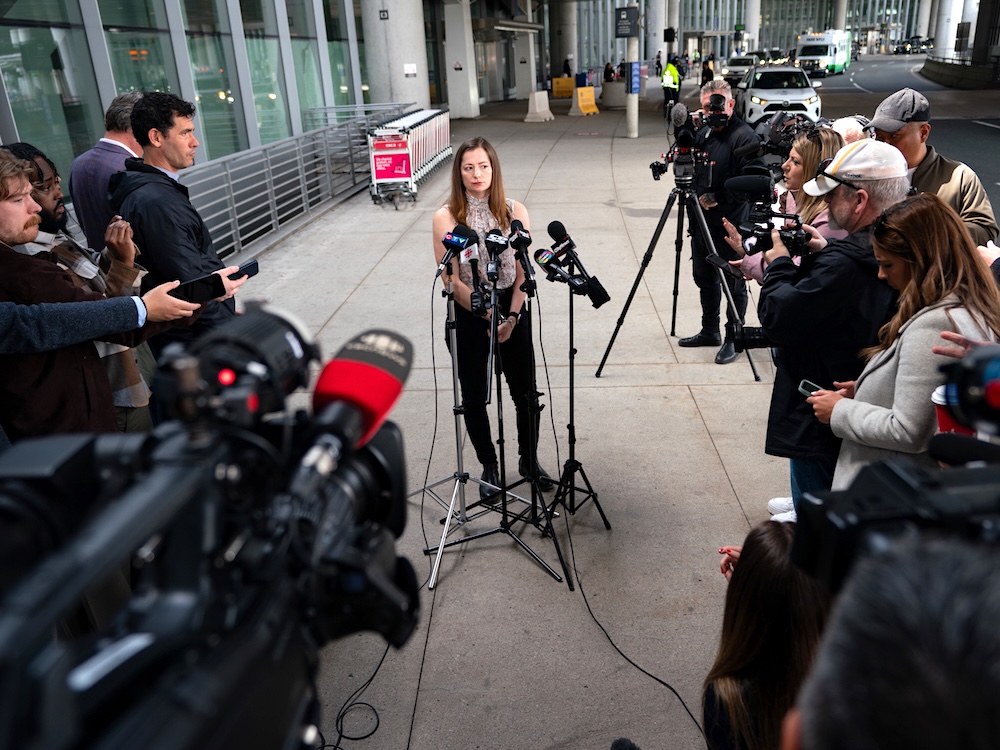
On Nov. 11, 2024, Ontario’s policing oversight body, the Special Investigations Unit, or SIU, reported that a Hamilton police officer and another man were injured after an “exchange of gunfire.” But this later turned out to be false. There were two police officers, both of whom fired a barrage of reportedly 24 bullets that struck Erixon Kabera several times, killing him, and injuring one of the other officers.
I’ve kept up with the subsequent reporting on this incident, and I constantly find myself in awe of the extent to which the Hamilton Police Service and the SIU projected a degree of normality in the face of this calamity. This was the response of an SIU spokesperson, commenting on the agency’s retraction of an earlier statement about an “exchange of gunfire,” as quoted in a CTV News story:
“Based on the information that the SIU initially had, a news release was issued with preliminary details," [SIU spokesperson Monica Hudon] said. “As the investigation proceeded and as further information came to light, we made it a priority to transparently release that updated information as quickly as possible via email, social media and our website.”
Kabera’s family and community of course felt indignant.
In this quote from a CBC story, Kabera’s family said in a statement: “We find that reversal of crucial facts, a full day after telling the entire world otherwise and painting an image of violence for our very own, to be deeply outrageous and unnerving.”
In a quote from a CP24 story, a Hamilton MP and a Hamilton member of the provincial parliament asked: “Why did the Chief of Police allow false information to be released about Erixon carrying a weapon? Why was the Chief of Police so quick to highlight the gun-related injuries to his officers, when according to the SIU report, Erixon did not shoot at police?”
More than just indignation, there was also of course a lot of grief about Kabera, a community organizer. This is how Kabera’s brother, Parfait Karekezi, responded, as described by CBC:
He said Kabera, who immigrated to Canada from Rwanda, worked for the government previously and was an upstanding person who helped him file his taxes for the first time and showed him “how to be a good citizen in Canada.”
There was also a lot of confusion about how the incident really unfolded: “As we grieve this senseless loss, we respectfully ask for transparency and accountability from the authorities. Whether it's police bodycam footage, surveillance videos from the building or any other pieces of evidence, we want to know details of the altercation so that we can understand the truth of what happened in Erixon's final moments,” Kabera’s family told the media (quoted in the Toronto Sun).
There seems to have been few answers for these questions from the SIU.
In another statement, Hamilton police noted the SIU report concluded the force used by officers was “reasonable under the circumstances.”
According to a story published in the Globe and Mail:
One of the officers told SIU investigators he believed the man had been the first to open fire, but it appears he mistook the other officer's initial gunfire for shots coming from the man, [SIU director Joseph] Martino wrote, describing it as “an honest but mistaken belief in the highly charged atmosphere that prevailed.”
In a St. Catharines Standard article, Hamilton Police Association president Jaimi Bannon is quoted as saying: “If the officers discharged their firearms, they must have felt imminent threat of life or serious bodily harm to themselves or others.”
The response from the community — stricken with grief, outrage, bewilderment — stands in stark contrast with the response from the policing bureaucracy, which used language that was largely muted, legalistic and neutral.
Police and civilians use different language
This contrast is not isolated to this case — it’s common across Canada. As a researcher trained in both linguistics and computer science, I analyzed 4,000 news articles on hundreds of deadly force incidents over the last 25 years in Canada.
I found that the reporting on Kabera’s tragic death was not an aberration but rather the norm when it comes to the contrast between police and civilian commentary. Here are the top 15 terms for both groups. I’ve shaded them based on their absolute emotional resonance scores. (These emotion scores were collected by the National Research Council Canada by asking people to rate words on a scale of positive to negative.)
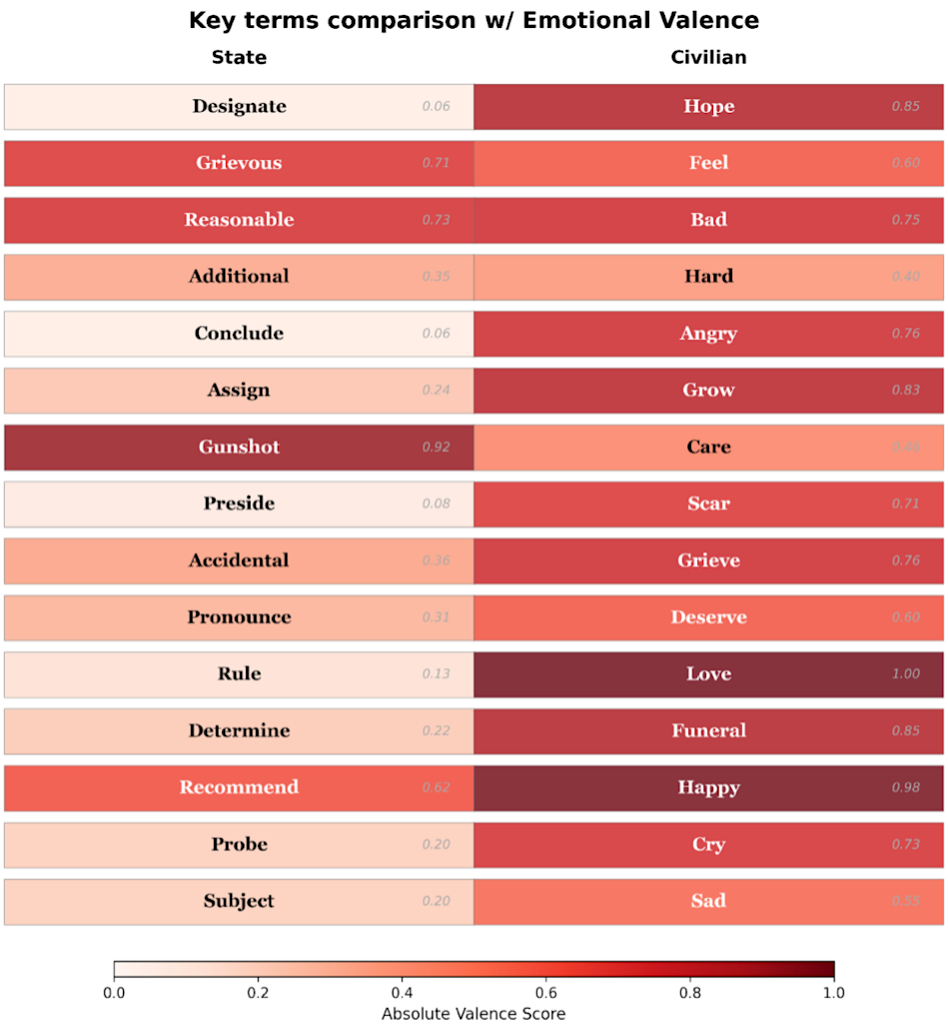
We find that police quotes in these news articles are largely centred on administrative procedure (“designate,” “probe,” “preside,” “assign” and so on). Even terms carrying higher emotional valence (“grievous,” “reasonable,” “gunshot,” “recommend”) are strongly related to administrative procedure.
For example, “gunshot” typically refers to the victim's cause of death (as determined by a coroner); “reasonable” is used when oversight agencies determine that (in their view) the officer's conduct was warranted. Similarly, “grievous” is a legal designation, often invoked to argue that the officer believed they were under threat of grievous bodily harm and therefore warranted to use deadly force.
Here’s an example from a Whitehorse Star story, quoting court testimony from RCMP Const. Terra Taylor regarding the death of Grant McLeod:
When pressed on the chokehold she was using, Taylor said “it is a last resort to be used when there is a threat of death of grievous harm.”
By comparison, the terms that characterize civilian discourse carry a much higher degree of emotional resonance. Civilians, specifically families, often express their hope for justice and that the administrative oversight procedures result in some sort of penalty for disproportionate conduct.
An example from a quote by the Nuu-chah-nulth Tribal Council in a Vancouver Island Free Daily story about the death of Julian Jones in 2021:
“There is always hope that the system will bring justice for a person killed by police, but the reality never lives up to this hope as the system is stacked against us.”
When civilians are quoted, we also tend to get a more vivid and complete picture of the person who was killed, highlighting their complex personhood, specifically in regard to the social relations they had with others who will be forced to grieve them.
From a Toronto Star story about the death of Chadd Facey:
For Fagan, the grief of losing her son was overwhelming, and not knowing what caused his death left her unable to eat, sleep or focus. She took a bereavement leave. When she returned to her job she struggled to concentrate.
There are also, of course, expressions of outrage and anger towards the jurisdictional police service and the broader punishment bureaucracy. From an Edmonton Journal story about the death of bystander James Hanna:
Norm Assiff, who is representing Hanna's estate, said Hanna's sister, Susan Bandola, is “angrier and left with more questions than answers” in the wake of the ASIRT report.
What’s more, I found that nearly half of news articles had no civilian perspectives at all. My discourse analysis model, fine-tuned on dozens of articles that my research assistants and I annotated and cross-checked by hand, found that 41 per cent of the articles we analyzed had no civilian representation.
Imagine if the reporting on Erixon Kabera’s case had no civilian perspectives, and we had only the SIU and the Hamilton Police Service to go by. Unfortunately, that is the reality for far too much reporting on deadly force incidents in Canada.
Including civilian voices matters
It should be acknowledged that reducing the representation gap between civilians and police in news reporting on deadly force incidents is a tall order. Police services know how to get their perspectives printed in the news; they have public relations offices for this express purpose.
There is an inherent structural bias that prevents critical civilian voices being heard with the same expediency: it takes a higher degree of journalistic labour to become acquainted with family and community members and develop the trust needed for these sources to be able to provide their characterizations of the complex and complete personhood of the victim, and the loss that is felt by the broader community.
Certain outlets have done better than others at having at least some civilian representation in their reporting. Here’s a breakdown of the number of articles in various news outlets that have included quotes from family members or community voices:
- Toronto Star: 73 per cent
- Globe and Mail: 68 per cent
- CBC: 66 per cent
- Vancouver Sun: 55 per cent
- CTV and Global News: 53 per cent
- Toronto Sun: 52 per cent
- Winnipeg Sun: 52 per cent
And our analysis over the last quarter-century shows that the percentage of civilian representation in news stories about police use of force has been improving.
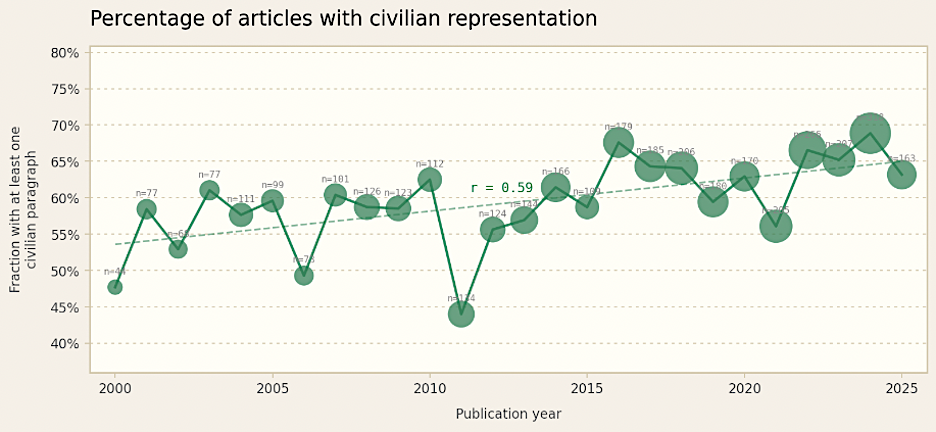
But there is still a long way to go in closing the gap. Getting the voices of those whose lives have been upended by state violence will be crucial to improving police accountability. ![[Tyee]](/design-article.thetyee.ca/ui/img/yellowblob.png)
Read more: Rights + Justice, Media





Tyee Commenting Guidelines
Please note that email notifications for replies are not currently working due to a software issue which may be resolved in a future update.
Comments that violate guidelines risk being deleted, and violations may result in a temporary or permanent user ban. Maintain the spirit of good conversation to stay in the discussion and be patient with moderators. Comments are reviewed regularly but not in real time.
Do:
Do not: